RV Grey vs Black Tank Smell: How to Tell the Difference
Last updated: February 2026
Something stinks in your RV, and you need to know whether it’s the grey tank, the black tank, or something else entirely before you start pouring chemicals down any drain. This guide gives you a fast smell-identification framework, a step-by-step isolation protocol, cause-by-cause fixes, and prevention habits so you can diagnose and eliminate RV holding tank odors for good.
Quick Answer — 60-Second Smell ID Cheat Sheet
Before you treat anything, narrow it down. Most RVers waste time and money treating the wrong tank — or worse, ignoring a safety issue. Here’s the fastest path:
- Sniff each fixture independently — kitchen sink, bathroom sink, shower drain, and toilet area. The strongest odor points to the likely source.
- Check your P-traps — run water in every sink and shower for a few seconds to refill any dried traps.
- Look at the toilet bowl — low water in the bowl or a worn seal lets black tank gas straight into the cabin.
- Inspect your roof vent — a blocked vent stack traps gas inside, making any tank smell worse.
- Rule out propane first — if the smell is chemical or gassy (not organic/sewage), treat it as a potential propane leak and follow your safety protocol immediately.
- Check valve position — if you’re at full hookups with valves open, that’s often the root cause.
- Don’t treat blindly — dumping chemicals in a tank when the real problem is a dry P-trap or failed vent solves nothing.
Smell comparison mini-chart (grey vs black vs other)
| Grey Tank | Black Tank | Not-a-Tank | |
|---|---|---|---|
| Typical smell | Sour, musty, mildew, “wet funk” | Rotten eggs, sewage, sulfur | Sharp chemical smell (propane) or hot-water sulfur |
| Most likely trigger | Biofilm buildup in drains/tank; kitchen grease and food debris | Tank buildup, dried toilet seal, venting failure | Propane leak; water heater anode rod reacting with bacteria |
| First check | Run water in sinks/shower to refill P-traps | Check toilet bowl water level and seal; verify vent is clear | Shut off propane and ventilate; check water heater anode rod |
“First 3 checks” (fast triage)
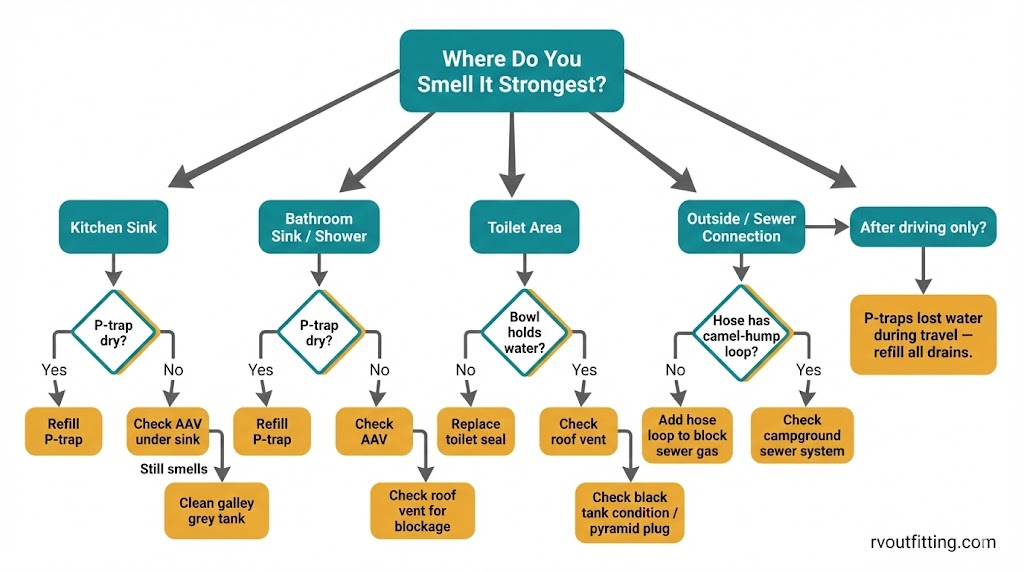
- Fixture-by-fixture sniff. Go to each drain and the toilet. Where is the smell strongest? Kitchen sink points to the galley grey tank. Toilet area points to the black tank. Bathroom sink or shower could be either grey plumbing or venting.
- Verify your water barriers. Run water in every sink and shower drain for several seconds to refill P-traps. Check that the toilet bowl holds water — if it drains down quickly, the seal may be compromised.
- Consider venting and valves before reaching for treatments. A clogged roof vent or a valve left open at full hookups can cause odors that no amount of tank additive will fix. Check these mechanical issues first.
Safety First — Propane vs. Tank Odor (Don’t Guess)
⚠️ Safety warning: If you smell something sharp, chemical, or gas-like in your RV, do not assume it’s a holding tank. Propane leaks can be life-threatening. When in doubt, shut off propane at the tank, open windows, evacuate, and investigate before doing anything else.
When to treat it as “not a tank smell”
The most important question when you detect an odor is: “Is this a propane leak or a tank smell?”
Propane has a distinctly chemical, artificial odor (the odorant added to it is mercaptan). Holding tank smells are organic — sewage, rot, mildew. If there’s any doubt, treat it as propane first. The consequences of guessing wrong are far worse than spending a few extra minutes checking.
There’s another common confusion: grey tank smell vs. water heater anode rod sulfur. If you’re getting a sulfur or rotten-egg smell specifically from the hot water side of your faucets (not the cold), the culprit may be your water heater’s magnesium anode rod reacting with bacteria in the water. That’s not a tank problem at all — it’s a water heater issue that requires checking or replacing the anode rod.
Hydrogen sulfide (H₂S) awareness callout
Hydrogen sulfide (H₂S) is the gas behind that classic “rotten egg” smell. It’s produced by anaerobic bacteria — organisms that thrive in low-oxygen environments like the inside of holding tanks, especially when waste sits and decomposes.
At low concentrations, H₂S is just unpleasant. At higher concentrations, it becomes a genuine health concern. Prolonged exposure in enclosed spaces like an RV interior is worth taking seriously, which is another reason to diagnose and fix the source rather than just masking the odor with fragrances or deodorizers.
Diagnosis Flow — Process of Elimination (Grey vs Black)
Most RVers guess which tank is causing the smell and throw treatments at it. That’s backwards. What you need is a systematic isolation process — test, observe, adjust — so you’re fixing the actual source.
Step-by-step isolation protocol (cause-finding, not guessing)
This is the process that separates real troubleshooting from random chemical dumping:
- Sniff each fixture independently. Kitchen sink, bathroom sink, shower drain, toilet — note where the odor is strongest and what it smells like.
- Close your grey tank valve (if it’s open at full hookups). Wait approximately 48 hours and see if the odor changes. If it improves, the problem was likely sewer gas entering through the open valve or connection.
- Refill all P-traps. Run water in every sink and shower for several seconds. If the smell disappears or weakens significantly, dried P-traps were the issue.
- Check under each sink for an air admittance valve (AAV). If one is stuck or failed, it can let gas bypass the P-trap.
- Inspect the roof vent. Go up top and check for blockages — debris, wasp nests, or a cap that’s not venting properly.
- Identify “grey-only” vs. “black-only” triggers. If the odor is strongest when you run water in the kitchen sink, that points to the galley grey tank. If it’s strongest when you flush or right after flushing, it points to the black tank or toilet seal.
“Smell only when I flush” branch
If the odor appears specifically when you flush the toilet, the most likely culprits are:
- Toilet seal or bowl water level — the seal between the toilet and the black tank may be worn, cracked, or not holding water properly. Without that water barrier, gas comes straight up.
- Venting issues — flushing changes the air pressure inside the system. If the vent is partially blocked, the pressure change can push gas through weak points.
- Black tank conditions — heavy buildup or a “pyramid plug” (more on that below) sitting near the opening creates concentrated odor right at the flush point.
“Smell only while driving / after travel” branch
Travel-related odors are almost always about P-trap water loss. When your RV is in motion, sloshing and vibration can cause water to bounce or siphon out of the P-traps in your sinks and shower. Once that water barrier is gone, tank gas flows freely into the cabin.
If the smell consistently appears after driving and disappears after you run the faucets for a few seconds at each drain, dried P-traps are your answer.
External sewer connection as odor source (diagnosis)
Don’t overlook the outside of your rig. When you’re connected to a campground sewer hookup, odors from the park’s sewer system can travel back up through your hose and into your tanks.
One practical check: look at how your sewer hose is routed. A “camel hump” — a loop in the hose that holds a small amount of water — can act as a trap to block sewer gas from migrating back toward your RV. If your hose runs straight downhill with no loop, external sewer odor has a clear path inside.
Why Grey Tanks Can Smell Worse Than Black Tanks
This surprises a lot of people. Most new RVers assume the black tank will always be the worst offender. In reality, the grey tank — especially the kitchen grey tank — is often the sneakier, nastier source of odors.
Grey tank odor chemistry + biology (in plain English)
Your grey tank collects everything that goes down your sinks and shower: grease, food particles, soap scum, hair, skin cells, and toothpaste. Over time, this mix coats the inside of the tank and pipes, forming a slimy layer called biofilm.
Biofilm is essentially a colony of bacteria embedded in the sludge on your tank walls. In the dark, warm, wet environment of a grey tank, these colonies thrive. As they break down the organic material, they produce that sour, musty, mildew-like funk that’s distinctly different from a black tank’s sewage smell.
The black tank, by contrast, is designed for waste — most RVers treat it regularly and flush it aggressively. The grey tank often gets neglected because people assume “it’s just soap and water.”
The “galley grey tank” problem (kitchen tank)
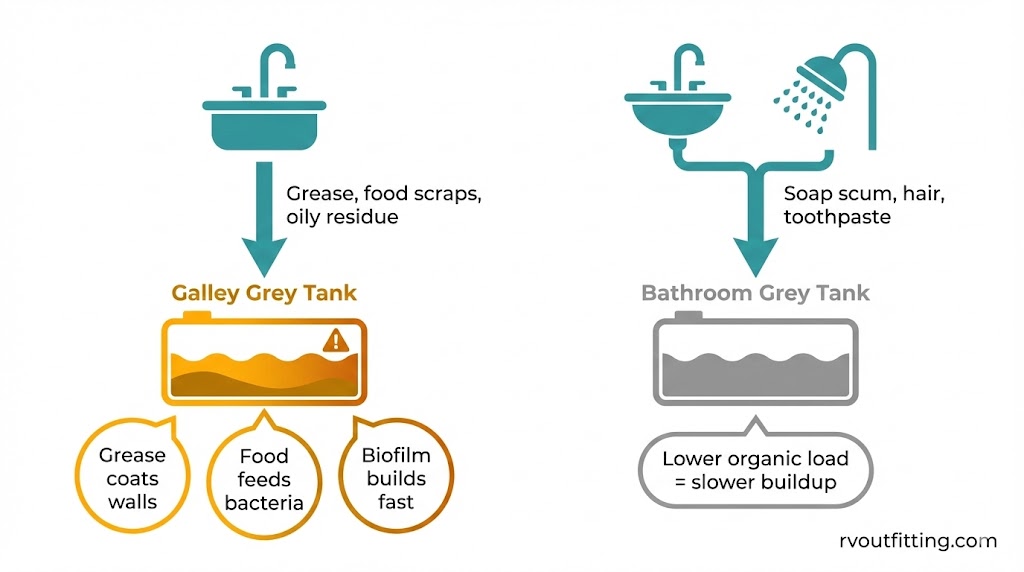
Some RVs have separate grey tanks: one for the kitchen (the “galley grey tank”) and one for the bathroom sinks and shower. If your rig has this setup, the galley grey tank is almost always the worst offender.
Why? Kitchen drains receive cooking grease, food scraps, and oily residue. Even with a drain strainer, small particles get through. That greasy organic matter is prime fuel for bacterial growth and biofilm buildup. Combine it with warm temperatures inside the tank and you get aggressive odor production that can rival — or exceed — anything the black tank puts out.
Most Common Root Causes (Both Tanks + Plumbing)
Once you’ve isolated where the smell is coming from, the next step is understanding why. Most RV tank odors trace back to a short list of root causes — and nearly all of them are fixable without professional help.
Plumbing barriers that fail
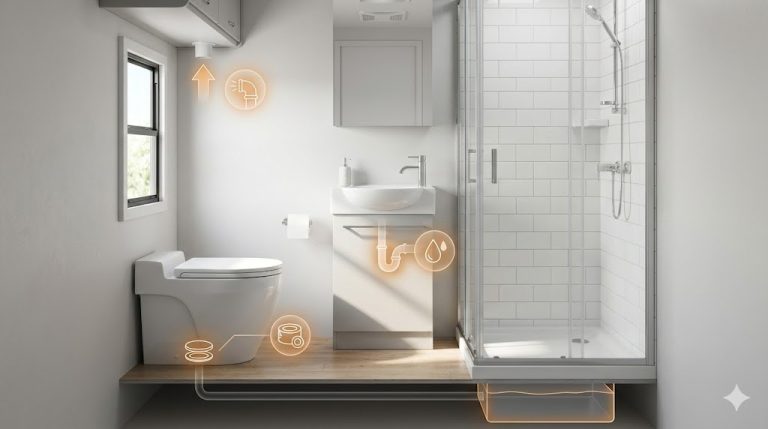
Your RV’s plumbing system has several barriers designed to block tank gas from entering the living space. When any of these fail, you get odor:
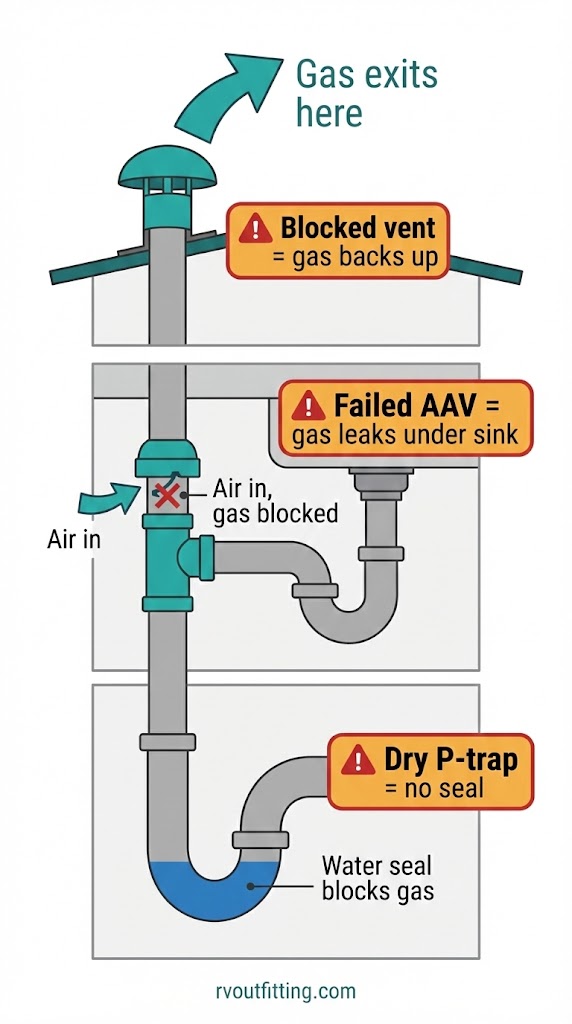
- Dried P-traps (sinks/shower). The P-trap is that curved section of pipe under each drain. It holds a small amount of water that acts as a seal against gas. When the water evaporates — from disuse, travel, or dry camping — the seal breaks.
- Air admittance valves (AAV/Studor vents) under sinks. An AAV is a one-way valve, usually installed under the sink, that lets air into the drain system when needed but is supposed to block gas from escaping. When these fail (they stick or wear out), gas leaks through.
- Vent stack / roof vent pipe clogs. Your RV has a vent pipe that runs from the tanks up through the roof. It equalizes pressure and lets gas escape outside. If it’s blocked by debris, insects, or ice, gas has nowhere to go but back into the cabin.
- Toilet seal / bowl water level issues. The toilet’s flush valve seal is the barrier between the black tank and the bathroom. A worn seal or low water level in the bowl lets gas pass right through.
Tank/valve usage issues
- Leaving the black tank valve open at full hookups. This is one of the most common mistakes. When the valve stays open, liquids drain out but solids stay behind, drying out and building up into a “pyramid plug” — a mound of dried waste under the toilet opening that creates severe odor and clogging problems.
- Residue on tank walls / sludge. Over time, both grey and black tanks accumulate residue on the walls that regular dumping doesn’t remove. This buildup is a constant source of bacterial activity and odor.
Fixes by Cause (Targeted, Not Generic)
Now that you know what’s causing the smell, here’s how to fix each issue specifically. Work through the fix that matches your diagnosis — don’t throw everything at the wall.
Fix dried P-traps (sinks/shower)
The P-trap is simply a U-shaped bend in the drainpipe that holds water. That water creates a seal that blocks gas from traveling up through the drain and into the cabin. The fix for a dried P-trap is straightforward: run water in the affected drain for several seconds to refill the trap.
For long-term prevention, make a habit of running a little water through every drain before and after travel, and periodically during extended storage.
If you want a hardware solution that eliminates the problem entirely, a HepvO waterless waste valve is a self-sealing membrane valve that replaces the traditional P-trap. It lets water flow through but seals against gas without requiring a standing water barrier. These have been gaining traction in the RV community as a more reliable long-term fix, especially for rigs that sit unused between trips.
Fix AAV / under-sink odor leaks
An air admittance valve (AAV) sits under the sink and serves as a one-way air valve — it opens to let air in when water drains (preventing the drain from gurgling or siphoning the P-trap), but it’s supposed to close and seal against sewer gas.
When an AAV fails, it sticks in the open position or doesn’t seal properly, allowing tank gas to vent directly under the sink and into the cabinet. You can usually hear a failing AAV: the sink may gurgle more than normal, or you’ll notice the smell is concentrated in the cabinet area.
Replacing an AAV is typically a simple job — they thread or push onto the drain pipe, and replacements are widely available at hardware and RV supply stores.
Fix venting issues (roof vent / vent stack)
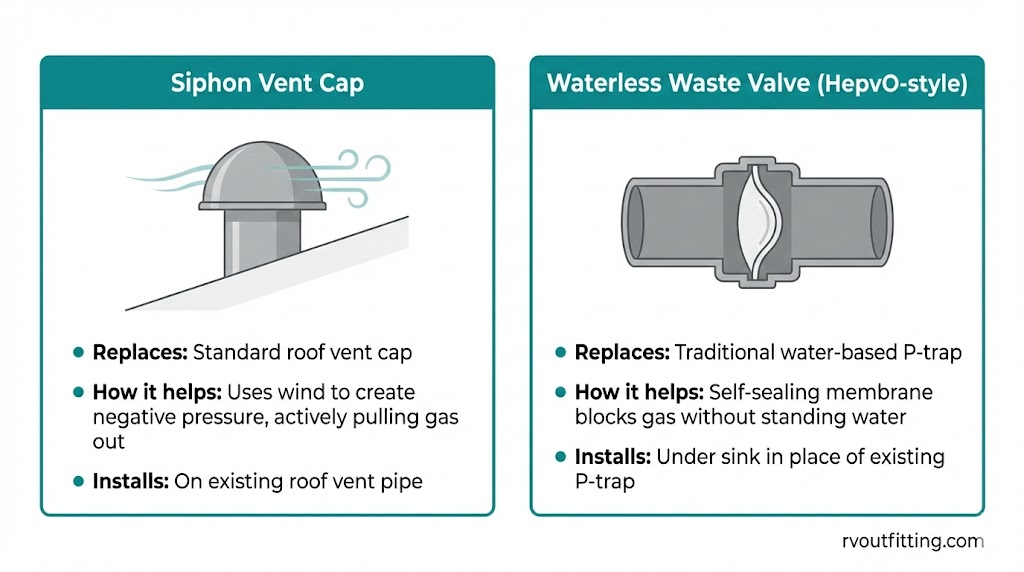
The vent stack runs from your holding tanks up through the roof. Its job is to equalize air pressure in the drain system and channel tank gases outside and above the RV where they dissipate harmlessly.
When the vent is blocked — by leaves, bird nests, wasp nests, spider webs, or ice in cold weather — gas backs up into the cabin. Inspect the vent pipe opening on your roof periodically and clear any obstructions.
For an upgrade, the 360 Siphon roof vent cap replaces your standard vent cap. It uses wind to create negative pressure (a siphon effect) that actively pulls gas up and out of the tank through the vent. This is a popular upgrade among RVers dealing with persistent venting-related odors, especially in low-wind or variable-weather camping conditions.
Fix toilet seal / bowl water odor
If the smell is strongest near the toilet, the flush valve seal is a prime suspect. Check whether the toilet bowl holds water at a consistent level. If the water slowly drops after flushing, the seal is likely worn or damaged.
Many RV toilet seals are replaceable without removing the toilet. The specific part depends on your toilet model. Also check that you’re adding enough water when flushing — a shallow bowl of water provides a weaker gas barrier.
Fix black-tank buildup / “pyramid plug”
A pyramid plug is a mound of dried waste that builds up directly under the toilet opening. It forms when the black tank valve is left open at full hookups — liquids drain away, but solids stack up and dry into a solid mass.
The fix starts with the habit change: keep the black tank valve closed until the tank is at least two-thirds full, then dump. This ensures there’s enough liquid to carry solids out during the dump. If you already have a pyramid plug, you’ll need to fill the tank with water (close the valve, add water through the toilet), let it soak, and then dump. Severe cases may require a tank rinser or professional cleaning.
Fix grey tank biofilm/sludge (cleaning approaches)
Grey tank sludge requires more than just dumping. You need to break up the biofilm on the tank walls. Several DIY methods have strong followings in the RV community:
- Geo Method: A combination of Calgon water softener and liquid dish soap. The Calgon helps break down grease and prevent residue from sticking to tank walls, while the dish soap cuts grease.
- KleenTank recipe: Calgon + Pine Sol + water. The Pine Sol adds a cleaning and deodorizing element to the water-softening action of the Calgon.
- Baking soda + vinegar flush: A classic cleaning combination. Pour baking soda down the drain, follow with vinegar, let it fizz and sit, then flush with water. Good for drains and mild tank buildup.
- Hydrogen peroxide soak: Filling or partially filling the grey tank with a diluted hydrogen peroxide solution and letting it sit before dumping. Targets bacteria and organic buildup.
- Dawn Ultra + Borax method: Dish soap for grease cutting, Borax for deodorizing and cleaning. Mixed and added through the drains.
- Ice trick: Add several pounds of ice through the drain (some RVers use around 10–20 lbs), then drive. The sloshing ice acts as a physical scrubber against the tank walls, knocking loose buildup that normal flushing can’t reach.
For any of these methods, follow up by flushing the tank thoroughly with clean water.
When to consider professional tank cleaning
If you’ve tried the DIY approaches and the odor persists, or if you suspect heavy buildup that’s been accumulating for years, professional tank cleaning is a legitimate option. Specialty RV service shops use pressurized tank rinse systems and specialized tools that can reach buildup DIY methods can’t. It’s not a failure to call a pro — some tanks just need a deeper reset before maintenance methods can keep up.
Tank Treatments — What Type Fits Your Situation?
Tank treatments are one of the most debated topics in the RV world. Everyone has an opinion. Here’s a neutral framework to help you decide what fits your situation — not what someone else swears by.
Treatment type comparison framework (what to compare)
| Treatment Type | What It Targets | Key Consideration | Hot-Weather Note |
|---|---|---|---|
| Mineral-based | Odor neutralization | Works across temperature ranges; doesn’t rely on biological activity | Generally stable in heat |
| Enzyme-based | Breaks down waste biologically | Requires active biological conditions to work | Performance may decline above 85–90°F as enzymes can denature |
| Chemical | Kills bacteria, masks odor | Strong short-term results; can harm dump station septic systems | Stable in heat, but doesn’t address root cause |
| Probiotic | Introduces beneficial bacteria | Works with the biology of the tank, not against it | Temperature-sensitive like enzyme treatments |
| DIY (Geo Method, etc.) | Grease, buildup, odor | Low cost; ingredients widely available | Effectiveness depends on method and consistency |
Hot weather deserves special attention. Enzyme and probiotic treatments rely on biological processes that can slow down or fail when tank temperatures climb above 85–90°F. If you camp in hot climates, keep this in mind when choosing a treatment approach.
Acknowledge the anti-additive viewpoint
Not everyone believes in tank treatments. Some professional tank cleaning services argue that additives — especially enzyme-based ones — can actually create a thick, sludgy buildup over time (sometimes described as a “pancake batter” consistency) that’s harder to clean than the original waste.
Their position is straightforward: proper cleaning, good hardware (functioning vents, seals, and traps), and correct usage habits (valve management, flushing technique) should handle odor without any additives at all.
This is a legitimate decision point for you. Some RVers find treatments helpful as part of a maintenance routine. Others prioritize mechanical and operational habits and skip additives entirely. Neither approach is universally wrong — it depends on your setup, your camping style, and what works in practice for your rig.
Example entities to include in comparison (no ranking claims)
Several products and brands are commonly discussed in the RV community:
- Mineral-based: Happy Campers is one of the most widely mentioned mineral-based treatments across RV forums and reviews.
- Enzyme/chemical/probiotic options: Camco, Walex, and TankTechsRx are among the brands that offer various formulations in these categories.
⚠️ Chemicals to avoid: Formaldehyde-based products, bronopol, and zinc-sulphate monohydrate are chemicals found in some older or cheaper tank treatments. These can damage dump station septic systems and are restricted or banned at many campgrounds.
Prevention — Keep Odors Out of the RV Interior
Fixing a smell is good. Preventing it from coming back is better. Most RV tank odor prevention comes down to simple habits and awareness.
Valve habits and dump order
Dump order: black first, grey second. When you dump your tanks at a dump station, always empty the black tank first, then the grey tank. The grey water helps rinse the sewer hose of black tank residue.
The full-hookup rule: When you’re parked at a site with full hookups, do not leave your black tank valve open. Keep it closed, let the tank fill to at least two-thirds, then dump. You can leave the grey tank valve open if you prefer (opinions vary), but leaving the black valve open is the leading cause of pyramid plugs and persistent black tank odor.
Hot weather odor management
Heat accelerates bacterial activity inside your tanks, which means faster odor production. In hot weather:
- Dump more frequently to avoid letting waste sit and cook in the heat.
- Be aware that enzyme-based treatments may lose effectiveness when temperatures inside the tank exceed 85–90°F.
- Consider switching to mineral-based treatments during peak summer months if your enzyme treatment isn’t keeping up.
- Ventilation matters more in heat — make sure your roof vent is clear and functioning.
For more on managing your RV environment in extreme temperatures, check out this guide on why climate control matters for year-round RV comfort.
Simple “keep-it-clean” practices (grey tank focus)
- Use a drain strainer or sink mesh screen on every drain, especially the kitchen sink. This catches food particles before they enter the grey tank and become biofilm fuel.
- Scrape and wipe greasy pots and pans before washing them. The less grease that goes down the drain, the less buildup in the galley grey tank.
- Run water after doing dishes to flush the drain line and push debris into the tank rather than leaving it sitting in the pipe.
- Periodically clean the grey tank even when there’s no odor — preventive cleaning is far easier than dealing with established biofilm.
If you want to stay ahead on other RV water system maintenance, our water systems resource page covers pumps, pressure, and plumbing basics.
Troubleshooting Matrix (Symptom → Likely Cause → First Fix)
Use this table as a fast-reference triage when you encounter a specific odor scenario in your RV.
Matrix rows to include (must mirror dossier symptom list)
| Symptom | Likely Cause | First Fix |
|---|---|---|
| Smells like rotten eggs but black tank is clean | Water heater anode rod reacting with bacteria; or H₂S from grey tank biofilm | Check if the smell is only from hot water faucets (anode rod). If from drains, clean grey tank. |
| Smell only when I flush | Worn toilet seal; low bowl water level; venting issue | Inspect toilet seal, ensure bowl holds water, check roof vent for blockage. |
| Grey tank smells like sewage | Severe biofilm/sludge buildup in grey tank, especially galley | Clean grey tank using a DIY method (Geo Method, ice trick, etc.) and use a drain strainer going forward. |
| Clogged vent pipe causes odors | Debris, insect nests, or ice blocking the vent stack | Inspect and clear the roof vent pipe; consider a 360 Siphon cap upgrade. |
| Smell only after driving | P-trap water sloshed or siphoned out during travel | Run water in every sink and shower drain to refill P-traps. Consider HepvO valve upgrade. |
| Galley grey is the worst smell | Kitchen grease and food debris creating heavy biofilm | Clean the galley grey tank aggressively; install a sink drain strainer; wipe greasy dishes before washing. |
| Odor at the external sewer connection | Campground sewer gas traveling back up the hose | Create a “camel hump” loop in the sewer hose to trap water and block gas migration. |
| Persistent smell despite treating the black tank | Problem is actually the grey tank, not the black | Isolate by sniffing each fixture; close grey valve and test over 48 hours. |
Mini FAQ
Can your grey tank smell like sewage?
Yes. When biofilm, grease, and food debris build up in the grey tank, the bacterial activity can produce an odor that smells very similar to sewage — even though no actual sewage is in the tank.
Why does my RV smell like rotten eggs but the black tank is clean?
The most common cause is the magnesium anode rod in your water heater reacting with bacteria in the water, producing hydrogen sulfide (H₂S). Check if the smell is isolated to hot water faucets. If it’s coming from drains instead, grey tank biofilm is the more likely culprit.
Can the grey tank smell worse than the black tank?
Absolutely. The grey tank, especially the galley grey tank, often gets neglected because people assume it’s “just soap and water.” In reality, kitchen grease and food particles create ideal conditions for odor-producing bacteria.
What causes the rotten egg smell in an RV?
Hydrogen sulfide (H₂S) gas, produced by anaerobic bacteria breaking down organic matter in holding tanks. It can also come from a water heater anode rod reacting with water bacteria — that’s a plumbing issue, not a tank issue.
How do I find out which tank is causing the smell in my RV?
Use the isolation protocol: sniff each fixture independently, refill P-traps, close the grey valve for 48 hours and observe, and check the toilet seal. The fixture where the smell is strongest points to the source tank.
Should I leave my grey tank valve open or closed at full hookups?
Opinions vary, but leaving it open is generally acceptable for the grey tank. The critical rule is the black tank valve — always keep it closed until the tank is at least two-thirds full to avoid pyramid plugs and dried buildup.
What is the best tank treatment for RV odor?
There’s no single “best” treatment — it depends on your situation. Mineral-based treatments (like Happy Campers) are popular for broad-spectrum odor control. Enzyme treatments work well in moderate temperatures. Some RVers skip additives entirely and rely on cleaning and good habits.
Why does my RV smell only when I flush?
A worn toilet seal, low bowl water level, or a partially blocked vent stack. Flushing changes air pressure in the system, and if any barrier is compromised, gas gets pushed into the cabin during that pressure change.
How do I get rid of grey water tank smell?
Clean the tank using a DIY method (Geo Method, baking soda and vinegar, ice trick, or hydrogen peroxide soak), refill P-traps, check under-sink AAVs, and use a drain strainer to prevent future buildup. For persistent odor, consider professional tank cleaning.
What is a P-trap and why does it cause RV smells?
A P-trap is a U-shaped bend in the drainpipe that holds a small pool of water. That water acts as a seal blocking tank gas from rising through the drain. When the water evaporates (from disuse, travel, or dry conditions), the seal breaks and gas enters the cabin. Refilling it is as simple as running the faucet for a few seconds.
Can a clogged vent pipe cause RV tank odors?
Yes. The vent pipe channels gas out through the roof. When it’s blocked, gas has no exit and backs up into the living space through drains and other weak points in the plumbing system.
How often should I clean my RV holding tanks?
There’s no fixed schedule — it depends on how heavily you use your RV. A good baseline is to do a thorough cleaning at the start and end of each camping season, and whenever you notice odor that basic dumping and treatment aren’t handling. If you’re a frequent traveler, consider a cleaning cycle every few months.
Does hot weather make RV tank smells worse?
Yes. Heat accelerates bacterial activity inside the tanks, which increases gas production. Enzyme and probiotic treatments can also lose effectiveness when tank temperatures climb above 85–90°F.
What is the Geo Method for RV tanks?
The Geo Method is a DIY tank cleaning approach that uses Calgon water softener combined with liquid dish soap. The Calgon breaks down mineral deposits and helps prevent residue from adhering to tank walls, while the dish soap cuts grease. It’s popular for grey tank maintenance in particular.
Do enzyme tank treatments actually work?
They can, within their limits. Enzyme treatments use biological processes to break down waste, and many RVers report good results. However, they’re temperature-sensitive (performance may drop in very hot conditions) and some professional cleaners argue they can contribute to sludgy buildup over time. They work best as part of a complete maintenance routine, not as a standalone solution.