RV Shower Temperature Swings: Causes, Fixes & Upgrades
Last updated: February 2026
If your RV shower keeps shocking you with blasts of scalding water followed by icy cold, you’re dealing with one of the most common — and most fixable — RV plumbing frustrations. This guide covers every root cause of RV shower temperature swings for both tank-style and tankless water heaters, with step-by-step fixes, brand-specific troubleshooting, and upgrade options that actually solve the problem.
Quick Answer / Quick Start
If you just want the fastest path to a stable shower temperature, start here:
- Identify your water heater type — tank-style (Suburban, Atwood/Dometic) or tankless (Furrion, Girard, Truma, Fogatti). Your fix depends entirely on which one you have.
- Check your bypass valve first — a partially open winterization bypass valve is the single most overlooked cause of cold water mixing into your hot supply.
- Tankless owners: use the “constant temperature method” — set your desired temperature at the heater’s controller and run hot-only at the faucet. Do not try to mix hot and cold at the handle.
- Check your flow rate — if your tankless heater shuts off mid-shower, a low-flow shower head or restrictors may be dropping flow below the activation threshold.
- Atwood G16-EXT owners: inspect the OEM mixing valve at the tank — this hidden valve is the most common cause of lukewarm or swinging temps on 10-gallon Atwood units, and most troubleshooting guides skip it entirely.
- Descale your water heater regularly — mineral buildup inside the heat exchanger or on valve components causes gradual temperature control failure.
- Consider a thermostatic mixing valve upgrade — a true thermostatic shower valve mechanically maintains your set temperature regardless of pressure or supply fluctuations.
- Verify water pressure is in the safe range — keep your incoming pressure between 40 and 55 PSI with an adjustable regulator.
Why Does Your RV Shower Go Hot Then Cold? (Root Causes Overview)
RV shower temperature swings almost always trace back to one of a handful of root causes. The tricky part is that some of these overlap, and the fix for a tank-style heater is completely different from the fix for a tankless unit.
Here’s a quick map of the most common culprits:
- Bypass valve partially open — cold water sneaks past the heater and mixes into your hot supply line
- Thermostat failure or hysteresis — the heater cycles on and off with a wide temperature gap, creating noticeable swings
- OEM mixing valve degradation — especially on Atwood/Dometic G16-EXT models, the wax-motor mixing valve at the tank breaks down with calcium buildup
- Cold water sandwich effect — unique to tankless heaters, a burst of cold water appears between two hot segments when the burner re-fires
- Flow rate too low for tankless activation — low-flow shower heads or restrictors drop flow below the minimum GPM needed to keep the burner running
- Water pressure imbalance — another fixture drawing water (toilet flush, kitchen faucet) throws off the hot/cold pressure ratio at the shower
- Mineral and limescale buildup — calcium deposits inside the heat exchanger, thermostat, or valves reduce heating efficiency and valve responsiveness
- Cross-connection from a failed check valve — hot water backflows into the cold line (or vice versa), creating unpredictable mixing
The sections below walk through each cause in detail, organized by heater type, so you can zero in on the fix that matches your rig.
Tank-Style Water Heater Fixes
If you have a Suburban (SW6DE, SW10DE) or Atwood/Dometic (G6A-8E, GCH6A, G16-EXT) tank-style water heater, start here. These units hold 6, 10, or 12 gallons and typically heat on propane, electric (drawing up to 1,500 watts), or both.
Check Your Bypass Valve Position

The bypass valve routes water around the heater tank during winterization. If it’s left partially open after de-winterizing — even slightly — cold water mixes directly into the hot supply without ever touching the tank.
How to check:
- Locate the bypass valve(s) behind your water heater access panel (exterior of the RV) or inside a cabinet near the heater.
- Most setups use one, two, or three valves. In normal operation, water should flow through the tank, not around it.
- Make sure all bypass valves are fully in the “normal use” position. If you’re unsure which way is which, trace the plumbing lines — water should enter the tank at the bottom and exit at the top.
Common mistake: Many RVers winterize in the fall and forget to fully close the bypass in spring. Even a quarter-turn open can cause lukewarm water and temperature swings.
If your bypass valve is corroded, stuck, or leaking, replacing it is a straightforward job with PEX fittings, a PEX cinch tool, and PEX clamps.
Thermostat Failure and Hysteresis
Your tank-style heater’s thermostat tells the burner (or electric element) when to fire and when to shut off. When the thermostat wears out, it can cause the heater to overshoot or undershoot the target temperature.
Even a working thermostat has a characteristic called thermostat hysteresis — the temperature gap between when the heater turns on and when it shuts off. On many RV thermostats, this gap is roughly 10°F. That means if the thermostat is set to 120°F, the heater may not re-fire until the water drops to around 110°F, and may overshoot slightly before cutting off. During a shower, this cycling creates noticeable warm-cool-warm swings.
Testing your thermostat:
- Use a multimeter to check continuity. For electric heating elements, you’re typically looking for a resistance in the 9.6 to 10 ohm range.
- If the thermostat shows no continuity or erratic readings, replace it.
Advanced DIY tip: Some RV owners have replaced mechanical thermostats with solid-state IC thermostats (such as the TC622), which can reduce hysteresis to roughly 4°F. This significantly smooths out temperature cycling, but it requires comfort with basic electrical work.
The OEM Mixing Valve on Atwood G16-EXT Models
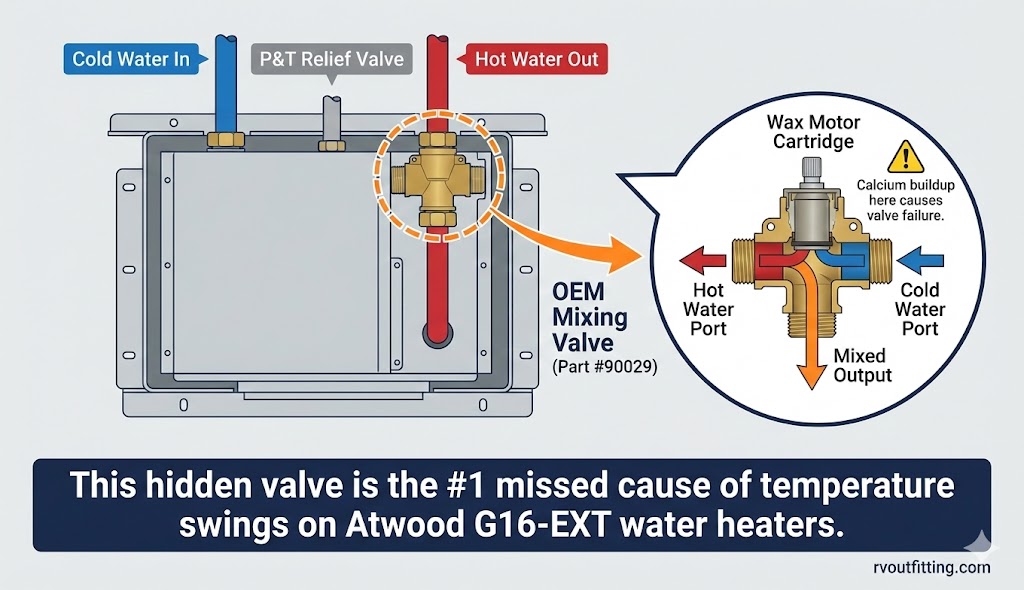
This is the single biggest “hidden culprit” in RV shower temperature problems — and most troubleshooting guides skip it completely.
The Atwood/Dometic G16-EXT is a 10-gallon tank marketed as a “16-gallon equivalent.” It achieves that claim by using an OEM mixing valve bolted directly to the tank’s hot water outlet. This valve blends incoming cold water with outgoing hot water to stretch the usable supply.
Inside this valve is a wax motor thermostat — a wax element that expands and contracts with temperature to mechanically adjust the valve’s mixing ratio. Over time, calcium and mineral buildup degrades the wax motor, causing it to stick, respond sluggishly, or fail entirely. When it fails, your hot water output becomes erratic, lukewarm, or wildly inconsistent.
How to diagnose:
- Locate the mixing valve on the back of the water heater (exterior access panel). It’s a brass or plastic valve attached to the hot water outlet.
- If you’ve already checked the bypass valve, thermostat, and shower faucet and still have temperature swings, the OEM mixing valve is your most likely culprit.
- Some owners temporarily bypass this valve to confirm it’s the problem — if water temperature stabilizes (though hotter), the valve is the issue.
Replacement:
The original Atwood part number is 90029, but this part is increasingly difficult to source. The widely recommended replacement is the Watts LFMMVM1-UT, available in ½-inch and 1-inch versions. This thermostatic mixing valve is adjustable between 80°F and 120°F, handles flow rates from 0.5 to 20 GPM, and is rated for up to 150 PSI.
Should you remove the mixing valve entirely? Some owners do, but keep in mind the valve also serves as an anti-scald device. If you remove it, your hot water will come straight from the tank at full temperature. A thermostatic shower valve (covered below) is a safer upgrade path.
Reset the ECO / High-Temperature Limit Switch
Every tank-style RV water heater has an ECO (Emergency Cut Off) switch — also called the high-temperature limit switch. This safety device trips if the water inside the tank reaches roughly 180°F, which happens when the thermostat fails to shut off the burner.
When the ECO trips, the heater stops heating entirely. The result: water starts hot (leftover from before the trip), then rapidly cools as you shower.
How to reset:
- Turn off the water heater (both gas and electric).
- Remove the exterior access panel.
- Locate the reset button — it’s usually a small red or black button on the thermostat housing or near the electric element.
- Press it firmly until you feel or hear a click.
- Restore power and relight/restart the heater.
Important: If the ECO keeps tripping, your thermostat is likely failing and needs replacement. Do not simply keep resetting it — the ECO exists to prevent dangerously hot water and potential tank damage.
The reset process varies slightly by brand. On Atwood/Dometic units, the reset is typically on the back of the thermostat. On Suburban units, it may be a separate button near the electric heating element.
Outdoor Shower Left On and Check Valve Failures
Two sneaky causes that are easy to miss:
Outdoor shower left on: If your RV has an exterior shower and the mixer is left in a partially open position, it creates a path for hot and cold water to cross-connect through the shower head, even when no water is flowing. This bleeds heat from your hot line and can cause temperature drops at the indoor shower.
Check valve failure: Check valves (sometimes called backflow preventers) keep hot water from flowing backward into the cold supply line. If a check valve fails, you get a cross-connection — hot water enters the cold line, and the resulting mixing causes unpredictable temperature swings at every fixture. PEX-compatible check valves from brands like Valterra are an inexpensive fix.
Quick diagnostic: Run only the hot side at your indoor shower. If the cold line also becomes warm, you likely have a cross-connection from a failed check valve or an open outdoor shower.
Tankless Water Heater Fixes
Tankless RV water heaters (Furrion, Girard, Truma AquaGo, Truma Combi, Fogatti, Camplux) heat water on demand as it flows through a heat exchanger. This eliminates the “running out of hot water” problem but introduces a different set of temperature issues.
Constant Temperature Method vs. Mixing Method
This is the single most important thing tankless RV water heater owners need to understand — and the one thing most troubleshooting guides fail to explain.
There are two ways to use a tankless heater:
Constant temperature method (recommended by manufacturers):
- Set your desired shower temperature at the heater’s wall controller or panel.
- At the faucet, turn the handle to hot only. Do not try to blend in cold water.
- The heater modulates its flame or element to deliver water at the set temperature.
Mixing method (residential-style, causes problems in RVs):
- Set the heater to its maximum temperature.
- Mix hot and cold at the faucet handle to reach your preferred temperature.
- This reduces total hot water flow through the heater, which can drop flow below the activation threshold, causing the burner to shut off and restart — the exact cause of temperature swings.
Bottom line: If you’re mixing hot and cold at the faucet with a tankless RV heater, you’re likely causing the very problem you’re trying to fix. Switch to the constant temperature method first. This single change resolves the majority of tankless temperature complaints.
Furrion, Girard, and Suburban all explicitly recommend the constant temperature method in their documentation.
Flow Rate, Water Pressure & Tankless Activation
Every tankless heater has a minimum flow rate required to activate the burner. If water flow drops below this threshold — even briefly — the unit shuts off, and you get a blast of cold water until it re-fires.
Activation thresholds by brand:
| Brand | Approximate Minimum Flow to Activate |
|---|---|
| Truma AquaGo | ~0.4 GPM |
| Girard GSWH-2 | ~0.8 GPM |
| Furrion | Varies by model |
Common flow-rate killers:
- Low-flow shower heads — some RV shower heads restrict flow well below 1 GPM, which can be too low for certain tankless units
- Built-in flow restrictors — many shower heads have a small plastic or rubber disc inside the fitting that limits flow. Removing it can restore adequate flow.
- Low campground water pressure — if incoming pressure is weak, total flow at the shower drops
- Other fixtures running simultaneously — flushing a toilet or running the kitchen faucet splits flow and may drop the shower below the activation threshold
What to do:
- Measure your shower’s actual flow rate by timing how long it takes to fill a one-gallon container.
- If flow is below your heater’s activation threshold, remove any flow restrictors from the shower head.
- Consider an adjustable water pressure regulator to maintain steady incoming pressure in the 40 to 55 PSI range.
- Avoid running other water fixtures while showering.
Shower heads designed for RV use, like the Oxygenics Fury (rated at 1.8 GPM at 80 PSI with a flow control lever), use aerating technology to maintain a satisfying spray feel while keeping flow above tankless activation thresholds.
Understanding the Cold Water Sandwich Effect
The cold water sandwich is a phenomenon unique to tankless water heaters. Here’s what happens:
- You turn on the hot water. A small amount of already-heated water sitting in the pipes reaches you first — nice and warm.
- Then a slug of cold water that was sitting in the heat exchanger (unheated) arrives — sudden cold blast.
- The burner fires and reaches operating temperature — hot water returns and stabilizes.
This cycle repeats any time you turn the hot water off and back on (for example, when you shut off the shower to lather up and then turn it back on).
How to minimize it:
- Let the water run for several seconds after turning it on before stepping into the spray.
- Avoid turning the hot water on and off repeatedly during your shower. Keep a consistent flow.
- The Truma AquaGo Comfort and Comfort Plus models feature a built-in “temperature stabilizing mixing vessel” specifically designed to reduce cold water sandwiches — this is unique among RV tankless heaters.
Is a buffer tank worth it? In residential plumbing, a small buffer tank installed after the tankless heater absorbs the cold slug and smooths output temperature. This approach is rarely discussed in the RV world due to space and weight constraints, but some full-time RVers with persistent cold water sandwich issues have added a 1 to 2 gallon mini tank with success. It adds weight and requires mounting space, so weigh the tradeoff for your rig.
Tankless Water Heater Temperature Swings by Brand
Each tankless brand has its own quirks, error codes, and common failure points.
Furrion Tankless
- Wall controller default temperature is 115°F (46°C); adjustable from the control panel.
- Common error codes: E3 (ignition failure), E4 (flame detection failure). Both can result in the heater shutting off mid-shower.
- If temperature swings persist after switching to the constant temperature method, check for firmware updates or controller resets per Furrion’s troubleshooting guide.
- Flow rate varies by model — confirm your shower head delivers adequate GPM.
Girard GSWH-2
- Rated flow of approximately 1.2 GPM with an activation threshold around 0.8 GPM. This is a relatively tight margin, making flow rate management critical.
- The GSWH-2 has a water control valve on the back of the unit. If temperature output is erratic, inspect this valve for debris or failure.
- Known for flow sensor issues — the impeller inside the flow sensor can stick or degrade, causing the unit to misread flow and shut off unexpectedly. Cleaning or replacing the flow sensor often resolves intermittent shutoffs.
Truma AquaGo (Basic, Comfort, Comfort Plus)
- 60,000 BTU output with a low activation threshold of approximately 0.4 GPM — the lowest among common RV tankless heaters, making it less sensitive to low-flow shower heads.
- The Comfort and Comfort Plus models include a built-in mixing vessel that reduces cold water sandwiches.
- Common error codes: E89, E90 (ignition/flame issues), E118 (overheating protection).
- Truma’s iNet app and Interconnect system allow remote temperature monitoring and adjustment — a connected-RV feature not available on competing brands.
Truma Combi
- A 2-in-1 furnace and water heater with a small 2.64-gallon internal tank. Because it’s a hybrid (not purely tankless), temperature behavior is different from fully tankless units.
- Common error codes: W17H, W18H (water temp sensor warnings), E43H, E44H (heating faults).
- The small tank means hot water supply is limited; long showers will deplete the buffer and cause temperature drops.
Fogatti
- The LSB64FR is a 42,000 BTU tankless unit gaining popularity as an aftermarket upgrade.
- Critical installation note: Users report temperature regulation problems when the Camco temperature and pressure (P&T) relief valve is not installed. This valve is not always included and must be purchased separately.
- As a newer market entrant, long-term reliability data is still limited. Monitor RV forums for evolving troubleshooting tips.
Winter and High-Altitude Performance
This is an area most RV water heater guides completely ignore, but it has a massive impact on tankless performance.
Cold weather: Tankless heaters can only raise inlet water temperature by a certain number of degrees (the “temperature rise”). In winter, incoming water can be significantly colder than in summer. If your inlet water is near freezing, even a powerful burner may not be able to reach a comfortable shower temperature at full flow. The workaround is to reduce flow slightly (while staying above the activation threshold) to give the heat exchanger more time to work.
High altitude: Propane-fired tankless heaters lose BTU output at elevation because there’s less oxygen for combustion. This compounds the cold-inlet-water problem in mountain camping scenarios. There’s no easy fix beyond being aware of the limitation and adjusting your temperature expectations.
Heavy rain: Some tankless units with exterior air intakes can have combustion disrupted by heavy, wind-driven rain. If your heater shuts off during a storm, this may be the cause — not a mechanical failure.
The Hidden Culprit — OEM Mixing Valve at the Tank
This topic deserves its own dedicated section because it’s the single largest gap in RV water heater troubleshooting content, and it affects a huge number of rigs.
Which RVs Have It?

The OEM mixing valve is found primarily on the Atwood/Dometic G16-EXT (10-gallon tank). This heater is commonly installed in mid-to-large motorhomes and fifth wheels from manufacturers including Fleetwood, American Coach, Tiffin, Newmar, and Winnebago.
The G16-EXT is marketed as providing “16-gallon equivalent” capacity. It achieves this by mixing cold water into the hot output at the tank, stretching usable volume. The mixing is handled by a Watts-style thermostatic mixing valve (Atwood part #90029) bolted to the hot water outlet on the back of the heater.
Why It Fails
Inside the valve is a wax motor cartridge. As the wax heats up, it expands and physically adjusts the valve’s internal piston to change the hot/cold mixing ratio. Over time — especially in areas with hard water — calcium and mineral deposits coat the wax cartridge and valve internals. The result:
- The valve sticks in one position, delivering lukewarm water regardless of tank temperature.
- The valve responds sluggishly, causing delayed or oscillating temperature changes.
- In worst cases, the valve fails open on the cold side, diluting hot water severely.
How to Fix or Replace It
- Locate the valve on the hot water outlet at the rear of the heater (accessible through the exterior panel).
- Test by bypassing: Temporarily remove the valve and connect the hot line directly. If water temperature stabilizes (it will be hotter than normal), the valve was the problem.
- Replace with a Watts LFMMVM1-UT. This is the recommended aftermarket replacement. It’s adjustable (80–120°F), handles 0.5 to 20 GPM, and is rated for up to 150 PSI. Available in ½-inch and 1-inch versions to match your plumbing.
- After installing, adjust the valve’s temperature dial to your preferred output temperature and test at the nearest faucet with a digital thermometer.
Why don’t more guides cover this? Most troubleshooting content jumps straight to the shower faucet, thermostat, or bypass valve. The OEM mixing valve at the tank is physically separate and often hidden behind insulation or mounting brackets. If you’ve tried everything else and still have temperature swings on an Atwood G16-EXT, this is almost certainly your answer.
Upgrade Your Shower Valve — Thermostatic Mixing Valves for RVs
If you’re tired of chasing individual root causes, a thermostatic mixing valve (TMV) at the shower is the most comprehensive upgrade you can make. It won’t fix a broken water heater, but it will stabilize your shower output temperature against pressure fluctuations, supply variations, and minor heater inconsistencies.
How Thermostatic Shower Valves Work
A TMV contains a temperature-sensing element (typically a wax motor or bimetallic strip) that continuously adjusts the internal mix of hot and cold water to maintain a set output temperature. If someone flushes a toilet and cold-side pressure drops, the valve compensates instantly. If the heater output fluctuates by a few degrees, the valve absorbs the difference.
This is fundamentally different from a standard RV shower faucet (like the Dura Faucet DF-SA100 series, rated at 2.4 GPM), which is a simple manual mixer with no temperature regulation.
Best Options for RV Installation
Grohe Grohtherm 1000:
- TurboStat technology for fast, accurate temperature regulation
- CoolTouch housing prevents burns from the valve body
- 38°C (100°F) SafeStop default with override capability
- Premium price point; residential quality; heavier than typical RV valves
- Requires a 2-hole mounting configuration
MISSMIN 4-inch Thermostatic RV Shower Faucet Valve:
- Budget-friendly option designed for RV use
- Available on Amazon; 4-inch center spacing fits many RV shower bezels
- Good entry point for RVers who want thermostatic control without the Grohe price tag
RecPro 2-hole shower bezel/trim plate:
- If you’re upgrading from a standard 3-hole RV shower faucet to a 2-hole thermostatic valve, you’ll likely need a new trim plate to cover the old holes. RecPro makes a 2-hole bezel designed for this purpose.
Installation Tips
- Measure your existing shower valve’s hole spacing before ordering. Most RV showers use either a 4-inch or 8-inch center.
- Thermostatic valves are heavier than standard RV faucets. Make sure your shower wall can support the weight — adding a backing plate behind the wall panel is a common reinforcement method.
- After installation, test the valve’s temperature output with a digital thermometer at the shower head. Adjust the valve’s temperature stop to your preference.
- If your RV has thin fiberglass or plastic shower walls, be gentle with mounting hardware to avoid cracking.
Water Pressure & Flow Rate — The Tankless Connection
Water pressure and flow rate are closely related but distinct concepts, and understanding the difference is critical for troubleshooting low water pressure in your RV.
Pressure is the force pushing water through the system (measured in PSI). Flow rate is the volume of water actually moving through a fixture (measured in GPM). You can have adequate pressure but inadequate flow if there’s a restriction in the line, a clogged filter, or a low-flow fixture.
Adjustable Water Pressure Regulators
Campground water pressure varies wildly — some parks deliver well over 100 PSI, which can damage RV plumbing, while others provide barely enough to run a shower. An adjustable water pressure regulator lets you dial in a safe, consistent pressure.
For most RVs, the recommended range is 40 to 55 PSI, with 60 PSI as a general maximum for safe operation. Setting your regulator in this range protects your plumbing while maintaining enough pressure to support adequate flow to your tankless heater.
Removing Shower Head Flow Restrictors
Many RV shower heads ship with a built-in flow restrictor — a small plastic or rubber disc inside the shower head’s inlet fitting. While these conserve water, they can reduce flow below the activation threshold of tankless water heaters.
To check: Unscrew your shower head and look inside the fitting. If you see a small disc with a tiny hole, that’s the restrictor. Remove it, reinstall the head, and test your flow.
Better option: Instead of removing the restrictor entirely (which wastes water when you’re on a tank), consider upgrading to a shower head designed for RVs with on-demand flow control. The Oxygenics Fury RV (1.8 GPM at 80 PSI) uses a patented Venturi effect to maintain spray quality at reduced flow while still delivering enough volume for tankless activation. Its built-in flow control lever lets you cut flow when lathering without fully shutting off — keeping the heater’s burner alive.
If you’re boondocking and relying on your RV freshwater tank, a shower head with adjustable flow gives you the best of both worlds: conservation when you need it and full flow when you need your heater to stay lit.
Does Pressure Affect Temperature?
Yes — but indirectly. A pressure-balancing valve (found in some RV shower faucets) adjusts the hot/cold ratio when pressure changes on one side. If someone flushes a toilet and cold-side pressure drops, the valve compensates to prevent a scald. But if your shower faucet doesn’t have a pressure-balancing mechanism (most basic RV faucets don’t), a pressure drop on the cold side means your shower suddenly runs hotter until pressure equalizes.
This is another reason a thermostatic shower valve upgrade is worth considering — it handles both pressure and temperature compensation automatically.
Maintenance Checklist to Prevent Future Fluctuations
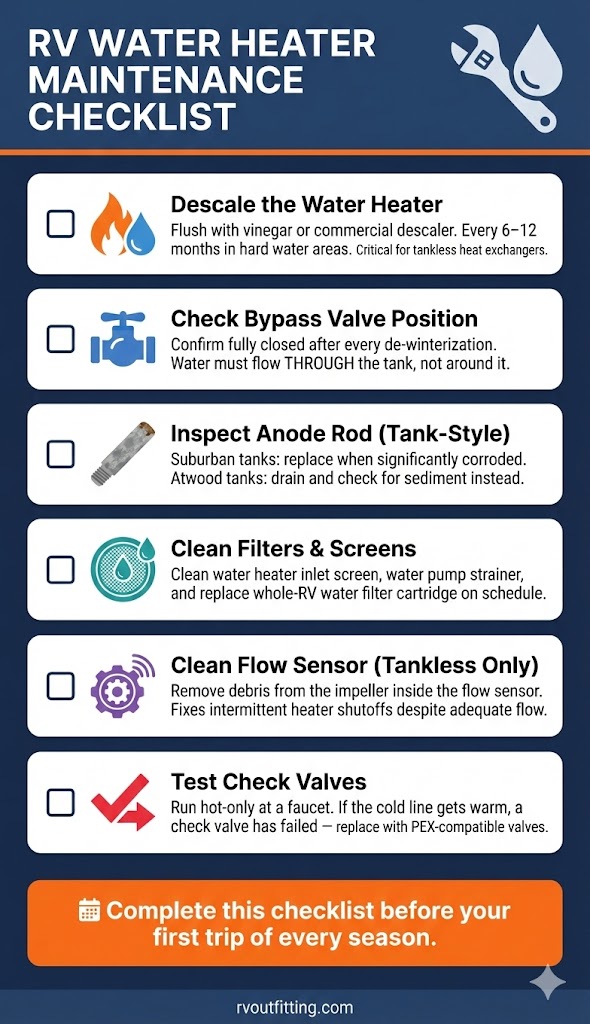
Regular maintenance prevents most RV shower temperature problems before they start. Here’s what to stay on top of:
Descaling / decalcification:
- Flush your water heater with white vinegar or a commercial descaler on a regular schedule, especially if you camp in areas with hard water.
- For tankless heaters, descaling the heat exchanger is critical — mineral buildup directly reduces heating efficiency and can cause error codes.
- For tank-style heaters, drain and flush the tank to remove sediment.
Bypass valve inspection:
- After every de-winterization, confirm bypass valves are fully closed (normal-use position).
- Check valve handles for stiffness or corrosion. Replace if they don’t move freely.
Anode rod check (tank-style only):
- Suburban tank heaters use a sacrificial anode rod to protect against tank corrosion. Inspect it periodically and replace when it’s significantly deteriorated.
- Atwood/Dometic tanks use an aluminum-clad steel tank and don’t have a traditional anode rod — instead, drain and inspect the tank for sediment buildup.
Filter and screen cleaning:
- Clean the inlet screen on your water heater.
- Clean or replace your RV water pump’s inlet strainer.
- If you use a whole-RV water filter, replace the cartridge on schedule.
Flow sensor maintenance (tankless only):
- The flow sensor/impeller inside tankless heaters can accumulate debris. If your heater intermittently shuts off despite adequate flow, cleaning the flow sensor is a common fix. Consult your heater’s manual for access instructions.
Check valve testing:
- Periodically test for cross-connections by running only the hot side at a faucet and checking if the cold line warms up. If it does, a check valve has failed and needs replacement.
Seasonal tip: Before your first trip of the season, run through this entire checklist. Most temperature-swing problems that show up on the first camping trip of the year trace back to winterization leftovers or off-season corrosion. If your RV freshwater tank needs sanitizing after winter storage, handle that at the same time.
Tools You’ll Need
Keep these on hand for diagnosing and fixing RV water heater temperature problems:
- Multimeter — for testing thermostat continuity and heating element resistance
- Digital thermometer — for verifying water temperature at the faucet (don’t guess)
- PEX cinch tool and PEX clamps — for replacing bypass valves or replumbing fittings
- Adjustable water pressure regulator — for maintaining safe, consistent incoming pressure
- White vinegar or commercial descaler — for flushing mineral buildup from tanks and heat exchangers
- Screwdrivers and wrenches — for accessing heater panels, valves, and fittings
When to Call a Professional
Some issues are best left to a certified RV technician:
- Gas leak smell near the water heater — shut off propane immediately and do not attempt a DIY fix.
- Repeated ECO trips — if the high-temperature limit switch keeps tripping after thermostat replacement, there may be a deeper electrical or control board issue.
- Error codes that won’t clear — persistent error codes on tankless heaters (especially Truma and Furrion) after basic troubleshooting may indicate a failed control board, gas valve, or sealed component.
- Unusual noises or visible damage — cracking, bulging, or heavy corrosion on the tank or heat exchanger means it’s time for professional evaluation or replacement.
- You’re uncomfortable working with gas or electrical systems — there’s no shame in this. RV propane and 120V AC systems can be dangerous if mishandled. Protecting your RV’s electrical system matters more than saving on a service call.
FAQ
Why does my RV shower keep going from hot to cold?
The most common causes are a partially open bypass valve, thermostat failure (or normal thermostat hysteresis), a failing OEM mixing valve at the water heater, or — on tankless units — flow rate dropping below the burner’s activation threshold. Start by checking the bypass valve, then work through the diagnostic steps for your heater type.
How do I fix temperature fluctuations in my RV tankless water heater?
Switch to the constant temperature method: set your desired temperature at the heater’s controller and run hot-only at the faucet. If that doesn’t resolve it, check that your shower flow rate is above the heater’s minimum activation threshold, remove any flow restrictors, and verify your water pressure is in the 40–55 PSI range.
What is the cold water sandwich effect in an RV?
A cold water sandwich is a burst of cold water that arrives between two segments of hot water when a tankless heater re-fires. It happens because the water sitting in the heat exchanger cools down when the burner is off. Letting the water run a few seconds before stepping in and avoiding on-off cycling during your shower helps minimize it.
Should I remove the mixing valve on my RV water heater?
If you have an Atwood/Dometic G16-EXT with a failing OEM mixing valve, replacing it (rather than simply removing it) is the recommended approach. Removing it eliminates the anti-scald function and delivers full-temperature water to your fixtures. The Watts LFMMVM1-UT is the standard aftermarket replacement.
Can I install a thermostatic shower valve in my RV?
Yes. Thermostatic shower valves like the Grohe Grohtherm 1000 or the budget MISSMIN 4-inch RV-specific valve can be installed in most RV showers. Measure your existing valve’s hole spacing, confirm your shower wall can support the weight (add a backing plate if needed), and you may need a new trim plate (like the RecPro 2-hole bezel) if your current setup has a different hole configuration.
Why does my RV water heater only get lukewarm?
The most likely causes are a partially open bypass valve, a failing OEM mixing valve (especially on Atwood G16-EXT models), or a thermostat that’s not reaching the correct setpoint. For tankless units, cold inlet water temperature (especially in winter) may exceed the heater’s temperature-rise capability at full flow.
How do I reset my RV water heater ECO switch?
Turn off the heater (gas and electric). Remove the exterior access panel. Locate the small red or black reset button on the thermostat housing or near the electric element. Press it firmly until it clicks. Restore power and restart the heater. If the ECO keeps tripping, the thermostat likely needs replacement.
Why does my tankless RV water heater shut off during a shower?
The most common cause is flow rate dropping below the minimum activation threshold — often due to a low-flow shower head, a built-in flow restrictor, or another fixture drawing water simultaneously. Using the mixing method (blending hot and cold at the faucet) also reduces hot-side flow and can cause shutoffs. Switch to the constant temperature method and verify adequate flow.
What is the best shower head for an RV with a tankless water heater?
Look for a shower head that delivers at least 1.5 GPM at your typical water pressure while offering a flow control option. The Oxygenics Fury RV (1.8 GPM at 80 PSI) is a popular choice — its Venturi-effect technology provides good spray feel at moderate flow, and the built-in lever lets you reduce flow without fully shutting off.
How do I adjust the temperature on a Furrion tankless water heater?
Use the wall-mounted controller panel. The factory default is 115°F (46°C). Adjust up or down to your preference, then use the constant temperature method — run hot-only at the faucet and let the heater regulate output. If the controller is unresponsive or shows error codes (E3, E4), consult Furrion’s troubleshooting guide for reset procedures.
Does water pressure affect RV shower temperature?
Indirectly, yes. If another fixture draws water (like a toilet flush), it can change the pressure balance between the hot and cold supply lines at your shower. Without a pressure-balancing or thermostatic valve, this causes a sudden temperature spike or drop. An adjustable pressure regulator at your hookup and a thermostatic shower valve are the best defenses.
How often should I descale my RV tankless water heater?
Frequency depends on your water hardness. In areas with hard water, descaling every 6 to 12 months is a reasonable starting point. If you notice reduced hot water output, longer warm-up times, or error codes related to overheating, descale sooner. Flushing with white vinegar or a commercial descaler designed for tankless heaters is the standard process.
Why is hot water mixing with cold water in my RV?
Check these in order: the bypass valve (most common), the OEM mixing valve at the tank (if you have an Atwood G16-EXT), and check valves in your plumbing. A failed check valve allows hot water to backflow into the cold supply line, creating a cross-connection that mixes temperatures unpredictably at every fixture.
What is the bypass valve on an RV water heater for?
The bypass valve allows you to route water around the water heater tank during winterization, so antifreeze goes through the plumbing lines without filling the tank. In normal use, the bypass must be fully closed so all water flows through the heater. A partially open bypass is one of the most common — and most overlooked — causes of lukewarm or fluctuating water temperature.
How long should an RV water heater take to heat up?
For tank-style heaters, expect roughly 10 to 15 minutes on propane or around 30 minutes on electric for a full tank. Tankless heaters produce hot water on demand with only a brief delay (a few seconds) as the burner fires and the heat exchanger reaches temperature. If your tank-style heater is taking significantly longer than these ranges, the heating element, thermostat, or gas burner may need attention.
How does altitude or cold weather affect my RV tankless water heater’s temperature output?
Propane-fired tankless heaters lose BTU output at higher elevations because there’s less oxygen available for combustion. Cold inlet water temperatures compound this — the heater has to work harder to achieve the same temperature rise. At high altitude in cold weather, you may need to reduce flow slightly or accept a somewhat lower maximum shower temperature.
What is thermostat hysteresis and why does it cause inconsistent RV water temperature?
Thermostat hysteresis is the temperature gap between when the heater’s burner turns on and when it shuts off. On many RV tank-style water heaters, this gap is roughly 10°F. So the water temperature in the tank constantly cycles within that range as the heater fires and rests. During a shower, you may feel this as subtle warm-cool waves. Replacing a mechanical thermostat with a solid-state IC thermostat (like the TC622) can reduce this gap significantly.
Can a clogged or malfunctioning check valve cause hot/cold mixing in my RV plumbing?
Absolutely. A failed check valve allows hot water to flow backward into the cold supply line (or vice versa), creating a cross-connection. This causes unpredictable temperature mixing at every fixture in the RV. To test, run hot-only at a faucet — if the cold line also becomes warm, you have a check valve problem. PEX-compatible check valves are inexpensive and straightforward to install.