Kohree Portable RV Toilet Review (2026): Worth It or Overhyped?
Freshness / Update Log
Last updated: June 2026
- Re-read the newest owner feedback through early summer 2026, including fresh boat, trucker, and off-grid use cases.
- Re-checked the recurring complaint clusters (leaks, flush-handle stiffness, seat size, odor) against the latest reports to see what’s still showing up.
- Verified that the “vent before you flush” warning keeps appearing in both happy and frustrated reviews — and moved it higher in the setup advice.
- Confirmed the Amazon listing still ships in multiple seat shapes (round vs. diagonal/elongated), which changes the comfort story a lot.
Affiliate disclosure: This article contains affiliate links. If you buy through them, we may earn a small commission at no extra cost to you. That doesn’t change what owners reported, and it doesn’t change what I’m willing to flag as a weakness.
The Pain Point Nobody Warns You About
If you’ve ever lain awake in a camper at 2 a.m. doing the math on whether you can hold it until morning or face the long, cold walk to the campground bathhouse, you already understand why portable RV toilets exist. The problem is that “portable toilet” is a category absolutely flooded with near-identical plastic units, many of them built by the same factories under different brand names, and the marketing photos all look reassuringly clean and sturdy. Figuring out which one actually seals, actually flushes, and actually survives a hot summer in a closed-up rig is genuinely hard.
The Kohree Portable RV Toilet sits right in the middle of that confusion. It promises a taller, more home-like sit, a detachable waste tank, a built-in sprayer, and leak-proof construction. Owners are sharply divided on whether it delivers — and the split isn’t random. It tracks closely with how people use it, which size they bought, and whether they read the instructions first. I went through a large pool of real owner experiences to separate the setup-driven gripes from the genuine design weaknesses. If you want the full category framework before you commit, the complete guide to choosing an RV toilet walks through tank types, seal designs, and capacity trade-offs in detail.
How this review was built (so you can trust it)
I synthesized roughly 275+ owner reviews spanning from late 2021 through early summer 2026, drawn from both the enthusiastic and the frustrated camps. That long window matters here, because a portable toilet’s real story is about durability over seasons, not first impressions.
Here’s how I worked through it:
- I tagged every piece of feedback into buckets: real-world performance (flush, odor, capacity), setup and learning-curve sensitivity, fitment and seat-size fit, reliability symptoms (cracks, leaks, handle failures), and support/returns experiences.
- I deliberately separated setup-driven issues (forgetting to vent before flushing, overfilling the tank, flushing too much paper) from likely product failures (cracked bases, leaking valve shafts, handles seizing up).
- I weighted patterns that came up again and again over isolated one-off complaints.
Important limitations:
- Reviews skew toward extremes — delighted buyers and angry buyers post more than the quietly satisfied middle.
- RVs, vans, boats, trucks, and off-grid cabins are wildly different environments, so the same toilet can genuinely perform differently for two honest owners.
- I prioritized recurring themes, but I can’t verify any individual claim, and I haven’t bench-tested this unit myself.
For the broader buying framework this review plugs into — capacity math, seal types, and how portable units compare to fixed RV toilets — the RV toilet selection walkthrough is the companion piece.
Quick Verdict (TL;DR)
Best for:
- Weekend and short-trip campers who want a near-standard seat height and easy dumping.
- Truckers, van-lifers, and boaters who need a compact unit for mostly #1 with occasional #2.
- Anyone replacing a leaky older cassette-style toilet who’s willing to learn the unit’s quirks.
Not for:
- Full-time off-grid living where you’d be emptying daily and fighting odor constantly.
- Buyers who won’t read instructions (the “vent before flush” step is non-negotiable here).
- People who need a guaranteed bulletproof unit they can leave in a baking-hot car.
Standout win:
- When it’s sealed correctly and paired with holding-tank treatment pods, owners repeatedly report genuinely no odor and an easy, swivel-pipe dump.
Watch-outs:
- A recurring minority report cracked bases, leaks around the flush-valve shaft, and flush handles that stiffen or fail over time.
Confidence Score: ⚖️ 6.5/10 — “Good with caveats.”
This score reflects how useful this unit is likely to be for a typical buyer, not a lab reliability rating. I weighed the strong cluster of satisfied campers against a stubborn, repeated set of durability and leak complaints, the size-confusion problem, and the learning curve. It lands above average because the happy patterns are numerous and consistent — but the failure reports are too common to ignore.
👉 Check today’s price on Amazon
What This Product Is (and What It Isn’t)
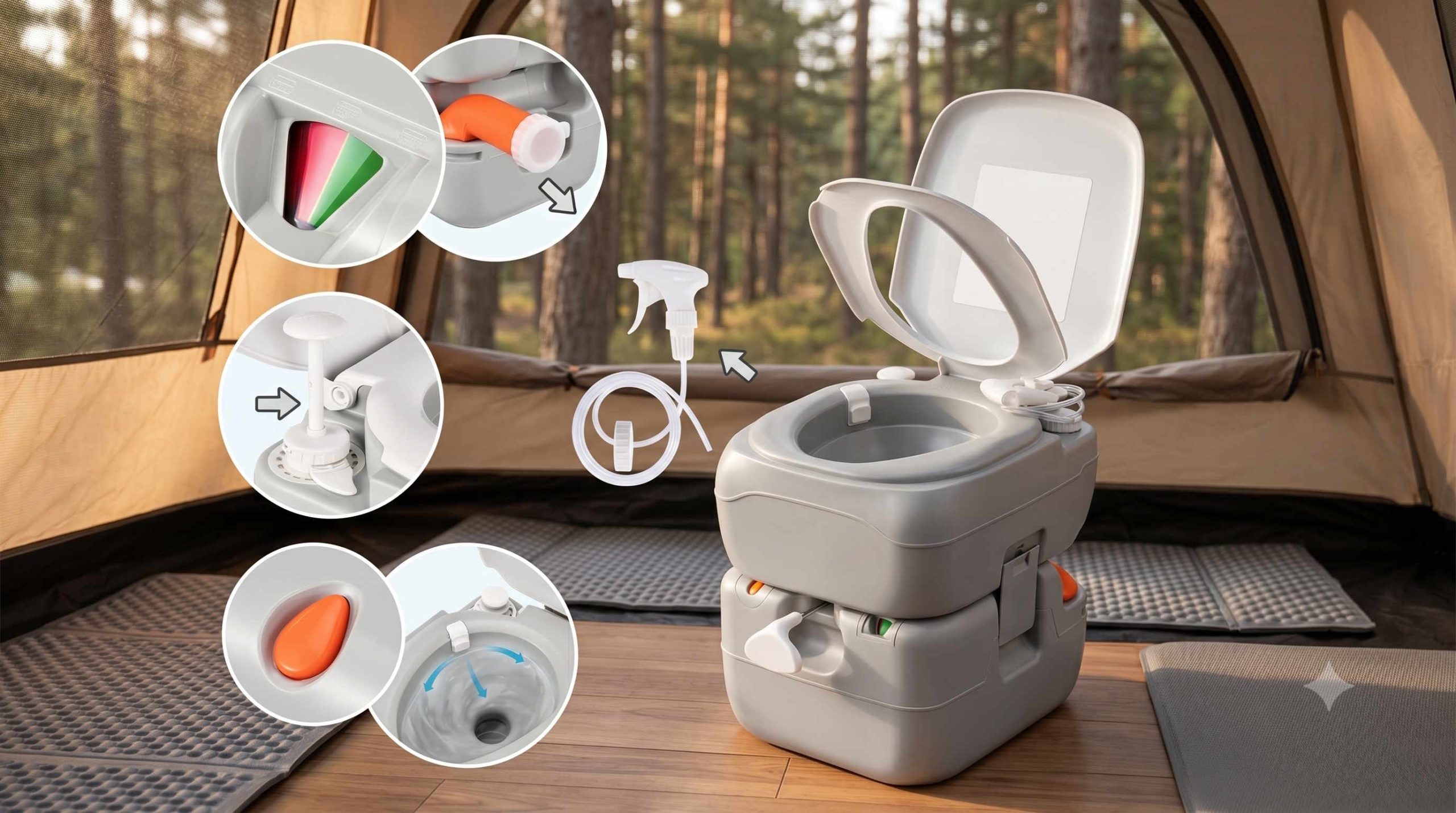
The Kohree is a self-contained portable flush toilet. The top section holds fresh water and the seat; the bottom is a detachable waste tank you carry to a dump point, restroom, or RV black-tank disposal. A hand pump or lever moves fresh water into the bowl, and a slide/blade valve opens the passage between bowl and waste tank. A long pipe swivels out for dumping.
A few misconceptions worth clearing up early, because they drive a lot of the angry reviews:
- It is not a composting toilet. Several owners bought it expecting composting behavior and were frustrated. It’s a chemical/flush-style holding-tank toilet — you’ll want holding-tank treatment to control odor and break down waste.
- It is not built for heavy daily off-grid living. Owners using it as a primary residence toilet found themselves emptying constantly and battling smell. As an emergency, travel, or supplemental unit, it fares far better.
- It is not a guaranteed “big seat.” Seat opening and overall height vary by the version you order, and the round versions run noticeably smaller than the diagonal/elongated ones.
Key Specs That Actually Matter for RVers
I’m only listing the things owners say actually change the experience — and I’m keeping numbers to what owners themselves reported.
- Seat shape (round vs. diagonal/elongated): This is the single most impactful choice. Owners overwhelmingly prefer the diagonal/elongated version for comfort and clearance; round-seat buyers more often complained about a cramped, shallow sit.
- Seat height: A frequent compliment is that it sits close to a standard home toilet height, which matters for older users, taller users, and anyone with mobility limits.
- Dual-tank detach design: The separating top/bottom design is what makes dumping manageable — but it’s also where weight becomes a factor when the tank is full.
- Built-in sprayer/rinse: Present, but polarizing. Some never use it; several reported it underperforming or failing.
- Level/fill indicator: Marketed as a convenience, but inaccuracy is a recurring complaint — several owners say it reads half-full when it’s actually full.
- Pressure-release vent: Easy to overlook, critical to use. Venting before opening the valve prevents the dreaded “burp.”
Feature-by-Feature Breakdown (Truth vs Marketing)
| Feature | What the Manufacturer Says | What It Actually Means (User Experience) | Compared to Competitors |
|---|---|---|---|
| Leak-proof construction | Sealed, leak-proof design | When sealed right, many owners confirm no leaks for days; but a recurring minority report leaks at the flush-valve shaft, fill opening, or cracked base | Mixed — some owners specifically switched to this after leaks on other brands and were happy; others switched away to Thetford after leaks here |
| Powerful flush | Pump-activated rinse | Flush is genuinely strong when primed; but solids and paper can linger if water is low | Comparable to similar plastic units; not as forceful as a plumbed RV toilet |
| Detachable waste tank | Easy to carry and empty | The swivel pipe makes dumping easier than many; full tank gets heavy and awkward with a single handle | On par or better than basic porta-potties for dumping ergonomics |
| Level indicator | Know when it’s full | Frequently reported as inaccurate; treat it as a rough hint, not a gauge | A real weak point versus expectations set by the price |
| Near-standard height | Comfortable, home-like | Widely praised; a top reason repeat buyers choose it | A genuine edge over shorter bucket-style and compact units |
| Built-in sprayer | Easy cleaning | Hit or miss; some love it, some say it’s weak or quit working | Many owners just use a separate spray bottle instead |
Real-World Owner Experience (Deep Pattern Analysis)
Pattern 1: Odor control is excellent — if you do two things
In a nutshell: The owners reporting zero smell almost always mention the same two habits: using a holding-tank treatment pod (Walex Porta-Pak comes up repeatedly) and venting/sealing the valve properly.
Hidden strength: When sealed and treated, the door between the waste tank and the upper section seals tightly enough that many owners report no odor even after multiple days of use.
Hidden weakness: Owners who skip treatment, or who try to use it for heavy daily off-grid loads, describe odor that’s hard or impossible to control.
What to do about it: Budget for treatment pods from day one, empty before the tank is completely full, and don’t expect it to handle full-time residential duty.
Pattern 2: The “burp” — vent before you flush
In a nutshell: A surprising number of both 5-star and 1-star reviews mention the same phenomenon: if there’s a temperature change (sitting in the sun, then opening the valve), trapped pressure can push bowl contents upward.
Hidden strength: It’s preventable. Owners who use the pressure-release vent first never have the problem and rate the unit highly.
Hidden weakness: The instructions are illustration-only and several owners found them genuinely confusing, so plenty of people learned this the messy way.
What to do about it: Make “vent first, then open the valve slowly” a hard rule. Close the lid before operating the flush valve as extra insurance.
Pattern 3: Flush-handle and valve durability is the weak link
In a nutshell: The most repeated mechanical failure is the flush/pump handle becoming extremely hard to pull, or breaking entirely, sometimes within months.
Hidden strength: When working, the pump-driven flush is praised as strong, and at least one repeat buyer got several years out of an earlier unit before the handle finally gave.
Hidden weakness: Vaseline on the seals (a manufacturer suggestion) doesn’t always fix the stiffness, and there’s a recurring complaint that replacement parts aren’t readily available — a crack or broken handle can mean replacing the whole unit.
What to do about it: Lightly lubricate gaskets out of the box, operate the handle gently, and test everything thoroughly inside your return window. If anything feels seized or glued, don’t force it — start a return immediately.
Pattern 4: Seat size and stability depend heavily on the version
In a nutshell: Comfort reviews split cleanly by version. Diagonal/elongated owners love the seat; some round-seat and standard owners found it small, shallow, or that it “sits low.”
Hidden strength: Multiple heavier owners (reports up to the 270–300 lb range) describe it as rock-solid and sturdy.
Hidden weakness: A separate minority report side-to-side rocking or a slightly bubbled/uneven base that won’t sit flat, especially on hard or uneven ground.
What to do about it: Order the diagonal/elongated version unless you specifically want compact. Set it on a level surface; if it rocks badly out of the box, that’s a defect worth returning.
Pattern 5: Heat is a real enemy
In a nutshell: Several owners report the unit swelling, expanding, or even unlatching when it gets hot, and at least one flagged a fine-print warning about not leaving it in high-heat environments.
Hidden strength: For its intended camping/travel/boat use in normal conditions, this rarely comes up.
Hidden weakness: Leaving it in a closed, sun-baked car or van — exactly the “stuck in traffic, gotta go” scenario the product imagery suggests — is where heat-related expansion and latch problems appear.
What to do about it: Don’t store it full in a hot vehicle. Empty it, and keep it out of extreme heat between uses.
Pattern 6: The paper-and-solids clog tendency
In a nutshell: Owners repeatedly note that too much toilet paper, or low water, leads to clogging and harder dumping, with at least one mention of an elbow/bend below the flange that can catch paper.
Hidden strength: Owners who keep paper out of the tank (using a separate bag, e.g. “double doodie” style bags) describe dramatically easier cleanup.
Hidden weakness: Solids need enough water to clear, and the swivel dump pipe can be stubborn if the tank wasn’t kept as a slurry.
What to do about it: Pre-fill the bowl with water, use treatment to keep waste broken down, and seriously consider keeping TP in a separate bag.
The Good, The Bad & The Ugly (Pros/Cons)
Pros — Comfort & convenience
- Near-standard seat height is a repeat favorite, especially in the diagonal/elongated version.
- Detachable tank with a swivel dump pipe makes emptying manageable.
- Lightweight when empty; fits well in trucks, vans, boats, small trailers, and tiny-home setups.
Pros — Performance (when set up right)
- Strong pump flush when primed.
- Genuinely effective odor sealing when paired with treatment pods.
- Many owners specifically chose it after leaks on other brands and stayed happy.
Cons — Durability
- Recurring reports of cracked bases, leaks at the flush-valve shaft, and stiff or broken flush handles.
- Limited replacement-part availability means a single failure can total the unit.
Cons — Accuracy & instructions
- Fill/level indicator frequently inaccurate.
- Illustration-only manual leaves owners guessing about the vent and valve.
Ugly — The messy-surprise risk
- Skip the vent step on a warm day and you can get a genuinely unpleasant backsplash. It’s preventable, but the unit doesn’t forgive ignorance.
Mini Toolkit: Decide + Fix (Fast)
Issue-Tag Box
- 🔧
FLUSH-HANDLE-STIFF— hard to pull / seizing - 💧
VALVE-SHAFT-LEAK— drips around the flush valve - 🌡️
HEAT-SWELL— expands/unlatches when hot - 📏
SEAT-TOO-SMALL— usually a round-version mismatch - 📊
INDICATOR-INACCURATE— reads full late - 💨
BURP-BACKSPLASH— pressure not vented first
Fitment / Version Mini-Matrix
| Your need | Better pick | Why |
|---|---|---|
| Max comfort / clearance | Diagonal / elongated seat | Owners consistently prefer it; deeper bowl |
| Tight cab or compact space | Standard / smaller version | Lighter, smaller footprint |
| Longer trips, fewer dumps | Larger-capacity version | “Buy the bigger one” is a repeated tip |
Mini Decision Tree
- If you need a full-time off-grid primary toilet → skip it, look at composting options.
- If you want comfort and clearance → order the diagonal/elongated version.
- If it rocks badly or a handle seizes out of the box → return now, don’t fight it.
- If odor is your top fear → commit to treatment pods + venting.
- If you’ll leave it in a hot vehicle full → reconsider, heat is its weakness.
Troubleshooting Quickflow (odor or backsplash)
- Add holding-tank treatment to the bottom tank with water before first use.
- Keep paper out of the tank (use a separate bag) to prevent clogs.
- Before flushing, press the pressure-release vent first.
- Open the slide valve slowly, lid closed.
- Pre-fill the bowl with water so solids clear.
- Empty before the tank is completely full to keep dumping clean and light.
Mini Return-Window Reality Check
Don’t wait until your trip to find out something’s wrong. Within the first few days:
- Cycle the flush handle/pump many times — if it’s stiff or feels glued, that’s an early red flag, not a break-in quirk.
- Fill the fresh tank and check for seepage around the fill opening and valve shaft.
- Set it on a flat floor and sit on it — any pronounced side-to-side rock can indicate a warped or bubbled base.
- Open the box version against what you ordered (round vs. diagonal) so the seat size doesn’t surprise you later.
- Confirm the sprayer actually works if that feature matters to you.
If you’re still weighing this against other contenders, the RV toilet decision guide lays out how capacity, seal design, and seat shape should drive your pick.
Installation / Setup Tips (RV-Realistic)
- Lubricate the gaskets first. A light film on the O-rings/seals out of the box is widely recommended and can ease early stiffness.
- Treat the tank from day one. Add a holding-tank pod with water to the bottom tank before first use — this is the difference between “no smell” and “impossible odor” in the reviews.
- Keep toilet paper out of the tank. A separate sealed bag for TP dramatically reduces clogs and makes dumping cleaner.
- Always vent before opening the valve. Press the pressure-release first, then open the slide valve slowly with the lid closed.
- Pre-fill the bowl with water. Solids clear far better with water already in the bowl; a 1-gallon jug works if you skip the sprayer.
- Set it on a level surface. Reduces rocking and takes stress off the base; avoid sharp rocks or rough ground that can crack the bottom.
- Don’t overfill before dumping. A full tank gets heavy and awkward; empty earlier for easier, cleaner handling.
- Keep it flat while transporting to dump. Owners warn against tipping it like some images suggest — keep the tank level until you reach the disposal point.
- Listen for the valve “click.” Make sure the slide valve is fully closed before separating sections.
- Don’t store it full in a hot vehicle. Heat-related swelling and unlatching are real; empty and keep it cool between uses.
- Buy the right size up front. “Buy the bigger one” and “order the diagonal version” are two of the most repeated pieces of owner advice.
- If any fix would involve forcing a seized mechanism, drilling, or modifying the unit beyond basic lubrication and leveling, verify against the manufacturer instructions or consult the manufacturer’s support before proceeding.
See It in Action: Visual Reality Check
Specs and bullet points only get you so far — seeing the unit assembled, flushed, and dumped in a real setting tells you far more about whether it fits your rig and your tolerance. A walkthrough video is worth a few minutes before you commit.
What to look for in this video (based on owner patterns):
- 💨 Vent Check: Watch whether the demonstrator presses the pressure-release before opening the valve — that single step is what prevents the backsplash so many owners describe.
- 🔧 Handle Feel: Notice how much effort the flush/pump handle takes. Stiffness on a brand-new unit is one of the most common early failure signs.
- 💧 Valve & Shaft Area: Keep an eye on the flush-valve shaft and fill opening — those are the spots owners most often report leaking later.
- 📏 Seat & Height Scale: Compare the seat opening and overall height to the person using it, so you can judge round vs. diagonal before ordering.
- ⚖️ Full-Tank Handling: If they lift or carry the waste tank, watch how awkward a heavy, full tank looks with a single handle.
Keep in mind this kind of video shows the initial setup and first flush, but it won’t show the flush-handle stiffening or base cracking that some owners report only after months of repeated use.
Owner Stories
The stories below are composite scenarios reflecting repeated patterns across owner feedback.
The teardrop weekender who cracked the odor code. A couple takes their teardrop out for stretches of several days. Early on they worried about smell, but once they started dropping a treatment pod into the bottom tank and venting before every flush, odor simply stopped being a topic. The swivel dump pipe made emptying painless, and the near-home seat height made the whole thing feel less like roughing it. Their one wish: a sturdier top lid.
The trucker on his second unit. An over-the-road driver wore out an earlier Kohree over a few years until the flush rod finally broke, then bought another. The compact profile fits his cab, dumping is quick, and he runs a little tank treatment after each weekly clean-out. He shrugs at the eventual handle wear as the cost of heavy use — but it’s exactly the durability pattern that frustrates lighter users who expect it to last longer.
The off-grid optimist who returned it. Someone tried to make it their everyday toilet at a remote setup. With daily heavy use, the small tank meant constant emptying and the odor became a daily fight. The unit itself wasn’t defective — it was just the wrong tool for full-time residential duty, a mismatch that shows up again and again in the most negative reviews.
🔎 See more owner feedback on Amazon
Who This Is For (and Who Should Skip It)
Buy it if…
- You want a near-standard seat height in a portable unit.
- You camp, travel, boat, or truck on weekends or trips rather than living off-grid full time.
- You’re willing to use treatment pods and learn the vent-first routine.
- You’re replacing a leaky older toilet and want easier dumping.
- You’ll order the diagonal/elongated version for comfort.
- You’ll test it thoroughly inside the return window.
Skip it if…
- You need a full-time, daily-use primary toilet for off-grid living.
- You want a composting toilet (this isn’t one).
- You’ll store it full in a hot vehicle.
- You won’t read instructions or maintain seals.
- You need guaranteed long-term durability with easy replacement parts.
- You want a large seat but are tempted by the cheaper round version.
👉 Check today’s price on Amazon
If you’re comparing options, start here: Top RV Toilet Picks
Alternatives (Quick Comparisons)
- For full-time off-grid or odor-sensitive setups: A dedicated composting or urine-diverting toilet is a better structural fit than any flush-and-hold unit — it sidesteps the daily-emptying and odor battle entirely.
- For buyers who’ve been burned by portable leaks: A name-brand cassette/portable from a long-established maker (a frequent “I switched to it” mention in reviews) may offer more predictable durability, often at a higher price.
- For permanent rigs with a black tank: If your RV can support it, a fixed, plumbed RV toilet removes the carry-and-dump chore altogether — worth weighing in the RV toilet buying walkthrough.
- For the absolute simplest backup: A bucket-style toilet with a snap-on seat and liner bags is cheaper and nearly foolproof, though far less comfortable and without a real flush.
Deep-Dive FAQ
What should I test immediately after delivery?
Cycle the flush handle many times (watch for stiffness), fill the fresh tank and check for leaks around the valve shaft and fill opening, sit on it on a flat floor to check for rocking, confirm the sprayer works, and verify you received the seat shape and capacity you ordered. Do this inside your return window.
What are the most common problems and fixes?
The big ones are a stiff or broken flush handle, leaks at the valve shaft or fill opening, an inaccurate fill indicator, odor when untreated, and the pressure “burp.” Most are mitigated by lubricating seals, using treatment pods, venting before flushing, keeping paper out of the tank, and not forcing a seized handle.
Is it a composting toilet?
No. It’s a flush-style holding-tank toilet. Several frustrated buyers expected composting behavior. Plan on tank treatment and regular emptying.
Why does it sometimes splash up when I flush?
That’s the pressure “burp.” A temperature change builds pressure in the bowl/tank; opening the valve releases it upward. Press the pressure-release vent first, then open the valve slowly with the lid closed.
Which size and seat shape should I get?
Owners repeatedly advise ordering the diagonal/elongated version for comfort and clearance, and choosing the larger capacity if you want fewer dump runs — the round and smaller versions draw more “too small” and “fills fast” complaints.
How do I keep it from smelling?
Use a holding-tank treatment pod with water in the bottom tank from the first use, empty before it’s completely full, and keep the valve sealed. Owners who do this routinely report no odor; those who skip it often struggle.
How heavy is it to dump when full?
Light when empty, but the full waste tank gets heavy and awkward to handle with a single handle. Empty it before it’s completely full to keep dumping manageable and cleaner.
Will it hold a heavier adult?
Multiple heavier owners report it feeling sturdy and stable, though a minority describe side-to-side rocking or an uneven base. Set it on a level surface, and treat severe rocking out of the box as a defect.
Can I leave it in my car for emergencies?
Be careful. Owners report heat-related swelling and unlatching, and at least one flagged a high-heat warning in the fine print. Don’t store it full in a sun-baked vehicle.
Are replacement parts available?
This is a recurring frustration — several owners say parts aren’t readily available, so a cracked base or broken handle can mean replacing the whole unit. Factor that into the value question.
Final Verdict
The Kohree Portable RV Toilet is a genuinely good unit for the right buyer and a genuinely frustrating one for the wrong buyer — and the dividing line is unusually clear. If you’re a weekend camper, boater, trucker, or van-lifer who wants a comfortable, near-standard-height portable toilet, you’ll order the diagonal/elongated version, commit to treatment pods, learn the vent-first habit, and stress-test it inside your return window, the odds are strongly in your favor. The happy owners in that lane are numerous and consistent: no odor, easy dumping, comfortable sit.
But it is not a full-time off-grid workhorse, it is not a composting toilet, and it is not immune to the durability gremlins — stiff handles, valve-shaft leaks, cracked bases, and thin replacement-part support — that show up too often to wave away. Buy it for what it actually is, set it up the way the satisfied owners do, and verify your specific unit early.