Kohree RV Fresh Water Pump Review: Quiet, High-Pressure Upgrade—With a Few Real-World Gotchas
Affiliate Disclaimer: This article contains affiliate links. If you click through and make a purchase, I may earn a small commission at no extra cost to you. This helps support my deep-dive research.
If your current RV water pump sounds like a coffee grinder trapped inside a cabinet—or your shower alternates between “meh drizzle” and “why is it pulsing like that?”—you’re not alone. Most RVers start paying attention to their pump only after it wakes the whole rig up at night, can’t keep pressure steady, or struggles to run two fixtures without turning your sink into a sad trickle.
So I did what I always do before recommending any RV water pump: I went through a large pile of real owner feedback looking for patterns—what people loved on day one, what showed up months later, and what issues kept repeating across different installs (travel trailers, fifth wheels, Class A motorhomes, and even boats).
This is a deep-dive review of the Kohree RV Fresh Water Pump, including what it does well (quiet operation and strong pressure are consistent themes), where it can bite you (fittings, cycling, and pressure switch/check valve complaints show up enough to matter), and exactly who should buy it versus skip it.
Quick Summary (TL;DR)
- What it does best: Delivers a noticeable pressure and flow upgrade over many OEM pumps, with many owners calling it surprisingly quiet for a diaphragm pump.
- Where it gets tricky: A recurring “real-world friction” theme is pressure switch behavior (won’t shut off, delayed shutoff, or intermittent cycling), plus fitting/connector quirks on some installs.
- Best fit: RVers who want a budget-friendly upgrade and are comfortable doing basic install tweaks (fittings, clamps, bypass/pressure adjustments).
- Skip if: You want “install once, never touch it again” reliability, or your pump location is hard to access (because troubleshooting a cycling pump in a tight cabinet is nobody’s idea of fun).
Quick Verdict + Confidence Score
My take: If you want a quieter, higher-flow pump at an aggressive price point, Kohree can feel like a big quality-of-life upgrade—as long as you install it carefully and test the shutoff/cycling behavior before you button everything back up.
Confidence Score: 7.6/10 (Excellent value/comfort upgrade potential; reliability consistency is the main limiter.)
If you want to check current pricing and versions: See the Kohree RV Fresh Water Pump on Amazon
Also, if you’re still deciding between pumps, start here first (it’ll save you a lot of guesswork):
What This Pump Is (In Plain English)
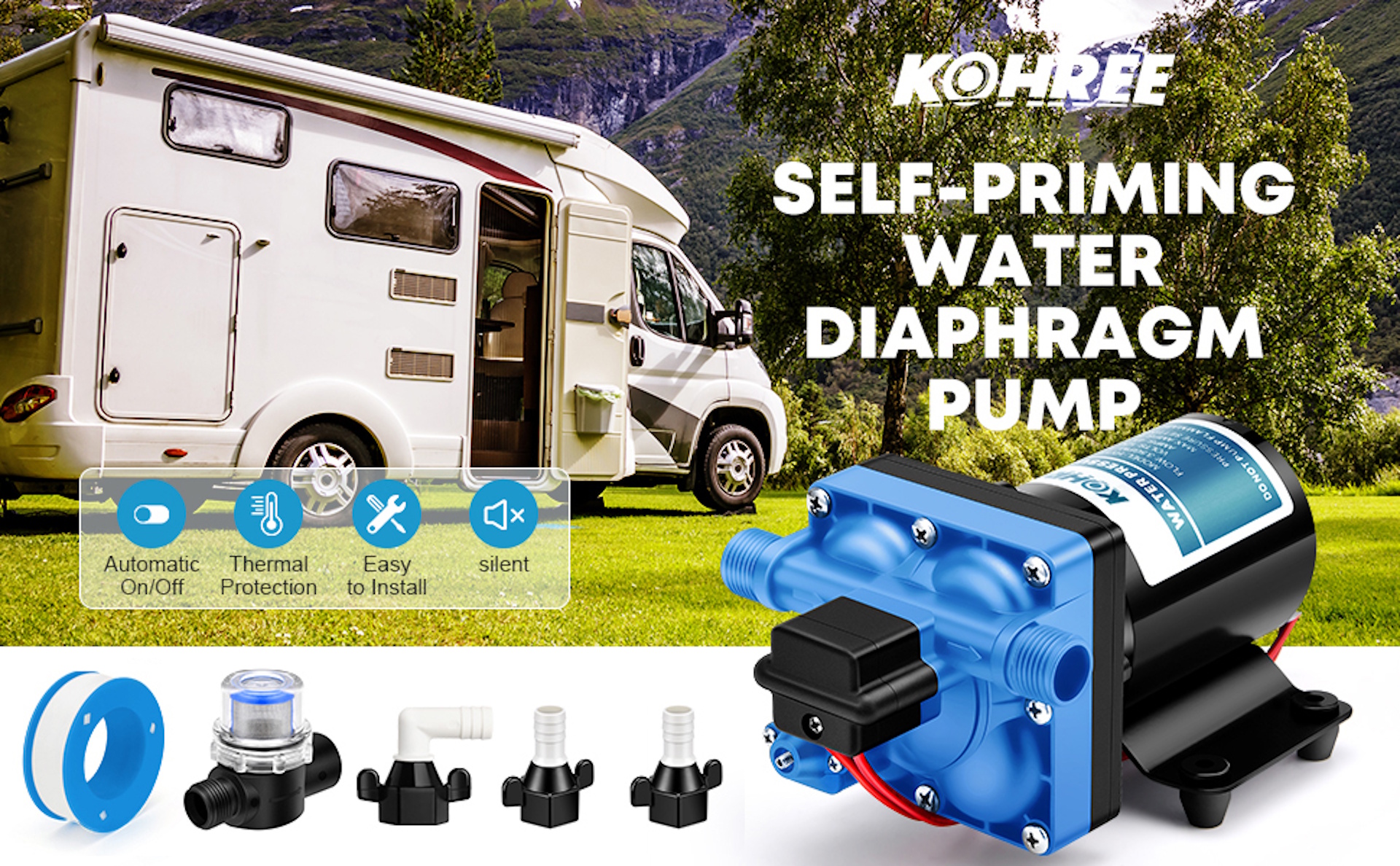
The Kohree is a 12V DC RV diaphragm pump designed to pull water from your fresh tank and pressurize your plumbing when you’re not on city water. In most RVs across the USA/Canada (and many caravans in Australia), this is the standard “onboard pump” setup: you flip the pump switch, and the pump pressurizes the lines so your faucets and shower work off-grid.
A diaphragm pump like this doesn’t run constantly. It cycles:
- ON when line pressure drops (you open a faucet)
- OFF when it reaches its set pressure (you close the faucet)
When everything is dialed in, you get smooth pressure and minimal noise. When it’s not dialed in (or the switch/check valve is misbehaving), you get the classic RV annoyance: rapid cycling, pulsing, or a pump that won’t shut off.
Specs & Variants That Matter (What You’ll Actually Feel)
Owners commonly mention variants around 3.5 GPM / 55 PSI, 5.5 GPM / 55 PSI, and a higher-output option (often noted as 7.0 GPM / 70 PSI). In real life, the “right” choice depends less on braggy flow numbers and more on what you’re trying to do in the rig.
Quick Spec Snapshot (Buyer-Relevant)
| Variant (Common Listing) | Best For | What You’ll Feel at the Faucet | The Tradeoff |
|---|---|---|---|
| 3.5 GPM / 55 PSI | Typical RV use, conserving water while boondocking | Solid shower/sink pressure with less waste | Can still pulse/cycle if not adjusted well |
| 5.5 GPM / 55 PSI | Running two fixtures or boosting “house-like” feel | Faster refill at sinks; stronger shower “push” | More likely to amplify noise/vibration if mounted poorly |
| 7.0 GPM / 70 PSI | High-demand setups (larger rigs, multi-fixture), specialty use | Strongest “city-water-like” feel | Higher stress on plumbing if regulated poorly; defects are more painful here |
Practical note: Many RV showerheads flow around the low-GPM range by design. So a bigger pump doesn’t automatically mean a better shower—sometimes it just means you hit cutoff faster and the pump cycles more aggressively if the bypass/pressure settings aren’t tuned.
First Impressions vs. Reality After Months (The Pattern That Matters)
Across the owner feedback I analyzed, a recurring theme is that this pump often wins on day-one comfort—quiet operation and satisfying pressure—then the long-term story depends heavily on whether you got a solid unit and whether the system was installed/tuned cleanly.
First Impression (Very Common Theme)
- “Quieter than my old pump.” Many owners describe it as a big reduction in cabinet-rattle noise.
- “Pressure feels amazing.” A lot of people say the shower feels upgraded immediately.
- “Install was straightforward.” Especially when replacing a similar-style pump with similar plumbing access.
Reality After 3–12 Months (The Split)
From real-world owner feedback, it looks like there are two camps:
- Camp A: “Still running great—quiet, strong, reliable.”
- Camp B: “Pressure switch/check valve/cycling issues started—and now it’s annoying.”
That “Camp B” theme is important: even a small percentage becomes a big deal because a pump that won’t shut off can waste water, kill your battery, and create leak panic.
Technical Deep Dive (Simple, Useful, and RV-Realistic)
Here’s what actually makes a pump feel “good” in a rig—and where the Kohree tends to land.
1) Flow (GPM) vs Pressure (PSI): Why Both Matter
- GPM (flow) is how much water you can move when one or more fixtures are open.
- PSI (pressure) is the “push” you feel at the faucet/shower.
A pump can have decent GPM but feel weak if pressure is low, or have decent pressure but feel stingy when you run two fixtures.
Owner pattern: The Kohree (especially the 5.5 GPM / 55 PSI version) frequently feels like it restores the “normal home” vibe—enough that people mention using two faucets at once with acceptable pressure.
2) Noise Isn’t Just the Pump—It’s the Install
A frequent buyer surprise is how much noise comes from:
- the cabinet acting like a speaker box
- hard-plumbed lines transmitting vibration
- loose mounting surfaces and missing isolation padding
Owner pattern: Many users still call it “quiet,” but a minority call it “loud.” That usually isn’t contradiction—it’s two different installs.
3) Pressure Switch + Check Valve: The Make-or-Break Mechanism
This is the part that decides whether you love your pump… or hate it at 2 a.m.
Symptoms people report when this goes sideways:
- Pump won’t shut off
- Pump takes a long time to shut off after closing a faucet
- Pump kicks on every minute even when no water is running (classic pressure bleed-back / check valve issue)
- Rapid cycling at low flow (toothbrushing trickle = chatter)
This is the most repeated “serious” theme in the negative experiences—and the reason I’m not giving this a 9/10.
Key Features Table (Manufacturer Promise vs. Real Owner Meaning)
| Feature | What the Manufacturer Says | What It Actually Means (User Experience) | Compared to Competitors |
|---|---|---|---|
| 55 PSI shutoff pressure | “Strong pressure” | Many users feel a real shower upgrade; some report inconsistent shutoff behavior | Similar target pressure to many mainstream RV pumps, but consistency varies by unit |
| High-flow options (3.5–5.5 GPM+) | “High volume output” | Great for multi-fixture use if tuned; can waste water if you boondock and don’t manage flow | Higher-flow variants can outperform many OEM pumps, but can magnify cycling if not adjusted |
| Included strainer/filter | “Protects pump & system” | Owners like having filtration right at the pump; helps reduce debris-related issues | Some competitor kits include strainers; many OEM installs are missing or poorly placed |
| Adjustability (pressure/bypass) | “Customizable performance” | Can solve cycling for some users; others say it’s finicky to dial in | Better than non-adjustable pumps, but not always as “set-and-forget” as pricier units |
| “Quiet” design | “Low noise” | Many users genuinely report a quieter cabin experience | Diaphragm pumps are rarely silent; mounting and plumbing matter as much as the pump |
Real User Experience Analysis (Deep Pattern Breakdown)
The #1 Most Common Praise: Quiet + “Luxury” Pressure
In the reviews I went through, I kept seeing the same outcome: people install it, and suddenly the rig feels less like an RV and more like a small apartment on wheels.
Typical real-world wins owners mention:
- Showers feel stronger and steadier
- Less rattling/vibration noise
- Better faucet performance when more than one tap is open
- Feels like a meaningful upgrade from OEM
The #1 Biggest Complaint: Shutoff/Cycling Behavior
One pattern that comes up repeatedly is frustration around the pump’s pressure control behavior:
- some units don’t shut off reliably
- some are slow to shut off
- some cycle/chatter at low flow
This is more than annoyance: if your pump is in a hard-to-access cabinet, repeated troubleshooting is a genuine quality-of-life problem.
Secondary Complaint Cluster: Fittings & Connectors
A smaller but very practical theme: some people had trouble with included fittings matching their RV’s plumbing (PEX and common RV hose sizes). That can turn a “30-minute swap” into a “why is water spraying in my cabinet?” afternoon.
If you’re hunting for alternatives with different reliability profiles, compare options here:
- Best RV Water Pumps for Reliable Pressure
And if your real issue might be line restriction or a bad regulator (not the pump), this is worth skimming: - Troubleshooting Low Water Pressure in Your RV
The Good, The Bad & The Ugly (Pros/Cons)
Pros (Themes I Saw Repeated Often)
- Noticeably quieter than many OEM pumps (a very common theme)
- Strong pressure—many owners describe a “spa-like” shower upgrade
- Good value for the output level (people compare it favorably to higher-priced “name” pumps)
- Includes helpful extras like a strainer/filter and fittings (when they fit your plumbing)
- Can be a solid upgrade for multi-fixture use (especially the higher-flow versions)
Cons (Where You Need to Go In With Eyes Open)
- Pressure switch reliability complaints: won’t shut off, intermittent behavior, or failure after short use (not universal, but repeated enough to matter)
- Low-flow rapid cycling / pulsing: especially noticeable when you’re trying to conserve water
- Fitting size/compatibility issues on some installs (may require a hardware store run)
- Heat/duty-cycle limits in continuous-use scenarios: some users report it getting hot or cutting out when run for long stretches
- Customer service is mixed: some owners report excellent replacements; others report no response
Owner Stories (The Human Side)
Here are a few real-life scenarios that show what owning this pump feels like—both the “this is awesome” side and the “why is it doing that?” side.
Story 1: The “Two Faucets at Once” Upgrade
One recurring happy outcome is the moment you realize you can run a sink and a second fixture without everything collapsing into a trickle. For RVers in larger rigs, that’s the difference between “RV life compromises” and “this feels normal.”
- Context link: Owner feedback on Amazon
Story 2: The “It Failed Fast… Then They Replaced It” Experience
A pattern that shows up a few times is early failure (sometimes within a day or a few trips), followed by a replacement experience that ranges from “handled quickly” to “why am I being asked to fix it myself?”
Story 3: The “Cycling Made Me Think I Had a Leak” Spiral
This one is painfully relatable: the pump kicks on when no water is running, so you start hunting for leaks, tightening clamps, checking lines—only to discover it may be pressure bleed-back or switch behavior. This is why I recommend bench-testing and system-testing before you close up the cabinet.
Expert Tips & Installation Hacks (Stuff Owners Learn the Hard Way)
These are the “do this now, thank yourself later” moves that keep your install clean and your pump behavior stable.
1) Do a Proper Install Test Before You Close the Cabinet
After installation:
- Fill fresh tank (or connect to a safe test supply if appropriate)
- Turn pump on and let it pressurize
- Open/close each faucet one at a time
- Confirm the pump shuts off quickly and stays off
- Wait 10–15 minutes—verify it doesn’t kick on by itself
If it cycles when nothing is running, don’t ignore it. That’s how water damage and battery drain stories start.
2) Use a Strainer and Keep It Clean
Many owners like that the pump comes with a strainer. Use it. Maintain it. A partially clogged strainer can cause:
- reduced flow
- extra noise
- longer run time to build pressure
3) If You Get Pulsing at Low Flow, Consider a Small Accumulator Tank
A small accumulator smooths pulses and reduces short-cycling when you’re using low flow (toothbrushing, quick rinse, etc.). It’s not mandatory, but it’s one of the best “comfort upgrades” in RV plumbing.
4) Be Deliberate With Fusing and Wiring
This is a 12V DC appliance. Use proper wire gauge for the run length and follow RV electrical safety practices. If the manual calls for a specific fuse size, take it seriously—startup current can be higher than steady draw. (For USA/Canada RVs, reference best practices aligned with NFPA 1192; for marine installs, ABYC guidance is commonly used.)
If you want a practical safety refresher for your rig’s systems, you might also like:
Who This Pump Is For (And Who Should Skip It)
You should buy the Kohree RV Fresh Water Pump if…
- You want a noticeable pressure/flow upgrade from an OEM pump
- You care about quieter operation (and you’re willing to mount it properly)
- You’re comfortable doing basic DIY troubleshooting (fittings, clamps, minor adjustment)
- You like value-focused gear and don’t want to pay premium pricing for similar PSI targets
Ready to check it out? See the Kohree RV Fresh Water Pump on Amazon
You should skip it if…
- Your pump compartment is a nightmare to access and you want maximum “set-and-forget” confidence
- You absolutely cannot tolerate any risk of cycling/shutoff quirks
- You frequently run long continuous duty cycles (non-RV use like irrigation or large tote filling)
- You’re already dealing with plumbing vulnerabilities (older lines, questionable clamps, past leaks)
If your pressure is inconsistent, your fix might not even be the pump. Start here first:
Installation Overview (Fast, RV-Realistic Step List)
If you’ve swapped an RV pump before, this will feel familiar. If you haven’t, here’s the cleanest approach.
Tools & Supplies (Typical)
- Screwdriver/nut driver
- PEX clamps/crimp tool (if your rig uses PEX)
- PTFE tape (if needed for threaded fittings)
- Towel/pan (you will spill water)
- Flashlight/headlamp
Step-by-step
- Turn off 12V power to the pump circuit (don’t rely on just the wall switch).
- Depressurize: open a faucet to relieve line pressure.
- Disconnect inlet/outlet lines and have towels ready.
- Remove the old pump and compare mounting footprint.
- Install the strainer (orientation matters—follow the flow arrow).
- Connect plumbing using correct fittings (don’t force mismatched connectors).
- Mount the pump with vibration control in mind (rubber feet + solid surface).
- Restore power and prime: run faucets until air is purged.
- Test shutoff and cycling (this is the critical step).
- Check for leaks again after 10–15 minutes of sitting pressurized.
If you want a dedicated walkthrough for swaps, here’s a full DIY guide:
Deep-Dive FAQ (High-Intent Questions RVers Actually Ask)
1) Why does my pump keep turning on when no water is running?
Usually one of three things:
- a small leak downstream (even a tiny drip can trigger cycling)
- pressure bleeding back through the pump/check valve
- pressure switch behavior that’s out of adjustment or failing
Start with leak checks, then verify the shutoff pressure and whether pressure holds overnight.
2) Is the 5.5 GPM version “too much” for boondocking?
It can be, depending on your habits. Higher flow makes it easier to waste water quickly, and it can trigger more noticeable cycling if you’re trying to sip water at low flow. If you boondock frequently, a lower-flow pump (or an accumulator tank) can feel more controlled.
3) My pump is loud—does that mean it’s bad?
Not necessarily. Diaphragm pumps make vibration. Noise usually comes from:
- poor mounting surface
- hard plumbing lines transmitting vibration
- cabinet resonance
Try isolating the mount, securing lines, and adding soft barriers (without restricting airflow).
4) Why does it take a while to shut off after I close the faucet?
A short delay can happen as the system reaches cutoff pressure. But if it runs a long time—or never shuts off—that’s a red flag. Check for leaks, verify the strainer isn’t clogged, and confirm the switch behavior during testing.
5) Can I use this pump for a boat or non-RV applications?
Some owners do, and it can work well—especially when the goal is strong flow at a lower price. The caution is duty cycle: long continuous runs can build heat. If your use case is “run for 30 minutes straight repeatedly,” you may want a heavier-duty pump class.
Final Verdict
If your current pump is noisy, weak, or can’t handle normal day-to-day RV life without annoying pulsing, the Kohree RV Fresh Water Pump can genuinely feel like a comfort upgrade—especially in the quietness + pressure department. Many owners describe it as the first time their RV shower felt “right.”
But here’s the honest bottom line: the strongest negative pattern is pressure switch/check valve behavior (cycling, delayed shutoff, or failure). That doesn’t mean it will happen to you—but it does mean you should install it like a pro: test thoroughly, confirm shutoff stability, and don’t ignore early warning signs.
If you want the best chance at a happy outcome, buy it, install it carefully, and test it hard during the return window:
And if you’re still comparing models by “real-life reliability feel,” start with our roundup: