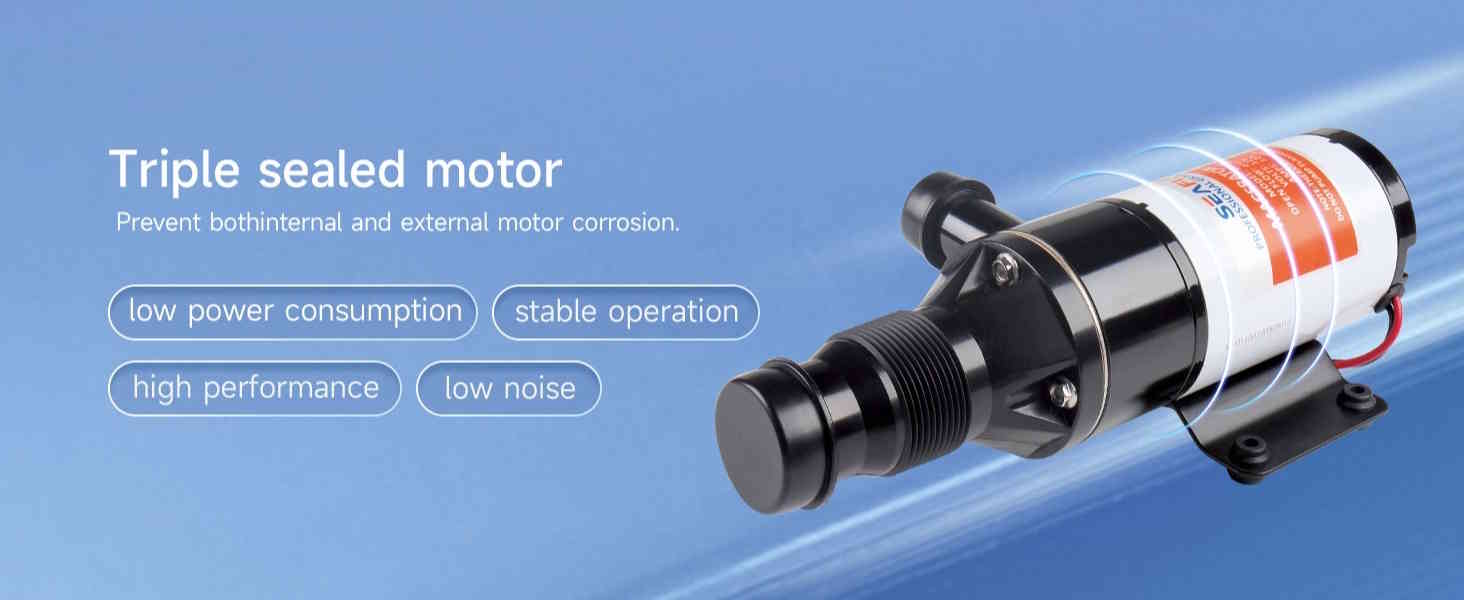
SEAFLO 01 Series Macerator Pump Review (2026): Worth It or Junk?
Last updated: June 2026
- Re-checked the “impeller swells and locks the motor after storage” pattern against happy long-term owners — confirmed it clusters around units stored with the shaft idle, not random failures.
- Re-examined the priming complaints and separated “mounted too high above the tank” installs from genuine seal failures — the split is sharper than the star rating suggests.
- Re-verified that the strongest praise comes from owners who installed the pump below the tank waterline and added an upstream water/rinse feed.
- Cross-checked warranty experiences: happy owners who reached the right contact got impellers shipped fast; frustrated owners couldn’t get a reply at all.
Affiliate disclosure: This article contains Amazon affiliate links. If you buy through them, I may earn a small commission at no extra cost to you. It doesn’t change what I write — the analysis below is driven entirely by what owners actually report.
Is the SEAFLO 01 Series Macerator Pump Worth It?
If you’ve ever stood at a dump station watching black water trickle out of a gravity drain while the smell builds, you already know why a macerator pump is tempting. The SEAFLO 01 Series is the budget-friendly, roughly half the price of a Jabsco option that shows up constantly in RV and marine forums — and that price is exactly what makes people nervous. Is it a smart way to save money, or are you buying a future headache you’ll have to unbolt and replace mid-season?
Quick answer: It’s worth it as a below-the-tank, gravity-fed workhorse if you install it right and don’t store it idle with waste inside — but treat it as a value pump with a real failure clock, not a lifetime fixture.
This review is a synthesis of real owner experience — hundreds of reviews spanning years of use across RVs, boats, fish boxes, and even a duck pond — not a spec sheet rewrite. The pump’s two loudest stories are “great value, did the job” and “locked up way too soon,” and the difference between those two outcomes is rarely random. If you want the broader category view first, the macerator pump selection framework walks through how lift, fitting size, and duty cycle interact before you commit to any single model.
How this review was built (so you can trust it)
- Reviews analyzed: Approximately 200+ owner reviews (a large positive set and a substantial critical set), spanning roughly 2015 through mid-2026.
- Time window: Nearly a decade of real-world use, which is unusually deep for a budget pump and lets long-term reliability patterns surface.
- Method: I tagged feedback into categories — priming/suction, install and fitment, power and wiring, reliability symptoms, storage behavior, and warranty/support — and deliberately separated setup-driven issues (mounted too high, intake hose too long, stored wet) from likely product/design issues (impeller swelling, seal intrusion, thermal-switch limits).
Important limitations:
- Review bias is real: people with a dead pump and people thrilled with a bargain both post more than the quiet middle.
- RV and boat plumbing varies enormously, so the same pump genuinely performs differently across installs.
- I prioritized patterns that recurred across many owners over dramatic one-off stories.
Quick Verdict (TL;DR)
Best for:
- RVers who can mount it at or below the tank outlet for a gravity-fed feed
- Budget-minded owners replacing a pricier pump and wanting spares on hand
- Permanent installs with a proper tee, isolation valve, and union for easy service
Not for:
- Anyone needing real self-priming or vertical lift above the liquid level
- Owners who store the rig for months with waste sitting in the pump
- Setups where the pump must sit well above the tank with a long intake run
Standout win:
- Strong, fast flow and aggressive maceration at a price that genuinely undercuts the big marine brands
Watch-outs:
- A recurring “works great, then suddenly locks up” reliability arc
- Thin warranty support experiences when something does go wrong
Confidence Score: 7/10 — “Buy with eyes open.” This score reflects buyer usefulness, not a reliability statistic. It weighs how well the pump satisfies owners when installed correctly, the consistency of the failure modes, the strength of the value argument, and the friction owners hit with support. It’s not a percentage and isn’t derived from any failure-rate math — it’s my read on how happy a well-prepared buyer is likely to be.
What This Product Is (and What It Isn’t)
A macerator pump grinds solid waste into slurry and pumps it out through a small-diameter hose, so you can empty a holding tank uphill or into a remote cleanout instead of relying on a fat gravity drain. In plain terms: the SEAFLO 01 Series is a 12V grinder-and-transfer pump that turns black-water emptying into a push-button job — when it’s fed properly.
Three misconceptions worth clearing up before you buy:
- “Self-priming means I can mount it anywhere.” In practice, owners overwhelmingly report it wants to sit low, fed by gravity. Treat strong priming as a bonus, not a design promise.
- “It’s a sealed lifetime unit.” It isn’t. The happiest owners frame it as an affordable consumable they’re willing to replace, sometimes keeping a spare on the shelf.
- “All the bad reviews mean it’s junk.” The failure stories are real, but a large share trace back to installs that fight the pump’s nature or to storage habits that physically damage the impeller.
Key Specs That Actually Matter for RVers
- Mounting position relative to the tank: This is the single biggest predictor of satisfaction. Below or at the waterline = happy owners; well above with a long intake = priming misery.
- Intake hose length and seal tightness: Owners found that even small air leaks or an over-long intake run kill suction. A tight, short, fully sealed inlet is non-negotiable.
- Discharge fitting style: The barbed outlet is long, and several owners had to trim it to fit clamping elbows or adapt it to standard RV dump fittings. Plan your adapters before install.
- Thermal protection behavior: There’s an overheat cutoff that pauses the pump when it runs hot or dry-ish; let it cool and it resumes. Good to know, but owners note it has limits over repeated heavy cycles.
- Shaft-access end cap: Many models include an end cap letting you spin the motor shaft with a screwdriver to free a stuck impeller — a genuinely useful, easy-to-miss feature.
For how these factors trade off against each other across different pump classes, the pump sizing and lift explainer is the cleaner place to map your specific setup.
Feature-by-Feature Breakdown (Truth vs Marketing)
| Feature | What the Manufacturer Says | What It Actually Means (User Experience) | Compared to Competitors |
|---|---|---|---|
| Self-priming | Pulls a prime with vertical lift | Owners consistently report reliable priming only with short intakes mounted low; lift above liquid level is where it struggles | Premium brands like Jabsco are repeatedly described as priming with less fuss in tougher positions |
| Maceration power | Heavy-duty grinding | Genuinely strong — chews fish scales, RV tissue, and waste fast when fed enough volume | On raw grinding and flow, owners rate it competitive with pumps costing far more |
| Anti-clog / run-dry | Tough, forgiving operation | Handles solids well, but running near-dry on tank dregs makes it whine and sputter air | Comparable on clogging; not uniquely better at dry running |
| Durability | Heavy-duty, long warranty | Wide spread — some last years of daily use, others lock up in weeks; outcome tracks install and storage | Big-brand pumps are perceived as more consistent, at roughly double the price |
| Value | Budget alternative | The clearest, most repeated win across the board | Nothing in the category matches the price-to-performance when it lasts |
Real-World Owner Experience (Deep Pattern Analysis)
Pattern 1: The “works great until it suddenly seizes” arc (the one owners obsess over)
In a nutshell: The most repeated story isn’t slow decline — it’s a pump that performs perfectly, then locks solid with little warning, often blowing the fuse.
Hidden strength: When it’s healthy, the flow and grinding genuinely impress people coming off pricier pumps.
Hidden weakness: The seizure frequently follows idle storage. Multiple owners independently describe the impeller physically swelling and binding against the housing after the pump sat unused — one even swapped in an old impeller and got the unit running again. This is the information-gain insight most reviews miss: a chunk of “dead on arrival after winter” failures are swollen-impeller lockups, not motor death.
What to do about it: Before storage, flush thoroughly and avoid leaving the impeller sitting saturated and idle for months. If it locks, use the end-cap screwdriver slot to try freeing the shaft before assuming it’s toast — and consider keeping a spare impeller from any old unit.
Pattern 2: Priming is a mounting problem disguised as a product problem
In a nutshell: A huge share of the harshest reviews are really install-geometry failures — the pump mounted feet above the tank with a long intake, then blamed for not lifting.
Hidden strength: Owners who mounted it low and fed it by gravity report it primes within seconds and empties tanks fast.
Hidden weakness: Air-tightness of the intake is unforgiving; a loose sanitary-hose fit or a long suction run causes intermittent-to-zero priming.
What to do about it: Mount the pump at or below the tank outlet, keep the intake hose short, and obsess over a leak-free, tightly clamped inlet. If you can’t mount it low, this is the wrong pump.
Pattern 3: Seal and corrosion intrusion in wet/marine spots
In a nutshell: In damp bilges or salt exposure, owners report water and waste working past the seals into the motor, plus the mounting bracket/shell rusting.
Hidden strength: Several owners ran it for years by proactively coating it (a corrosion-preventing film is a repeatedly mentioned trick) and keeping it out of standing water.
Hidden weakness: It does not love a permanently damp home; corrosion and seal intrusion show up as a real failure path.
What to do about it: Keep it out of standing water, protect the bracket, and in marine use treat external corrosion proactively rather than reactively.
Pattern 4: Needs volume to run happy
In a nutshell: As a tank empties to the dregs, the pump starts to whine and pull air; it runs best with liquid volume moving through it.
Hidden strength: Owners who plumbed an upstream water/rinse feed got smoother runs and cleaner pump-outs.
Hidden weakness: Trickle-feeding the last bit of a tank is where it sounds worst and works least.
What to do about it: Add a rinse/water feed upstream so the pump always has volume, especially at the end of a tank.
The Good, The Bad & The Ugly (Pros/Cons)
Pros — by theme
- Value: Consistently the standout; repeatedly described as matching pumps costing two-to-three times more, when it lasts.
- Performance when healthy: Strong flow, aggressive grinding, empties tanks quickly.
- Serviceability: End-cap shaft access and a fit that often matches existing hoses/holes make swaps and unsticks easier.
- Versatility: Owners successfully use it for black water, fish boxes, transfer between tanks, and remote waste disposal.
Cons — by theme
- Reliability variance: The sudden-lockup pattern and short lifespans for some owners are the dominant complaint.
- Install sensitivity: Priming and suction punish any mounting-height or seal mistake.
- Environment limits: Damp/marine homes invite corrosion and seal intrusion.
- Support friction: The long warranty is praised in marketing but several owners couldn’t get a response when they needed it.
Mini Toolkit: Decide + Fix (Fast)
Issue-Tag Box
🔒 IMPELLER-SWELL LOCKUP— seizes after idle storage💨 PRIME-FAIL— won’t pull suction when mounted high or with long intake🌊 SEAL-INTRUSION— water/waste into motor in damp spots⚡ THERMAL-TRIP— pauses when hot/near-dry, resumes after cooling🔧 FITMENT-GAP— long barb / no 3″-to-1.5″ adapter included📞 SUPPORT-MISS— warranty replies unreliable
Fitment/Adapter Mini-Matrix
| Your setup | Likely need | Owner note |
|---|---|---|
| Standard 3″ RV dump outlet | A 3″-to-pump adapter you source separately | Several owners had to fabricate or buy this |
| Clamping elbows on discharge | Trim the long barbed outlet | Common, easy with a hacksaw |
| Existing brand-name pump | Often bolts to old holes/hoses | Frequently a near-direct swap |
Mini Decision Tree (max 5 lines)
- If you can mount at/below tank level → it’s a strong value pick.
- If the pump must sit well above the tank → choose a true high-lift pump instead.
- If the rig stores for months with waste in the line → plan to flush hard or expect impeller risk.
- If it’s going in a damp bilge / salt environment → only proceed with corrosion-proofing.
- If you need guaranteed warranty responsiveness → weigh a premium brand.
Troubleshooting Quickflow (max 6 steps)
- Pump runs but won’t move liquid → check it’s primed and the intake is fully sealed.
- Still nothing → shorten/lower the intake or pre-flood the pump to prime.
- Motor hums but shaft won’t turn → use the end-cap slot to spin the shaft free.
- Freed but still binding → suspect a swollen impeller; inspect/replace it.
- Blows fuse instantly → check wiring polarity and for a seized/damaged unit.
- Trips on heat mid-job → let it cool, then add upstream volume and resume.
Mini Return-Window Reality Check
- Bench-test it the day it arrives — wire it up and confirm the shaft spins freely and the motor doesn’t instantly trip a fuse.
- Several owners received what looked like resold/returned units; verify yours is genuinely new and functional fast.
- Test priming in your actual mounting position, not on a short bench hose, since geometry is the whole game.
- Confirm fitment to your dump outlet before you cut or glue anything irreversible — some installs can’t be returned once modified.
- Don’t wait past the return window to “really test it,” which is exactly how many regretful owners got stuck.
For a deeper pre-purchase compatibility pass, the installation-readiness guide for waste pumps helps you confirm lift, fittings, and duty cycle before that window closes.
Installation / Setup Tips (RV-Realistic)
- Mount at or below the tank outlet. This single choice resolves the majority of priming complaints.
- Keep the intake hose short. Owners found longer intakes progressively kill priming until it stops entirely.
- Seal the inlet obsessively. A loose sanitary-hose fit or any air leak is a top cause of “won’t suck.”
- Plan your adapters first. There’s often no included 3″-to-1.5″ adapter; source it before install day.
- Trim the long barbed outlet if you’re using clamping elbows — a common, simple fix.
- Wire with adequate gauge straight toward the battery and double-check polarity; one owner traced a no-start to wiring, and a few found leads that needed re-attaching.
- Add an upstream water/rinse feed so the pump always has volume and doesn’t whine on the dregs.
- Build in serviceability: a tee, isolation valve, and union let you remove the pump without a sewage bath later.
- Note the shaft-access end cap now so you know how to free a stuck impeller before you ever need to.
- Keep it out of standing water and protect against corrosion if it lives anywhere damp.
- Don’t store it idle with waste inside; flush thoroughly before long layups to reduce impeller-swell lockups.
Anything beyond basic wiring and plumbing — adding relays, upgrading circuits, or re-plumbing your waste system — should be verified against the manufacturer instructions or done with a qualified RV tech/electrician. For general guidance on safe DC wiring practices, the U.S. Department of Energy’s overview of electrical safety basics is a reasonable starting point before you touch your power system.
Owner Stories
The stories below are composite scenarios reflecting repeated patterns across owner feedback.
- The happy gravity-fed swapper: Replaces an aging premium pump, bolts the SEAFLO to the same holes and hoses, mounts it low, and empties a 40-gallon tank in minutes. A year in, still thrilled with the money saved.
- The high-mount frustration: Installs it a few feet above the tank with a longish intake, can’t get it to prime, forces water in once, watches it lose prime at the first air pocket, and concludes the pump is defective — when geometry was the real culprit.
- The seasonal-storage casualty: Uses it happily all season, winterizes, and next spring finds it locked solid. The impeller swelled while idle; an old spare impeller brings it back to life.
SEE MORE OWNER FEEDBACK ON AMAZON
Who This Is For (and Who Should Skip It)
Buy it if…
- You can mount it at or below the tank for a gravity feed
- You want big-brand-style flow at a fraction of the cost
- You’re comfortable keeping a spare and treating it as a consumable
- You’re doing a permanent install with proper valves and a union
- You value fast maceration over guaranteed longevity
Skip it if…
- Your only mounting spot is well above the tank
- You need dependable lift/self-priming above the liquid line
- The pump will sit idle with waste for months at a time
- It must live in a wet bilge or constant salt exposure
- You require rock-solid warranty responsiveness
If you’re comparing options, start here: Top RV Macerator Pump Picks
Alternatives (Quick Comparisons)
- The premium-brand route (e.g., established marine pumps): Owners repeatedly cite more consistent priming and longevity, at roughly double the price — the trade is reliability for cost.
- A higher-lift portable macerator: If your geometry forces a high mount or long run, a pump explicitly built for lift will frustrate you less than fighting this one.
- A second SEAFLO as a planned spare: Some owners simply buy two — one in service, one on the shelf — and treat the low price as built-in redundancy.
For a structured side-by-side of these paths, the broader waste-pump comparison resource lays out the trade-offs by use case.
Deep-Dive FAQ
Is the SEAFLO 01 Series macerator pump actually self-priming?
Only in the limited sense that it primes well when mounted low with a short, sealed intake. Owners overwhelmingly find it struggles to lift above the liquid level, so if you need genuine vertical self-priming, this isn’t the pump to trust.
What should I test immediately after delivery?
Bench-test it the day it arrives: wire it up, confirm the shaft spins freely, and make sure it doesn’t instantly trip a fuse. A meaningful number of owners received units that looked previously returned or arrived seized, so verifying yours is new and functional inside the return window is the most important thing you can do.
What are the most common problems and fixes?
The big three are sudden lockups (often a swollen impeller after idle storage — free the shaft via the end cap or replace the impeller), priming failures (mount lower, shorten and seal the intake), and corrosion in damp installs (keep it dry and coat it). Most are preventable with correct mounting and storage rather than repair.
Will this work with my RV setup?
It works best if you can mount it at or below your tank outlet and feed it by gravity. Note that it often doesn’t include a 3″-to-1.5″ adapter for standard RV dump outlets, and the discharge barb may need trimming for clamping elbows, so plan fittings before install.
Why does mine seize up after sitting over winter?
The most likely cause owners report is the impeller swelling while idle and binding against the housing. Flushing thoroughly before storage and avoiding long layups with waste inside the pump reduces the risk, and a spare impeller is cheap insurance.
How reliable is the warranty and support?
Experiences are mixed and this is a real watch-out. Some owners got impellers and help shipped quickly through the right contact, while others sent repeated messages and got no response, so don’t buy on the strength of the warranty alone.
Can I use it for things other than black water?
Yes — owners successfully run it on fish boxes, tank-to-tank transfer, remote waste disposal, and more. The same rules apply: feed it volume, mount it sensibly, and keep it out of standing water.
Final Verdict
The SEAFLO 01 Series is a legitimately good deal for the right install. Mount it at or below your tank, seal the intake, give it volume, and don’t let it sit idle full of waste — do that, and a lot of owners get years of strong, fast service at a price the premium brands can’t touch. Ignore those rules, especially mounting height and storage, and you’ll likely join the chorus of “worked great, then locked up.” Buy it as a smart, serviceable value pump with a spare on the shelf — not as a set-and-forget lifetime fixture — and it’s an easy recommendation for the gravity-fed RVer.