BLUETTI 350W RV Solar Panel Review – Real-World Charging Power for Off-Grid Campers
Affiliate disclosure: This article may contain affiliate links. If you buy through them, you won’t pay extra, but we may earn a small commission that helps keep this site running.
If you’re trying to camp off-grid without constantly worrying about your batteries, at some point you start eyeing big portable solar. A single 100W panel is cute for a phone and lights—but it’s not going to keep a power-hungry RV or van setup happy for long.
That’s where high-output portable panels like the BLUETTI 350W RV solar panel (PV350) come in. It promises serious wattage in a folding, “throw-it-on-the-ground-and-go” format. For RVers who don’t want to drill into their roof (or can’t), it’s a tempting solution.
In this review, you’ll see how the BLUETTI 350W panel actually performs based on hundred of recent Amazon buyer reviews, plus independent testing and manufacturer specs. We’ll look at charging speed, build quality, real-world wattage, durability, and whether it’s worth the premium price for RV use.
If you’re still sizing your overall solar system, it’s also worth reading our guide on how to size your RV solar system for panels and batteries before you lock anything in:
Quick Summary
It is heavy and expensive, and the fabric shell, handles, and stands are not built for abuse or permanent outdoor mounting. It’s also splash-resistant, not fully waterproof, so you must bring it in when rain rolls through.
If you want a big, portable panel to park beside your RV and feed a decent-size power station, this is a strong option. If you’re looking for a permanent roof panel, or you hate babysitting gear when storms hit, it’s not the best match.
At-a-Glance
- Approx. Amazon rating: Low-to-mid 4-star range (solid, but not flawless)
- Best for: Boondockers and van lifers using Bluetti power stations (AC180, AC200, AC200MAX, etc.) who want fast portable charging
- Not ideal for: Full-time roof mounting, wet coastal/marine use, ultralight setups, or extremely tight budgets
Pros (real-owner based):
- Strong real-world wattage in good sun (often 250–300W+)
- Folds up and stores flat; easy to deploy
- Pairs seamlessly with Bluetti power stations (MC4 connectors)
- ETFE laminated surface, IP65 splash resistance, easy to wipe cleanStorageReview.com+1
- Many owners praise overall build and “solid” feel
- Bluetti customer service often proactive on defects (handles/snaps, etc.)
Cons:
- Heavy (~30.6 lb / 13.9 kg) for a “portable” panelStorageReview.com
- Handles, zippers, straps, and kickstand legs are a repeated weak point
- Not waterproof—can’t be left out in rain or used as a permanent roof panelStorageReview.com+1
- Real-world output often 70–85% of rating; some owners report faster performance loss over time
- Premium price versus other large portable panels
👉 Ready to check price and owner photos?
See the BLUETTI 350W RV solar panel on Amazon (opens in a new tab).
What the BLUETTI 350W RV Solar Panel Actually Is
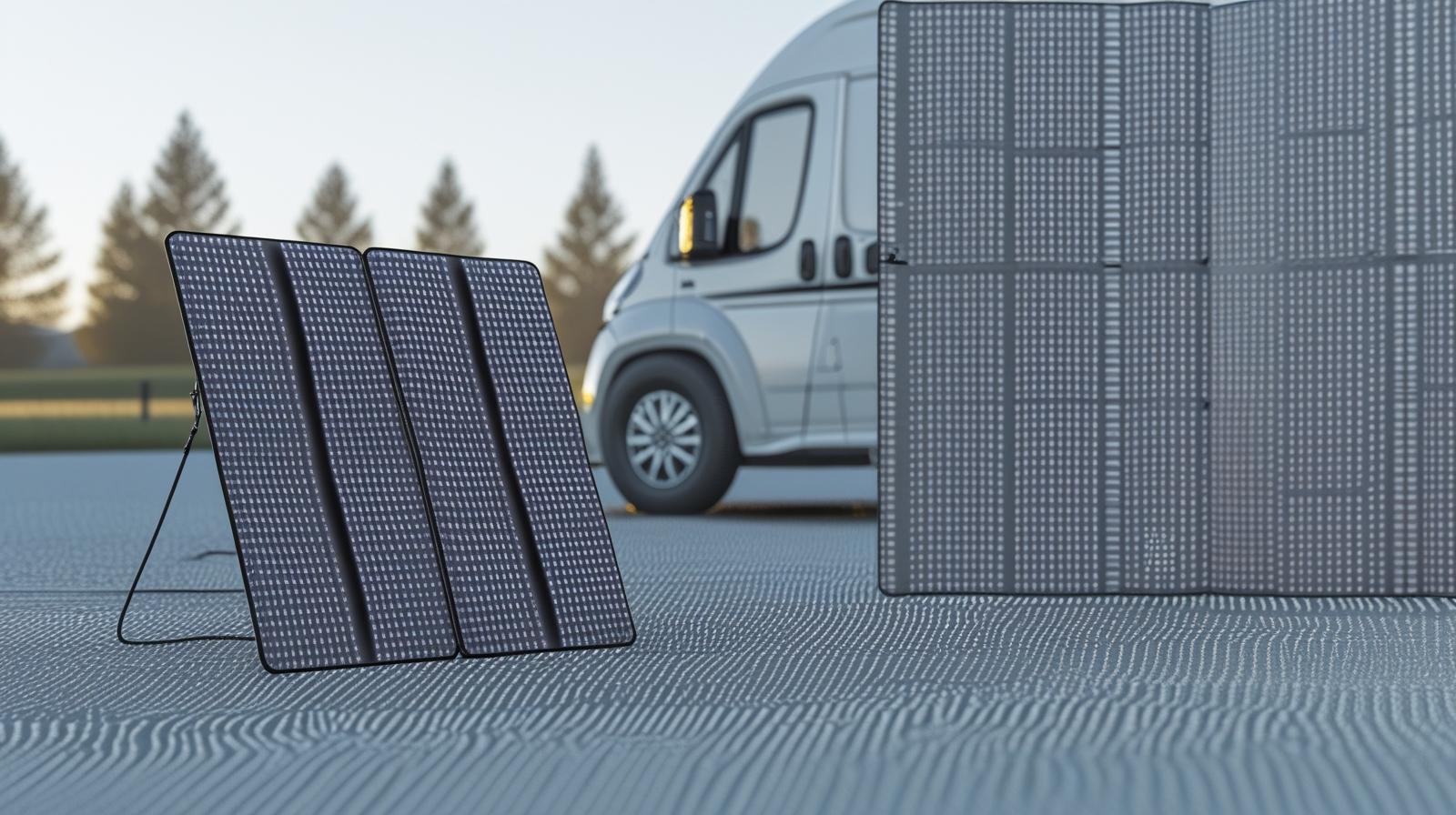
Think of the BLUETTI 350W panel (PV350) as a folding “solar briefcase” meant to sit on the ground next to your RV or van while feeding a portable power station.
Instead of roof mounting, you:
- Carry it out from the rig
- Unfold four large monocrystalline panels
- Kick out the built-in legs
- Plug the MC4 cable into your power station
- Point everything at the sun
Key Specs (PV350)
These are the core specs that matter for RV owners, taken from Bluetti and distributor data:
| Spec | BLUETTI PV350 350W Panel |
|---|---|
| Panel type | Foldable monocrystalline |
| Rated power | 350 W |
| Cell efficiency | Up to 23.4% |
| Surface | ETFE laminated |
| Voltage at max power (Vmp) | ~37.5 V |
| Current at max power (Imp) | ~9.2 A |
| Open-circuit voltage (Voc) | ~46.5 V |
| Connector | Standard MC4 |
| Weight | ~30.6 lb (13.9 kg) |
| Dimensions folded | ~35.6 × 24.1 × 2.5 in |
| Dimensions unfolded | ~35.6 × 94.4 in (approx.) |
| Water resistance | IP65 (splash-proof only) |
| Operating temp | -10°C to 65°C (14–149°F) |
In plain English:
- It’s big and heavy, but still manageable for most adults.
- It’s designed to work beautifully with Bluetti power stations, but the MC4 connectors mean it also works with many other brands (with the right adapter or MPPT controller).
- It’s a portable panel, not a permanent roof fixture. You fold it out when you need it, then fold it away when you don’t.
If you’re brand-new to RV solar and want a foundational primer, bookmark this for later:
How It Fits Among Your RV Solar Options
For RVers, the big question is: “How does this compare to other ways of getting 300–400W of solar?”
Here’s a simplified comparison:
| Option | Rated Power | Typical Real Output | Weight / Mounting | Weather Resistance | Best For |
|---|---|---|---|---|---|
| BLUETTI 350W portable (PV350) | 350 W | ~250–300 W in good sun | ~30.6 lb, folding, ground | IP65 splash-proof (no rain) | Portable off-grid use next to RV |
| Portable 200W folding panel | 200 W | ~130–170 W | ~15–20 lb | Usually IP65 | Weekend camping, smaller systems |
| 400W rigid RV roof panel | 400 W | ~280–320 W | Fixed on roof | Often IP67–IP68 waterproof | Full-time roof-mounted solar |
Real-world wattage numbers are based on owner reports and independent testing showing the PV350 peaking near 295–330W in strong mid-day sun.
The big advantage of the BLUETTI 350W is that you get “roof-panel-level” wattage in a panel you can move around—into sun, away from shade, between rigs, or even off the RV entirely for home emergency use. The trade-offs: weight, bulk, and weather babysitting.
Real-World Owner Snapshot
Based on dozens of recent Amazon buyer reviews across Bluetti’s folding panel line (including the 350W model), here’s the consensus:
Owner Feedback Summary
- Average rating: Roughly 4+ out of 5 stars overall (strong but not perfect)
- Top praise:
- Good real-world charging power in decent sun
- Easy “plug-and-play” setup with Bluetti power stations
- Solid feel; many report they’re rugged and well-built
- Most common complaints:
- Handles, snaps, and stands breaking earlier than expected
- Panels are heavy and bulky to carry long distances
- Not waterproof, only splash-resistant, so you can’t leave them out in the rain
- Real-world wattage often below the label (more like 70–85% of rated)
Best For / Not Ideal For
- Best for:
- RVers and van lifers who want serious portable wattage
- Owners of Bluetti power stations who want same-brand integration
- Boondockers who can move panels around to chase the sun
- Not ideal for:
- People wanting a permanent roof-mounted solution
- Coastal/marine environments or very wet climates
- Anyone who expects a feather-light, backpacking-style panel
- Buyers who are ultra price-sensitive
👉 Want to see current deals and owner photos?
View the BLUETTI 350W RV solar panel on Amazon (opens in new tab).
What Real Owners Like – Pros
Here are the major “pro themes” that show up again and again in buyer reviews.
1. Strong Real-World Power (When the Sun Cooperates)
Many owners report impressive charging speeds when the PV350 is set up correctly in good sun:
- Several users with power stations like the AC200MAX or AC180 see sustained inputs in the 250–300+ watt range, sometimes peaking close to the full 350W on clear, cool days with good angles.
- One user running multiple PV350s in series reported 600–800W of sustained power into a Bluetti battery pack—enough to feel like a “portable solar powerhouse.”
What this means for you:
- A single PV350 can meaningfully charge a mid-size power station in a day, especially if you start early and babysit the angle a bit.
- For moderate loads (CPAP, 12V fridge, laptop, lights), many RVers find it keeps up very well during a sunny spell.
2. Easy to Set Up, Even for Beginners
Owner after owner mentions how simple the setup is:
- Panels unfold like a big book and the kickstands have adjustable straps.
- The MC4 cables are straightforward: plug into the panel, then into your power station or an MPPT controller.
- A 70-year-old reviewer explicitly said the panel was easy to set up and use, and several “first-solar-panel ever” buyers were up and charging within minutes.
If you’re worried about a steep learning curve, this is a reassuring pattern.
3. Feels Solid and Rugged (Panel Side)
While there are complaints about the handles and straps, many owners still describe the panel itself as:
- “Heavy duty”
- “Beast mode”
- “Very well built”
- “Not flimsy at all”
The ETFE laminated surface and overall construction do seem to inspire confidence about the panel’s ability to handle sun, dust, and basic camp abuse—as long as you protect it from constant rain and rough handling of the fabric parts.
4. Packs Down Flat and Stores Easily
Despite the weight, the PV350 folds down into a surprisingly compact, flat package:
- Many owners store it behind a cabinet, under a bed, in a truck bed, or in an RV pass-through.
- The integrated cable pouch and clips help keep things tidy (when the clips and zippers behave).
For RVs where roof real estate is already crowded (AC units, fans, skylights, roof solar), a big folding panel you can stash inside is a compelling option.
5. Tight Integration with Bluetti Power Stations
For Bluetti users, this is a big plus:
- The panel is designed to pair with Bluetti generators like the EB70, EB55, AC180, AC200MAX and others.
- Owners frequently mention “plug and play” operation: plug the MC4 cable into the included adapter, then into the DC input, and you’re charging.
Several people also successfully use the panel with other brands via MC4-to-Anderson, MC4-to-XT60 or an external MPPT controller—just plan on buying any non-Bluetti cables yourself.
6. Customer Support Often Steps Up
While not every experience is perfect, multiple reviewers mention that:
- Bluetti sent replacement handles or hardware when plastic pieces broke.
- In some cases they offered partial refunds or replacement units.
- Support staff reached out proactively after negative reviews.
In other words, the product is not flawless, but the company does often try to make things right.
What Real Owners Complain About – Cons & Downsides
This is where things get real. The BLUETTI 350W panel has some consistent weak spots that you absolutely need to understand before buying.
1. Not Waterproof (Only Splash-Resistant)
The PV350 carries an IP65 rating—fine for splashes and light mist, not for sitting in a rainstorm.
From owner reports:
- Some buyers assumed it was weatherproof because of marketing language and used it in heavy rain. Their panels stopped charging until thoroughly dried—some failed permanently.
- Several marine or coastal users were particularly disappointed; they expected a panel that could live outside.
For RV use, that means:
- You must bring it in when storms or heavy rain roll through.
- It’s not a permanent roof-mount solution for rigs that see all-weather exposure.
If you want year-round, all-weather solar for your RV, you’re better off with rigid, roof-mounted, IP67+ panels plus a good charge controller—and use the PV350 as a supplemental, portable option only.
2. Handles, Straps, and Stands Are Weak Points
This is the single most repetitive complaint across the entire Bluetti folding panel line:
- Plastic handles: Many owners report the plastic handles cracking or coming apart after a handful of uses. Screws strip out of the plastic, or the two halves split.
- Snaps and straps: The snaps that hold the panel folded can break early, and the small strap/clip system doesn’t always inspire confidence.
- Kickstand legs: Owners describe them as “flimsy,” “flexy,” or just weaker than they’d like for windy conditions.
A lot of RVers have resorted to DIY fixes:
- Replacing handle screws with bolts and nuts
- Reinforcing straps with duct tape or bungee cords
- Adding foam pipe insulation or other support under the legs
None of this is hard to do, but at this price point, it’s understandable why people expect better hardware out of the box.
3. Heavy and Bulky
At about 30.6 lb / 13.9 kg, this isn’t a “just toss it in your backpack” panel.
- Owners repeatedly mention that it’s heavier than expected, especially when carrying it any distance from the parking spot to a campsite.
- Several reviewers note that while it’s “portable,” it’s really aimed at car camping, RVs, and trailers, not hike-in sites.
If you’re full-time RV or van life and you mostly move it a few yards from your rig, that’s manageable. If you imagined hiking half a mile with it, you’ll hate it.
4. Real-World Output Often 70–85% of Rating
This is typical of portable panels, but it’s still a source of friction for buyers:
- Many users of Bluetti’s 200W panels report 130–170W in excellent sun.
- Owners of the 350W panel commonly report 230–300W, with occasional peaks higher.
- A minority sees much lower numbers (75–150W), often in hot weather, at high latitudes, or in partially shaded conditions.
Some longer-term users also report degradation over 10–24 months, with output dropping to roughly half the original numbers. That’s not universal, but it shows up often enough that it’s worth noting.
The takeaway:
- Don’t expect a full 350W all the time—even in ideal sun.
- Consider that you’re buying roughly 250–280W of realistic usable power in most RV-friendly conditions from a single panel.
5. Premium Price vs Alternatives
Another repeated theme: “It works, but it’s expensive.”
- Several buyers compare Bluetti panels to other brands (EcoFlow, Renogy, Allpowers, BougeRV) and note similar real-world output at lower prices.
- Some bought alternative panels later and felt they got comparable watts for significantly less money.
What you’re paying for with Bluetti is:
- Brand integration with Bluetti power stations
- ETFE laminated construction
- A big wattage number in a single folding package
- A relatively polished user experience
Only you can decide if that premium is justified for your RV setup.
Who the BLUETTI 350W Panel Is Best For (and Who Should Skip It)
Best For You If…
You’ll likely be happy with the BLUETTI 350W RV solar panel if:
- You camp off-grid regularly (boondocking, dispersed camping, state parks with no hookups).
- You already own (or plan to buy) a Bluetti power station like the AC180, AC200, EB70, etc.
- You want a big chunk of portable wattage in one object instead of juggling multiple smaller panels.
- You prefer to park in the shade and move panels out into the sun.
- You’re okay with storing the panel inside and putting it away when storms pass through.
For many RVers, this panel + a decent Bluetti power station is enough to:
- Run a 12V fridge, fans, lights, phones, laptops, and a CPAP
- Top up batteries after cloudy spells
- Ride out shorter power outages at home
Maybe Skip This If…
You may want a different solution if:
- You want permanent, year-round roof-mounted solar that can live in rain and snow without babysitting.
- Your budget is tight and you want maximum watts per dollar.
- You need something ultra-lightweight for backpacking or human-powered adventure.
- You expect a single 350W panel to fully recharge a large power station from empty every day, even in shade or weak winter sun.
If you’re leaning toward a more permanent solution or a larger system, see:
- DIY RV Solar Installation Guide – Step-by-Step Setup for Beginners
- RV Solar 101: The Complete Guide to Off-Grid Power
Mini Real-World Stories (Paraphrased from Owners)
Sometimes stories are more helpful than specs. Here are a few real-world scenarios owners described:
- “Portable power house” with three 350W panels
- One owner runs three PV350 panels in series into a large Bluetti battery pack using a 100-ft 8-gauge PV cable.
- With all three deployed, they see 600–800W of sustained charge in good sun, enough to run their setup and charge at the same time.
- They specifically appreciate the long MC4 leads and the ability to position panels for best sun while keeping the battery safely inside.
- Off-grid “camping” with an AC180 + 350W panel
- Another user uses a Bluetti power station (AC180 class) and PV350 for camping.
- On hot summer days, the panel keeps up with an electric cooler and small loads, keeping the station around 95–100% all afternoon as long as the panel faces the sun.
- Hurricane / power-outage backup
- One buyer used Bluetti panels (multiple wattages) during a hurricane outage to keep a car fridge and phones running.
- They noted that even in a less-than-ideal yard with trees and slope, the panel was still producing enough power to be “very pleased.”
- Frustrated full-time van lifer
- A full-timer who started van life with a Bluetti panel and power station was initially getting ~135W from a 200W panel in Arizona sun.
- After a few months, they reported output dropping noticeably, plus hardware (snaps, zippers) failing under constant use.
- For them, the longevity and hardware durability were not acceptable given the price.
Different stories, same conclusion: when used as intended (portable, deployed in good sun, cared for), the BLUETTI panels can be excellent. Pushed into “permanent, all-weather, daily abuse” duty, the weaknesses show up faster.
Installation & Usage Tips (From Real Owners + Best Practices)
To squeeze the most out of a BLUETTI 350W RV panel and avoid headaches, follow these practical steps:
1. Choose the Right Spot
- Park your RV where you want to sleep and live, not where the sun hits hardest.
- Lay the panel out 10–25 ft away in full sun, pointing it roughly south (in the U.S.) and tilting toward the sun.
- Whenever possible, keep your power station in the shade behind the panel, using the panel itself as shade.GearDiary
2. Connect Safely
- Keep all cables fully uncoiled to reduce heat buildup.
- Connect the panel’s MC4 leads to the correct adapter for your power station (Bluetti’s own or a compatible one).
- If charging batteries directly, always run through a proper MPPT charge controller rated for the PV350’s voltage and current.
3. Optimize Sun Angle
- Use the kickstands and straps to set a reasonable tilt.
- Re-angle once or twice during the day if you want to maximize input.
- Avoid partial shading from trees, A-frame jacks, or awnings—shade on even part of a section can sharply reduce output.
4. Protect from Weather & Damage
- Treat the panel as splash-resistant, not rain-proof—bring it in if rain is likely.StorageReview.com+1
- Avoid leaving it out in high winds without extra staking; the legs are not designed for big gusts.
- Store it indoors, clean and dry, when not in use. Brush off dirt from the fabric edges before folding to reduce wear.
5. Reinforce Weak Hardware (Optional, but Smart)
- If your handle feels weak, consider through-bolting with small bolts and lock nuts.
- If straps/snaps worry you, add a bungee or webbing strap around the folded panel for transport.
- Some owners use foam pipe insulation on the bottom edges and legs to protect the panel when placed on gravel or wet ground.
To keep your entire RV solar setup healthy, you may also want to read:
RV Use Case: Where a Single 350W Panel Fits in Your System
A 350W panel like this typically generates around 1,600–1,700Wh per day in good conditions according to distributor estimates. Realistically in RV life (mixed sun, some clouds, imperfect angles), you might see 900–1,400Wh on a typical day.
What does that power? Roughly:
- 12V compressor fridge: 40–60Ah/day (~500–750Wh)
- LED lights, phone/laptop charging, fans: 200–400Wh
- Occasional CPAP use: 200–400Wh
So for many rigs, a single PV350 is:
- Enough to keep a modest 12V fridge + small electronics running indefinitely in good sun.
- A strong booster for roof solar if you already have some panels installed.
- A very useful emergency backup at home for blackouts.
If you’re running big loads (inverters powering microwaves, coffee machines, induction cooktops, etc.), you’ll either need:
- Multiple PV350s,
- Or a mix of roof-mounted rigid panels and portable panels.
Again, if you’re unsure, use a system sizing guide before buying panels or batteries:
FAQ – BLUETTI 350W RV Solar Panel
Q1. Will the BLUETTI 350W panel work with non-Bluetti power stations?
A: Yes, as long as your power station supports the PV350’s voltage and input wattage and you use a suitable adapter or MPPT controller. It uses standard MC4 connectors, so it’s compatible with many brands, but you may need an MC4-to-XT60, Anderson, or proprietary adapter (often sold separately).
Q2. Can I permanently mount the PV350 on my RV roof?
A: It’s not recommended. The PV350 is built as a portable, folding panel with a canvas-style outer shell and an IP65 splash-resistant rating—not a fully waterproof, hail-rated roof panel. Bluetti and independent reviewers explicitly warn against prolonged exposure to rain or snow.
Q3. How long will it take to charge a typical Bluetti power station with one PV350?
A: It depends on sun and station size. As a rough example:
- If the panel averages ~250W into an AC180 (~1,152Wh), you might go from 10% to full in 4–6 hours of strong sun.
- Larger units like the AC200MAX (~2,048Wh) will take longer—often a full sunny day with one panel, or significantly faster if you parallel multiple PV350s.
Q4. Is the BLUETTI 350W panel safe in the rain?
A: It’s rated IP65 (splash-proof), so it can tolerate minor splashes or light mist, but should not be left in heavy rain, submerged, or treated as fully waterproof. Several owners report problems after leaving it in storms. Bring it in when weather turns bad.
Q5. Does it come with everything I need to charge my Bluetti power station?
A: For Bluetti-to-Bluetti setups, you usually get the correct MC4 adapter in the power station box, not with the panel itself. The panel includes MC4 leads. If you’re using another brand of power station, you’ll almost certainly need to purchase additional adapter cables separately.
Final Verdict: Is the BLUETTI 350W RV Solar Panel Worth It?
Overall, the BLUETTI 350W RV solar panel (PV350) delivers on its core promise: a lot of portable solar power in a single, foldable package. When deployed in good sun, it can absolutely keep a mid-size Bluetti power station happy and support typical RV boondocking loads—fridge, fans, devices, and more.
Strengths:
- Strong real-world power output for a portable panel
- Excellent portability for the wattage—folds flat, stows easily in an RV or tow vehicle
- Tight integration with Bluetti power stations; straightforward to use
- ETFE laminated construction and splash-resistant design that’s easy to wipe clean
Weaknesses:
- Heavy and bulky to carry long distances
- Handles, straps, zippers, and stands could be more robust
- Not waterproof; you must protect it from rain and long-term outdoor exposure
- Premium pricing compared to some competing portable panels with similar real-world output
Who should buy it?
If you’re an RVer or van lifer using Bluetti gear, want a set-and-forget portable solar slab you can throw out in the sun, and you’re willing to take care of it (bring it in for storms, reinforce a handle if needed), the BLUETTI 350W panel is a strong, high-output choice.
If, on the other hand, you want a permanent roof system, rarely boondock, or are extremely price-conscious, you’ll probably be better off with rigid roof panels plus a good charge controller, and perhaps add a smaller portable panel later.
👉 Curious what the latest price, bundles, and real-world photos look like?
Check the BLUETTI 350W RV solar panel’s current price and owner reviews on Amazon (opens in a new tab).
And if you’re dialing in the rest of your rig’s safety gear alongside solar, you may also want to look at:
- RV Surge Protectors 101: Safeguarding Your RV’s Electrical System
- Essential RV Safety Gear Checklist Every New RVer Should Have
That way your RV is protected both from bad power at the pedestal and from running out of power when you’re off-grid.