Jackery SolarSaga 100W Bifacial Review – Fast Setup, Real-World Watts, and the Adapter “Gotchas” RVers Mention
Affiliate disclosure: This post contains affiliate links. If you buy through them, we may earn a commission at no extra cost to you.
Quick Summary
- Best for: RVers who want plug-and-play portable solar for a Jackery power station (weekenders + many boondockers).
- What owners like most: Easy setup, solid build feel, and reliable charging when you have good sun.
- Biggest recurring complaints: Adapters/compatibility confusion, premium price, and a minority reporting connector or durability issues over time.
- Reality check: “100W” is a rating under ideal lab conditions—owners commonly report anything from ~45–105W depending on sun angle, heat, and your power station’s charging stage.
Quick Verdict
If you want a portable, fast-to-deploy RV solar panel that “just works” with a Jackery ecosystem in strong sun, the SolarSaga 100W Bifacial is a strong pick—especially for trips where simplicity matters more than maximum watts per dollar. The trade-off is that you need to be comfortable with adapter quirks, realistic output expectations, and the fact that a few owners report quality-control or connector frustrations.
See the Jackery SolarSaga 100W Bifacial Portable Solar Panel on Amazon (opens in a new tab)
What This Product Is (and Why RVers Buy It)
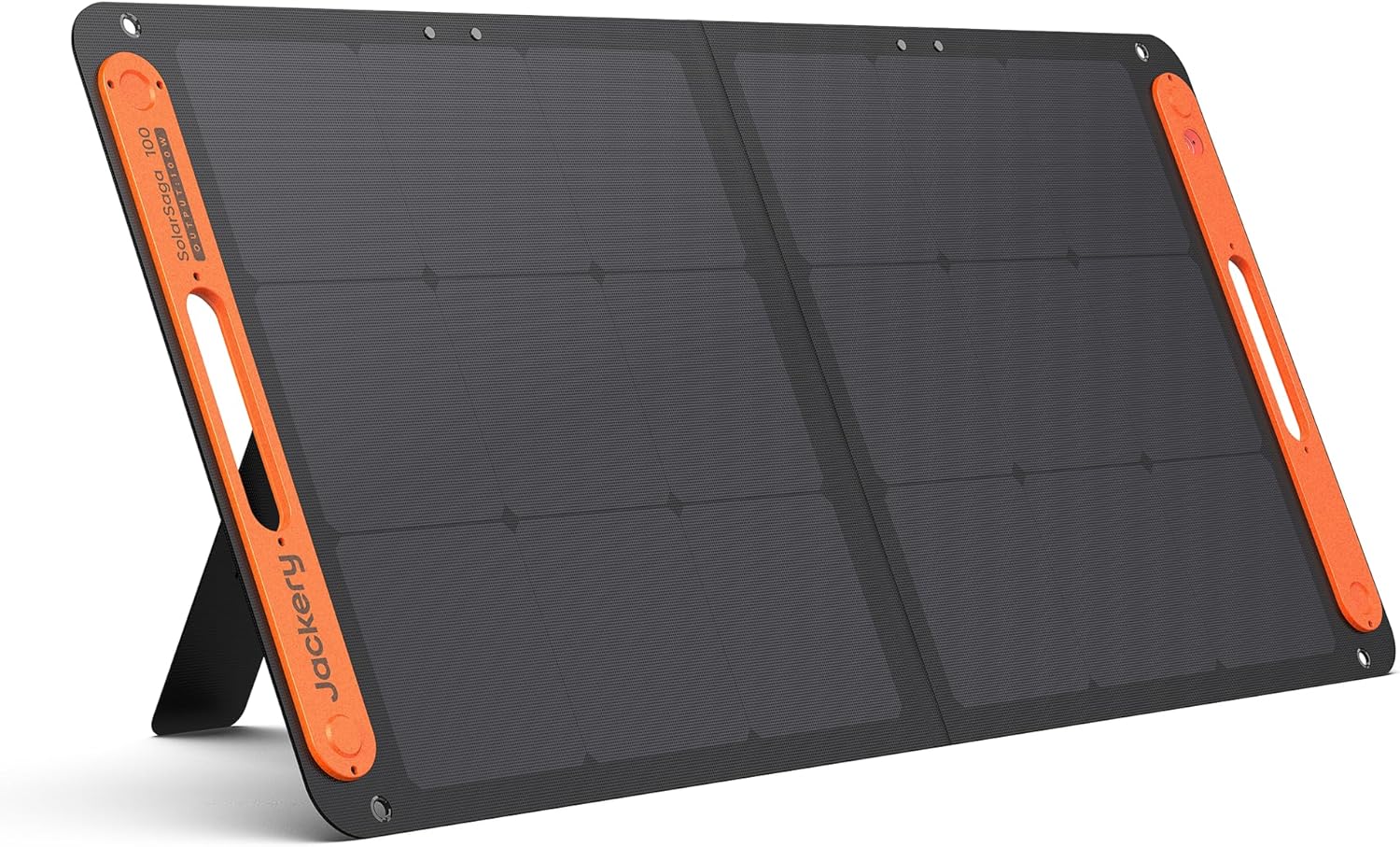
The Jackery SolarSaga 100W Bifacial is a foldable portable solar panel designed primarily to charge portable power stations (especially Jackery units). For RV life, that usually means:
- Charging your power station during the day so you can run 12V/USB gear, lights, fans, CPAP, small fridge/cooler, or device charging at night.
- Having a simple, moveable solar solution when you don’t want (or can’t) mount rigid panels on the roof.
- Adding extra charging capacity for boondocking without firing up a generator.
A key idea that comes up repeatedly in owner feedback: these panels shine when you treat them like a portable “set it in the sun and aim it” tool, not a permanent roof array replacement.
Helpful internal read (especially if you’re building a full setup):
Key Features RVers Actually Care About
1) Bifacial design (the “bonus light” concept)
In plain English: bifacial panels can pick up some light from the “rear” side due to reflected/ambient light. Owners are split on how meaningful this is in real life—some love the concept, others find it situational (surface reflectivity, angle, and environment matter a lot).
Practical RV takeaway: if you place it over bright surfaces (concrete, light gravel, a reflective blanket), you may see better results than placing it flat on dark ground.
2) Foldable, portable format
Multiple reviewers emphasize the “grab it, carry it, deploy it” aspect. This is the core value: you can move it to chase sun—which is often more impactful than having a slightly more efficient panel stuck in partial shade.
3) Kickstand + aiming help (owners mention an alignment indicator)
Several owners specifically mention using the aiming aid to get better output. Translation: this panel rewards you for good orientation.
4) “Plug and play”… with a big asterisk
Many owners love the simple connection experience—then you see a recurring theme: some models or use cases require extra adapters (for certain Jackery “Plus” units, certain RV solar ports, or direct battery charging setups).
If you hate compatibility puzzles, this is the biggest reason you might skip.
Spec Snapshot (what owners mentioned + what matters)
| Spec / Detail | What you should know (real-world focused) |
|---|---|
| Rated power | 100W (rating; real-world varies) |
| Real-world output owners reported | Peaks around ~105W in ideal sun for some; ~45–75W for others depending on conditions |
| Physical size (reported by owners) | About 24.02″ × 21.06″ × 0.2″ (may vary by version/listing) |
| Portability | Foldable, travel-friendly; commonly used for camping/boondocking |
| Best pairing | Portable power stations (especially Jackery); compatibility can require adapters in some cases |
| Common “gotchas” | Adapters, connector fit/stability, wind stability, price |
Real-World Owner Summary (Based on the Reviews)
Here’s the consensus pattern that shows up repeatedly across the feedback:
Owner Feedback Snapshot
- Overall sentiment: Mostly positive (lots of 4–5 star experiences), with a smaller but very vocal group of low-star reviews.
- Most loved: Simple setup + dependable charging when you have strong, direct sunlight.
- Common complaints:
- Adapter/compatibility surprises (especially when pairing with certain units or RV solar inputs)
- Price (many call it premium/expensive)
- A minority report connector/durability failures, sometimes after limited uses
- Best for: RVers who value ease, portability, and ecosystem fit more than lowest cost per watt.
- Not ideal for: Anyone who expects 100W all day, camps in heavy shade, or wants universal RV plug compatibility with zero adapters.
Check the Jackery SolarSaga 100W Bifacial price on Amazon (opens in a new tab)
What Real Owners Like (Pros)
Pro 1: “It charges well when the sun is good”
Multiple owners report strong charging performance in direct sun—some describing a “few hours” to meaningfully charge a mid-sized power station, and others reporting solid peaks when well aimed.
What this means for you: If your camping style includes open sun (desert, open lakeside, exposed pads), you’re likely to be happy—especially if you’re charging during mid-day.
Pro 2: Easy to use (for most people)
A common theme is simplicity: unfold, aim, connect, and you’re producing power. Several reviews describe it as a smooth, no-drama experience.
What this means for you: If you’re a weekend camper who doesn’t want a “solar project,” this is the type of panel you’ll actually deploy instead of leaving it stored.
Pro 3: Build quality feels “solid” to many buyers
A lot of owners mention the panel feels well made. Some also mention packaging and delivery protection being good.
What this means for you: Many buyers trust it for travel—moving it around, using it repeatedly, and folding/storing it often.
Pro 4: Useful even in imperfect conditions (tempered expectations)
A few owners mention still seeing some input through clouds (low wattage, but not zero). That’s normal solar behavior—and it’s still helpful for topping off phones, lights, and slow charging.
What this means for you: It’s not magic in overcast, but it’s often better than nothing—especially for lighter loads.
What Real Owners Complain About (Cons)
Con 1: Adapter / compatibility “gotchas”
This is the most consistent pain point in the negative reviews. Several owners expected universal compatibility, then discovered they needed an additional adapter/dongle for specific power stations or connections.
What this means for you: If you’re pairing with a specific Jackery model (especially newer “Plus” variants) or trying to connect to an RV solar port/controller, confirm your adapter path before your trip—otherwise you risk arriving at camp and discovering you can’t connect.
Con 2: Real-world watts don’t always match “100W” expectations
Some owners are disappointed when they see ~44–65W rather than 80–100W. Others explain the “why” in detail: solar is rated at standard test conditions, and output drops with heat, imperfect angle, and charging controller behavior.
What this means for you: If you buy 100W expecting a guaranteed 100W, you’ll likely be frustrated. If you buy it expecting variable output and value the portability, you’ll be fine.
Con 3: Price complaints are common
Even many happy owners still call it expensive. A recurring sentiment is: “Works great… but it’s premium-priced.”
What this means for you: You’re often paying for the ecosystem fit + design convenience—not necessarily best dollars-per-watt.
Con 4: Wind stability and leg design complaints (minority, but real)
Some owners report panels blowing over easily (especially because they’re light). Others complain about leg/stand quirks.
What this means for you: If you camp in windy areas, you may need a routine to stabilize it (more on that below).
Con 5: Durability/connector failures (small but serious group)
A small group reports the panel stopped working after limited uses, or that connectors felt poorly designed or unreliable. There are also complaints about customer service experiences in warranty situations.
What this means for you: Most owners are fine, but the downside risk exists. Treat the cable/connector gently and avoid stress points.
Use Cases & Buyer Types: Who It’s Best For (and Not For)
Best For You If…
- You want portable solar for boondocking and you value fast setup over building a permanent roof system.
- You already own a Jackery power station and want a matching, simple charging solution.
- You often camp where you can place panels in full sun (and you’re willing to reposition once or twice).
- You want a panel you can use for outages at home and for camping.
Skip This If…
- You want the lowest cost per watt (you’ll likely find cheaper options—though not always as convenient).
- You need universal RV solar-port compatibility with no adapters and no homework.
- You camp primarily in dense shade and cannot reposition to chase sun.
- You’re extremely sensitive to potential connector/quality-control frustrations.
Mini Real-World Owner Stories (Paraphrased)
- The “two-panel boost” moment: One owner described using two 100W units together and seeing input around the ~200W range in strong sun, then settling slightly lower after stabilization. That’s exactly how solar often behaves: great peaks when conditions are perfect, then it levels out.
- The “cloudy day reality” test: Another owner noted they still saw modest input through clouds and hit a bit above 100W in direct sun. That’s a useful expectation: solar keeps helping, but you shouldn’t plan your whole power budget around cloudy output.
- The “trip ruined by adapter surprise” warning: A frustrated reviewer described arriving at camp expecting compatibility—then discovering an extra dongle/adapter was required. The lesson is simple: test and confirm adapters at home, not in the campground parking lot.
Setup & Usage Tips (From Owners + Practical RV Reality)
Step-by-step: quick setup that tends to get better watts
- Unfold fully and confirm the stand/kickstand is locked and stable.
- Aim at the sun using the panel’s alignment aid (if your version includes it).
- Connect the cable in the correct “two-step” way (one owner noted the cable needs to be connected correctly—panel lead to adapter lead—before going to the battery).
- Start charging early if you’re trying to refill a large battery. Midday is best, but total “sun hours” matter.
- Re-aim once or twice as the sun moves. Even small angle changes can be meaningful.
Stabilize it so it doesn’t blow over
- Set it at a slightly lower angle in wind (you may lose some watts, but keep it upright).
- Keep the panel off dusty ground when possible.
- If safe to do so, add gentle weight near the base area (without covering cells).
Keep the connector healthy (this matters)
- Avoid a hard 90-degree cable bend right at the connector.
- Don’t let the cable “hang” and pull on the port; relieve strain with slack.
- If you ever see intermittent charging, your first checks should be: connector seating, adapter correctness, cable strain, and panel cleanliness.
Don’t cook your grass (yes, really)
One owner learned the hard way that laying panels flat in strong sun can create “hot spots” below. If you’re on grass, keep it elevated or move it periodically.
Maintenance: simple habits that protect output
Dust and debris show up as a surprisingly common performance killer. If you want a quick routine that keeps your system happy, use:
Why You Might See “Low Watts” Even in Full Sun (Owner-Explained)
Two owner explanations are worth translating into plain English:
1) Rated watts vs. real life
One detail-oriented reviewer walked through how solar ratings assume specific test conditions (very strong sun + cooler panel temps). In real summer heat, panels run hot—and hotter panels usually output less. That’s why you might never see the full rating even when the sky is perfect.
2) Your power station may not “take” full power all the time
Another owner explained something many people miss: the number you see on your power station may reflect what the charge controller is accepting, not the panel’s theoretical maximum at that moment. As batteries approach full, charging can taper—so your displayed input can drop even if the sun is still strong.
Bottom line: If you’re getting “less than expected,” don’t panic immediately. First troubleshoot the basics: sun angle, dust, heat, cable/adapter correctness, and battery state of charge.
Comparison Table: How This Fits in RV Solar Choices
| Option | Best for | What you gain | What you give up |
|---|---|---|---|
| Jackery SolarSaga 100W Bifacial (portable) | Power station users, quick trips, flexible sun-chasing | Fast setup, portability, ecosystem convenience | Premium price, adapter quirks, variable watts |
| Roof-mounted rigid panels | Full-timers, always-on charging | “Set and forget,” consistent daily harvest | No portability; install complexity |
| Flexible roof panels | Low-profile installs, curved roofs | Light weight, low profile | Heat can reduce output; less portable |
| Budget folding panels | Cost-focused users | Lower entry cost | More variability in connectors/fit/long-term feel |
Pros & Cons Box (Quick Scan)
Pros
- Easy to deploy and reposition for better sun
- Strong performance in direct sunlight (per many owners)
- Portable, travel-friendly folding format
- Works very smoothly for many Jackery users
Cons
- Adapter/compatibility surprises are common in negative reviews
- Premium pricing
- Output varies widely by conditions (and expectations need to be realistic)
- Some reports of connector/durability issues (minority, but notable)
FAQ
Does the SolarSaga 100W Bifacial always produce 100 watts?
No. Owners report anything from roughly mid-double digits to around 100W+ depending on sun angle, clouds, heat, cleanliness, and what your power station is accepting during charging.
Why does my Jackery show lower input even in strong sun?
Your power station may be tapering charge as the battery fills, or the panel isn’t perfectly aimed/clean, or it’s running hot. Also verify the connector and correct adapter.
Do I need an adapter for my Jackery Explorer model or RV solar port?
Possibly. This is one of the most common owner complaints: some combinations require a separate adapter/dongle. Test your exact setup at home before you travel.
Can I use this to charge an RV battery directly?
Some owners aim to do this, but the practical issue is usually connection compatibility (and what controller/input your RV battery system uses). If your plan is “panel → RV charge controller,” confirm the adapter/cable path first.
Is it okay in wind and weather?
Owners report it can handle normal outdoor use, but wind stability is a common complaint. In gusty conditions, stabilize it and avoid stressing the connector/cable. If you expect rain, don’t gamble—portable panels and connectors aren’t something you want to “test” during a storm.
Final Verdict
The Jackery SolarSaga 100W Bifacial Portable Solar Panel is at its best when you want simple, portable charging and you’re willing to treat solar as variable (because it is). Most happy owners describe a smooth experience—quick setup, solid charging in direct sun, and an overall feeling of quality. The strongest negative theme isn’t “it never works,” but rather: compatibility and adapter surprises (plus a smaller set of durability/connector complaints and plenty of price grumbling).
If you’re the kind of RVer who wants to roll into camp, drop a panel in the sun, and start charging without building a whole solar system, this is the kind of product you’ll actually use—just make sure your adapter situation is sorted before the trip.
See the Jackery SolarSaga 100W Bifacial Portable Solar Panel on Amazon (opens in a new tab)