Lippert Flow Max RV Water Pump Review: Quiet Pressure Upgrade or Leak Risk?
Affiliate Disclaimer: This article contains affiliate links. If you click through and make a purchase, I may earn a small commission at no extra cost to you. This helps support my deep-dive research.
If your RV water pump is waking up the whole rig (or worse—short-cycling all night like a woodpecker in a tin can), you already know the “small” water pump can become a big quality-of-life issue. And when a pump fails, it usually fails at the worst time: mid-trip, mid-shower, or when you’re boondocking and every gallon matters.
So I went deep into real owner feedback on the Lippert Flow Max RV water pump to answer the only questions that actually matter:
- Is it actually quiet in a real RV install?
- Does it deliver steady pressure… or does it surge and hammer?
- What breaks first: the switch, the housing, the bracket, or your patience?
- And is it a smart replacement for common OEM pumps (like older SHURFLO units), or a “buy once, install twice” situation?
This review is written to save you time—and ideally save you from water damage.
Quick Summary
Here’s the pattern I kept seeing across the owner feedback I analyzed:
- Best strength: A lot of owners report it’s dramatically quieter than their old pump and feels like a clean OEM-style swap.
- Best scenario: Weekend trips, normal faucet/shower use, and rigs where the current pump is loud, pulsing, or slow to prime.
- Biggest red flag: A meaningful chunk of owners report leaks (often around the pressure switch / pump head area) and/or overheating / thermal shutdown, especially if you push longer run times.
- Most underrated “fix”: Many “noise problems” aren’t the pump—it’s the plumbing line slapping the floor/walls. A few simple install tweaks can make this pump feel even quieter.
If you want a broader context before buying, bookmark this guide:
Quick Verdict (TL;DR)
My bottom line: The Lippert Flow Max is one of those RV pumps that can feel like an incredible upgrade when you get a good unit and install it correctly. Many owners describe quiet operation, fast priming, and steady pressure—the kind of change you notice immediately when showering.
But I can’t ignore the other recurring theme: leaks and heat issues show up often enough that I’d treat this as a “buy smart, install defensively” pump—especially if your pump location is hard to access (under-bed, basement panel, behind drawers).
Confidence Score: 7.1/10 (high comfort upgrade potential, but reliability variance keeps it from an 8+)
If you want to check current pricing and versions:
What This Pump Is (And Why RVers Replace Their Pump in the First Place)
Most RV fresh-water pumps in this category are 12V DC diaphragm pumps with a pressure switch. That switch is the “brain” that turns the pump on when line pressure drops (you open a faucet) and turns it off when pressure reaches the shutoff point.
So when your water system gets annoying, it’s usually one of these:
- Noise + vibration: Pump sounds like it’s trying to escape the RV.
- Pulsing shower: Pressure surges that make showers feel inconsistent.
- Slow priming: You open a faucet and wait… and wait.
- Short-cycling: Pump kicks on briefly even when you’re not using water (can indicate a small leak, check valve issue, or pressure switch behavior).
- Failure/leaks: Water where it absolutely should not be.
If you’re still getting your head around how the whole system flows (tank, pump, city connection, etc.), this primer helps:
Technical Deep Dive (In Plain English)
1) Noise: Why “Quiet” Can Be Real (And Why It Can Still Be Loud)
In the reviews I went through, “quiet” is the #1 praise. Many owners say they can barely hear it, especially compared to older, harsher-running pumps.
Here’s the practical truth though: pump noise is a system problem, not just a pump problem. The pump can be quiet, but the plumbing line on the pressure side can still:
- flex,
- tap the floor/walls,
- transmit vibration like a drum.
One pattern that comes up repeatedly is that people who address line slap (not over-clamping lines, adding soft isolation, and letting the line flex) report a huge noise improvement—sometimes more than swapping pumps alone.
2) Pressure and Flow: “Steady” Is the Win You Feel
From real-world owner feedback, it looks like many users feel the pressure is strong and consistent, and several specifically mention showers becoming more comfortable because the pump doesn’t “surge” as much.
That said, a frequent buyer surprise is that some units don’t seem to hit the advertised shutoff pressure consistently. A few owners reported lower shutoff pressure than expected even after adjustment attempts. Translation: some rigs will feel like a pressure upgrade; others will feel like “fine, but not magical.”
3) Duty Cycle + Heat: The Detail People Miss Until Shower Day
Multiple owners point out a labeled/mentioned duty cycle of about 5 minutes on / 10 minutes off (a ~50% duty cycle). For normal RV use (handwashing, toilet flushes, quick dish rinse), that may never matter.
But if you:
- take long showers,
- run a spray nozzle,
- transfer water continuously,
- or have a system issue causing the pump to run more than it should,
…you can push the pump into hot-running territory or even thermal shutdown.
4) Pressure Switch: The Comfort Feature That Can Become the Failure Point
Owners commonly report that if something goes sideways, it’s often related to the pressure switch area:
- switch leaking,
- pump not shutting off,
- switch behavior becoming intermittent,
- or water getting where it shouldn’t, leading to electrical weirdness.
That’s why my install guidance (below) is “defensive” even if you’re buying for a simple swap.
Key Features (Benefit-Driven & Comparative)
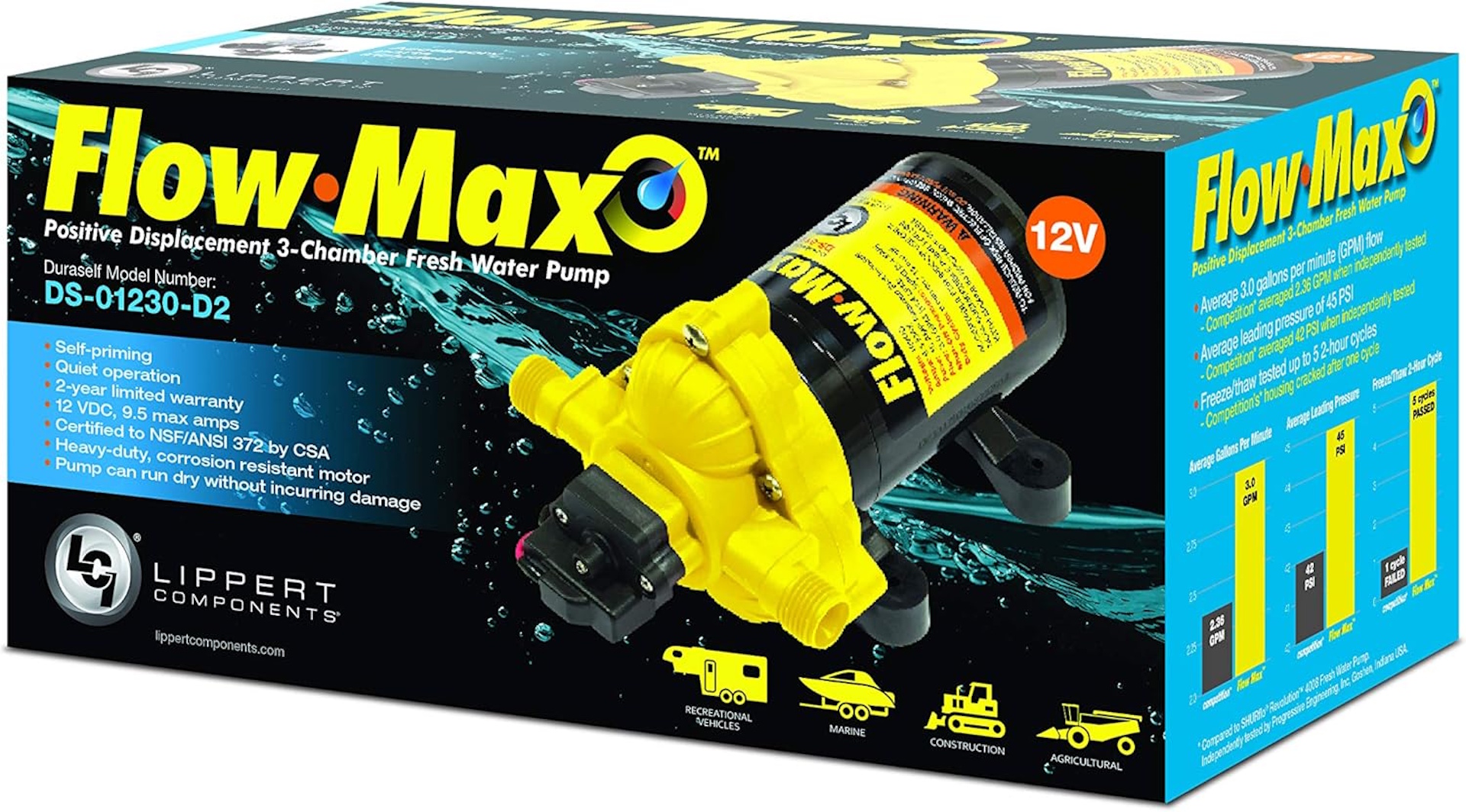
Below is a “manufacturer claim vs real meaning” breakdown based on aggregated owner experiences.
| Feature | What the Manufacturer Says | What It Actually Means (User Experience) | Compared to Competitors |
|---|---|---|---|
| “Quiet operation” design | Quieter pump for RV use | Many owners report it’s significantly quieter than older OEM pumps—sometimes “barely noticeable” at night | Quietness can match or beat common OEM replacements, but install quality (isolation + line routing) matters more than people expect |
| Self-priming behavior | Reliable, easy priming | A common win: users report quick priming and stable delivery—especially as a replacement for older pumps that struggled to hold pressure | Similar to other diaphragm pumps when healthy, but some owners report prime-loss/failure on bad units |
| Pressure switch shutoff | Automatic on/off control | When it’s working right, it’s convenient and smooth. When it’s not, you’ll see short-cycling, running when it shouldn’t, or failure to shut off | Pressure-switch quirks exist across brands, but this is a repeated theme owners mention with Flow Max |
| Included strainer/fittings (varies by package) | Easier install + pump protection | Some owners love the inline strainer as a practical bonus. Others report missing parts/instructions depending on shipment | Many competitors also offer strainers, but consistency in what arrives can vary by seller/listing |
| “OEM replacement fit” | Direct swap for many RVs | Many users say it’s a straightforward swap: mount pattern and size often match older pumps | Comparable to other “OEM style” pumps; fitment can still involve fittings/PEX transitions |
The Real User Experience (Pattern Analysis)
First impression: it often feels like a premium, solid pump
Across the owner feedback I analyzed, a recurring theme is that the pump feels sturdy—good weight, solid build, not toy-like. People replacing older pumps frequently describe immediate relief: less racket, better pressure, smoother cycling.
Reality after months: reliability is the make-or-break category
From real-world owner feedback, it looks like the experience splits into two camps:
Camp A: “This fixed my whole water system.”
- quieter than stock
- steady pressure
- easy installation
- good value for an OEM-style replacement
Camp B: “It worked… until it leaked or overheated.”
- pressure switch leaks
- housing/pump head leaks
- pump gets too hot under normal shower use
- intermittent pressure switch behavior
- early failures (sometimes within months)
If you’re a casual weekender, you may never hit the stress conditions that trigger the worst stories. If you’re full-time or you take longer showers, the risk profile changes.
Hidden strength: it can make your RV feel “more residential”
In real-world use, many users find that when the pump runs smoother and quieter, the whole rig feels more comfortable—especially at night. For families, that “don’t wake everyone up when flushing” factor comes up again and again.
Hidden weakness: heat + duty cycle + “runs when it shouldn’t”
One pattern that comes up repeatedly is that overheating is often tied to either:
- long continuous run time, or
- pump cycling when no water is being used (which can add heat and wear even when you think everything is “off”).
If your pump ever runs unexpectedly, don’t ignore it. That’s how small issues become water damage.
If you want to check the current listing and verify you’re ordering the right variant:
Installation: What Owners Say Is Easy (And What Actually Trips People Up)
A lot of owners say install is “simple” and “fast.” That’s believable because a pump swap is typically:
- 2 wires (12V + and -)
- inlet + outlet plumbing
- 4 mounting screws
But here are the real-world sticking points people report.
Step-by-step: My practical install checklist (12V RVs)
- Kill power first
- Turn off the pump switch.
- Disconnect shore power (if applicable).
- If you’re cautious (you should be), pull the fuse or disconnect the RV battery.
- Relieve pressure
- Open a faucet to bleed pressure before you loosen lines.
- Take photos
- Wire routing, inlet/outlet orientation, and hose paths.
- Plan your fittings
- Some owners report the included fittings are usable, but 90-degree fittings would have made life easier in tight compartments.
- If your rig uses PEX transitions, verify what you need before you start.
- Seal threads correctly
- Several owners mention needing Teflon tape or thread sealant to stop weeping at threaded adapters.
- Don’t overtighten plastic fittings—snug plus correct sealant usually wins.
- Mount with vibration control
- Use the existing isolators if present.
- If the pump is hard-mounted to thin wood, consider a rubber isolation pad.
- Fix the #1 “quiet pump still noisy” issue: line slap
- Don’t clamp the pressure line rigidly against a wall or floor.
- Add foam pipe insulation where the line could tap surfaces.
- Give the line room to flex without hitting structure.
- Prime and test
- Run water at the closest faucet first.
- Then check every connection for leaks with a dry paper towel.
If you want a full visual walkthrough style guide (no fluff), this is the one to keep open while you work:
Common Pain Points (The Stuff That Makes People Rage-Replace Pumps)
1) Leaks (pump head / pressure switch area)
A frequent buyer surprise is how many negative experiences revolve around leaking from the pump itself, not from user-installed fittings.
And here’s why this is serious: a leak in an RV isn’t just “annoying.” It can mean:
- soaked subfloor
- mold risk
- damaged insulation
- electrical issues (especially near the switch)
If your pump is installed in a hidden compartment, this is the #1 reason to install defensively (shutoff valve, alarm, and periodic checks).
2) Overheating and thermal shutdown
In the reviews I went through, I kept seeing versions of the same story: the pump runs, then gets too hot, and either shuts down or starts acting weird.
A lot of the time, that ties back to:
- duty cycle limits,
- long showers,
- nozzle use (restricted flow),
- or the pump running when it shouldn’t.
3) Pressure switch quirks (won’t shut off, cycles randomly, drains battery)
Owners commonly report that if the pump doesn’t shut off reliably, it can:
- cycle on/off repeatedly,
- run “low power” when it shouldn’t,
- and in worst cases, drain your battery.
If you’re boondocking, that’s not just annoying—that’s a trip problem.
4) Fitment/fitting weirdness
Most buyers report straightforward fit, but some report:
- odd thread compatibility issues,
- needing different adapters,
- or hoses that don’t want to seal unless clamps are cranked down.
This is especially common when you’re transitioning to/from PEX or older stiff hoses.
Pros and Cons (The Good, The Bad, and the Deal-Breakers)
Pros (what a clear majority of happy owners praise)
- Very quiet operation compared to older or cheaper pumps
- Smooth, steady pressure that improves shower comfort
- Often a direct OEM-style replacement (mount pattern and general size)
- Quick install for DIYers (simple wiring + simple plumbing)
- Good value when you catch it at a solid price point
Cons (themes that show up repeatedly in unhappy reports)
- Leak risk from the pump body / head / pressure switch area (high consequence)
- Heat / duty cycle limitations can matter more than buyers expect
- Pressure switch reliability variance (cycling, failing to shut off, intermittent behavior)
- Inconsistent shipments (some reports of missing instructions/parts or “not new” appearance)
- Not the best pick for long continuous run time (transfer pumping, long showers, etc.)
Owner Stories (The “Human” Side)
Here are a few real-world scenarios that come up repeatedly in the owner feedback—retold as practical mini-stories, not marketing claims.
Story 1: The “finally quiet enough to sleep” upgrade
In real-world use, many users find the best part isn’t pressure—it’s peace. The pump runs so quietly that late-night bathroom trips don’t wake everyone up. This is especially noticeable if you’re replacing an older pump that sounded like it was hammering the floor.
If you want to scan current buyer experiences directly:
Story 2: The easy swap that turned into a fitting chase
A common theme with DIY installs: the pump swap is mechanically simple, but the plumbing transitions aren’t always “plug-and-play.” Some owners report needing thread sealant, fighting stiff hoses, or wishing they had 90-degree adapters on hand before starting.
Story 3: The “it worked great… until the leak” gut punch
There are a number of reports where the pump performs well—quiet, good pressure—then develops a leak later. In an RV, that’s the kind of failure that doesn’t just cost you a pump. It can cost you flooring, time, and a whole weekend of repairs.
That’s why my recommendation is to treat any pump swap as a chance to add simple safeguards.
Expert Tips & Installation Hacks (What Helps in the Real World)
Here are the best “pro tips” that owners indirectly taught through their experiences—things manuals rarely emphasize.
- Add a shutoff valve right after the pump
- If the pump ever leaks, you can isolate it fast.
- This is especially important for under-bed or basement installs.
- Quieting trick that works: insulate the pressure line where it can slap
- Foam pipe insulation can reduce “thunking” dramatically.
- Let the line flex instead of clamping it rigidly.
- Seal threaded fittings correctly—don’t brute-force them
- Use Teflon tape or appropriate thread sealant.
- Over-tightening plastic fittings can crack parts or create leaks later.
- Verify fuse size and wiring ampacity before you assume it’s a straight swap
- Some owners report receiving different amp variants than expected.
- Match fuse and wiring to the actual pump label, not just the listing description.
- Don’t ignore short-cycling—diagnose it
- If the pump cycles with no faucets open, you may have:
- a tiny leak,
- a check valve issue,
- trapped air,
- or a pressure switch problem.
- Use this guide to systematically troubleshoot:
- If the pump cycles with no faucets open, you may have:
- If you use city water, protect your plumbing
- City pressure can be inconsistent and sometimes too high.
- Use a regulator so your pump isn’t “covering up” a pressure problem elsewhere:
- If you’re full-time, consider a water leak alarm as “cheap insurance”
- A slow leak under a cabinet can cause expensive damage quietly.
Who This Is For (And Who Should Skip It)
You should buy the Lippert Flow Max RV water pump if…
- You’re replacing a loud, vibrating older pump and your top priority is quiet operation
- You want an OEM-style replacement that many people report as a straightforward swap
- Your usage is typical RV living: sinks, toilet, normal showers (not prolonged continuous runs)
- You’re willing to install it intelligently (seal threads, reduce vibration, add a shutoff valve)
If that sounds like you, check current pricing here:
You should skip it (or be extremely cautious) if…
- Your pump is installed where a leak would be catastrophic and hard to detect (hidden basement, sealed compartments)
- You take long showers frequently or run the pump continuously (transfer pumping, extended nozzle use)
- You’ve had repeated water-damage trauma and want the lowest possible leak-risk profile
- You don’t want to think about duty cycle limits at all
If reliability is your #1 metric (not noise), compare your options in this roundup first:
Deep-Dive FAQ (High-Intent Questions RVers Actually Ask)
1) Is the Lippert Flow Max actually quiet in a real RV?
Based on aggregated owner experiences discussed in these reviews, quietness is the most consistent win—especially compared to older OEM pumps. But if your plumbing line is slapping the floor, you’ll still hear thumping until you fix the line routing/insulation.
2) Why does my pump get hot?
In real-world use, many users find heat shows up when the pump is asked to run longer than typical RV faucet cycles. Duty cycle matters, restricted-flow nozzles can increase strain, and a pump that runs when it shouldn’t will build heat faster.
3) What’s the deal with “5 minutes on / 10 minutes off”?
That’s a duty cycle limit some owners report seeing on the pump label/manual. For quick RV water use, it may not matter. For long showers or transfer pumping, it can become a practical limitation.
4) Do I need an accumulator tank with this pump?
Not always. Some owners add one to reduce cycling and smooth pressure. If your current system short-cycles or hammers, an accumulator can help—sometimes more than changing pumps alone. If you’re dealing with cycling issues, troubleshoot first so you don’t mask a leak.
5) Why does my pump cycle even when no faucet is open?
That’s usually not “normal.” It often points to:
- a small leak,
- trapped air,
- a check valve issue,
- or a pressure switch behavior problem.
Start here for a systematic approach:
6) Is this a good choice for boondocking?
It can be, especially if you value quiet nights and steady pressure. But boondocking also means battery management, and a pump that cycles unexpectedly can drain power. Install carefully, monitor behavior, and consider a shutoff valve and leak alarm.
Final Verdict
If your current pump is loud, pulse-heavy, or slow to prime, the Lippert Flow Max RV water pump can feel like a serious comfort upgrade—when you get a solid unit and install it with basic vibration and leak prevention in mind.
But because leak/heat complaints appear often enough to matter, I’d treat this as a pump that rewards smart setup:
- isolate vibration,
- seal threads correctly,
- give plumbing lines room to flex,
- and add a simple shutoff valve so a leak doesn’t become a disaster.
If you’re a typical weekender and want a quieter rig, this can be a strong value pick. If you’re full-time or your pump location is hard to access, weigh the risk carefully and compare alternatives in our pump roundup.