ECO-WORTHY 12V RV Fresh Water Pump Review: Real-World Pressure, Noise, and Reliability (No Fluff)
Affiliate Disclaimer: This article contains affiliate links. If you click through and make a purchase, I may earn a small commission at no extra cost to you. This helps support my deep-dive research.
If you’ve ever had your RV pump start machine-gunning on/off at 2 a.m., or you’ve tried to shower on “campground pressure” that feels like someone is politely sighing water at you… you already know why a water pump upgrade can feel like a quality-of-life purchase.
For this review, I went through a large pile of real-world owner feedback and looked for repeating patterns: what people loved on day one, what started annoying them by month six, and what failures showed up often enough to treat as “plan for it” issues.
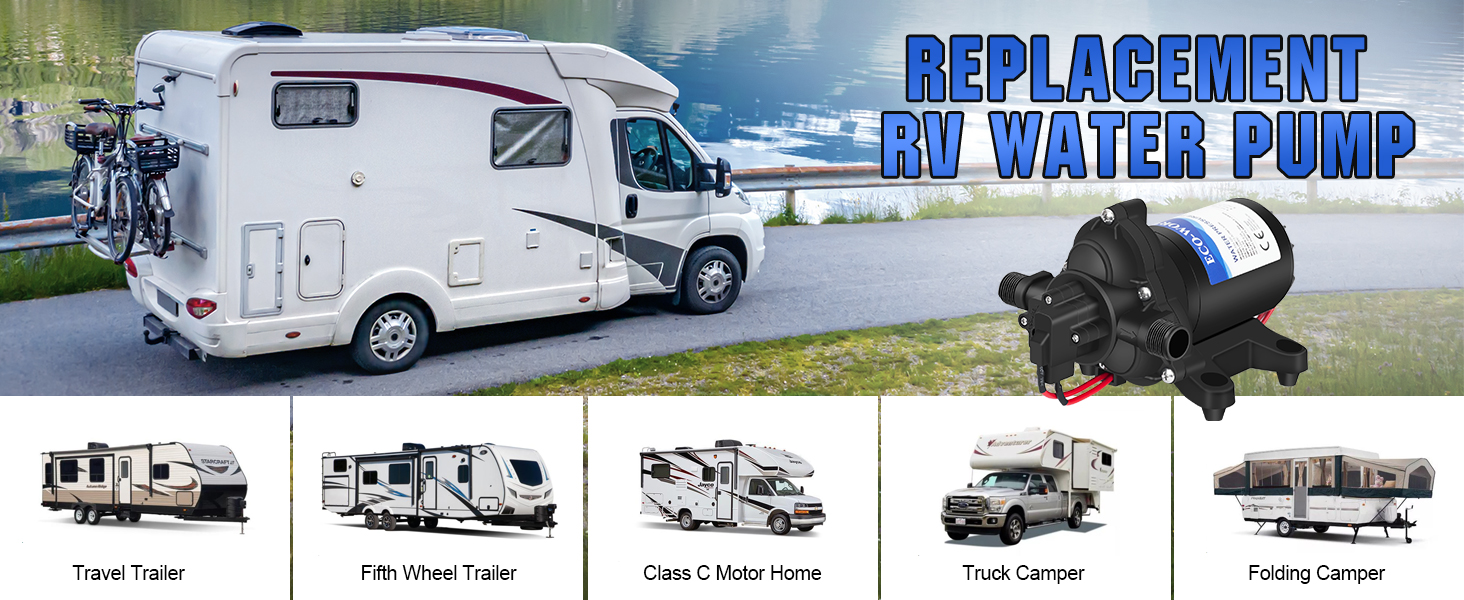
Today we’re talking about the ECO-WORTHY 12V RV fresh water pump—a budget-friendly, on-demand diaphragm pump that a lot of people use as an RV replacement pump, a tank fill pump, or even a booster-style solution when pressure is weak.
Quick Summary
- Best for: RVers who want an affordable 12V on-demand pump with decent pressure for sinks/showers and common RV plumbing setups.
- Biggest upside: Many owners report strong pressure for the money and surprisingly quiet operation when mounted correctly.
- Biggest downside: Fitment quirks (threads/adapters), and a subset of owners report pressure switch issues, cycling, leaks, or early failures.
- My bottom line: Excellent value if you install it like a grown-up (proper strainer, correct fittings, good wiring, vibration isolation). If you need “install it once and forget it for five years,” you may want to compare alternatives first.
For a broader shortlist of proven options, I’d also skim: Best RV Water Pumps for Reliable Pressure
Quick Verdict (TL;DR)
The ECO-WORTHY 12V RV fresh water pump delivers the core thing most RVers want: steady, usable pressure without paying premium-brand pricing. Owners commonly report that it’s a noticeable upgrade over tired factory pumps—especially if your old pump was loud, weak, or inconsistent.
Where the story gets complicated is reliability variance. Based on aggregated owner experiences discussed in these reviews, the 12V versions trend more positive than the 110V variants, but there are still recurring themes: adapter confusion, thread compatibility surprises, and the occasional pressure switch drama (cycling, not shutting off, or failing early).
Confidence Score: 8.1/10 (high value, but install/fitment and long-term variance keep it from a “blind buy” 9+)
If you want to check the current price: See the ECO-WORTHY 12V pump on Amazon
What This Pump Is (In Plain English)
This is a diaphragm-style RV water pump with an on-demand pressure switch. That means:
- You open a faucet → pressure drops → pump turns on.
- You close the faucet → pressure builds → pump turns off.
That on-demand behavior is exactly what you want in most RV plumbing. It’s what makes an RV feel “house-like” even when you’re pulling water from a fresh tank.
If you’re new to how all this plumbing flows together, you’ll get more clarity from this primer: RV Water System 101: How Your RV Gets Water
Key Specs That Matter for RVers (And What They Actually Affect)
Here’s how I think about pump specs in real RV life:
| Spec | Why You Care in an RV | What Owners Typically Notice |
|---|---|---|
| Flow rate (GPM / LPM) | Impacts how “normal” the faucet feels and how quickly the shower recovers | Higher flow feels less restrictive, especially with shower heads |
| Pressure (PSI / bar) | Too low feels weak; too high can stress fittings without a regulator | Many owners feel this pump hits a “sweet spot” when set up right |
| On-demand pressure switch | Prevents constant running | If it’s mis-adjusted or you’ve got leaks/air, you can get cycling |
| 12V DC operation | Works off your RV battery system (USA/Canada typically 12V) | Great for boondocking; wiring quality matters a lot |
Regional note: In the USA/Canada RV world, 12V DC pumps are standard for fresh water. In Australia, many RVs/caravans are also 12V, but shore power is typically 230V—so don’t confuse a 12V RV pump with a 230V mains-powered booster.
Technical Deep Dive (Simple Explanations, Useful Takeaways)
Diaphragm pump vs. centrifugal (why it matters)
A diaphragm pump is the right tool for pressurized RV plumbing because it:
- Can build pressure against closed valves (within limits)
- Works with an on-demand pressure switch
- Handles typical RV intermittent use well
A centrifugal pump is often better for high-flow transfer tasks, but it’s not the default for RV “open faucet, get water” plumbing behavior.
This is why a few owners get disappointed when they try to use certain versions as a “make my sprinkler shoot 30 feet farther” tool. That’s a different job.
The pressure switch is both the magic and the weakness
One pattern that comes up repeatedly is this: when these pumps are working well, the auto on/off feels amazing. When they’re not, the pressure switch becomes the trouble spot (cycling, not shutting off, or failing early).
The good news: a lot of “bad behavior” is caused by install conditions:
- tiny leaks
- air in the inlet line
- restrictive fittings
- poor wiring
- no strainer (debris damages valves/switch behavior)
Key Features (Benefit-Driven + What Owners Actually Experience)
Here’s the feature breakdown in the format you asked for—manufacturer claim vs. real-world reality.
| Feature | What the Manufacturer Says | What It Actually Means (User Experience) | Compared to Competitors |
|---|---|---|---|
| On-demand auto on/off | “Automatic pressure switch” | In real-world use, many users find it turns on/off cleanly when the system is sealed and primed. With tiny leaks or air, it may short-cycle. | Similar to SHURFLO/SEAFLO class pumps, but premium brands tend to have more consistent switches long-term. |
| “Strong pressure” (PSI class) | “High pressure performance” | Many owners report it feels like “normal” water pressure for sinks/showers. A frequent buyer surprise is that the “max PSI” discussion can confuse expectations. | Competes well on feel-per-dollar; premium pumps often win on consistency and longevity. |
| Self-priming behavior | “Self-priming” | Owners commonly report it primes fine in typical RV layouts, but hose length, elevation, and air leaks matter a lot. | Comparable to many diaphragm pumps; transfer-focused pumps can win for raw priming/flow. |
| Included fittings/adapters (varies by package) | “Comes with adapters” | This is the #1 “gotcha” theme: several owners say fittings vary by package, some threads feel non-standard, and cross-threading is easy. | Competitors often use more standardized RV fittings or better documentation. |
| Noise/vibration | “Quiet operation” | Many users find it quiet enough—but mounting matters. Hard-mounting to a resonant surface can make it sound 2–3x louder. | Premium pumps often ship with better dampening and more consistent noise control. |
Step 5: Real User Experience Analysis (Deep Pattern Themes)
This is where the review gets honest.
1) First impressions: “Feels solid… and pressure is immediately better”
Across the owner feedback I analyzed, a recurring theme is that when people unbox it, it feels substantial for the price. When installed as a replacement, many report the first faucet test is a win: better stream, faster tank fills, more usable shower pressure.
Where this shows up most:
- replacing a tired OEM RV pump
- pulling from portable bladders or barrels into an RV fresh tank
- boosting weak supply situations (with the right setup)
If you want to verify current pricing and package options: See it on Amazon
2) “Delivers about 80% of the advertised performance” (and that’s usually fine)
In the reviews I went through, I kept seeing versions of this sentiment: it’s not a miracle pump, but it’s a meaningful upgrade.
Hidden strength: It’s very good at everyday RV water needs:
- morning sink routines
- quick dish wash
- a normal-feeling shower (especially if your old pump was weak)
Hidden weakness: When people ask it to be something else—like a high-pressure sprinkler driver, or a continuous-duty workhorse—complaints spike:
- “not as strong as the PSI number implies”
- pressure sag under constant flow in some setups
- heat buildup when run long
3) Noise is polarizing (because install quality is everything)
Owners commonly report two totally different experiences:
- Group A: “Surprisingly quiet”
- Group B: “Loud, vibrating, sounds like a compressor”
Those can both be true. A diaphragm pump will transmit vibration into whatever it’s mounted to. If you bolt it directly to thin wood or a hollow compartment panel, you’ve basically built a speaker box.
What consistently helps (and shows up in owner workarounds):
- mount on a more solid surface (or add a rubber isolation pad)
- use short flexible hoses on inlet/outlet
- avoid hard plumbing that transfers vibration into the RV structure
If you’re chasing better shower performance overall (not just pump noise), this guide helps too: Troubleshooting Low Water Pressure in Your RV
4) Common pain points (the ones you should plan for)
#1: Fittings, adapters, and “why won’t this thread on?”
A frequent buyer surprise is that thread compatibility isn’t always plug-and-play. Several owners describe:
- needing extra adapters that weren’t included (especially on some 12V packages)
- fittings that feel “metric” or simply not standard NPT
- cross-threading risk because many ports are plastic
My practical take: Assume you may need a quick hardware run. And go slow when starting threads—plastic will lose that battle fast.
#2: Cycling / pulsing / “it turns on when nobody’s using water”
One pattern that comes up repeatedly is intermittent cycling. This is almost always caused by:
- a tiny leak on the pressure side
- air entering the suction line
- a check valve problem
- pressure switch set wrong (or failing)
It’s not unique to this pump, but it’s reported often enough that I’d treat it as a “be ready to troubleshoot” item.
#3: Heat buildup on longer runs
Many owners describe the motor housing getting hot to the touch during longer operation. That’s common for compact pumps, but it becomes a concern if you’re running it for extended periods.
Rule of thumb: This style of pump is happiest with intermittent RV duty (faucets, showers, short transfers). If you need long continuous runs, you may want a different class of pump.
#4: Leaks (from fittings… and sometimes from the pump body)
Some owners report leaks at:
- threaded connections (common, fixable)
- seams/gaskets (more serious)
- filter caps or housings on certain variants
In an RV, any leak inside a compartment is a big deal. If you install this pump in a place where a leak could damage flooring or cabinetry, add a drip pan or route a drain—future you will be grateful.
Owner Stories (The Human Side)
These are retold as real scenarios that show how the pump behaves in the messy real world. If you want to read more firsthand experiences, you can browse them here: Owner feedback on Amazon
Story 1: “We refill the RV tank from a portable bladder—no more slow pours”
From real-world owner feedback, it looks like the pump shines as a tank-fill helper. One camper owner described using the 12V version to pull water from a large portable container into their rig, turning a slow, awkward chore into a smooth routine with consistent flow.
Why it matters: If you boondock or camp where filling from a spigot isn’t convenient, this is one of the most practical uses.
Story 2: “Our RV park pressure was awful—this saved the season”
Another recurring setup: weak campground pressure. One full-timer described using the pump to avoid miserable low-flow situations when the park supply couldn’t keep up.
Important caveat: Booster setups can get tricky. For campground hookups, you still need proper protection and sane pressure management. This guide is worth having bookmarked: Best RV Water Pressure Regulators (and How to Use Them)
Story 3: “It worked great… until the switch started acting up”
On the flip side, there are owners who loved it at first and then ran into classic symptoms: cycling, inconsistent shutoff, or a pump that quits earlier than expected.
The lesson: Install quality (air leaks, fittings, strainer) heavily influences whether you get the “quiet reliable pump” story or the “why is it doing that?” story.
Expert Tips & Installation Hacks (Stuff Owners Learned the Hard Way)
Here are the best “not in the manual” tips that show up repeatedly in owner workarounds:
1) Don’t touch the pressure adjustment until it’s running correctly
More than a few owners basically said: “I adjusted it early and created my own problems.” Get a baseline first. Confirm:
- it primes properly
- it shuts off cleanly
- it doesn’t leak
Then adjust only if you truly need to.
2) Add a strainer/filter and keep it accessible
Debris is a pump killer. A simple inline strainer protects valves and helps the pressure switch behave more predictably.
3) Use flexible lines to kill vibration noise
If you want the “quiet pump” experience, don’t hard-plumb it like a house. Use short flexible connections so vibration doesn’t turn your RV into an amplifier.
4) Wire it like you care about your battery
A 12V pump is only as good as its power delivery:
- correct wire gauge for the run length
- proper fuse
- a solid switch
- tight, corrosion-resistant connections
If your voltage sags under load, pumps act weird—weak pressure, chatter, hot wiring, the whole mess.
If you’re doing a replacement install, this walkthrough pairs well with the practical steps above: How to Replace an RV Water Pump (DIY Step-by-Step)
Installation Overview (Quick, Practical Steps)
What you’ll need
- Basic hand tools
- Inline strainer (strongly recommended)
- Correct fittings/adapters for your RV plumbing
- PTFE tape or appropriate thread seal (where applicable)
- Proper fuse and wiring if you’re rewiring
Step-by-step (typical RV replacement)
- Turn off pump power and relieve pressure (open a faucet).
- Place towels/drip pan under the pump area.
- Disconnect inlet/outlet lines (label if needed).
- Mount the pump with vibration isolation if possible.
- Install a strainer on the inlet side.
- Connect plumbing carefully (avoid cross-threading).
- Wire the pump with correct polarity and fuse protection.
- Prime and test: check leaks, verify shutoff, confirm steady pressure.
- Only then consider fine pressure adjustments.
Comparison Snapshot: Where This Pump Fits
I’m not going to pretend this is a premium pump with premium consistency. What it is—based on owner feedback—is a strong value-tier option.
| Category | ECO-WORTHY 12V Pump | Typical Premium RV Pump |
|---|---|---|
| Price/value | Often excellent | Higher cost, usually steadier long-term |
| Install friendliness | Can be finicky with fittings | Usually more standardized documentation/fittings |
| Noise control | Good if mounted well | Often more consistent out of the box |
| Reliability variance | Mixed (some early failures) | Typically better track record |
If you want to compare the most common alternatives side-by-side, start here: Best RV Water Pumps for Reliable Pressure
The Good, The Bad & The Ugly (Pros/Cons)
Pros (What people consistently like)
- Strong pressure for the price in typical RV faucet/shower use
- On-demand auto on/off works well when the system is sealed and primed
- Many owners report quiet operation, especially on the 12V variants
- Useful beyond RVs (tank fills, winterizing, portable water transfers)
Cons (The honest drawbacks)
- Fitting/thread quirks are common enough to be expected
- Plastic threads can cross-thread or fail if forced
- Reports of pressure switch issues (cycling, not shutting off, failing)
- Some owners report leaks or early failures, especially under harsh use or long run times
- Documentation/packaging consistency complaints (what’s included can vary)
Ugly (The “plan for it” risks)
- A pump that doesn’t shut off can run your battery down or overheat
- A leak in an RV compartment can cause real damage if unnoticed
- Continuous-duty use is where disappointment spikes—this isn’t a forever industrial pump
Who Is This For?
Buy it if you’re this person
- You want a budget-friendly RV water pump replacement and you’re comfortable doing a careful install.
- You’re okay with potentially buying a couple of fittings/adapters to make it perfect.
- You want solid everyday pressure for sinks, showering, and normal RV routines.
If that sounds like you, check the current listing here: ECO-WORTHY 12V RV pump on Amazon
Skip it if you’re this person
- You need continuous-duty operation or high-head performance.
- You want “absolutely standardized fittings, zero tinkering.”
- You’re installing it in a location where even a small leak would be catastrophic, and you don’t want to add leak protection.
If your main issue is weak shower performance specifically, I’d troubleshoot the whole system first: Troubleshooting Low Water Pressure in Your RV
Deep-Dive FAQ (High-Intent Questions)
1) Will this pump make my RV shower pressure stronger?
Often, yes—especially if your existing pump is worn out. But your shower experience also depends on the shower head restrictor, plumbing leaks, and pressure regulation. If pressure is inconsistent, troubleshoot the system, not just the pump.
2) Why does an on-demand pump “pulse” when nobody is using water?
That’s usually a tiny leak, air in the suction line, a check valve issue, or a pressure switch that’s misadjusted/failing. Start by checking fittings and the strainer area for micro-leaks.
3) Is it actually quiet?
It can be—if you mount it correctly. Hard-mounting on thin panels or rigid plumbing can make it sound dramatically louder. Use vibration isolation and short flexible hoses if noise matters to you.
4) Do I need extra fittings/adapters?
Possibly. This is one of the most common owner complaints: some packages include adapters, others require you to source the right pieces. Take your time with plastic threads and avoid forcing connections.
5) Is it okay for boondocking on battery power?
Yes, that’s the point of a 12V RV pump. Just wire it properly (correct gauge, proper fuse, good connections). Poor wiring causes voltage drop—and voltage drop causes weird pump behavior.
Final Verdict
If you want the cleanest summary: the ECO-WORTHY 12V RV fresh water pump is a high-value pump that can absolutely improve daily RV life—as long as you install it carefully and treat fittings/wiring like they matter (because they do).
Based on aggregated owner experiences discussed in these reviews, the 12V versions earn a lot of genuine praise for pressure and usability. The “ding” is consistency: enough people run into cycling, switch issues, leaks, or early failures that you should treat this as a value play—not a “set it and forget it for a decade” investment.
Want to see the current price and package options? Check the ECO-WORTHY 12V pump on Amazon