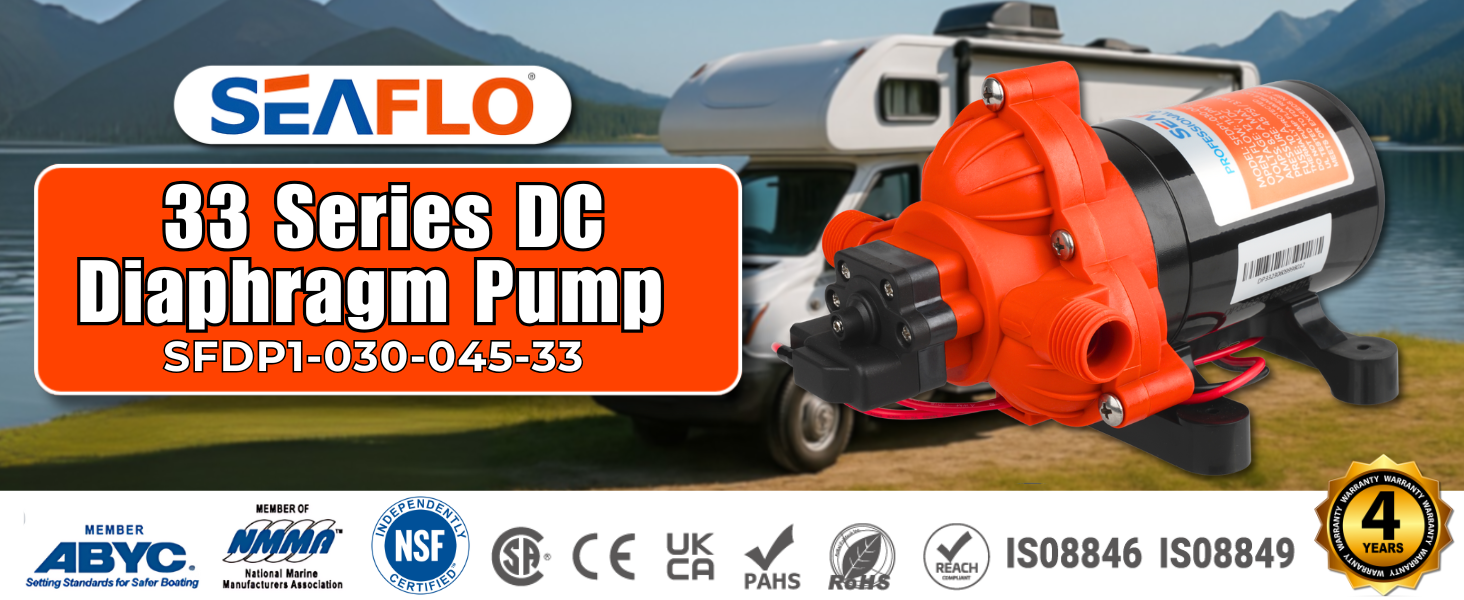
SEAFLO 33 Series RV Water Pump Review: Quieter Showers, But Watch the Pressure Switch
Affiliate Disclaimer: This article contains affiliate links. If you click through and make a purchase, I may earn a small commission at no extra cost to you. This helps support my deep-dive research.
Quick Summary (TL;DR)
If your factory pump thumps like a woodpecker under your bed at 2 a.m., the SEAFLO 33 Series RV water pump is often the kind of upgrade that makes your rig feel instantly more “home-like.” Across the owner feedback I analyzed, people repeatedly praised:
- Noticeably quieter operation than many stock pumps (especially when paired with an accumulator tank)
- Easy, plug-and-play replacement in many RVs and trailers
- Strong, usable flow and pressure for normal faucets, showers, and toilets
But here’s the honest catch: a meaningful chunk of owners report pressure switch failures, overheating, and premature failures—especially if the pump is used in continuous-duty or outdoor applications, or if a unit develops a “won’t shut off” issue.
If you want the short recommendation: it’s a great “comfort upgrade” when you get a good unit and install it correctly—but it’s not the most confidence-inspiring pick if you’re full-time, remote, or hate repeat repairs.
The Real RV Water Problem Isn’t ‘No Water’—It’s ‘Bad Water Vibes’
I’ve seen a lot of RV upgrades that sound important but don’t change your daily life. A water pump upgrade is the opposite.
Because when your pump is annoying, it’s not just annoying—it’s sleep-ruining. It’s the harsh buzzing under the bed. It’s the faucet pulsing while you’re trying to rinse dishes. It’s the “do I really want to flush right now?” hesitation.
That’s why I went deep into real-world owner experiences with the SEAFLO 33 Series RV water pump—to figure out what actually changes after install, what problems show up later, and whether this is one of those upgrades that makes your rig feel instantly more livable… or one that turns into a repeat repair project.
If you’re still learning how your system works end-to-end, it helps to understand the plumbing flow first:
Quick Verdict (The TL;DR)
My bottom line: The SEAFLO 33 Series RV water pump (3.0 GPM / ~11.4 LPM, 45 PSI / ~3.1 bar) is frequently praised as a quiet, easy replacement that restores “normal” faucet/shower pressure—especially when paired with an accumulator tank and vibration isolation.
Confidence Score: 7.4/10
Why not higher? Because the most consistent negative theme is pressure switch reliability and overheating, including units that won’t shut off (battery drain risk) or fail early.
If you’re ready to check current pricing:
Where This Pump Fits in the RV Water Pump World
Most RVs and travel trailers use an on-demand 12V DC diaphragm pump. You open a faucet, pressure drops, the pump turns on. You close the faucet, pressure rises, the pump shuts off.
That “on-demand” experience is what makes your RV feel like a tiny house instead of a camping setup.
If you’re comparing options, I’d strongly recommend starting here first, because it frames the whole category and shows alternatives:
(That list helps you sanity-check whether you really want 3.0 GPM at 45 PSI, or if your rig will be happier at a slightly lower pressure.)
Technical Deep Dive: What the SEAFLO 33 Series Actually Is
The SEAFLO 33 Series is a 12V DC diaphragm pump designed for pressurized, on-demand water. “Diaphragm pump” matters because it’s self-priming, can run dry briefly, and handles intermittent cycling well—when everything is healthy.
Key specs you should care about (in real RV terms)
- Voltage: 12V DC (common in USA/Canada RVs and Australian caravans)
- Rated flow: 3.0 GPM (~11.4 L/min)
- Pressure: 45 PSI (~3.1 bar)
- On-demand pressure switch: automatic start/stop
- Inline strainer: included in many packages (helps protect valves/diaphragm)
- Vibration isolation: rubber feet help, but install details matter more
The part that makes or breaks the experience: the pressure switch
In real-world use, the pressure switch is both the magic and the risk.
- When it works correctly: the pump gives you that “regular faucet” feeling.
- When it fails (or gets fooled by leaks/air): the pump may cycle, run long, overheat, or not start.
A frequent buyer surprise is how many “pump problems” end up being:
- A tiny suction-side air leak
- A clogged strainer
- A fitting/thread mismatch causing restriction
- Or a failing pressure switch that creates weird behavior
If you’re already fighting low pressure, this guide helps diagnose before you blame the pump:
Key Features (Benefit-Driven & Comparative)
Here’s the exact “marketing vs reality” breakdown RVers actually care about.
| Feature | What the Manufacturer Says | What It Actually Means (User Experience) | Compared to Competitors |
|---|---|---|---|
| 3.0 GPM flow | “High flow, strong output” | Feels like a real upgrade from weak 1.2–2.0 GPM pumps; enough for normal showering and dish duty. Restrictions and hose size can reduce real output. | Often a step up from budget pumps; similar “rated” class to many mainstream RV units. |
| 45 PSI pressure | “Stable pressure” | Many owners report strong pressure—sometimes too aggressive for older plumbing without an accumulator (pulsing/vibration). | Some competitors run 35–40 PSI which can feel smoother in older rigs. |
| Self-priming | “Easy prime” | Frequently reported as quick and hassle-free—unless suction side has air leaks, high lift, or restrictive fittings. | Comparable to other diaphragm pumps; install quality matters more than brand here. |
| Quieter operation | “Low noise” | A big win in many RV installs—especially when mounted correctly with flex lines and/or an accumulator. But a subset still report loud cycling and cabinet rattles. | Often described as quieter than many stock pumps; not universally “silent.” |
| 4-year warranty | “Long warranty coverage” | Owners have mixed experiences: some get quick help; others report frustrating processes, registration issues, or shipping costs. | Some competitors have simpler warranty workflows; varies by seller and region. |
First Impressions vs. 6-Month Reality: The Pattern I Kept Seeing
First impression (very common)
In the reviews I went through, I kept seeing variations of:
- “Feels solid for the price”
- “Easy install”
- “Much quieter than the old pump”
- “Pressure is back immediately”
This is the honeymoon phase: you replace an old, worn, rattly pump, and anything healthy feels like a miracle.
Reality after months (where the story splits)
One pattern that comes up repeatedly is that owners fall into two camps:
Camp A: “Set it and forget it” (happy owners)
- Quiet operation stays quiet
- Pressure stays stable
- Works great with an accumulator tank
- Some even buy a second as a spare
Camp B: “Why is this pump cooking itself?” (unhappy owners)
- Overheating episodes
- Pressure switch failure (won’t shut off, won’t start, cycles oddly)
- Early failures within weeks/months in some cases
- Battery drain when the pump runs unexpectedly
That split is why my confidence score lands in the 7’s, not the 9’s.
The Installation Details That Decide Whether You’ll Love It
If you want the best odds of getting the “quiet upgrade” experience, install is everything. These are the practical moves owners kept repeating.
1) Add an accumulator tank (seriously)
Based on aggregated owner experiences discussed in these reviews, pairing this pump with an accumulator tank often:
- Reduces pulsing at the faucet
- Reduces rapid cycling
- Makes the pump sound quieter (less hammering/vibration)
- Makes showers feel smoother
If you’re chasing that “home-like” water feel, the accumulator is the cheat code.
2) Use flex hoses to isolate vibration
Hard PEX straight into the pump can turn your entire RV into a speaker cabinet.
A common workaround found by owners was:
- Short braided flex lines (or flexible hose sections) on inlet/outlet
- Mounting the pump so it doesn’t touch cabinet walls
- Rubber isolation (included feet help, but don’t fix everything alone)
3) Don’t “force-fit” threads or fittings
A frequent buyer surprise is the port/thread situation. Some owners report that:
- Standard 1/2″ NPT fittings don’t always thread as expected
- Plastic threads can be easy to cross-thread
- Some setups work perfectly with included barbs; others require careful adapter selection
If your existing lines don’t align, don’t brute-force it. That’s how threads strip or housings crack.
4) Wire it like an RV component, not a science fair project
This is a 12V DC pump. It can draw meaningful current—especially at startup or under load.
Real-world wiring tips (USA/Canada/Australia 12V systems):
- Use an appropriately sized fuse close to the power source
- Use adequately thick wire (voltage drop can cause weird behavior)
- If your pump is far from the battery/converter, wire gauge matters more
If your pump ever runs hot, cycles oddly, or dims lights, treat that as a wiring/voltage-drop clue—not just “pump drama.”
Step 5: Real User Experience Analysis (Deep Pattern Analysis)
Here’s the honest pattern map—what people love, what breaks, and what triggers the ugly stories.
What owners consistently love
1) Noise reduction (when installed right)
From real-world owner feedback, it looks like a large share of buyers purchase this pump for one reason: less noise. Nighttime bathroom trips become less disruptive. The “thump-thump” under the bed becomes a faint tapping or hum.
2) On-demand faucet feel
A big quality-of-life win is getting away from weird pump timing and back to: open faucet → water is there → close faucet → pump stops cleanly.
3) “Good enough” pressure for normal RV living
Owners commonly report solid pressure for:
- sinks
- showers
- toilet flushes
- basic two-fixture usage in smaller rigs
The hidden weakness: overheating + pressure switch failures
The most repeated serious complaint is some version of:
- pump gets burning hot
- pump won’t shut off
- pump shuts down on thermal protection
- pump becomes unreliable after heat events
- batteries drain when pump runs unexpectedly
This is not a minor annoyance. In an RV, a pump that won’t shut off can:
- drain your battery bank
- overheat wiring if it’s not fused correctly
- create a safety concern if it’s mounted near materials that don’t love heat
If you ever notice your pump staying on when all faucets are off, treat it as a “stop and diagnose now” situation.
Where reliability complaints cluster
In real-world use, many users find failures happen more often in these scenarios:
- Continuous-duty or timed outdoor use (sprayers, irrigation, long runtimes)
- Installations where the pump is left powered continuously and a switch problem develops
- Units that appear to have QC variance (some last years, some fail quickly)
If you want to compare alternatives before committing, start here:
SEAFLO 33 Series Specs (and What They Mean in Your RV)
| Spec | What it is | What it means for you |
|---|---|---|
| 3.0 GPM (~11.4 L/min) | Flow rating | Plenty for typical RV faucets and showers. Restrictions reduce real flow. |
| 45 PSI (~3.1 bar) | Shutoff pressure target | Strong pressure. In older rigs, can cause vibration unless you add an accumulator. |
| 12V DC | Power | Works with RV house batteries and converters. Wiring quality matters. |
| On-demand switch | Auto control | Great when healthy. Main failure point when unhappy. |
| Inline strainer | Debris protection | Helps protect valves and diaphragm. Keep it clean. |
The Good, The Bad & The Ugly (Pros/Cons)
Pros (the “good” themes)
- Quieter than many factory pumps in a lot of installs
- Strong pressure and quick prime for everyday RV use
- Easy replacement for many rigs (10–15 minute swaps are common)
- Good value when you get a solid unit
- Works even better with an accumulator tank and vibration isolation
Cons (the “bad” themes)
- Pressure switch failures show up repeatedly (won’t shut off / won’t start / cycles oddly)
- Overheating complaints are not rare, especially in continuous-duty or problematic units
- Fitting/thread confusion can create install frustration
- Some reports of missing parts/instructions or packaging issues
- Warranty experiences are mixed (some quick support, others report hassle)
The Ugly (the deal-breaker scenarios)
- Pump runs when it shouldn’t → battery drain
- Pump gets extremely hot → potential safety concern if ignored
- Early failures that force another replacement (and nobody wants to do this job twice)
Owner Stories (The Human Side)
These are the kinds of “this is why I bought it” stories that kept popping up.
Story #1: The “We Can Finally Use Water at Night” Upgrade
One common scenario: the stock pump is mounted under the bedroom or near sleeping areas. Owners describe a constant tension—“please don’t flush at night.” After installing the SEAFLO and isolating it better (often with an accumulator), the pump becomes a faint background sound instead of a wake-up event.
If you want to browse more owner experiences directly:
Story #2: The Quick Swap That Feels Like a New RV
Another frequent pattern: older RVs with worn pumps develop noise, vibration, and even cracked plumbing fittings from shaking. After replacement, owners describe:
- immediate pressure restoration
- smoother faucet use
- less pipe chatter
And for many, that’s the whole win: your RV stops feeling “tired.”
(If you’re doing the job yourself, this is the cleanest step-by-step I’d follow.)
Story #3: The “Worked Great… Until It Didn’t” Frustration
The most painful stories are the ones where the pump works beautifully—then overheats or stops shutting off, often mid-trip. Those owners tend to end up:
- turning the pump on/off manually every time they need water
- replacing the pressure switch
- or switching brands entirely
If you’re a full-timer or you boondock far from parts, this is the scenario you’re trying to avoid.
Expert Tips & Installation Hacks (Stuff Owners Learn the Hard Way)
Here are the pro-level, real-world tips that aren’t always obvious on day one:
- Take a photo of the serial number before installing
Some owners regretted installing in a tight bay and then realizing warranty registration needed info they couldn’t easily access. - Mount it with air space and avoid “cabinet contact”
Even a quiet pump can get loud if it’s physically touching wood panels or hard plumbing that resonates. - If you see pulsing, don’t blame the pump first—add an accumulator
Pulsing and faucet shake are often system behavior at 45 PSI. An accumulator usually fixes the feel. - Treat overheating as a diagnosis trigger
If the pump gets too hot to touch, don’t normalize that. Check:
- suction-side air leaks
- clogged strainer
- restricted fittings
- voltage drop / undersized wire
- pressure switch behavior (won’t shut off)
Who This Pump Is For (and Who Should Skip It)
Buy it if you’re this person:
- You want a quieter upgrade from a loud factory pump
- Your use is typical RV duty: sinks, toilet, shower
- You’re willing to install it properly (accumulator + isolation is ideal)
- You want good value in a 3.0 GPM / 45 PSI class pump
Skip it (or at least think twice) if:
- You need continuous-duty pumping (sprayers, irrigation timers, long runtimes)
- You’re full-time and can’t tolerate the risk of a pressure switch failure mid-week
- Your pump bay has poor ventilation and you’ve had heat-related pump issues before
- You want the absolute highest confidence, “replace it once and forget it” vibe
If you want to compare with other proven RV options, this roundup is the fastest way to shortlist:
SEAFLO 33 Series vs Competitors (Quick Comparison Table)
This is the practical decision view—what you’re really trading.
| Pump Option | Typical Strength | Typical Tradeoff | Best For |
|---|---|---|---|
| SEAFLO 33 Series (3.0 GPM / 45 PSI) | Often quieter, strong pressure, good value | Mixed reliability reports (pressure switch/overheat) | Comfort-focused upgrades on a budget |
| SHURFLO-style mainstream RV pumps | Widely used, familiar parts ecosystem | Often louder / more vibration unless isolated | Buyers who prioritize parts availability and familiarity |
| Flojet-style options | Smooth, stable operation for many rigs | Often higher cost | Older rigs that dislike higher PSI pulsing |
| Higher-end multi-chamber pumps (Remco-type) | Strong performance with smoother delivery | Cost and sometimes more install complexity | Full-timers chasing premium “house-like” feel |
If you want to go deeper into picking the right flow/pressure for your exact rig, I’d start here:
Deep-Dive FAQ (High-Intent Questions)
1) Is the SEAFLO 33 Series actually quiet in an RV?
In real-world use, many users find it much quieter than their stock pump—but “quiet” depends heavily on:
- vibration isolation
- flex lines vs hard lines
- whether you add an accumulator
- where it’s mounted (bedroom-adjacent bays are unforgiving)
2) Do I need an accumulator tank with this pump?
You don’t need one for basic operation, but if you want:
- smoother flow
- less cycling
- less pulsing
- less cabinet rattle
…it’s one of the best add-ons you can do with a 45 PSI pump.
3) Why does my pump overheat or keep running when all faucets are off?
That symptom often points to one of these:
- a leak (even a tiny one) that never lets pressure stabilize
- suction-side air leak causing weird cycling
- clogged strainer / restriction
- voltage drop making the pump behave unpredictably
- or a pressure switch issue that fails to read pressure correctly
If it won’t shut off, don’t ignore it—especially in an RV electrical environment.
4) Can I use this pump for outdoor sprayers, irrigation, or long continuous runtimes?
That’s where many negative experiences cluster. Owners using it for long-duty or outdoor cycles more often report overheating or shutdowns. For RV fresh-water systems (intermittent on-demand), it’s a better fit.
5) What’s the #1 install mistake people make with this pump?
Forcing fittings/threads or creating restrictive plumbing that chokes flow. The second most common: mounting it in a way that transfers vibration into the RV structure.
Final Verdict
If you’re upgrading from an older, rattly factory pump, the SEAFLO 33 Series RV water pump can feel like an instant comfort win: better pressure, easier on-demand behavior, and often dramatically less noise—especially with an accumulator and flex-line isolation.
But I can’t sugarcoat the downside: the owner feedback includes a consistent thread of pressure switch and overheating reliability issues in a non-trivial number of cases. If you’re the kind of RVer who hates repeat repairs—or you’re full-time and remote—you should compare alternatives before deciding.