BougeRV Arch 200W Flexible Solar Panel Review – Big Output in a Low-Profile RV Setup?
Affiliate Disclosure: This post contains affiliate links. If you buy through them, we may earn a commission at no extra cost to you.
RV solar sounds simple until you’re on the road and reality shows up: roof curves, wind, heat, weird campground shade, and that one time you realize your “200W” panel isn’t behaving like 200W.
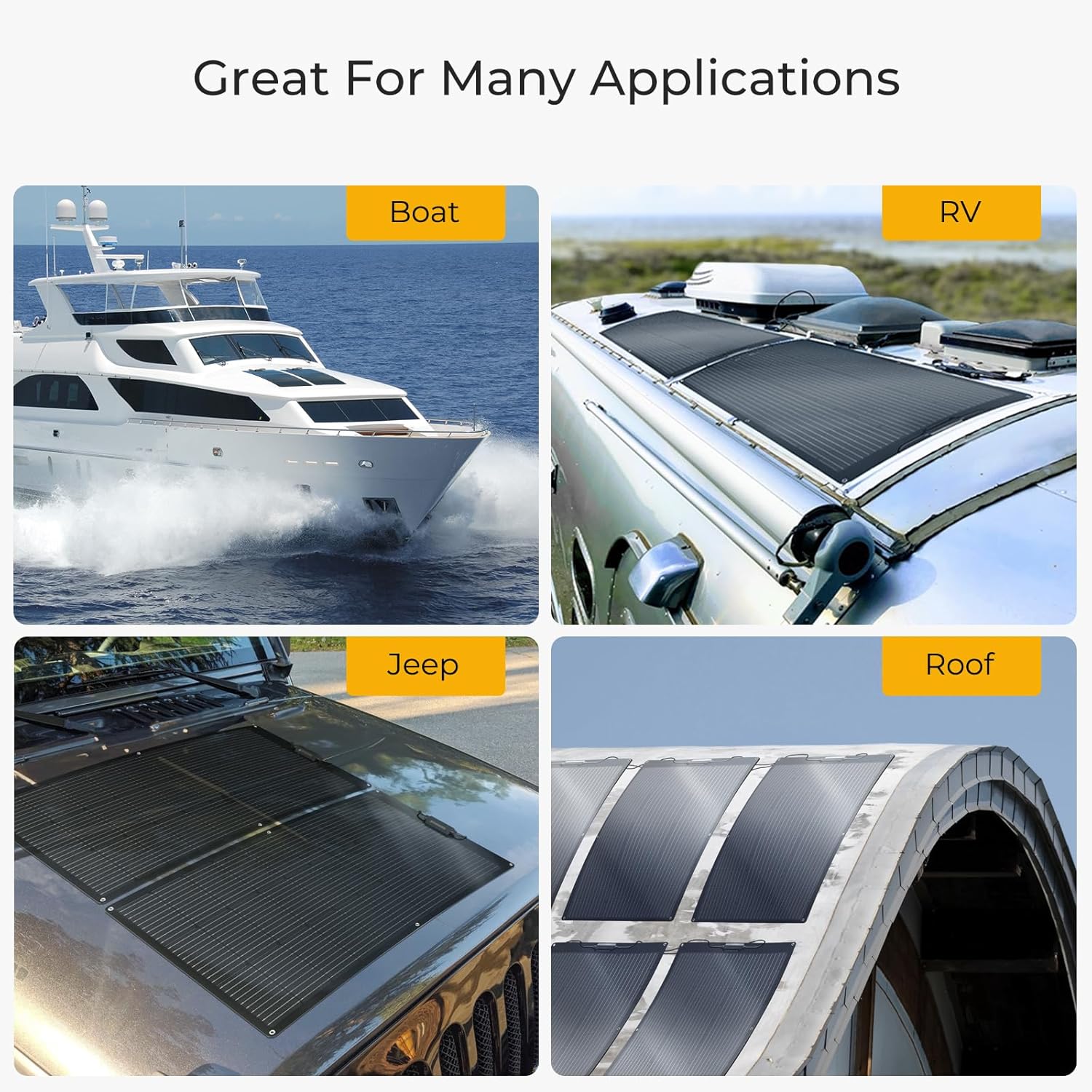
The BougeRV Arch 200 Watts Flexible Solar Panel is popular because it promises a high-wattage, low-profile setup that can conform to gentle curves—perfect for RV roofs, skoolies, vans, and even boat biminis. But Amazon owner feedback shows a clear theme: when it’s good, it’s very good; when it’s bad, it can be frustrating (and in a few cases, concerning).
If you’re still deciding how much solar you actually need, start with How to Size Your RV Solar System (Panels + Batteries)—it’ll save you from buying too much (or not enough).
Quick Verdict
For many RVers and boaters, the BougeRV Arch 200W is a strong performer with excellent real-world output for a flexible panel, plus the low-profile look people want on curved surfaces. However, a meaningful minority of owners report delamination, shipping damage, and occasional electrical/connector issues—so it’s best for buyers who will inspect, test immediately, and install thoughtfully.
👉 Ready to check price and owner photos?
See the BougeRV Arch 200W Flexible Solar Panel on Amazon (opens in a new tab)
Quick Summary (what matters most)
- Best for: curved roofs (skoolies/vans), low-profile installs, boats/biminis, and anyone trying to avoid roof rack height.
- Real output (owner-reported): commonly 130–180W in strong sun; some report near 200W; others report much lower when conditions or mounting aren’t ideal.
- Durability (mixed): many long-trip success stories (thousands of miles; months at sea), but repeated complaints about delamination from some buyers.
- Install sensitivity: flexible panels can be more sensitive to heat, airflow, surface prep, and adhesive choice than rigid glass panels.
What This Product Is (and why RVers buy it)
The BougeRV Arch 200W flexible panel is designed to give you high wattage without the bulk of a traditional rigid glass panel. The big appeal is that it can conform to gentle curves, so your roof install looks cleaner—and it can be mounted where rigid panels would be awkward.
In practical RV terms, you’re using it to:
- recharge your house battery bank (often 12V in the US/Canada and many Australian rigs, sometimes 24V on larger setups),
- keep a power station topped up, or
- run day-to-day loads like 12V fridges, lights, fans, routers, and device charging—especially when you’re boondocking.
Key specs at a glance (as described by owners)
Note: values below reflect what owners referenced in reviews and typical usage scenarios—not lab certification data.
| Spec / Attribute | What owners referenced | Why it matters for you |
|---|---|---|
| Rated power | 200W class panel | Helps you plan daily energy harvest and system sizing |
| Size (approx.) | 58.1 × 31 × 0.08 in (147.6 × 78.7 × 2.0 mm) | Big footprint; measure roof/bimini space carefully |
| Weight (approx.) | ~7 lb (~3.2 kg) mentioned by owners | Easier handling vs many rigid panels |
| Flexibility | Bends to match gentle curves | Useful for skoolies, vans, rounded RV roofs |
| Typical use | RV roofs, skoolies, boats/bimini tops, trailers | Real-world versatility shows up repeatedly in feedback |
Real-World Owner Snapshot
Here’s the “consensus view” you can take to the bank:
Most common praise
- Surprisingly strong output for a flexible panel (multiple owners report 165W–180W+ in good sun; a few report near-rated performance).
- Low-profile, clean installs on curved surfaces (skoolie roofs and boat biminis show up a lot).
- Lightweight and easy to handle compared to rigid panels.
Most common complaints
- Delamination concerns from a subset of buyers (some reported repeated failures across multiple panels).
- Shipping/packaging damage (cracked/broken on arrival).
- Wiring/connector issues reported by a few (short leads, polarity/termination complaints, overheating/connector damage in rare cases).
Best for / Not ideal for
- Best for: DIYers who will inspect/test quickly, want low-profile mounting, and can manage mounting/airflow correctly.
- Not ideal for: “install it and forget it forever” buyers who don’t want to troubleshoot, or anyone who needs maximum durability with the lowest risk profile (rigid panels typically win there).
👉 Want to see current pricing and the latest owner photos?
Check the BougeRV Arch 200W on Amazon (opens in a new tab)
What Real Owners Like (Pros)
1) Real output that often feels “at spec” in strong sun
A lot of 5-star feedback focuses on the same point: in strong, direct sunlight, owners commonly see output that feels legitimately “200W-class,” with several reporting high-100s (and occasional near-200 readings). That’s a big deal because flexible panels often underperform their label in the real world.
Why you care: If your goal is boondocking reliability—keeping a power station charged, running a 12V fridge, or recovering from overnight battery draw—higher real output translates directly into less generator time.
2) Great fit for curved roofs (skoolies and vans especially)
One skoolie owner described mounting multiple 200W panels on a gently curved bus roof and being happy with both the clean look and long-distance durability (thousands of miles reported).
Why you care: Curved surfaces are where flexible panels are supposed to shine. If your rig has roof curvature that makes brackets awkward, this is one of the strongest “yes” arguments.
3) Survives real travel: heat, rain, highway speeds (many reports)
There are multiple stories of these panels staying put through highway miles, rain, and hot conditions. Boaters also reported good experiences on bimini tops and frames, including wind-heavy conditions.
Why you care: RV roofs experience vibration and wind load constantly. If a panel can’t handle travel, nothing else matters.
4) Lightweight handling and “place it almost anywhere” flexibility
Several owners call out how easy it is to mount, move, or position because it’s light and not framed like a rigid panel.
Why you care: Weight and handling matter if you’re doing a DIY install or you want the option to temporarily position panels for better sun.
5) Customer support (often praised, not universally)
A number of reviewers who had an issue said support sent replacements quickly after they provided photos and details.
Why you care: With flexible panels, warranty experience is part of the value. Owner reports suggest support can be strong—though not every buyer felt that way (see cons).
What Real Owners Complain About (Cons)
1) Delamination reports (this is the biggest red flag theme)
A cluster of negative reviews focuses on delamination—the layered construction separating over time. Some buyers described multiple panels failing, and at least one framed it as a safety concern.
How to interpret it:
- Many owners report long-term success, but delamination appears frequently enough that you should take it seriously.
- Flexible panels tend to run hotter than rigid glass panels, and heat management plus mounting method can influence longevity.
2) Shipping damage and “arrived broken”
Some 1-star reviews weren’t about performance at all—panels arrived with crushed packaging and cracks/breaks.
What to do: Inspect immediately on delivery, photograph any damage, and test output early so you’re not discovering issues after your return window.
3) Output complaints (often tied to mounting angle, heat, and expectations)
While many buyers are thrilled, some report disappointing output—sometimes extremely low compared to expectations.
Reality check: Solar output depends heavily on:
- sun angle (morning/late afternoon drops hard),
- partial shading (even a small shadow can reduce power dramatically),
- roof heat and airflow,
- controller type and settings (MPPT vs PWM), and
- wiring losses (length, gauge, connections).
4) Adhesion and mounting method sensitivity
One buyer reported a panel coming loose quickly at highway speed and later being told it wasn’t recommended for their roof type (fiberglass).
Takeaway: Surface prep and adhesive selection matter a lot. Flexible panels are less forgiving than bracket-mounted rigid panels.
5) Electrical/connector complaints (rare, but important)
A few reviews mention concerns like:
- very short or thin leads,
- fixed termination position (limits routing choices),
- connector overheating/damage in one case,
- polarity/connector wiring complaints in another.
Takeaway: These are not “everyone issues,” but they’re the type you want to catch early with inspection and testing.
Real-World Performance: What Output Can You Expect?
Based on owner reports, here’s a practical way to set expectations:
Typical reported numbers (owners)
- Near-rated performance: Some owners reported close to 200W in strong sun under good conditions.
- Common “good day” range: Many reports cluster around 130–180W depending on location, season, and aiming.
- Suboptimal conditions: Winter sun, imperfect angle, haze/clouds, or roof heat commonly pulls output down.
A simple “expectations” table
| Scenario | What owners commonly reported | What it means for you |
|---|---|---|
| Peak midday sun, good angle, good controller | High-100s (sometimes near 200W) | Best-case recharge window; great for fast recovery |
| Good sun but imperfect aim / seasonal sun | 130–165W is commonly mentioned | Still very usable for fridge + daily charging |
| Cloudy / low sun angle / partial shade | Noticeable drop | Plan buffer capacity (battery Ah) and/or more panel area |
| Multiple panels (series/parallel) | Some owners reported strong combined totals | System design matters as much as panel choice |
Tip: If you’re planning a full system, panel wattage is only one piece. Your battery capacity in Ah (amp-hours), your controller, and your daily loads determine whether 200W feels like “plenty” or “not enough.” For a sizing walkthrough, use How to Size Your RV Solar System (Panels + Batteries).
Installation & Usage Tips (pulled from real owner habits)
Flexible panels reward careful installs. Here’s what owners repeatedly did (and what you should consider doing).
Roof-mount install (step-by-step best practice)
- Dry-fit the panel first
Make sure the panel lands where you want it and won’t be shaded by AC shrouds, antennas, or roof rails. - Inspect the panel edges and surface
Look for bubbling, lifting edges, cracks, or irregularities. If anything looks wrong, document it immediately. - Test output before permanent mounting
In full sun, do a quick performance sanity check. You’re not chasing perfection—just confirming it’s behaving like a 200W-class panel. - Plan airflow and heat management
Several owners intentionally created a small air gap (even minimal) or avoided fully “sealing” the entire back surface to reduce heat buildup. - Use a mounting method that matches your roof material
Owners mentioned using heavy-duty tape, butyl-style tape, Velcro-based approaches, and edge-securing tape on the leading edge. The common theme: secure the leading edge against wind lift and don’t rely on “weak adhesion” to carry highway wind loads. - Strain-relieve the cables
Don’t let the cable tug on the panel termination point. Vibration over miles is real. - Re-check after your first drive day
Do a quick rooftop inspection after 20–50 miles and again after a week. Catch lift early.
Portable / “move it to the sun” usage
A few owners used these panels in more portable ways—on trips, on boats, or for ground placement. The big advantage is you can chase sun when your campsite is shaded.
Practical note: If you’ll move it often, pay attention to lead length, routing, and where the connectors naturally land.
Troubleshooting low output (quick checklist)
If your wattage feels wrong, check these before blaming the panel:
- Are you in midday sun or low angle sun?
- Is there any shade (even a small one)?
- Is your controller actually MPPT (Maximum Power Point Tracking) and configured correctly?
- Are your connections tight and dry?
- Is the panel surface very hot with no airflow?
- Are you measuring at the controller display vs a power station input vs a meter?
For a deeper system-wide troubleshooting approach, keep this bookmarked: RV Solar Maintenance & Troubleshooting Guide.
Who This Panel Is Best For (and who should skip)
Best for you if…
- You have a curved roof (skoolie/van/rounded RV roof) and want a low-profile look.
- You value lighter weight handling and easier DIY placement.
- You’re comfortable doing a smart install (test early, mount carefully, manage cables).
- You’re building a boondocking setup where real output matters, and you’re okay with solar’s variability.
Skip this if…
- You want the lowest-risk long-term durability and you have room for rigid panels (rigid glass panels often win on longevity).
- You don’t want to deal with any chance of delamination or shipping damage drama.
- Your roof material/adhesive situation is uncertain and you can’t confidently secure against wind lift.
If you’re starting from scratch and want a beginner-friendly wiring walkthrough, pair this review with DIY RV Solar Installation Guide (Step-by-Step).
Pros & Cons (at a glance)
Pros
- Strong real-world output reported by many owners for a flexible panel
- Low-profile look; conforms to gentle curves
- Lightweight; easier DIY handling
- Many success stories on RV roofs and boat biminis
- Support experiences often positive (replacements sent quickly in several cases)
Cons
- Delamination appears in a noticeable set of negative reviews
- Some shipping/packaging damage reports
- Output complaints from some buyers (often tied to mounting/conditions, but still a real risk)
- Adhesive/mounting method can make or break the experience
- A few reports of connector/wiring issues (rare, but important)
FAQ
Does a “200W” flexible panel actually put out 200W?
Sometimes, under strong midday sun with ideal conditions, owners reported close to rated output. More commonly, real-world numbers vary widely with sun angle, heat, shading, and controller setup.
Is a flexible panel good for an RV roof?
It can be—especially if your roof is curved and you want low-profile mounting. But flexible panels tend to be more install-sensitive than rigid panels. Mounting method and airflow management matter.
Can I use this with a power station?
Many owners used it with popular power stations. The key is matching the panel output characteristics to your power station’s solar input limits and connector type.
Why do some people see low wattage?
Common reasons are low sun angle, partial shade, roof heat, wiring/controller losses, or imperfect positioning. A quick pre-mount test and basic troubleshooting often clarifies what’s going on.
What’s the biggest “watch out” from owner feedback?
Delamination and shipping damage are the two themes you should take seriously. Inspect and test early so you can act quickly if your unit is affected.
Final Verdict
If you want a high-wattage, low-profile flexible panel for a curved roof or a bimini-style setup, the BougeRV Arch 200W has enough strong owner feedback to justify consideration—especially because many people report output that feels legitimately “200W-class” in good sun.
But go in with your eyes open: a subset of buyers report delamination and damage issues, and flexible panels are not as forgiving as rigid panels when it comes to heat, airflow, and mounting technique.
If you’re the kind of RVer who will inspect, test early, and install carefully, this can be a high-performing upgrade.
👉 Ready to check today’s price and the newest owner photos?
See the BougeRV Arch 200W Flexible Solar Panel on Amazon (opens in a new tab)