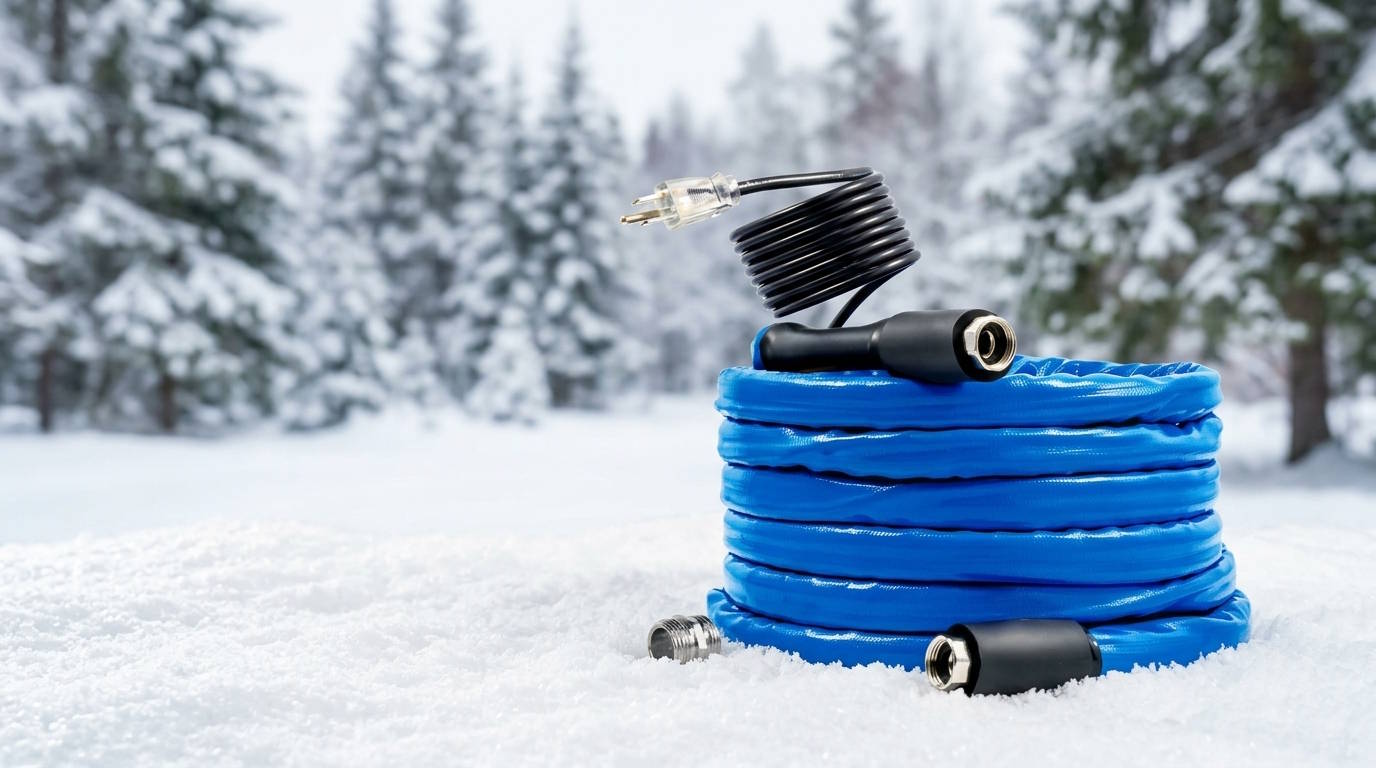
Camco Heated Water Hose Review: Heater Works, Hose Leaks
Last updated: September 2026
- Re-checked whether the leak reports point at the threaded connections or at the sheathed collar behind them — the collar pattern held up across both recent and older feedback.
- Re-read every “it froze anyway” complaint against the setup habits described by owners who’ve run this hose for multiple winters. A meaningful share of the freeze reports trace back to where the sensor end was sitting.
- Compared replacement-unit outcomes against original-unit outcomes to see whether the same component fails twice on the same owner.
- Re-checked warranty and support reports from the last two seasons; the split between “free replacement in a day” and “no reply at all” is still there.
Affiliate disclosure: this page contains Amazon affiliate links. If you buy through them, I may earn a small commission at no extra cost to you. It doesn’t change what I write about a product’s weak spots.
The 3 a.m. Problem Nobody Warns You About
You wake up in a cold snap, turn the tap, and get nothing. Not a trickle. Somewhere between the campground pedestal and your rig, your water line has turned into a popsicle, and now you’re either dragging a frozen hose into the shower to thaw or hauling jugs in the dark.
A heated hose is supposed to end that. What confuses buyers about this one is that the feedback splits so hard it reads like two different products. Plenty of owners run it through single-digit nights for years. Plenty of others open the box and find water spraying out of the ends before it’s ever seen frost.
Is it worth it? Yes, if it stays connected in one spot with the sensor end in outside air — that’s where owners report multi-season life. Coil-and-stow users report far shorter runs.
Everything below is a synthesis of real owner experience rather than a spec sheet rewrite, and it’s aimed at one question: which side of that split are you going to land on? If you’re still deciding between lengths, temperature ratings and heat-tape alternatives, the full heated-hose decision framework covers the category-level tradeoffs this review doesn’t repeat.
📋 How I Built This Review (and Why You Can Trust It)
Sample size: I analyzed a sample of roughly 185 individual verified-purchase owner reviews — the actual text reviews I read, not the listing’s total rating count.
Time window: Feedback spans roughly spring 2024 through mid-2026, with the heaviest concentration across the last two winters. That means it reflects current production, though several long-term owners are explicitly comparing today’s hose to one they bought years earlier and rating it worse.
Method: I tagged every review into categories — heating performance, leak location, install and setup sensitivity, cord and thermostat behavior, fitment and adapters, stiffness and coiling, cold-weather thresholds, warranty and support, and repeat-purchase behavior — then separated setup-driven issues (sensor in the wrong place, hose energized while coiled, connections not snugged past hand-tight) from likely product or manufacturing issues (leaks originating under the sheathing, cord jackets splitting, thermostats that quit).
Important limitations:
- Reviews skew toward extremes. People who are neither thrilled nor flooded rarely write anything.
- Rigs and duty cycles are wildly different here — permanent seasonal sites, full-time boondocker-adjacent setups, weekend trailers, livestock troughs, tiny homes, even bird baths.
- I prioritized patterns that repeat across many owners over dramatic one-off lemons.
- Some complaint units appear to have arrived open-box or repackaged rather than factory sealed, which muddies the true defect signal.
Quick Verdict (TL;DR)
Best for
- Seasonal or permanent hookups where the hose gets connected once and left alone all winter
- Full-timers in genuinely cold country who will rig the sensor end correctly at the spigot
- Anyone who wants a drinking-water-rated hose rather than a DIY heat-tape wrap
Not for
- Weekenders who coil, stow and re-deploy the hose every trip in cold weather
- Buyers who want to stock up on a summer sale and open the box in November
- Anyone expecting the rated temperature number to protect the spigot, fittings and filter too
Standout win
- When the heating cable works and the hose is deployed straight, owners report water flowing through nights well below zero, including reports at -22°F and -30°F
Watch-outs
- The most repeated failure isn’t the heater — it’s water appearing under the shrink-wrapped collar where the metal fitting meets the hose, where no amount of tightening helps
- Reports of thermostat cords fraying, baking or shorting inside the jacket are a minority but they recur, and they’re the serious kind
Confidence Score: 7/10 🎯 This is buyer-usefulness, not a reliability statistic. It’s a 7 because the who-it-fits answer is unusually clear: the performance signal (it heats, it keeps water moving in deep cold) is consistent, and the setup variables that separate happy owners from furious ones are well documented by owners themselves. It isn’t higher because the durability signal is genuinely polarized — long-run successes and early end-leaks appear side by side in the same sizes and the same climates, and a chunk of negative feedback is not setup-driven and can’t be explained away.
👉 CHECK TODAY’S PRICE ON AMAZON
What This Heated RV Water Hose Is (and What It Isn’t)
It’s a drinking-water-rated hose with a thermostat-controlled heating cable bonded along its length under an outer sleeve. You connect it between the campground or house spigot and your rig’s city water inlet, then plug the cord into a grounded outdoor outlet. The thermostat decides when to heat, so it isn’t drawing power around the clock.
Three misconceptions worth clearing up before you buy:
- It is not a whole-system freeze solution. Owners with heated underbellies and insulated bays still report frozen plumbing elsewhere while the hose itself stayed clear. The cable heats the hose, not your spigot, your regulator, your inline filter or your rig’s lines.
- It is not “plug it in and forget where the ends are.” The temperature sensor lives at one end. Owners repeatedly describe the hose failing to activate because that end was tucked somewhere warm.
- It is not a coil-friendly hose. It’s deliberately stiff and thick-walled. That’s what makes it kink-resistant when deployed and what makes it a wrestling match to roll up cold.
The Specs That Actually Change Your Winter
Only a handful of the listed features change real outcomes on a cold night:
- Sensor location. It sits at one end, not in the middle. Owners describe it as needing to be out in the actual cold to trigger. Get this wrong and everything else is irrelevant.
- Length options (12, 25 and 50 feet). Owners consistently advise buying the shortest length that reaches. One reports noticeably reduced flow on a longer run; another simply wishes he’d bought longer for a distant pedestal. There’s no middle ground here, because heated hoses of this type can’t be joined end to end.
- The swap adapter. Several owners praise being able to move the power end to whichever side has the outlet. Others report the adapter missing from the box entirely. Confirm it’s in there on day one.
- Sheath and end-crimp construction. This is the component that dominates the complaint pool. The junction where the metal fitting disappears under the shrink-wrapped collar is where leaks originate for most unhappy owners.
- Thermostat pod and cord. Owners describe the pod as heavy relative to the cord, sitting where the cable exits the hose. Several report the cord fraying or chafing at that exit point over time.
- Drinking-water rating. Multiple owners mention a chemical or vinyl smell out of the box, some strong enough that they filtered before drinking. Flushing is standard practice for any potable hose, and the EPA’s drinking water guidance is the right baseline if water quality is a concern in your setup.
Owners’ accounts of the warranty terms conflict — some describe a multi-year warranty, another says coverage applies only to the electrical components. Verify the current terms with the manufacturer before you count on them.
Fitment & Compatibility: What Owners Actually Report
Does it hook up as sold? Mostly, yes — it threads onto a standard spigot and a standard city water inlet, and most owners describe installation as no harder than a regular hose. The surprises are in the details.
The tightening threshold. More than one owner reports that normal hand-tight isn’t enough: the internal rubber washer doesn’t seat, and both ends weep until the connections are snugged well past what you’d do with a garden hose. One owner stopped a persistent drip simply by swapping the rubber washer. If your leak is at the threads, that’s your fix. If it’s coming from behind the collar, tightening is the wrong tool and you’ll just stress the fitting.
Pressure gear doesn’t rescue it. Owners running regulators — including one who logged a peak reading well within normal RV range — still had end blowouts. A regulator is still the right call for your whole system, and if you’re not running one, choosing and setting up a water pressure regulator is worth doing regardless. Just don’t buy one expecting it to prevent this hose’s signature failure.
Power side. Owners cite manufacturer guidance to plug directly into a GFCI-protected outlet rather than daisy-chaining an extension cord. That matches standard practice for anything energized outdoors in the wet; the CPSC’s ground fault circuit interrupter fact sheet explains why that protection matters where electricity and water share a pedestal. It also creates a real fitment problem: if your only outlet is inside the wet bay, you can’t simply plug in there and leave the sensor end in the bay too.
Rig-type behavior:
- Travel trailers and fifth wheels on seasonal sites — the strongest outcomes in the whole feedback pool. Connected once, left straight, undisturbed.
- Class A and Class C full-timers moving through cold country — good reports, but these owners describe building a setup: sensor at the spigot, faucet covered separately, cable exposed rather than wrapped.
- Vans and small trailers with tight bays — the stiffness and coil memory fight you. Owners describe it as difficult to stow, especially cold.
- Non-RV users (livestock, tiny homes, well hookups) — surprisingly common, and their permanent-installation pattern produces good longevity reports.
If you’re new to the pedestal side of this, the campground city water hookup walkthrough covers the order of operations that keeps you from discovering a leak after everything’s pressurized.
Feature-by-Feature: Marketing Claims vs Owner Truth
| Feature | What the manufacturer says | What it actually means in use | Compared to alternatives |
|---|---|---|---|
| Deep-cold freeze protection | Rated for extreme sub-zero temperatures | Confirmed repeatedly by owners running well below zero — when the sensor is exposed and the cable is working. A separate cluster of owners report frozen lines in the teens and twenties, most often with the sensor placed somewhere warm or the freeze occurring at the spigot rather than in the hose. | The rating is competitive; the sensitivity to sensor placement is the differentiator most brands don’t advertise |
| Thermostat-controlled heating | Heats only when needed, saving energy | Owners confirm they see no meaningful power-bill change. Reported activation points vary — some describe it kicking on around 40°F, one measured closer to the mid-30s. It’s not a precision instrument. | Heat tape gives you manual control but no automatic cutoff |
| Premium drinking-water-grade hose | Safe for potable water | Widely accepted, but a recurring minority report a strong vinyl or chemical smell out of the box. Some flush and move on; a few won’t drink from it without a filter. | Common complaint across potable hoses generally, not unique here |
| Kink resistant | Stays open under load | True when deployed straight. Owners who coiled it — especially in cold — report kinks, pinches, and inner-tube splits that only show up as leaks later. | The stiffness that delivers this is exactly what makes storage a chore |
| Rugged sealed ends | Built for the job | The single most-reported weak point. Leaks appear beneath the sheathed collar, water tracks between the inner tube and the outer jacket, and the jacket visibly swells before both ends start weeping. | This is where owners say cheaper no-name hoses sometimes outlast it |
| Included swap adapter | Choose which end takes power | A genuine convenience when it’s in the box. Several owners report it missing and had to buy one. | Nice-to-have that becomes a fitment problem when absent |
Real-World Owner Experience: The Patterns Behind the Split
1. The heater usually works. The hose is what fails. (Lead pattern)
In a nutshell: Read enough one-star reviews and a strange consistency emerges — owners keep confirming the heating element still works while condemning the hose. One owner split the outer casing open, found multiple pinches and splits in the inner tube, tested the heating elements, found them fine, and rebuilt the whole thing around a better hose.
Hidden strength: It means the electronics and cable design aren’t the primary liability. That’s why owners who baby the hose body get years out of it.
Hidden weakness: It also means the failure is structural, and there’s nothing you can do from the outside. The leak lives under sealed sheathing you can’t service.
What to do about it: When water shows up, identify where before you touch a wrench. Threads and washers are fixable. Anything emerging from under the collar or mid-length isn’t, and continuing to tighten just accelerates it.
2. The failure sequence, in order
In a nutshell: Owners describe a repeatable progression. A small weep appears at one end — usually right where the metal fitting vanishes under the collar, not at the threads. Water then migrates between the inner hose and the outer jacket. The jacket balloons or feels squishy. Then both ends leak, often within days of each other.
Hidden strength: The early stage is quiet and slow, so if you catch the first weep you have time to act while a return or warranty claim is still live.
Hidden weakness: Owners who assume “it’s just the gasket” burn their window replacing washers on a hose that was already done.
What to do about it: Squeeze the outer jacket near both ends every few weeks in season. Sponginess or swelling means water is already inside the sleeve, and that’s the point to file a claim, not after it’s spraying.
3. The second failure sequence: it starts at the cord, not the hose
In a nutshell: The other repeat pattern is electrical, and it also has a tell. Owners describe the thermostat pod swinging freely where the cable exits the hose, chafing and fraying the jacket at that exact point. What follows is a pinhole in the hose, a tripping GFCI, a cord baked hard enough to snap when touched, or a short inside the vinyl sleeve. A handful of owners report burning and fire.
Hidden strength: The GFCI trip is doing its job. Owners who reported repeated breaker trips caught the problem before anything worse happened.
Hidden weakness: This one escalates faster than the leak pattern, and it happens near standing water at a powered pedestal.
What to do about it: Inspect the cable where it exits the hose and where the pod hangs, at least monthly in season. If you find cracking, fraying, discoloration or a warm plug, unplug it and stop using it. Damaged cords get replaced, not repaired — that’s explicit in the U.S. Fire Administration’s electrical fire safety guidance, and it applies here more than most places. Anything beyond a visual check and unplugging belongs with a qualified RV tech or electrician.
4. What most reviews won’t tell you: the failures cluster past the purchase window, not the use window
In a nutshell: This is the highest-value pattern in the entire feedback set, and it’s a timing trap rather than a quality one. People buy this hose in summer or early fall — often on sale, often “getting ahead of winter.” The box sits sealed. They open it in November or during the first ice storm, and it leaks straight out of the packaging. By then the return clock, which started the day it was delivered, ran out weeks or months ago. Owner after owner describes exactly this sequence, some missing the window by only days.
Layered on top: a distinct cluster of failures lands somewhere between roughly one season and about sixteen months — long enough to look like normal wear, short enough to feel like a defect. Several owners state their hose died at thirteen to sixteen months.
Hidden strength: It’s completely avoidable, and it costs you nothing but ten minutes.
Hidden weakness: It disguises out-of-box defects as durability failures, which makes the product look better than it is in the aggregate ratings.
What to do about it: Buy it when you’ll use it, not when it’s cheap. If you do buy early, unbox and pressure-test it the week it arrives.
5. The repeat-defect pattern: replacements fail at the same place
In a nutshell: This is what separates bad luck from a manufacturing consistency issue. Owners who received or bought replacements repeatedly report the second unit failing the same way — both ends leaking within days, or two hoses purchased a year apart both shorting inside the vinyl jacket, or two units both cracking during the same hard freeze. Same component, different unit, same owner.
Hidden strength: It’s diagnostic. If your replacement fails identically, you have a design or process problem on your hands, not a fluke, and you can stop hoping the third one is different.
Hidden weakness: It undermines the “just get it replaced” advice that dominates the positive reviews.
What to do about it: If your replacement leaks the same way, change strategy rather than units — either a different product, or fill your fresh tank and run on the pump for the cold stretch.
6. The re-buyer paradox
In a nutshell: Here’s the part that scrambles the picture. A striking number of owners who describe this hose in unprintable terms are on their third or fourth one. One says plainly he’s buying his fourth in four years and wishes he had another choice. Another dumpstered a leaking unit after a frustrating support experience, bought the same brand again, and reported no issues a year later.
Hidden strength: It tells you the category has few credible alternatives and that this one, when it works, works well enough that people accept the risk.
Hidden weakness: It also means the high overall rating partly reflects captivity, not satisfaction.
What to do about it: Read it as a budget signal. If you’re a cold-climate full-timer, plan for this being a consumable on a multi-season replacement cycle rather than a buy-it-for-life item.
7. The setup-skill threshold that flips one star to five
In a nutshell: Two owner-discovered techniques account for a large share of the difference between the two camps.
First: uncoil it completely before pressurizing. One owner hooked up a partially coiled hose, got exactly the under-the-insulation leak everyone complains about, then remembered the instructions call for full deployment. He disconnected, stretched it out dead straight, removed the kinks, reconnected — no leak, and it ran warm through a hard night. Coiled and energized is where the melted-sleeve and overheating reports concentrate too.
Second: the sensor end goes in the cold. One owner plugged into the campground pedestal for convenience, which put the sensor end inside his heated wet bay, so the cable never activated. Another put it plainly: the sensor has to be in the cold to turn on. A third notes that if you wrap your faucet for winter, the thermostat wire needs to sit outside the wrap.
Hidden strength: Both fixes are free and take minutes.
Hidden weakness: Neither is obvious, and both produce failure symptoms that look like product defects — a leak “for no reason,” or a frozen line on a hose rated far colder.
What to do about it: Make full deployment and sensor-end placement part of your setup routine, every time, before you turn the water on.
8. Support is a lottery — but a surprisingly good one when it lands
In a nutshell: The support reports are almost comically bimodal. Some owners get a replacement shipped within 24 hours, or three days, sometimes past the return window and even past the stated warranty period, occasionally with photo proof requested. Others contact the company twice and never hear back at all.
Hidden strength: The fast-replacement stories are frequent enough to be worth attempting. Several owners rewrote their reviews upward purely because of it.
Hidden weakness: You can’t plan around it, and the buyers who felt most abandoned were the ones who’d bought through a channel that left them bouncing between the retailer and the manufacturer.
What to do about it: Photograph the failure clearly, keep your order record, and contact the manufacturer directly rather than only the retailer. Do it the day you notice, not at the end of the season.
Loved in Place, Cursed on the Reel
The Good
- Genuinely keeps water flowing in deep cold when it’s working, with owner reports far below zero
- Thermostat control means no noticeable power cost and no babysitting
- Stiff, thick-walled construction resists kinking while deployed
- Multi-year success stories are real and repeated: two winters, three years, one owner at five years of daily use
- Manufacturer replacements, when you get them, are often fast and generous about timing
The Bad
- Difficult to coil and store, and close to unmanageable when cold — several owners lay it in the sun before connecting
- A noticeable minority report a strong vinyl smell out of the box
- Longer runs can cost you noticeable flow at the tap
- Can’t be joined to another heated hose to bridge a long pedestal gap
- The included swap adapter goes missing often enough to check for it
The Ugly
- Leaks originating under the sealed collar, which are unfixable and often discovered after the return window
- Cord jackets fraying, splitting or baking at the thermostat exit point, with a small but real cluster of burning and fire reports
- Replacement units failing the same way as the originals
- Some units arriving in plain packaging looking previously opened
Mini Toolkit: Decide Fast, Fix Fast
🏷️ Issue tags to search your own hose against: #collar-leak #jacket-balloon #sensor-in-warm-bay #cord-fray-at-pod #coiled-and-energized #opened-after-return-window
Fitment mini-matrix
| Your hookup style | Verdict |
|---|---|
| Seasonal or permanent site, hose connected once and left straight | Strongest fit — this is where the multi-year success stories live |
| Full-timer moving through cold country, willing to rig the sensor at the spigot | Works well, but treat setup as a procedure, not a plug-in |
| Weekender coiling and stowing after every trip in cold weather | Highest risk of kinks, inner-tube splits and end leaks |
Mini decision tree
- If your hose stays hooked up all winter in one spot → this is the use case owners rate highest.
- If you break camp weekly and roll it up cold → expect a shorter life and budget accordingly.
- If your pedestal is farther than one hose length → size up, because these can’t be coupled together.
- If your only outdoor outlet is inside the wet bay → solve the sensor-end placement problem before you buy.
- If you can’t test it within a week of delivery → wait and buy it in season instead.
Troubleshooting quickflow
- Water at an end? Look at where — threads, or under the sheathed collar?
- At the threads → back it off, inspect or replace the rubber washer, resnug well past hand-tight.
- Under the collar or mid-length → stop tightening. That’s the hose, and it’s a claim, not a repair.
- Not heating or line frozen → find the sensor end. It must be in open outside air, unwrapped, at the cold source.
- Sensor placed right and still frozen → check the spigot, fitting, regulator and filter; those aren’t heated.
- GFCI tripping, warm plug, or any smell of burning → unplug immediately, stop using it, don’t attempt a cord repair.
Still weighing whether a heated hose is even the right approach for your climate and hookup? The category-level comparison of heated hose designs lays out the tradeoffs between rated temperatures, lengths and construction types.
Mini Return-Window Reality Check
Do these within days of delivery, not on the first cold night:
- Unbox and pressure-test at a normal tap immediately, even in July. Most out-of-box leaks show up on the first hookup, and the return clock starts at delivery.
- Stretch it out completely straight before you pressurize. Testing it half-coiled produces false leaks and, if energized, risks overheating.
- Watch both ends for a full minute under pressure, then run a finger under each collar. A slow weep behind the sheathing is the diagnostic finding, not a drip at the threads.
- Confirm the swap adapter is actually in the box.
- Plug it in and verify the indicator responds, and locate which end carries the sensor so you know how you’ll orient it at the site.
- Squeeze the jacket near both ends. Any sponginess means water is already between the layers.
Installation & Setup Tips That Flip This Hose From One Star to Five
- Deploy it dead straight before water or power. Full deployment is the single highest-leverage step; partial coils produce both leaks and heat problems.
- Warm it before you fight it. Owners lay it in the sun or a warm space before connecting; cold stiffness is what creates the kinks that split the inner tube later.
- Put the sensor end at the water source, in open air. Not in the bay, not under the faucet wrap, not inside an insulated cover.
- If you wrap the spigot, keep the thermostat wire outside the wrap so it reads actual ambient temperature.
- Snug the connections past normal hand-tight. Owners consistently report the internal rubber washer needs real pressure to seal. Keep a spare washer on hand.
- Plug directly into a GFCI-protected outdoor outlet. Owners cite manufacturer guidance against extension cords here, and a wet pedestal is the worst place to improvise.
- Route the cord so the thermostat pod is supported, not swinging. A loose zip tie taking the weight off the cable where it exits the hose addresses the exact spot owners report fraying.
- Don’t energize it coiled, bundled or on a reel. Melted-sleeve and overheating reports concentrate here.
- Protect the parts the cable doesn’t heat — spigot, fittings, regulator, inline filter. Several “it froze” reports were freezes at the spigot, not the hose.
- Inspect monthly in season: cord jacket at both exits, plug for discoloration or warmth, jacket near both ends for swelling.
- Store it stretched or in a wide loose loop, never tightly coiled, and store it dry and indoors — one owner’s hose split silently in summer storage and only revealed it at the next hookup.
- Anything beyond visual checks and unplugging — cutting off crimped ends, splicing cord, rewiring the pedestal — should be verified against the manufacturer instructions or handed to a qualified RV tech or electrician. Basic electrical hygiene around your whole hookup is covered in the RV electrical safety fundamentals.
Owner Stories
These are composite scenarios assembled from recurring owner patterns — not direct quotes from any individual.
The seasonal-site re-buyer. She keeps a trailer on a permanent site in snow country. The hose goes on in October, runs straight from spigot to inlet with the sensor sitting out in the weather, and doesn’t move until spring. Two winters in, no leaks, no drama. Her verdict is short: it works, it isn’t cheap, she’ll buy another. Her setup happens to satisfy every condition the unhappy owners violated.
The wet-bay mismatch. He installs it on the first cold weekend, plugs into the nearest outlet — the one in his heated bay — and wakes to a frozen line. The hose is rated far below the temperature outside. He assumes it’s defective. The sensor was sitting in warm air the whole time and never triggered. It’s a five-minute fix that reads, in a review, like a product failure.
The summer-sale buyer. She orders it in July on a discount, pleased with herself for getting ahead of winter. The box stays sealed until the first cold snap in late November. Water sprays from both ends the moment she pressurizes it. The return window closed months ago, and now she’s chasing a warranty claim in the dark with a frozen rig.
👉 SEE MORE OWNER FEEDBACK ON AMAZON
Who This Is For (and Who Should Skip It)
Buy it if…
- Your hookup is seasonal or permanent and the hose can stay connected and straight
- You’ll commit to putting the sensor end in outside air every single time
- You’re in a climate where the alternative is hauling water or dragging frozen hose indoors
- You want a potable-rated hose rather than building your own heat-tape-and-insulation stack
- You’ll test it the week it arrives and treat it as a multi-season consumable, not a lifetime purchase
Skip it if…
- You break camp weekly and will be coiling it cold every time
- Your only outdoor power is inside the bay and you can’t solve the sensor placement
- You need to bridge a distance longer than a single hose — these don’t join
- You’re expecting the temperature rating to protect your entire water system
- You want guaranteed out-of-box quality; the manufacturing consistency at the end crimps is the real weak spot
👉 CHECK AVAILABILITY ON AMAZON
If you’re comparing options, start here: Top Heated RV Water Hose Picks
Alternatives (Quick Comparisons)
- DIY heat tape plus pipe insulation over a standard drinking-water hose. Several owners rebuilt exactly this after a failure and report going years without trouble, including one who’s run a homemade heat-trace setup for the better part of a decade. Cheaper, more labor, no automatic thermostat, and you own the safety of the install.
- Fill the fresh tank and run on the pump. The pragmatic winter answer, and multiple owners defaulted to it after their heated hose quit. No freeze risk at the hookup at all, at the cost of refilling and tank monitoring. If you’ve never run this way, using your freshwater tank off-grid covers the routine.
- A shorter length of the same hose. If your spigot is close, owners favor the shortest run that reaches — less to store, fewer pinch points, better flow.
- A different heated hose brand. Worth noting that several owners report unbranded or store-brand heated hoses outlasting this one at lower cost. Nobody in the feedback describes a category leader that’s clearly immune to end-crimp leaks.
Deep-Dive FAQ
What should I test the day the hose arrives?
Pressurize it at any tap, fully stretched out, and inspect both ends for weeping under the collar. Do this immediately, regardless of season.
The single most preventable bad outcome with this product is discovering an out-of-box defect after the return window closed. Because the clock starts at delivery rather than first use, buying in summer for a winter need is how good owners end up stuck with defective hoses. Stretch it straight, run water through it, watch both connection points for a full minute, then squeeze the jacket near each end to feel for water trapped under the sleeve. Confirm the swap adapter is present and note which end holds the sensor.
Why is my Camco heated hose leaking at the ends, and can I fix it?
If it’s leaking at the threads, replace the rubber washer and tighten well past hand-tight. If it’s leaking from under the sheathed collar, it can’t be fixed.
That distinction is everything. Owners repeatedly report chasing a threaded connection with wrenches, Teflon tape and new washers only to discover the water was coming from behind the crimp, where the metal fitting meets the hose under the shrink-wrap. Once water is between the inner tube and the outer jacket, the sleeve balloons and both ends eventually weep. At that point it’s a warranty conversation, not a repair. Photograph it clearly and contact the manufacturer directly — replacements are frequently issued even past the retailer’s window.
Will it work with my rig and my power setup?
Yes for standard spigot-to-city-water-inlet hookups, but the sensor end must sit in outside air and the cord should go directly into a GFCI-protected outlet.
The compatibility problems owners hit aren’t threads — they’re geometry and power. If your only outdoor outlet is inside a heated bay, plugging in there puts the sensor in warm air and the heater never turns on. If your pedestal is farther than one hose length, you can’t join two heated hoses to bridge the gap. And if you’re wrapping the spigot for winter, the thermostat wire has to stay outside the wrap. Sort these three things out before ordering, not on the first freezing night.
How long does this heated hose actually last?
The realistic spread from owner reports is one winter to about three years, with a visible failure cluster around one season to sixteen months and a smaller group reporting two to five years.
What predicts your position on that spread isn’t climate — it’s handling. Owners who leave it connected, straight and undisturbed report the long numbers, including one at five years of constant daily use. Owners who connect, disconnect and coil it repeatedly report the short ones, and several describe splits appearing after summer storage rather than during use. Treat repeated coiling as the wear mechanism and you’ll predict your own outcome better than any temperature rating does.
Camco heated hose vs. DIY heat tape and insulation — which should I buy?
Buy the heated hose if you value plug-and-play convenience and potable-water certification; build the DIY wrap if you value durability and control over cost.
Owners who’ve done both are unusually candid here. The DIY route — foam pipe insulation, a foil-backed outer layer, heat trace, everything wrapped from spigot to rig — is described by several owners as having survived winters without incident, and one has run a homemade version far longer than any commercial hose lasted. The tradeoffs are real: it takes an afternoon, it isn’t packaged as drinking-water safe, you’re responsible for the wiring being safe, and it doesn’t travel well. The Camco is the right call if you move around, need certification for potable water, or simply don’t want a project. It’s the wrong call if you’ve already had two fail at the crimps.
Does it really hold up at its rated temperature?
For many owners, yes — reports of it working at -22°F and -30°F are in the feedback. But a separate cluster reports frozen lines in the teens and twenties.
Most of the second group’s reports contain a setup clue: the sensor sitting somewhere warm, the freeze occurring at the spigot rather than in the hose, or the hose deployed with kinks. A minority describe correct setups that still froze, which is where the genuine thermostat-failure reports live. The honest read is that the rating is achievable but conditional, and the conditions aren’t printed on the box.
Can I leave it plugged in all winter?
Owners commonly do, and several report running it continuously for entire seasons without issue.
The caveats are worth respecting though. Leave it deployed straight, never energized while coiled or on a reel, plugged directly into a GFCI-protected outlet. Inspect the cord where it exits the hose and where the thermostat pod hangs — that’s where fraying starts. If the breaker begins tripping, the plug feels warm, or you notice any burning smell, unplug it and take it out of service rather than trying to nurse it through the rest of the season.
Final Verdict
This is a product whose reputation is decided almost entirely by how you use it, and the feedback makes that unusually legible. The heating cable does its job. What fails is the hose body and the sealed junctions at the ends — and it fails most on the owners who coil it, stow it, redeploy it cold, and open the box months after the return window quietly expired.
If you have a seasonal or permanent hookup, if the hose can go on in the fall and stay straight until spring, and if you’ll put the sensor end out in the actual cold, this is a hose that owners run for years and buy again. If you’re a mobile weekender who’ll be wrestling it into a bay every Sunday in January, go in knowing you’re buying a consumable, keep the receipt, and test it the day it lands.
For everyone else, the two habits that separate the five-star reviews from the one-star ones are free: stretch it out completely, and put the sensor where the weather is.