Magam RV Macerator Pump Review 2026: Worth It or Risky Buy?
Last updated: June 2026
- Re-checked the dominant “dies a few months after the return window closes” pattern against the long-tail happy owners who are 1–2 seasons in and still pumping — both camps are real, and the split matters.
- Re-verified the recurring cigarette-lighter plug complaint (the spring inside that overheats and deforms) against happy owners who quietly rewired around it.
- Re-examined the “took 30 minutes, not 5” speed gripes and traced most of them back to a specific unboxing fault rather than a weak motor.
Affiliate disclosure: This article contains Amazon affiliate links. If you buy through them, I may earn a small commission at no extra cost to you. It never changes which patterns I report or how I weigh them.
If you’ve ever stood at a crowded dump station paying $25–$35 to empty your tanks — or wrestled a sloshing portable tote across rough ground because your rig won’t park near the cleanout — you already know why a macerator pump is tempting. The confusing part is figuring out whether a budget 12V unit like the Magam is a genuine shortcut or a short-lived headache. I spent a long time digging through real owner feedback to sort that out.
Quick answer: Is it worth it? For at-home dumping and moochdocking, yes — it’s an affordable, easy way to push waste through a garden hose. Just go in expecting the plug and switch to be the weak points, and durability to be a gamble.
This review is a synthesis of real owner experience — the happy long-haul stories and the frustrated early failures alike — not a spec sheet rewrite. If you want the broader category framework before committing, the framework for choosing an RV macerator pump walks through the selection logic this review assumes.
How this review was built (so you can trust it)
I worked through roughly 150 owner reviews for this pump, spanning from about late 2024 through mid-2026 — a healthy mix of glowing five-stars, measured Vine reviews, and angry one-stars.
Here’s the method in plain English: I tagged feedback into categories — pumping performance, install and power-cord sensitivity, fitment and hose setup, reliability symptoms, and support/returns experience — then separated setup-driven issues (wrong hose diameter, underpowered cigarette-lighter plug, pump head not seated from the factory) from likely product or design issues (motors that hum but won’t spin after a handful of uses). That separation is the whole game with this pump, because the two groups tell very different stories.
Important limitations:
- Reviews skew toward extremes — thrilled owners and furious ones both write more than the quietly satisfied middle.
- RV setups vary enormously (battery location, hose length, lift, climate), so one owner’s “flawless” and another’s “garbage” can both be true.
- I prioritized patterns that recurred across many owners over isolated one-off complaints.
Quick Verdict (TL;DR)
Best for:
- Home dumping into a septic cleanout when your rig parks too far away or at the wrong slope.
- Moochdocking and boondocking where you can run a long garden hose to a drain.
- Anyone tired of hauling and lugging a heavy portable tote back and forth.
Not for:
- Owners who want a guaranteed multi-year workhorse with bulletproof reliability.
- Anyone unwilling to swap the included plug/switch for sturdier wiring if needed.
- Setups needing very high lift or fast emptying of large tanks on a tight schedule.
Standout win: Owners consistently report it pumps waste long distances — many cite runs well over 100 feet to a cleanout — and the clear inspection elbow plus fresh-water rinse make the dirty job genuinely tolerable.
Watch-outs: The cigarette-lighter plug and inline on/off switch are the repeated weak links, and a meaningful minority of units fail a month or two after the 30-day return window closes.
Confidence Score: 7/10 🛠️ — This reflects how useful the review is for making a buy/skip decision, not a reliability percentage. It’s high because the owner patterns are unusually clear and consistent; it’s not higher because the durability outcomes genuinely split, and that variability is the buyer’s main risk to weigh.
What This Product Is (and What It Isn’t)
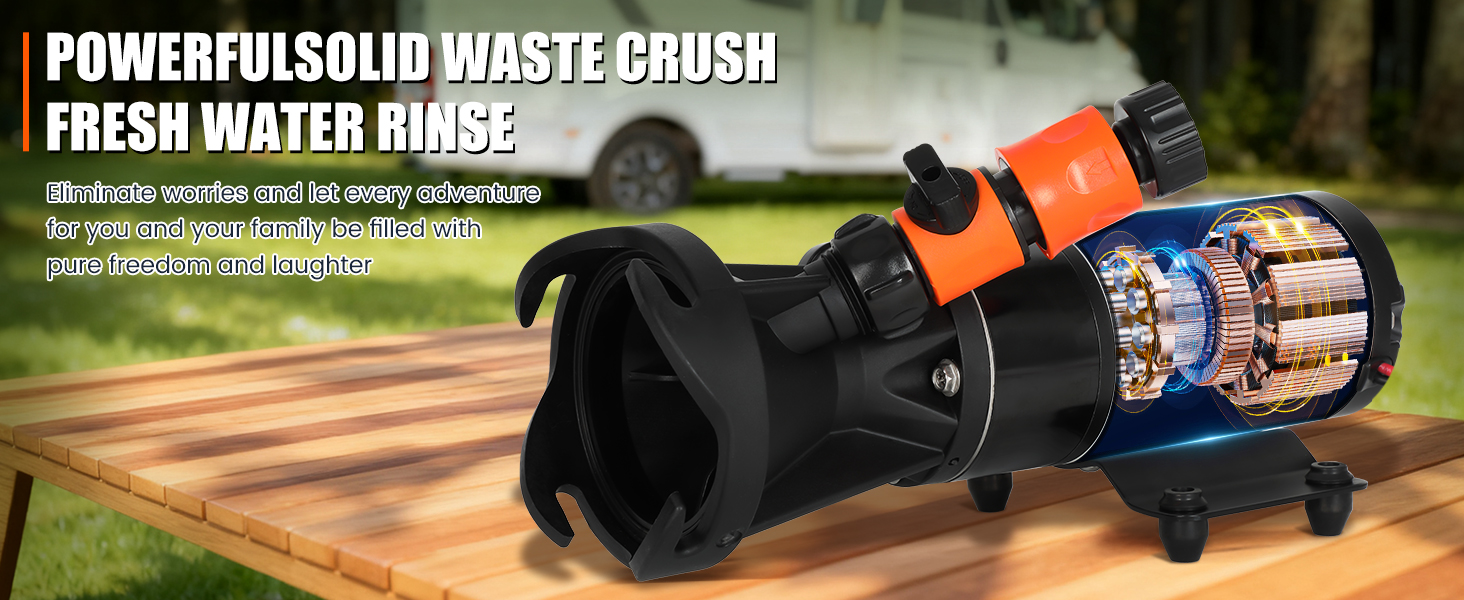
A macerator pump is a small 12V grinder-and-pump combo: it chews up solid waste into slurry and pushes it through a standard garden hose, so you can dump uphill, around obstacles, or over long distances instead of relying on a fat gravity-fed “stinky slinky.”
The Magam is a budget entry in that category. It hooks to your black/gray drain on the wide end, takes a garden hose on the discharge end, includes a fresh-water rinse port, and powers off a cigarette-lighter plug or battery alligator clips.
A few misconceptions worth clearing up:
- It isn’t a “park anywhere and forget gravity” miracle for speed. Owners who expected a 40-gallon tank emptied in five minutes were disappointed; realistic times run longer, often around 15 minutes for a mid-size tank.
- It isn’t a plug-and-play AC appliance. It’s 12V DC only. Several owners were frustrated that they had to drag a battery over or buy an AC-to-DC adapter to power it conveniently.
- It isn’t a sealed, name-brand-identical unit despite looking like one. Multiple owners note it resembles Jabsco/Flojet-style pumps, and at least one points out name-brand internal parts may interchange — but Magam’s own spare-parts support is thin.
Key Specs That Actually Matter for RVers
I’ll only flag the things owners actually tied to outcomes:
- 12V DC power (no AC option): This is the single biggest setup friction point. Your battery is probably at the front of the rig, far from your dump valve, so plan your power run before anything else.
- Garden-hose discharge port: This is the whole appeal — use any length of dedicated hose to reach a distant cleanout. Owners report success over surprisingly long runs.
- Fresh-water rinse / back-flush connection: Genuinely valued for cleaning the pump and hose after each dump. Note one owner’s caution: open your tank gate valve before opening the back-flush valve, or you can pressurize and damage the gate.
- Clear inspection section on the discharge: Lets you watch the flow turn from waste to clean water so you know you’re done. Repeatedly called out as a quality-of-life win.
- Included carry bag (on some “upgraded” sizes): Frequently too small to hold the pump with hose fittings attached — a recurring annoyance, not a dealbreaker.
Feature-by-Feature Breakdown (Truth vs Marketing)
| Feature | What the Manufacturer Says | What It Actually Means (User Experience) | Compared to Competitors |
|---|---|---|---|
| Pumping power / distance | Strong suction and lift, long discharge | Owners routinely push waste 100+ feet to a cleanout, often up modest grades; works as the headline use case | Comparable real-world reach to pricier name-brand pumps, per owners who switched |
| Emptying speed | Fast tank emptying | Realistic, not instant — mid-size tanks commonly take around 15 minutes; “5-minute” claims didn’t hold up | Roughly in line with category; slower than expectations set by the listing |
| Power connection | Cigarette-lighter plug + battery clips | The repeated weak link — the plug’s internal spring overheats, deforms, and melts fuses for some owners | A clear step below better-integrated wiring on premium units |
| Fresh-water rinse | Easy hygienic cleanup | Well-liked and works; a standout convenience for most | On par with or better than basic competitors that omit it |
| Quick-release fitting | Tool-free connect/disconnect | Polarizing — several owners call it leaky and useless, and swap in a standard shutoff | Weaker than expected; easy to replace |
| Build / motor | Durable, heavy-duty | Bimodal: many find it solid and quiet for 1–2 seasons; a real minority see motors hum-but-not-spin early | The durability gamble is the main gap vs. established brands |
Real-World Owner Experience (Deep Pattern Analysis)
Pattern 1: The durability split — and the cruel timing of failures
This is what owners obsess over most, so I’m leading with it. There are two distinct camps, and both are large. One camp is 1–2 seasons in, dumping at home regularly, and thrilled. The other camp watched the motor hum without spinning — or quit entirely — after a handful of uses.
The information gain most reviews miss: the failures cluster just past the 30-day Amazon return window. Owner after owner describes the unit dying at roughly the 2–5 month mark — weeks or a month after they could easily return it. That timing pattern is the real risk here, more than any single defect.
- In a nutshell: It either becomes a beloved tool or a paperweight, and you often won’t know which until you’re past the return window.
- Hidden strength: Owners who get a good unit and treat the power connection gently report years of quiet, reliable service.
- Hidden weakness: Manufacturer warranty support beyond Amazon is inconsistent — some owners got full refunds and replacements, others couldn’t reach anyone.
- What to do about it: Test it hard and repeatedly inside your 30-day window — multiple full dump-and-rinse cycles, not one gentle trial. This won’t catch every failure, but it surfaces dead-on-arrival and obviously weak units while you can still act.
Pattern 2: The cigarette-lighter plug is the Achilles’ heel
If there’s a single design flaw that recurs across happy and unhappy reviews, it’s the power connector. Owners describe a spring inside the lighter-style plug that gets hot, loses its shape, and stops holding the center pin out — leading to melted fuses, intermittent power, or no power at all. Some trace early motor death to the undersized cabling running hot.
- In a nutshell: The pump motor is often fine; the bundled power hardware is the liability.
- Hidden strength: It’s a cheap, isolated failure point — not the pump itself.
- Hidden weakness: When the plug fails mid-job, you can be stranded with waste in the hose.
- What to do about it: Many satisfied owners simply bypass the lighter plug — wiring to a dedicated 12V socket, using the battery clips directly, or running a proper power supply. If you’re comfortable with basic 12V connections, this single move sidesteps most complaints. For anything beyond a basic socket swap, verify against the manufacturer instructions or consult a qualified RV tech/electrician.
Pattern 3: Hose diameter quietly decides clog vs. flow
A subtle but repeated thread: owners who used a 1/2-inch hose fought clogs, and several of those same owners reported it “worked well” once they switched to a 3/4-inch hose. Owners also note keeping toilet paper out of the macerator (use a separate basket or RV-safe TP) to avoid binding the blades.
- In a nutshell: A lot of “it clogs” complaints are really “wrong hose” complaints.
- Hidden strength: Cheap fix — hose diameter is fully in your control.
- Hidden weakness: The listing doesn’t make the diameter sensitivity obvious up front.
- What to do about it: Start with 3/4-inch dedicated hose, mark it clearly so it never touches drinking water, and keep paper load low.
Pattern 4: The “it’s slow / pump head loose from the factory” surprise
Some of the harshest early reviews — 30 minutes to empty, weak push — trace back to a quality-control miss rather than a weak design. At least one owner discovered the pump head wasn’t seated to the motor and the discharge port wasn’t aligned out of the box; once corrected, it “worked as described.”
- In a nutshell: Disappointing first-use performance can be an assembly fault, not a verdict.
- Hidden strength: It’s often fixable in minutes if you inspect before blaming the motor.
- Hidden weakness: A new owner has no reason to expect a factory misalignment.
- What to do about it: Before your first real dump, check that the pump head is fully seated and the discharge is aligned. Bench-test with clean water so any fault shows up dry, not mid-job.
The Good, The Bad & The Ugly (Pros/Cons)
Pros — by theme:
- Core job: Grinds and moves waste reliably over long distances and modest grades; turns a dreaded chore into a quick one.
- Convenience: Fresh-water rinse, clear inspection elbow, light weight, compact storage, and flexible power (lighter plug or battery clips).
- Value: Repeatedly described as performing like pumps costing two to three times more, for those who get a good unit.
Cons — by theme:
- Power hardware: The cigarette-lighter plug/spring and inline switch are the most common failure points.
- Durability variance: A real minority fail shortly after the return window, with patchy manufacturer support.
- Setup friction: 12V-only (no AC), often-too-small carry bag, and a quick-release fitting some find leaky.
Mini Toolkit: Decide + Fix (Fast)
Issue-Tag Box:
plug-overheat— lighter-plug spring deforms / fuses meltpost-window-failure— dies 2–5 months in, just past returnswrong-hose-clog— 1/2″ hose clogs; 3/4″ fixes itfactory-misalign— pump head/discharge not seated out of boxdc-only— no AC option; battery reach is a hasslebag-too-small— won’t store with fittings attached
Fitment / Adapter Mini-Matrix:
| Your setup | Likely need | Owner-reported fix |
|---|---|---|
| Battery far from dump valve | Convenient power | Dedicated 12V socket near valve, or AC-to-DC adapter |
| Long run to cleanout | Flow without clogs | 3/4″ dedicated garden hose, full length needed |
| Frequent back-flushing | Safe rinse | Open tank gate valve before back-flush valve |
Mini Decision Tree:
- If you dump mostly at home/moochdocking → it’s a strong fit.
- If you can’t reach 12V power near the valve → solve power first or skip.
- If you need guaranteed multi-year reliability → consider a name brand.
- If first use is slow/weak → check pump-head seating before returning.
- If the plug overheats → rewire to socket/clips before condemning the pump.
Troubleshooting Quickflow (motor hums, no flow):
- Confirm 12V actually reaching the pump (test the plug — it’s the usual culprit).
- Check the fuse; inspect the lighter plug’s spring/contacts for heat damage.
- Verify pump head is seated and discharge aligned.
- Confirm hose is 3/4″ and not clogged with paper.
- Use the screwdriver slot on the motor end to free a stuck impeller.
- Still dead? If inside 30 days, return now; if not, contact the seller for warranty.
Mini Return-Window Reality Check
- Don’t do one gentle test — run several full dump-and-rinse cycles in your first weeks.
- Bench-test with clean water first so factory faults show up before a messy job.
- Confirm the pump head is seated and the discharge aligned on day one.
- Power it the way you’ll actually use it, so plug/cable heat issues surface early.
- Keep the box and packaging until you’re confident — failures cluster right after the window.
For how this return-window thinking fits the wider category, this pre-purchase validation rundown lays out the full checklist before you commit.
Installation / Setup Tips (RV-Realistic)
- Bench-test with clean water before the first real dump. Owners who skipped this discovered factory misalignment mid-job — exactly when you don’t want to.
- Verify the pump head is fully seated to the motor. A loose head was the root cause behind several “it’s too slow” complaints.
- Use 3/4-inch hose, not 1/2-inch. This single choice resolved many clog complaints in the feedback.
- Dedicate that hose forever. Cut off or mark the end so it never gets mistaken for a drinking-water hose.
- Plan your 12V power before anything. Since batteries usually sit at the front, owners run a dedicated socket near the dump valve or use an AC-to-DC adapter.
- Go gentle on the cigarette-lighter plug — or skip it. The spring/contacts overheating is the top complaint; battery clips or a hard-wired socket sidestep it.
- Open the tank gate valve before the back-flush valve. One owner learned the hard way that pressurizing a closed gate valve can break it.
- Keep run times reasonable. Owners note a roughly 30-minute max run before giving the motor a rest; long continuous runs heat the cable and motor.
- Keep solids/TP load low. Use a separate basket or RV-safe paper so the blades don’t bind.
- Sort storage early. The included bag often won’t fit the pump with fittings on — a small tool bag is the common workaround.
- For any wiring beyond a basic socket or clip connection, verify against the manufacturer instructions or consult a qualified RV tech/electrician.
Owner Stories
The stories below are composite scenarios reflecting repeated patterns across owner feedback.
The happy home-dumper: Lives on a permanent or seasonal lot where the septic cleanout sits a hundred-plus feet away, downhill from nothing convenient. They run a long dedicated garden hose, dump at home on their own schedule, and after a couple of seasons it’s still going. For them, it replaced the dreaded tote-haul entirely and feels like a steal.
The post-window casualty: Bought it before camping season, used it a handful of times, loved it — then the motor started humming without spinning right around the 2–4 month mark, just after returns closed. They rewired the power, confirmed good voltage, and still couldn’t revive it. Their takeaway: great when it worked, but they wish they’d stress-tested it sooner.
The setup-mismatch owner: Frustrated at first — slow flow, a clog, a balky plug. After switching to a 3/4-inch hose, reseating the pump head, and powering it off the battery clips instead of the lighter plug, the same unit started performing the way the listing promised. Their experience straddles both camps depending on the day.
SEE MORE OWNER FEEDBACK ON AMAZON
Who This Is For (and Who Should Skip It)
Buy it if…
- You dump at home or moochdock and need to reach a distant or awkwardly placed cleanout.
- You’re comfortable swapping the plug for a socket or using battery clips.
- You want name-brand-style performance at a budget price and accept some durability risk.
- You value the fresh-water rinse and clear inspection elbow for a cleaner job.
- You’d rather pump through a garden hose than haul a heavy tote.
Skip it if…
- You need a proven, multi-year-reliable pump and won’t tolerate a coin-flip on longevity.
- You can’t conveniently get 12V power to your dump valve and don’t want an adapter.
- You expect five-minute emptying of large tanks.
- You won’t have time to stress-test inside the return window.
- You want dependable, responsive manufacturer warranty support as a baseline.
If you’re comparing options, start here: Top RV Macerator Pump Picks
Alternatives (Quick Comparisons)
- The name-brand workhorse (Jabsco/Flojet-style): Costs more, but owners who switched note the Magam looks and performs similarly — and that brand-name internal parts may even interchange. Worth it if reliability and parts availability matter most.
- The run-dry-protected kit (Camco-style): If you worry about accidentally running the pump dry while you’re at the far end of the hose, a unit with run-dry protection buys peace of mind.
- The portable tote (no pump): Cheaper and dead simple, but it’s the back-breaking hauling this pump exists to eliminate. Some owners found that once you add hose and an AC adapter, the cost gap narrows.
For a structured way to weigh these trade-offs, the macerator selection framework covers how to match pump type to your dumping situation.
Deep-Dive FAQ
What should I test immediately after delivery?
Bench-test it with clean water within your first few days, then run several full dump-and-rinse cycles. Confirm the pump head is seated to the motor and the discharge port is aligned, and power it the exact way you’ll use it so any plug or cable heat issue surfaces while you can still return it.
What are the most common problems and fixes?
The two big ones are the overheating cigarette-lighter plug and motors that hum but won’t spin. Fix the plug by switching to battery clips or a hard-wired 12V socket; for a stuck impeller, use the screwdriver slot on the motor end to free it. Clogs are usually a hose-diameter problem — move from 1/2-inch to 3/4-inch.
Will this work with my RV setup?
For most rigs, yes — it attaches to a standard black/gray drain port and discharges through any garden hose, which is exactly why owners use it for distant or awkward cleanouts. The main constraint is power: it’s 12V DC only, so if your battery is far from the dump valve, plan a socket or AC-to-DC adapter before you buy.
How long does it take to empty a tank?
Plan on roughly 15 minutes for a mid-size tank, longer for larger ones. The listing’s very fast claims didn’t match owner reality, but most owners consider real-world times perfectly acceptable for the convenience gained.
Can I power it without lugging a battery to the back of my RV?
Yes — many owners install a dedicated 12V cigarette socket near the dump valve or buy an AC-to-DC adapter to run it off household power. Several specifically wished for a factory AC option, so budget for this workaround if battery reach is a problem.
Why do some owners love it and others call it garbage?
It comes down to unit-to-unit durability variance plus setup. Owners who get a sound unit, use 3/4-inch hose, and bypass the weak plug tend to be thrilled for seasons; those who hit an early motor failure — often just past the return window — are understandably furious. Your job is to surface a bad unit early.
Does the manufacturer honor the warranty?
It’s inconsistent. Some owners report full refunds or replacements after reaching the seller; others couldn’t make contact beyond Amazon’s 30-day window. Treat reliable post-window support as uncertain, and lean on your return window as the real safety net.
Final Verdict
The Magam RV Macerator Pump is a strong budget pick for one clear job: dumping at home or while moochdocking when your rig can’t reach the cleanout the easy way. When you get a good unit — and most owners do — it punches well above its price, with a fresh-water rinse and clear inspection elbow that make a grim task genuinely manageable. The honest catch is durability variance and a weak power plug, with failures that tend to land just after returns close.
So the best-fit buyer is the practical RVer who dumps at home, is comfortable swapping the plug for sturdier power, and will stress-test the unit hard inside the return window. If that’s you, it’s an easy recommendation. If you need guaranteed, hands-off, multi-year reliability, spend up for a name brand instead.