Kohree RV Macerator Pump Review (2026): Worth It or Junk? Real Owner Patterns
Last updated: June 2026
- Re-checked the “dies just past the return window” complaint against the long-haul happy owners — the split is real, and it tracks almost perfectly with how the unit gets powered.
- Re-read the cigarette-lighter/melting reports next to owners who hardwired straight to the battery; the pattern got sharper, not vague.
- Verified that the hose-and-fittings griping shows up across both thrilled and frustrated buyers, which tells you it’s a kit-quality issue, not a love/hate divide.
Affiliate disclosure: If you buy through links on this page, I may earn a small Amazon commission at no extra cost to you. It doesn’t change what I write — the patterns below come straight from real owner feedback.
Emptying a black tank is nobody’s favorite chore, and it gets genuinely miserable when the dump connection is uphill, far away, or just plain absent. A 12V macerator like the Kohree promises to grind and pump waste through a thin garden hose to wherever you can reach — a cleanout, a tote, even a toilet. The confusion buyers run into is simple: half the reviews call it a game-changer, the other half call it junk that died in months. So which is it?
Quick answer: The Kohree is worth it as an occasional-use kit for boondockers and weekenders who power it properly from a real battery — but it’s a gamble for daily full-timers, and the included hose and cigarette-lighter plug are its weak links.
This review is a synthesis of real owner experience — the people actually wrestling these pumps onto their tank outlets — not a spec sheet rewrite. For the wider category framework (what flow, lift, and power setup to look for before you commit), the full macerator selection walkthrough is the companion piece to this hands-on verdict.
How this review was built (so you can trust it)
I went through roughly 110 owner reviews spanning from early 2024 into mid-2026, covering both the enthusiastic five-star crowd and the angry one-stars. I tagged each piece of feedback into buckets — pumping performance, install and setup sensitivity, power and wiring, fitment and accessories, reliability symptoms, and support/returns — and then separated setup-driven problems (wrong power source, leaky included hose, undersized 12V supply) from likely product or design problems (motors that quit, switches that fail out of the box).
Important limitations:
- Review samples skew toward extremes — the delighted and the furious write more than the indifferent, so the failure rate looks scarier than the average experience probably is.
- RV setups vary wildly (tank size, hose run, battery placement, electrical capacity), so one owner’s “dies in 3 minutes” can be another owner’s power problem, not a dead pump.
- I prioritized patterns that came up repeatedly across many owners over any single dramatic story.
Quick Verdict (TL;DR)
Best for:
- Boondockers and mooch-dockers who dump occasionally and need to reach a faraway cleanout or tote
- Buyers who’ll power it from a proper RV/truck battery or a power station
- People who want a complete kit-in-a-box (gloves, fittings, rinse port, screwdriver) rather than sourcing parts
Not for:
- Daily full-timers who’ll cycle it hard (the failure reports cluster here)
- Anyone planning to run it off a cheap 12V wall adapter or rely on the cigarette-lighter plug long-term
- Buyers who want a sealed, run-it-and-forget permanent install with zero fiddling
Standout win: When powered right, it empties tanks fast through a thin hose and the fresh-water rinse port keeps the pump and tank cleaner than gravity dumping ever does.
Watch-outs: The included garden hose and the cigarette-lighter connector are the two parts owners replace most — budget for a better hose and plan to hardwire.
Confidence Score: 7/10 🟡 — Useful for the right buyer, risky for the wrong one.
What This Product Is (and What It Isn’t)
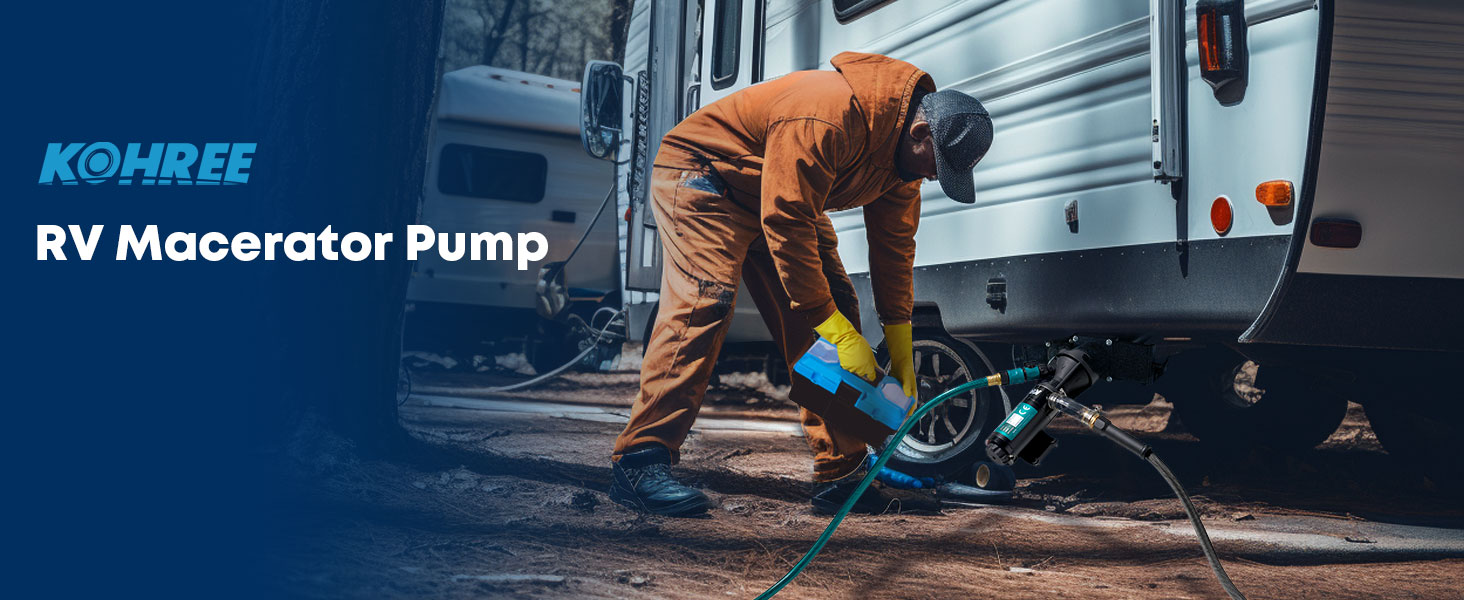
A macerator pump grinds RV waste into a slurry and pumps it through a narrow hose (think garden-hose diameter) to a drain, so you’re not dependent on a big 3-inch gravity sewer connection. The Kohree is the portable, kit-style version: a 12V pump that lives in a storage box with its accessories, meant to be hauled out when you need it.
A few misconceptions worth clearing up:
- It’s not a faster gravity dump. Through a thin hose it moves waste reliably, but several owners note it takes longer than a wide-open 3-inch gravity drop. The point isn’t speed — it’s reach.
- It’s not plug-and-play off any 12V source. Owners who tried small generic adapters found they couldn’t feed it enough power. It wants a real battery.
- It’s not a permanent fixture by default. Most owners use it as a portable tool, though a few have hard-mounted it with their own switch.
Key Specs That Actually Matter for RVers
- 12V power draw is real. This is a current-hungry pump. One owner measured it pulling around 120 watts from a power station. That matters because it dictates how you power it — a strong battery, truck battery, or power bank, not a bargain adapter.
- Self-priming — but it can lose prime. When the power connection cuts out mid-run, owners report it loses suction and has to be re-primed. The priming feature is only as good as your power stability.
- Fresh-water rinse/flush port. Repeatedly called out as the feature owners love — it lets you back-flush the tank and clean the pump head after use.
- Thin-hose discharge. It’s built to push through 5/8″ or 3/4″ garden hose over long runs, which is the whole reason to own it.
- Kit completeness. Gloves, clamps, adapters, screwdriver, storage box — the “everything included” pitch is mostly true, with the hose being the asterisk.
Feature-by-Feature Breakdown (Truth vs Marketing)
| Feature | What the Manufacturer Says | What It Actually Means (User Experience) | Compared to Competitors |
|---|---|---|---|
| Pumping power | Strong grinding, handles solids | Owners confirm it chews through waste and toilet paper without clogging when running | On par with strong portables; some say it’s slower than a wide gravity dump but fine for thin-hose runs |
| Self-priming | Primes itself | Works — but loses prime if the loose power plug cuts out mid-cycle | Comparable in principle; reliability hinges on your power connection |
| Complete kit | Comes with everything | Largely true (gloves, fittings, rinse port, box) — but the included hose and plug are weak | More generous than bare pumps; rivals like the Rhino kit get praised for sturdier fittings |
| Cigarette-lighter power | Easy 12V hookup | A recurring failure point — melts, gets hot, or quits; many rewire direct | A genuine weak spot vs pumps owners trust more long-term |
| Storage box | Keeps it all organized | Loved — but too small to fit the pump with the output adapter attached | Nice-to-have most competitors don’t match |
Real-World Owner Experience (Deep Pattern Analysis)
The reliability cliff: great until it suddenly isn’t
This is the pattern owners obsess over most, so let’s lead with it. A striking number of unhappy buyers describe the same arc: it worked perfectly for weeks or a few months, then abruptly stopped — and frequently just past the Amazon return window. Reports of “stopped after 3 months,” “8 uses over 4 months then dead,” and “worked until the fuse blew and never recovered” repeat over and over.
- In a nutshell: When it fails, it tends to fail early-ish but often after you can easily return it.
- Hidden strength: Plenty of owners run it hard for a full season — even daily on rental campers — with zero complaints, so it’s not a guaranteed failure.
- Hidden weakness: The failure cluster is real and the seller’s out-of-window support is inconsistent (some got full refunds after the fact; others got nothing).
- What to do about it: Test it hard and immediately — run multiple full tank cycles in your first two weeks, not just one. Don’t let the return window lapse on an untested pump sitting in a box.
What most reviews won’t tell you: the failures track the power source
Here’s the information-gain insight buried in the feedback. Many “it died” and “it only runs 2–3 minutes then quits” complaints sit right next to mentions of the cigarette-lighter plug melting, getting hot, or going loose. One owner had to stop every couple minutes to let the plug cool. Another’s self-priming pump kept losing suction because the adapter turned itself off. Meanwhile, the owners who wired straight to the battery or used a power station overwhelmingly report it “works great” and “pulls a lot of power but never quits.”
- In a nutshell: A meaningful share of “dead pump” reports may actually be “starved pump” — the motor over-amps or cuts out because the flimsy plug can’t deliver clean, sustained current.
- Hidden strength: This is partly fixable — bypass the plug and the unit often behaves.
- Hidden weakness: Kohree ships the weak link in the box and markets it as the easy hookup.
- What to do about it: Plan from day one to hardwire to a battery or run a proper 12V power station. Treat the cigarette-lighter adapter as a temporary convenience, not your real power plan. Anything beyond basic plug swaps — splicing, adding a switch — should be verified against the manufacturer instructions or done by a qualified RV tech.
The included hose and fittings are the other weak link
Across happy and unhappy owners alike, the supplied garden hose draws fire: cuts out of the box, leaks at both ends, kinks, collapses, “cheapest hose I’ve ever seen.” A few owners got sprayed with waste on first use because of a bad hose connection.
- In a nutshell: The pump can be fine while the hose ruins the experience.
- Hidden strength: It’s an easy, cheap fix — a quality dedicated hose solves it.
- Hidden weakness: A leaking waste hose isn’t a minor annoyance; it’s a sanitation problem on first use.
- What to do about it: Buy a good 5/8″ or 3/4″ dedicated discharge hose before your first dump and don’t trust the included one for black water.
The gasket and O-ring that won’t stay put
A quieter but repeated gripe: the pre-installed gasket/O-ring falls out between uses, occasionally causing a leak until you notice it’s gone.
- In a nutshell: Small part, annoying consequence.
- Hidden strength: The kit includes a spare gasket, and owners who keep a couple extras shrug it off.
- Hidden weakness: If it drops out unnoticed, your next dump can leak.
- What to do about it: Check the gasket seats properly every time before you open the valve, and stock a couple of spares.
The Good, The Bad & The Ugly
The Good — performance & convenience:
- Grinds waste and toilet paper without clogging when powered well
- Reaches faraway cleanouts, toilets, and totes through thin hose — the core value
- Fresh-water rinse/flush port for cleaner tanks and a cleaner pump
- Genuinely complete kit with a handy storage box
- Many owners run it a full season or daily with no issues
The Bad — setup friction:
- Power cord is short for a lot of layouts (battery often on the opposite side)
- Box won’t fit the pump with the output adapter attached, so you re-assemble each time
- Slower than a wide gravity dump through a thin hose
The Ugly — the deal-breakers:
- Cigarette-lighter connector melting/failing is a repeated, serious complaint
- A real cluster of motors that quit just past the return window
- Out-of-window support is hit-or-miss
Mini Toolkit: Decide + Fix (Fast)
Issue-Tag Box:
#power-plug-failure— cigarette adapter melts/loosens/quits#dies-past-return-window— works then stops after weeks/months#weak-included-hose— leaks, kinks, collapses#gasket-falls-out— O-ring won’t stay seated#box-too-small— won’t store with adapter attached
Fitment/Adapter Mini-Matrix:
| Your setup | Likely need |
|---|---|
| Battery far from waste outlet | A longer/heavier-gauge power extension to reach the battery |
| Long discharge run | A dedicated 5/8″ or 3/4″ garden hose (skip the included one) |
| No reliable 12V battery nearby | A 12V power station/bank that can sustain the draw |
Mini Decision Tree:
- If you dump occasionally and can power it from a real battery → good fit, buy it.
- If you’ll run it daily as a full-timer → consider a heavier-duty pump instead.
- If you only have a small generic 12V adapter → fix the power plan first or skip it.
- If you need a sealed permanent install with no fiddling → this isn’t ideal out of the box.
- If price-to-features matters most and you’ll baby the weak parts → it’s a strong value.
Troubleshooting Quickflow (runs then stops):
- Confirm the pump is primed with water before powering on.
- Check the cigarette-lighter plug for heat/looseness — if hot, stop.
- Move to a direct battery connection or power station.
- Re-test a full cycle; if it now runs steadily, the plug was the culprit.
- If it still over-amps/quits on good power, the motor is likely the issue — pursue a return/refund fast.
Mini Return-Window Reality Check
- Don’t let the box sit unopened — the failure cluster lands right after the window closes.
- Run multiple full tank cycles in the first two weeks, not a single test.
- Power it off your real battery during testing so you’re testing the pump, not the plug.
- Inspect the included hose for cuts and the gasket for seating before the first black-tank dump.
- If anything over-amps, melts, or quits early, start the return immediately — don’t wait and hope.
For a broader sense of what longevity and power specs separate occasional-use pumps from daily-driver ones, the macerator buyer’s framework lays out the tradeoffs before your window closes.
Installation / Setup Tips (RV-Realistic)
- Power from a real battery or power station, not a cheap adapter — owners who used undersized 12V supplies couldn’t get enough power to run it.
- Plan for a power extension. The cord is commonly too short to reach a battery on the opposite side of the rig; many owners add 10+ feet of correct-gauge wire.
- Prime the pump with water before switching on — owners report this prevents an annoying loud whine and helps longevity.
- Replace the included hose for black-water duty; treat the supplied one as a backup at best.
- Seat the gasket every time and keep spares — it likes to fall out between uses.
- Use a short section of sewer hose and let the pump sit on the ground — connecting it rigidly to the outlet pipe makes it vibrate, “walk,” and drip.
- Use the fresh-water flush port at the end of every dump to clean the pump head and tank.
- Store smart: the adapter won’t fit in the box attached, so either accept the re-assembly step or use a larger tote bag like many owners do.
- If you hardwire or add a switch, verify the wiring against the manufacturer instructions or consult a qualified RV tech/electrician — several owners spliced in their own switch after the stock one failed.
Owner Stories
The stories below are composite scenarios reflecting repeated patterns across owner feedback.
The happy boondocker: Camps off-grid most weekends, powers the pump from the truck battery, and runs a dedicated 75-foot hose to a home or campground cleanout. Tanks empty in minutes, the rinse port keeps things clean, and after a full season there’s nothing negative to say. This is the Kohree at its best.
The power-starved buyer: Plugs into the cigarette-lighter adapter, watches it run two or three minutes, then quits. Assumes the pump is junk. The adapter is hot to the touch. After rewiring straight to the battery, the same “dead” pump suddenly runs strong — a fixable problem that read like a defect.
The just-past-the-window owner: Buys it, tests it once, tucks it away. Months later the motor over-amps and dies, the return window is long gone, and out-of-window support is a coin flip. A harder, earlier test would have caught it in time.
SEE MORE OWNER FEEDBACK ON AMAZON
Who This Is For (and Who Should Skip It)
Buy it if…
- You boondock or mooch-dock and need to reach a distant cleanout or tote
- You can and will power it from a proper battery or power station
- You want a complete kit-in-a-box rather than assembling parts
- You dump occasionally rather than grinding it daily
- You’re comfortable swapping a hose and possibly hardwiring power
Skip it if…
- You’re a full-timer who’ll cycle it hard every day
- Your only power plan is the cigarette-lighter plug
- You want a sealed, permanent, no-fiddle install
- You won’t test it thoroughly inside the return window
- You’d rather pay more upfront for a pump with a sturdier long-term reputation
If you’re comparing options, start here: Top RV Macerator Pump Picks.
Alternatives (Quick Comparisons)
- Heavier-duty branded kits (e.g., the orange Rhino-style pump): Owners who jumped ship after a Kohree failure repeatedly praise these for sturdier fittings and build. Worth the extra spend if you’ll use it hard.
- Bare/cheaper pumps without the kit: Lower price, but you’ll source your own hose, gloves, and adapters — and you lose the storage box and rinse port that owners love here.
- Permanent-mount macerators: Better for full-timers wanting a fixed install, at the cost of portability and the dump-anywhere flexibility this kit gives you.
Deep-Dive FAQ
What should I test immediately after delivery?
Run multiple full tank-dump cycles within your first two weeks, powered from a real battery — not a single quick test. The most common regret in the feedback is a pump that died just after the return window because it was never stress-tested. Also inspect the included hose for cuts and confirm the gasket is seated before your first black-water dump.
What are the most common problems and fixes?
The big three are the cigarette-lighter plug failing, the included hose leaking or kinking, and the gasket falling out. Fixes are mostly straightforward: hardwire to the battery or use a power station, swap in a quality dedicated hose, and keep spare gaskets while checking the seat every use. A pump that “only runs a few minutes then stops” is very often a power-delivery problem, not a dead motor.
Will this work with my RV setup?
Usually yes — if you have a reliable 12V battery and can get power to the pump. The most common fitment snag isn’t the tank connection, it’s the power cord being too short to reach a battery on the far side of the rig, so plan for a correct-gauge extension. Owners run it on everything from small travel trailers to Class C motorhomes.
How long does it take to empty a tank?
Owners describe minutes for a typical tank through a thin hose — fast enough to beat hauling a tote, but slower than a wide-open 3-inch gravity dump. Through very long or narrow hose runs it takes longer, which is normal physics, not a defect.
Can I dump uphill or far from a sewer connection?
Yes — that’s the entire reason to own it. Owners pump to home cleanouts, septic drops, totes in a truck bed, and even toilets via a garden hose, including modestly uphill runs. Just confirm your power source can sustain the draw over the longer run.
Is the cigarette-lighter connection really that bad?
It’s the single most-repeated weak point, with reports of melting, overheating, looseness, and outright failure. Many owners rewire straight to the battery or splice in their own switch and have no further issues. Treat it as a temporary convenience, not your permanent power solution.
Does the seller honor problems after the return window?
It’s inconsistent. Some owners who reached out — even after leaving a bad review — got full refunds and praised the customer service; others got no help at all on out-of-window failures. Don’t count on it; rely on testing within the window instead.
Final Verdict
The Kohree RV Macerator Pump is a genuinely useful, well-equipped kit that shines for boondockers and weekenders who dump occasionally and power it the right way. Its core job — grinding waste and pushing it through a thin hose to wherever you can reach — it does well, and the rinse port and complete kit are real wins. But it carries two honest risks: a flimsy power plug that masquerades as pump failure, and a cluster of motors that quit just past the return window with spotty out-of-window support. Fix the power plan, swap the hose, test it hard and early, and most buyers in the right use case will be happy. Full-timers who’ll grind it daily should spend up for something heavier-duty.
If you’re an occasional dumper who’ll power it properly and stress-test it inside the window, it’s a strong value buy.