Kitvance RV Macerator Pump Review: What 350+ Owners Reveal (2026)
Last updated: June 2026
- Re-checked the “dies in 4–9 months” failure cluster against the long-haul owners who report a year or more of weekly use — the gap is real and tracks with how the unit is wired and protected.
- Re-examined the cigarette-lighter plug complaints versus owners who cut it off and clamped to a battery, to separate the connector problem from the pump itself.
- Verified the “won’t pull solids / clogs on hair” reports against happy boondockers, and the pattern points to grey-tank hair and run-dry habits more than raw motor power.
- Confirmed the customer-service story has two faces: many “no contact info” complaints, but a growing number of replacement-and-refund updates once the seller is reached through Amazon.
Affiliate disclosure: This article contains Amazon affiliate links. If you buy through them, we may earn a small commission at no extra cost to you. It never changes what we recommend or how we read the feedback.
The honest, quick answer
If you’ve ever stood at a sewer cleanout that’s uphill, 100 feet away, or 3 feet higher than your dump valve, you already know the specific misery this pump is built for. Gravity dumping only works when geometry cooperates, and a lot of campsites, driveways, and off-grid setups simply don’t. A macerator grinds waste and pushes it through a skinny garden hose to wherever your drain actually is — uphill, across the yard, into a tote in your truck bed.
Is the Kitvance 12V macerator worth it? For occasional and seasonal RVers who need to move waste uphill or over distance, yes — it’s an inexpensive, capable grinder. But its electrical connectors and switch are weak points, and longevity is a genuine gamble.
I spent a long time reading through real owner feedback on this exact pump — the glowing reviews and the furious ones — and the picture that emerges is more useful than any spec sheet. Before you commit, it’s worth validating your specific dump geometry and power setup against the full macerator pump selection framework, because most of the unhappy owners here were fighting their setup as much as the pump.
How this review was built (so you can trust it)
I analyzed roughly 350+ owner reviews for this pump, spanning a window from about mid-2022 through June 2026 — heavily weighted toward the last year and a half, where most of the volume sits. I worked from both the enthusiastic reviews and the critical ones so the synthesis isn’t cherry-picked in either direction.
My method was simple: I tagged every piece of feedback into buckets — pumping performance, install/wiring sensitivity, power and connector reliability, fitment/hose compatibility, longevity symptoms, and support/returns experience. Then I separated setup-driven issues (running the pump dry, regular toilet paper, hair in the grey tank, cheap cigarette-plug power) from likely product/design issues (the connector and switch quality, no dry-run auto-shutoff, inconsistent unit-to-unit lifespan).
Important limitations to keep in mind:
- Review samples skew toward extremes — thrilled buyers and angry ones both post more than the quiet middle.
- RVs vary enormously (tank size, outlet height, hose length, power source), so the same pump behaves very differently rig to rig.
- I prioritized patterns that recurred across many owners, not one-off complaints, but no synthesis can verify any single failure.
Quick Verdict (TL;DR)
Best for:
- Seasonal or off-grid users whose cleanout is uphill, far away, or higher than the dump valve
- People transferring waste into a tote, a truck-bed tank, or a distant septic cleanout
- Budget-minded buyers who’d rather replace a cheap pump occasionally than pay triple for a premium one
Not for:
- Anyone expecting a sealed, set-and-forget unit that lives attached to the rig year-round
- Full-timers who can’t tolerate a mid-trip failure with no instant local replacement
- Households that flush regular (non-RV) toilet paper or send lots of hair down the grey tank
Standout win: When it works and you respect its limits, it turns an awful chore — uphill or long-distance dumping — into a 5-to-20-minute, hands-off job.
Watch-outs: The included cigarette-lighter plug and plastic switch are the most-reported failure points, and the pump has no auto-shutoff when run dry, so an unattended run can cook it.
Confidence Score: 6.5/10 ⚖️ — This reflects buyer usefulness, not a reliability guarantee. I weighed the strong real-world performance and overwhelmingly positive “it solved my exact problem” feedback against a heavy, recurring longevity-and-connector complaint cluster and patchy support access. It scores well for the right buyer with realistic expectations, and poorly for anyone who needs guaranteed multi-year durability.
What This Product Is (and What It Isn’t)
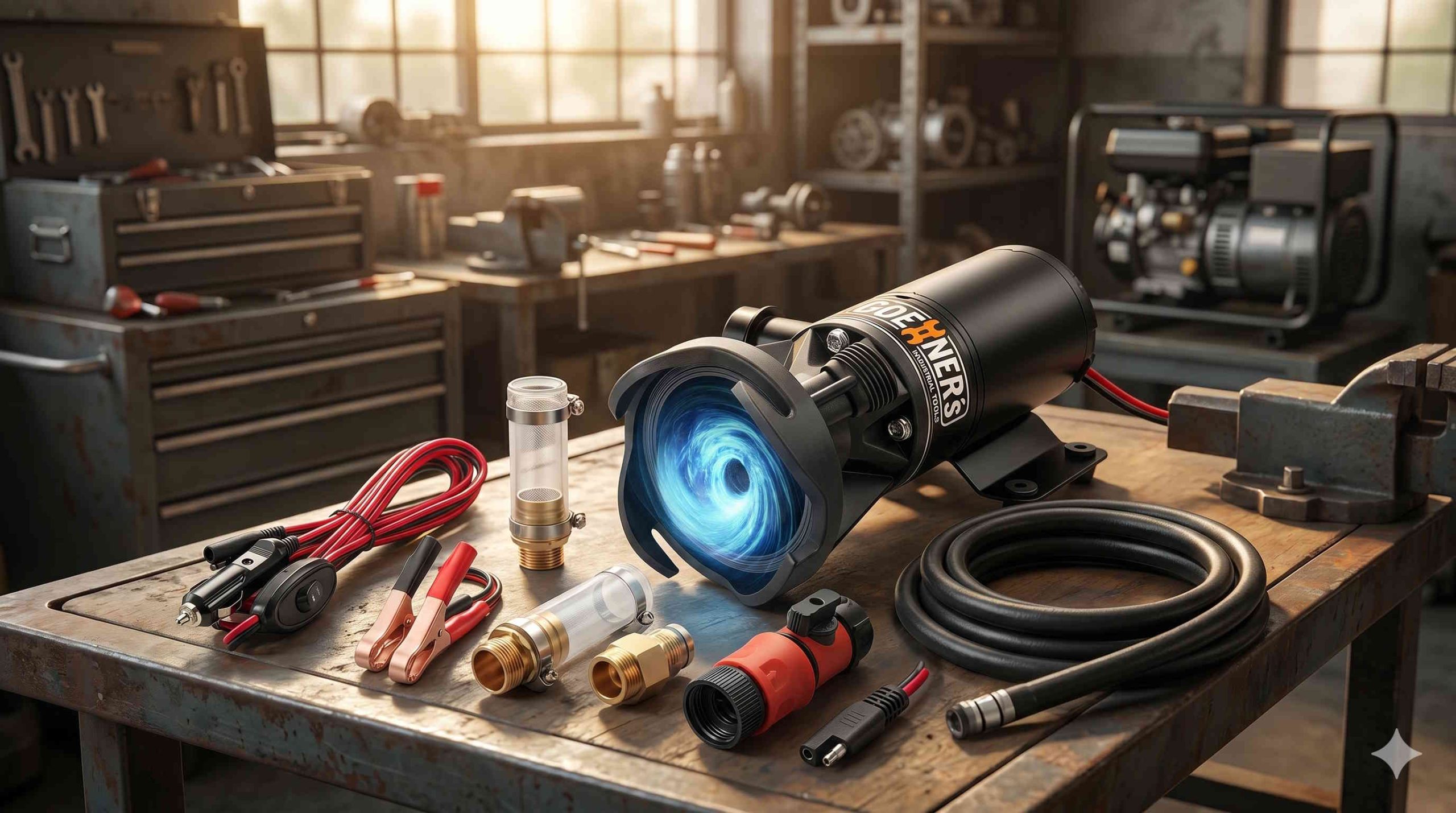
A macerator pump is a 12-volt grinder-and-pump combo: it chops waste from your black (and grey) tank into a fine slurry, then pushes it under pressure through a standard garden hose to a drain that gravity can’t reach. In one line: it trades the fat 3-inch gravity “stinky slinky” for a thin hose you can run uphill and over distance.
This Kitvance kit connects to a standard 3-inch RV waste outlet, discharges through a smaller (roughly 3/4-inch) hose, and powers off 12V via either a cigarette-lighter plug or alligator clips to a battery.
Three misconceptions worth clearing up:
- It’s not a high-pressure powerhouse. Several owners learned the hard way that introducing a hose drops the flow dramatically versus the unrestricted spec, and it pumps liquid far more eagerly than stubborn solids if the slurry isn’t broken down.
- It’s not faster than gravity. Through a narrow hose it’s slower than a wide gravity dump — you’re buying reach, not speed.
- It’s not “install once and forget.” Owners who treat it as disposable-ish field gear are far happier than those who expected a permanent fixture.
Key Specs That Actually Matter for RVers
- 12V DC power, two connection methods. It runs off a cigarette-lighter plug or battery clamps. This flexibility is real, but the quality of those connectors is the single biggest reliability story (more below). The power source you choose largely determines your experience.
- Discharge through a garden-hose-sized fitting. Because output is much smaller than a 3-inch gravity hose, your hose diameter and length directly shape how fast and clean it runs. Bigger-diameter (3/4-inch) hose is the owner-favorite.
- Self-priming with a fresh-water rinse/backflush port. Lets you flush the line and tank after dumping — the feature happy owners praise most for clean teardown.
- No automatic dry-run shutoff. It has thermal overload protection for overheating, but multiple owners stress it will not stop itself if it runs dry — so monitoring matters.
- It’s heavy. The weight comes from a solid motor, which inspires confidence, but it’s enough that hanging it directly off your outlet’s plastic fitting worries a lot of owners.
If you’re unsure whether your tank size, outlet height, and hose run are a match for a pump like this, the macerator compatibility and sizing walkthrough is the right place to pressure-test that before you buy.
Feature-by-Feature Breakdown (Truth vs Marketing)
| Feature | What the Manufacturer Says | What It Actually Means (User Experience) | Compared to Competitors |
|---|---|---|---|
| Grinding / cutter | Grinds waste fine for clog-free flow | Handles black-tank waste and RV toilet paper well; struggles with hair and regular TP | On par with budget macerators; premium units tolerate abuse better |
| Flow rate | High-output, empties tanks fast | Strong through wide hose; noticeably slower than gravity, very slow through thin/long hose | Similar real-world feel to other budget pumps; not a speed upgrade over gravity |
| 12V connectors | Two convenient power options included | Convenient concept, but the cigarette plug and switch overheat/fail for many | A common weak spot across cheap pumps; many owners hard-wire to fix it |
| Lift / distance | Pumps uphill and over long runs | Genuinely pumps 100+ ft and meaningful rise for many owners | Competitive; this is the pump’s real strength |
| Build / housing | Durable, well-made | Feels heavy and solid out of the box; internals are the question mark | Heavier than some rivals; durability is inconsistent unit-to-unit |
| Rinse/backflush port | Easy cleaning | Genuinely useful; clear elbow + this port = clean teardown | A nice-to-have many cheaper pumps skip |
Real-World Owner Experience (Deep Pattern Analysis)
Pattern 1: The connector and switch fail long before the pump does (what most reviews won’t tell you)
This is the dominant theme, and it’s the most actionable insight here: a large share of “the pump died” reports are actually the cheap 12V cigarette-lighter plug or the plastic on/off switch failing — not the motor. Owners describe the plug overheating within minutes, melting, blowing its internal fuse, or the rocker switch getting so hot it could burn you and intermittently refusing to make contact.
- In a nutshell: The grinder/motor is often fine; the included power hardware is the weak link.
- Hidden strength: Because it’s “just” the connector, mechanically-inclined owners rescue these pumps cheaply — cutting off the plug, wiring straight to the battery with a heavier-gauge wire and clips, or swapping the plastic button for a metal click switch. Those owners report the pump then runs reliably.
- Hidden weakness: Less handy buyers experience it as a total, mysterious death — and there’s a blown in-line fuse in the 12V adapter that many never discover, leading them to trash a working pump.
- What to do about it: From day one, plan to power it via battery clamps, not the cigarette plug. Keep spare fuses for that adapter. If you’re comfortable, consider upgrading the switch and using a heavier-gauge battery lead. Anything beyond basic clip-on power — re-wiring, soldering, gauge upgrades — should be verified against the manufacturer instructions or a qualified RV tech/electrician.
Pattern 2: Longevity is a real coin-flip — and “weekly, year-round, attached to the rig” loses
Owners cluster into two camps. One group gets a year or more (a few report 15–18 months) of regular use. The other reports death in roughly 4 to 9 months, sometimes after only a handful of dumps.
- In a nutshell: Lifespan is inconsistent, and usage style predicts a lot of it.
- Hidden strength: Light, intermittent, well-powered use correlates strongly with the long-lived units; happy owners often run a designated, well-charged 12V battery.
- Hidden weakness: Leaving it permanently attached to the rig, exposed to the elements, and running it on weak/low-voltage power correlates with early failure — low voltage is hard on these brushed motors, and a couple of owners found burned-up motor brushes after winter storage.
- What to do about it: Treat it as stowable gear, not a fixture. Store it dry and indoors. Power it from a fully-charged, adequately-sized battery rather than a marginal source. Several long-haul owners simply keep a backup on the shelf for mission-critical trips.
Pattern 3: It pumps liquid eagerly but punishes hair, regular TP, and run-dry mistakes
The “it won’t pull solids” complaints almost always pair with a preventable cause.
- In a nutshell: Clogs and “won’t grind” reports trace heavily to grey-tank hair, non-RV toilet paper, and running it dry.
- Hidden strength: Owners who use RV/septic-safe paper and keep hair out of the grey tank report it chews through black-tank waste and tissue without drama — one even joked about what it happily ate.
- Hidden weakness: Long hair wraps internal components over time; regular toilet paper can blow the motor because the cutter can’t break it down; and because there’s no dry-run shutoff, finishing a tank and letting it run dry overheats it fast.
- What to do about it: Use RV toilet paper, keep hair out of the grey tank (a drain catch helps), and shut it off the moment the clear elbow shows clean water. Start fresh water flowing a few seconds before you switch the pump on so it never catches up and runs dry.
Pattern 4: The clear elbow is the single best accessory you can add
This is an information-gain point owners discovered, not a marketed feature: a transparent (clear) discharge elbow turns the pump’s biggest risk — running dry — into a non-issue, because you can see exactly when the flow turns to clean water and stop immediately.
- In a nutshell: Visibility prevents the most common self-inflicted failure.
- Hidden strength: Combined with the fresh-water backflush, it lets you confirm the line and tank are actually clean before teardown.
- Hidden weakness: Without it, you’re guessing — and guessing wrong is how unattended pumps burn out.
- What to do about it: Buy a clear elbow or short clear vinyl section for the discharge side. It’s cheap insurance for a pump with no dry-run protection.
Pattern 5: Don’t let it hang off your outlet — and watch the O-ring
- In a nutshell: The pump’s reassuring weight becomes a liability when bolted straight to your plastic outlet.
- Hidden strength: It’s heavy because the motor is solid; owners read that as quality.
- Hidden weakness: Hanging that mass on a PVC fitting stresses it, and the connector O-ring/gasket is notorious for falling out and getting lost — forget it, and you get a flooding mess.
- What to do about it: Run a short hose so the pump rests on the ground, or support it with blocks. Check the O-ring every single time before you open the valve, and keep a bucket under the connection.
Pattern 6: Support is real, but you have to reach it the right way
- In a nutshell: Many owners report no findable phone number or website — yet a growing number get full replacements and refunds once connected.
- Hidden strength: Repeatedly, owners who pushed through (often via Amazon’s “contact seller” path) describe the seller replacing the unit and issuing a refund, sometimes even past the return window.
- Hidden weakness: The discovery friction is brutal; people who can’t find contact info feel scammed and say so loudly.
- What to do about it: If it fails, don’t go hunting for a direct website — go through Amazon’s order page to message the seller. Several owners say that’s exactly what finally worked.
The Good, The Bad & The Ugly (Pros/Cons)
Pros — by theme:
- Solves a real geometry problem: pumps uphill, over 100+ ft, and into totes/truck-bed tanks that gravity can’t reach.
- Clean operation: fresh-water rinse and backflush port make teardown tidy; saves the storage space a 3-inch sewer hose hogs.
- Build feel: heavy, solid-feeling motor; comes as a complete kit ready to run.
- Value: cheap enough that even occasional replacement beats premium-pump pricing for many owners.
Cons — by theme:
- Electrical weak points: cigarette-lighter plug and plastic switch overheat, melt, or fail; in-line fuse trips and confuses owners.
- Longevity gamble: a meaningful share die in 4–9 months, especially under heavy or weather-exposed use.
- No dry-run protection: will cook itself if left running empty.
- Setup-sensitive: hair, regular TP, and unsupported mounting cause avoidable failures.
Mini Toolkit: Decide + Fix (Fast)
Issue-Tag Box (most-reported themes):
#cigarette-plug-overheat · #switch-failure · #runs-dry-no-autostop · #hair-clog · #oring-falls-out · #short-power-cord
Fitment / Power Mini-Matrix:
| Your setup | Reality | Move |
|---|---|---|
| Cigarette-lighter power | Most-reported failure point | Wire to battery via clamps instead |
| Long / thin discharge hose | Slower flow, more strain | Use wider (3/4″) hose, keep runs reasonable |
| Battery far from outlet | Stock cord is short | Plan an extension or longer lead up front |
Mini Decision Tree:
- If your cleanout is uphill/far OR you dump into a tote → this pump’s core strength fits you.
- If you’ll leave it attached to the rig outdoors year-round → expect early failure; reconsider.
- If you flush regular TP or send hair down the grey tank → fix that first or skip.
- If you’re not comfortable doing basic battery wiring → the plug-quality risk hits you harder.
- If you need guaranteed multi-year reliability with no fuss → look at a premium tier instead.
Troubleshooting Quickflow (pump won’t run):
- Check the in-line fuse in the 12V cigarette adapter — a blown fuse mimics a “dead” pump.
- Bypass the cigarette plug; clamp directly to a fully-charged battery.
- Confirm correct polarity (a few units shipped wired so the plug ran it backward).
- Inspect/replace the cheap plastic switch if it’s hot or intermittent.
- Spin the rear manual-drive nub with a screwdriver/drill to confirm the motor isn’t seized.
- Still dead → message the seller through Amazon’s order page for replacement/refund.
Mini Return-Window Reality Check
- Test it on water immediately — don’t wait for a camping trip; many owners discovered failures only after the return window closed.
- Confirm it actually pumps through your hose (not just spins) and pulls a real vacuum.
- Verify the cigarette plug doesn’t overheat in the first few minutes — if it does, that’s your early warning.
- Check that the connector O-ring/gasket is present and seats properly.
- Don’t test on real waste during the trial — owners warn that ends your return option (and your dignity).
- Because the return clock is short and unforgiving here, sanity-check your whole setup against the pre-purchase macerator checklist before that window closes.
Installation / Setup Tips (RV-Realistic)
- Power from a battery, not the cigarette plug. The plug is the #1 reported failure; clamping to a good 12V battery sidesteps most “it died” stories.
- Size your battery up. Owners report low voltage is hard on the brushed motor; a fully-charged 50Ah+ (or a quality lithium) keeps it healthy.
- Buy a longer power lead early. The stock cord is widely called too short, especially if your battery is on the tongue and outlet is at the rear.
- Don’t hang the pump off your outlet. Run a short hose so it rests on the ground or on blocks — that weight stresses PVC fittings.
- Add a clear discharge elbow. It’s the cheapest way to avoid the dry-run failure this pump can’t stop on its own.
- Use a wider (3/4″) discharge hose for better, faster flow than a standard skinny hose.
- Start water before the pump when backflushing, so it never catches up and runs dry.
- Shut off the instant flow runs clear — don’t let it idle empty even for a few seconds.
- Keep spare 12V fuses for the adapter; a blown one looks exactly like a dead pump.
- Inspect the O-ring every use and keep a catch bucket under the connection.
- Use RV/septic-safe toilet paper and keep hair out of the grey tank to protect the cutter.
- Anything past basic clamp-on power — re-wiring, soldering, switch swaps, gauge upgrades — should be verified against the manufacturer instructions or a qualified RV tech/electrician.
Owner Stories
The stories below are composite scenarios reflecting repeated patterns across owner feedback.
- The happy off-gridder: A seasonal camper parks 100+ feet from a septic cleanout. They run a 3/4″ hose, power it from a dedicated battery, flush with fresh water after each dump, and store it indoors. A year-plus in, it’s still their favorite piece of gear — they even keep a spare for peace of mind.
- The connector casualty: A weekend RVer uses the cigarette-lighter plug as shipped. Within a few uses it overheats and quits. They assume the pump is dead and post a furious review — never realizing the in-line fuse blew or that clamping to the battery would have fixed it.
- The expectations mismatch: A buyer expects a sealed, permanent, gravity-speed solution, leaves it bolted to the rig outside through a season, and flushes regular toilet paper. It clogs, then dies early. The pump wasn’t wrong for everyone — it was wrong for that usage.
SEE MORE OWNER FEEDBACK ON AMAZON
Who This Is For (and Who Should Skip It)
Buy it if:
- Your dump point is uphill, far away, or higher than your valve
- You transfer waste into a tote, truck-bed tank, or distant cleanout
- You’re comfortable powering it from a battery and doing minor fixes
- You want a budget option and accept occasional replacement
- You’ll store it properly and treat it as stowable gear
Skip it if:
- You need guaranteed, fuss-free multi-year reliability
- You can’t tolerate a mid-trip failure with no local backup
- You won’t switch off the cigarette-plug habit or upgrade power
- You flush regular TP or can’t keep hair out of the grey tank
- You want something faster than gravity (this buys reach, not speed)
If you’re comparing options, start here: Top RV Macerator Pump Picks
Alternatives (Quick Comparisons)
- Premium-brand macerator (e.g., established sewer-pump names): Costs noticeably more, but owners who’ve run both sometimes say this Kitvance performs comparably for less — while others pay up specifically for better long-term durability and easier support. Choose this if multi-year reliability matters more than price.
- Portable waste tote (“blue boy”) + gravity: No electrical failure points and dead simple, but it’s heavy back-breaking hauling and can’t beat distance/uphill the way a macerator can. Good as a backup, not a replacement, for hard geometry.
- Built-in macerator or hard-plumbed system: A bigger, pricier commitment for full-timers who want a permanent fixture — overkill for occasional or seasonal users this pump targets.
Deep-Dive FAQ
What should I test immediately after delivery?
Test it on clean water the day it arrives — don’t wait for a trip. Confirm it actually pushes water through your hose (not just spins), check that the cigarette plug doesn’t overheat in the first few minutes, and verify the O-ring is present and seating. Owners repeatedly discovered defects only after the short return window closed, so early water-testing is the difference between a refund and a brick.
What are the most common problems and fixes?
The most common “failures” are the cigarette-lighter plug overheating/melting and the plastic switch dying — not the motor. The fixes owners use: check the adapter’s in-line fuse first, then bypass the plug and clamp straight to a battery, and swap the plastic switch for a metal one if needed. The second big issue is running it dry; a clear discharge elbow lets you stop the moment flow runs clean.
Will this work with my RV setup?
It connects to a standard 3-inch RV waste outlet and discharges through a garden-hose-sized fitting, so most rigs are compatible. The bigger questions are power and geometry: you’ll want a fully-charged 12V battery (the short stock cord often needs an extension) and realistic expectations about speed through a thin hose. If your cleanout is uphill or far, it shines; if you just want faster gravity-style dumping, it won’t deliver that.
Why won’t it pump solids / why does it clog?
Usually it’s preventable. Regular (non-RV) toilet paper can overwhelm the cutter and even blow the motor, and long hair from the grey tank wraps internal parts over time. Use RV/septic-safe paper, keep hair out of the grey tank, and make sure waste is liquefied — owners who do this report it grinds black-tank waste without drama.
How long will it actually last?
Honestly, it’s inconsistent. Some owners get a year or more of regular use; others see failure in 4–9 months. The strongest predictor in the feedback is usage: light/intermittent use with a strong battery and indoor storage lasts; heavy weekly use while permanently attached and weather-exposed fails early. Many long-term owners keep a backup on hand.
The company seems unreachable — is there a warranty?
Many owners report no findable phone number or website, which is the loudest support complaint. However, a growing number get full replacements and refunds — sometimes past the return window — once they reach the seller through Amazon’s “contact seller” path on the order page. If yours fails, go that route rather than searching for a direct site.
It stopped turning — is it definitely dead?
Not necessarily. Owners repeatedly report a blown fuse in the 12V adapter masquerading as a dead pump, plus a manual-drive nub at the rear of the motor you can spin with a screwdriver or drill to check whether the motor is truly seized. Check the fuse, try battery power directly, and confirm polarity before giving up.
Final Verdict
The Kitvance 12V macerator is a genuinely useful tool wrapped around two real weaknesses. When you respect its limits — power it from a battery, add a clear elbow, use RV paper, never let it run dry, and store it indoors — it reliably solves the uphill-and-distance dumping problem that drives RVers crazy, and it does it cheaply. When you ignore those limits or expect a sealed, guaranteed-for-years appliance, it disappoints, and the cigarette-plug failures and longevity coin-flip are the reasons.
So the best-fit buyer is clear: the seasonal, off-grid, or tote-using RVer who wants reach over speed, is comfortable with basic battery wiring, and accepts that a budget pump may need replacing eventually. For that person, it’s an easy recommendation. For anyone needing bulletproof, hands-off, multi-year reliability, spend up a tier instead.