SHURFLO 4008-101-A65 RV Water Pump Review: Quiet Pressure… or a Quality-Control Gamble?
Affiliate Disclaimer: This article contains affiliate links. If you click through and make a purchase, I may earn a small commission at no extra cost to you. This helps support my deep-dive research.
Quick Summary
If your current RV pump is screaming at night, short-cycling every 30 seconds, or flat-out dead—this is the exact scenario where the SHURFLO 4008 RV water pump shows up on shortlists.
Here’s the straight answer based on the owner feedback I analyzed:
- When you get a good unit: owners commonly report strong, consistent pressure and a noticeably quieter run than many older/budget pumps.
- When you don’t: a frequent buyer surprise is quality-control drama (arriving “not-new,” leaking quickly, dying early, or needing a replacement to get a good one).
- Best fit: as an exact replacement for an existing 4008-style setup (same ports, same wiring, same mounting vibe).
- Biggest “gotcha”: the plastic ports/threads—multiple owners warn they’re easy to cross-thread or damage if you rush the fittings.
The Real RV Water Pump Problem Isn’t “No Water”—It’s “No Peace”
A dying RV water pump rarely fails in a polite way.
It starts with a little symptom: the pump runs longer than usual after you wash your hands. Then it thumps when it kicks on. Then it wakes you up at 2:00 a.m. because it’s cycling for no obvious reason. And when it finally quits? That’s when you realize how many “small” RV tasks—dishes, toilets, showers, quick winterizing—depend on that one box under a cabinet.
That’s why I went deep on real owner experiences with the SHURFLO 4008 RV water pump—to save you time, reduce the trial-and-error installs, and help you decide whether this pump is the “buy once, relax” fix… or the kind of purchase where you plan your return label in advance.
Quick Verdict (TL;DR)
My bottom line: The SHURFLO 4008 RV water pump is often a quiet, effective replacement that brings pressure back to normal—especially when it’s replacing an older, noisier pump in the same footprint. But the owner feedback also shows high variability: plenty of 5-star “perfect replacement” stories, and plenty of 1-star “dead early / leaking / not new” complaints.
Confidence Score: 7.6/10 (excellent performance when you get a good one, but quality-control inconsistency lowers confidence)
If you want to check current pricing and availability:
At-a-Glance Specs (what owners consistently reference)
Across the owner feedback I analyzed, these specs and “what it feels like in use” come up repeatedly:
| Spec / Detail | What you’re likely shopping for | What it means in your RV day-to-day |
|---|---|---|
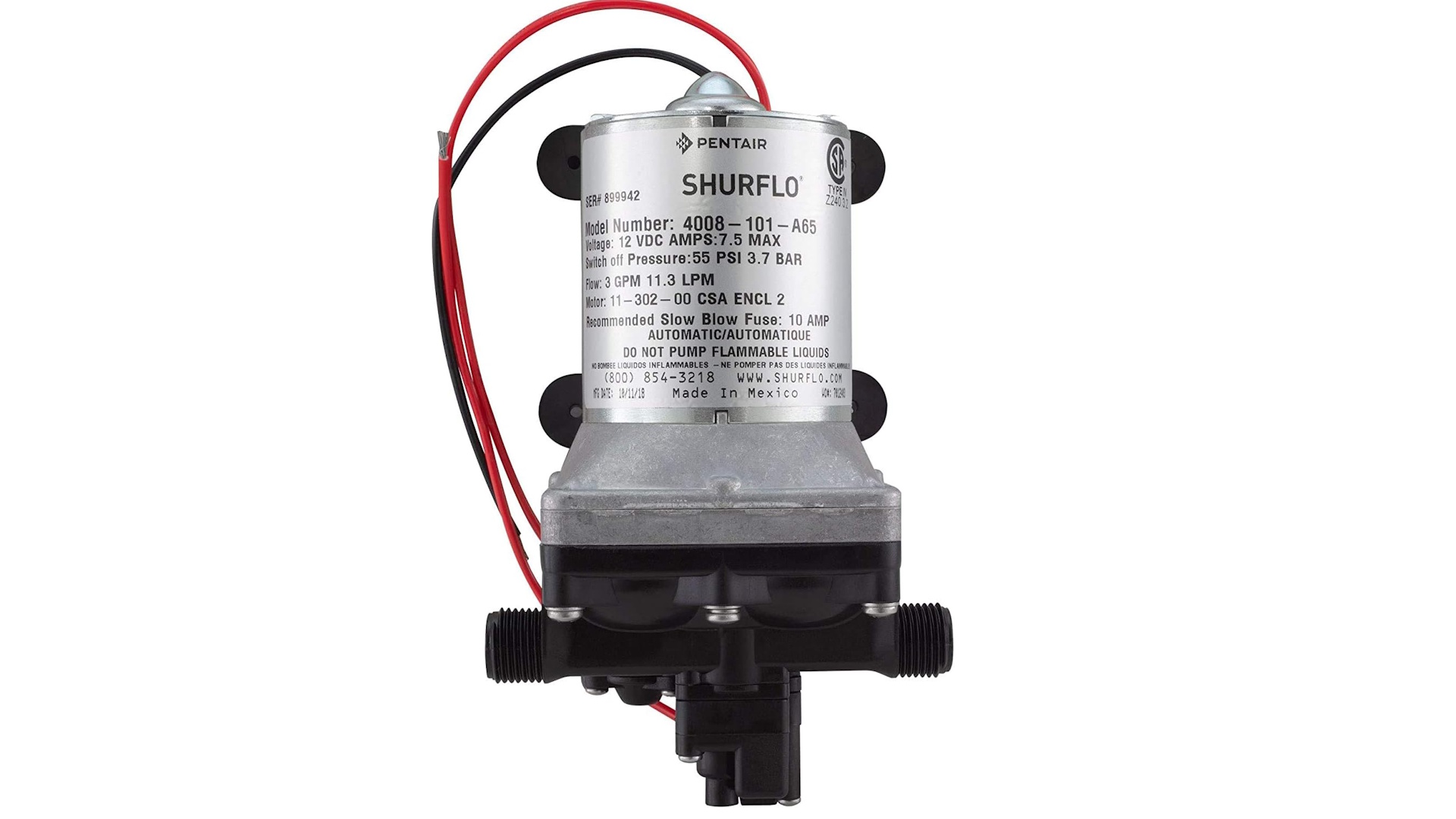
| Power | 12V DC RV pump | Standard for RVs in the USA/Canada and many Australian caravans running 12V house systems |
| Flow class | ~3.0 GPM class | Enough for typical single-fixture use; feels “normal” for sinks/toilet/shower in most rigs |
| Pressure class | ~55 PSI class | Stronger shower feel than tired old pumps; can also expose weak fittings if your plumbing is marginal |
| Current draw class | ~7.5A class (owners mention this) | Still reasonable on battery, but wiring/ground quality matters for stable pressure switch behavior |
| Pump type | Diaphragm “on-demand” | Runs when pressure drops; stops when pressure builds—unless leaks/air cause cycling |
If you want a fast refresher on how the whole system works (and why pumps cycle), this helps:
Technical Deep Dive: What This Pump Actually Is
The SHURFLO 4008 is a 12V on-demand diaphragm pump. That phrase sounds technical, but here’s what it means in real RV life:
- “On-demand” means the pump is controlled by pressure. Open a faucet → pressure drops → pump turns on. Close the faucet → pressure builds → pump turns off.
- “Diaphragm pump” means it moves water in pulses. Some setups feel smooth; others feel like a heartbeat—especially without an accumulator tank.
- Pressure switch behavior is everything. Many of the best reviews praise how it shuts off cleanly and holds pressure; many of the worst reviews complain the switch (or something affecting it) becomes unreliable.
This is also why pump installs can look “easy” but still perform badly if:
- you have air leaks on the inlet side,
- fittings are cross-threaded,
- the pump is mounted hard to a resonant panel,
- your check valve situation is messy,
- or your RV has a slow drip somewhere that makes the pump “hunt.”
If you’re already fighting weak flow, you may also want this troubleshooting guide handy:
Key Features (Benefit-Driven & Comparative Reality)
Here’s the most useful way to think about the pump’s “features”—not as marketing, but as real ownership outcomes.
| Feature | What the manufacturer position usually implies | What it actually means (owner experience) | Compared to typical alternatives |
|---|---|---|---|
| 3.0 GPM class flow | “Strong water delivery” | Owners commonly report it restores “normal” sink/shower behavior—especially replacing an aging pump | Similar flow class to many 3.0–3.5 GPM pumps; the difference is often noise + consistency |
| ~55 PSI class pressure | “Better shower pressure” | Many users find showers feel less weak, but higher pressure can expose weak fittings/leaky connections | Budget pumps may feel softer or surge more; higher-end pumps may feel smoother with an accumulator |
| On-demand pressure switch | “Automatic operation” | When it’s dialed, it shuts off cleanly; when something’s off, you may see short-cycling or failure complaints | This is the make-or-break point across most RV diaphragm pumps |
| Plastic ports / threaded ends | “Lightweight, corrosion-resistant” | A frequent buyer surprise is how easy these can be to cross-thread or damage if overtightened | Metal/brass ports tolerate abuse better, but many RV pumps use plastic ends—install technique matters |
| Replacement-friendly footprint | “Easy swap” | In the reviews I went through, “exact replacement” stories are some of the happiest owners | If you’re adapting from a different pump/port style, frustration increases fast |
Real User Experience Analysis (Deep Pattern Themes)
1) The “Two Worlds” Problem: People Either Love It… or They Get a Bad One
Based on aggregated owner experiences discussed in these reviews, the rating split is unusually polarized:
- 5-star reviews: 89 out of 188
- 1-star reviews: 57 out of 188
That gap tells you something important: this pump’s design can satisfy people, but the ownership experience can depend heavily on whether you receive a solid unit and whether your install avoids the common pitfalls (threads, inlet air leaks, mounting resonance).
Practical takeaway: If you’re going to buy it, install and test it immediately (pressure hold, shutoff behavior, leak check), so you’re not discovering problems when you’re already on the road.
2) Noise & Vibration: Many Owners Call It Quiet—If You Mount It Like You Mean It
Across the owner feedback I analyzed, “quiet” shows up as a repeated win—especially from people replacing older pumps that sounded like a drum solo under the bed.
But the same theme comes with a condition: mounting and plumbing choices decide whether it stays quiet.
Owners commonly report better results when:
- the pump isn’t hard-mounted to a thin, echo-prone panel,
- flexible lines reduce vibration transfer,
- and the pump is secured so it can’t “walk” or loosen hardware over time.
One pattern that comes up repeatedly is that a pump can be “quiet out of the box,” then get annoyingly loud later if mounting screws loosen or the install transmits vibration into cabinetry.
3) Pressure & Shutoff Behavior: The Best Units Feel Strong; the Worst Stories Center on the Switch
When the pump behaves properly, owners describe:
- strong “normal” RV pressure,
- quick recovery after flushing/toilet use,
- and clean shutoff once fixtures close.
But the complaints cluster around:
- not shutting off,
- cycling when nothing is running,
- or pressure sensor/switch failures after months of use.
In the reviews I went through, I kept seeing early-failure stories where a key component (often described as the pressure sensor/switch) didn’t hold up, leaving people with a pump that won’t build/hold pressure.
What I’d do if you’re installing one:
- After install, close all fixtures and listen. The pump should stop and stay stopped.
- If it cycles: check for drips, loose clamps, and inlet-side air leaks first—before blaming the pump.
If you’re not sure whether you’re diagnosing a pump issue or a plumbing issue, this guide pairs well with a pump swap:
4) Install & Fit: “Exact Replacement” Owners Are the Happiest
A frequent buyer surprise is how much happiness correlates with being a true replacement.
Owners who replaced the same model (or an equivalent footprint) often describe:
- fast swap,
- wiring that matches expectations,
- pressure that feels instantly restored.
Owners who had to adapt fittings or force compatibility describe a more frustrating experience, often tied to:
- thread compatibility issues,
- lack of included adapters,
- and the risk of damaging plastic ports.
One recurring point: some owners note it does not come with adapters—so you should expect to reuse your existing fittings or plan your adapters ahead of time.
If you want a step-by-step RV-friendly replacement walkthrough, keep this open while you work:
5) Ports & Threads: The “Don’t Muscle It” Lesson
This is the most practical warning signal in the owner feedback:
- multiple owners complain the plastic threaded ends feel soft,
- some report they’re easy to cross-thread,
- and at least a few mention the connections aren’t what they expected when trying to force standard fittings.
What it means for you:
If your install style is “grab wrench, crank until it stops,” this is not the pump to learn that lesson on.
Better approach (based on what owners learned the hard way):
- start threads by hand (always),
- avoid over-tightening,
- and make sure your fittings match the port style you’re actually working with.
6) Quality Control & “Not New” Complaints: The Trust Killer
From real-world owner feedback, it looks like the biggest emotional trigger isn’t noise or pressure—it’s confidence.
Several negative reviews describe receiving a unit that appeared:
- used,
- wet,
- corroded,
- or otherwise not “new in the way you expect new to be.”
And when that happens, the story usually turns into returns, downtime, and frustration—especially for RVers who bought the pump while traveling.
The Good, The Bad & The Ugly (Pros/Cons)
Pros (what happy owners consistently praise)
Based on aggregated owner experiences discussed in these reviews:
- Strong “restored” pressure: Many users find it brings their system back to a normal feel after an aging pump weakens.
- Often quieter than older/budget pumps: In the reviews I went through, quiet operation shows up as a recurring win—especially when mounted well.
- Fast replacement when it’s the same model: Owners commonly report a straightforward swap when the footprint matches.
- Good “trip saver” potential: Several stories read like: pump dies → replacement arrives → RV life becomes normal again.
Cons (the trust and durability concerns)
- Quality-control variability: The rating split shows a real “great unit vs bad unit” pattern.
- Early failures show up: Some owners report pressure switch/sensor problems within months.
- Plastic ports can be unforgiving: Cross-threading/over-tightening is a repeated pain point.
- “Not new” / wet-in-box complaints: Even a few of these can damage buyer trust—because you can’t afford surprises on the road.
Owner Stories (the human side)
Here are a few real-world scenarios that show what ownership feels like—beyond specs.
Story 1: “My pump finally died… and this made the RV feel normal again”
One common pattern that comes up repeatedly is the long-life original pump finally quitting after years of service, followed by a replacement that restores pressure immediately. In that scenario, owners tend to describe a quick install and a return to “normal RV water”—the kind of fix you feel in every faucet.
If you want to skim additional owner experiences directly, here’s the review page:
Story 2: “Perfect… until it sat unused”
In real-world use, many users find RV water pumps can be a little like generators: they behave better when they’re used. One owner describes solid performance for about a year, then trouble after the RV sat—leading to the practical lesson that running the system periodically (and winterizing correctly) can matter more than people think.
Related tip for off-season hygiene (and better water taste):
Story 3: “I had to swap it again to get a good one”
A frequent buyer surprise is how some of the harshest reviews aren’t about the pump’s concept—they’re about receiving a unit that doesn’t work right out of the gate, or needing multiple tries to land a good one. This is the core risk story: when you’re traveling, returns are more than inconvenience—they’re a trip disruption.
Again, owner reviews for context:
Expert Tips & Installation Hacks (practical, not theoretical)
I’m going to assume you want the pump to do two things:
- deliver steady pressure, and
- not wake the whole rig when someone uses the bathroom at night.
Here’s how owners tend to get the best outcome.
Pro Tip #1: Treat the inlet side like it’s sacred
If the inlet side pulls air, you’ll see weird behavior:
- longer run times,
- sputtering,
- or short-cycling.
Do this:
- check the inlet hose clamp,
- confirm the strainer/filter is seated,
- and avoid kinks that starve the pump.
For a deeper system overview (and why inlet restrictions matter):
Pro Tip #2: Don’t let the pump “broadcast” into your cabinetry
Owners commonly report quieter results when vibration isn’t transferred into a big hollow wooden box.
Do this:
- mount it securely,
- use a vibration-damping pad if you can,
- and consider flexible line sections to reduce resonance.
Pro Tip #3: Be gentle with the plastic ports
One pattern that comes up repeatedly is thread damage from rushing the install.
Do this:
- start threads by hand,
- stop if it binds,
- and tighten just enough to seal—don’t muscle it.
Pro Tip #4: Test shutoff and pressure hold immediately (before you pack up)
Once installed:
- Fill tank / prime system.
- Run a faucet until air clears.
- Close everything.
- Listen.
What you want: pump stops and stays stopped.
If it cycles: you likely have a drip, a loose fitting, or inlet-side air—fix those before assuming a bad pump.
Who This Is For (and Who Should Skip)
Buy the SHURFLO 4008 RV water pump if…
- you’re replacing a similar pump and want a straightforward swap,
- you care about quieter operation versus older, rattlier pumps,
- and you’re willing to install carefully (threads, fittings, leak check).
Skip it (or be cautious) if…
- you hate the idea of returns and want the lowest possible variability,
- your setup requires heavy fitting adaptation and you tend to overtighten,
- or you’re already dealing with mystery leaks—because any on-demand pump will look “bad” when the plumbing is actually the problem.
If you’re still choosing between pumps, this roundup helps frame alternatives by use case:
Deep-Dive FAQ (high-intent answers)
1) Is this pump actually “quiet” in an RV?
Many owners say yes—especially compared to older pumps—but the quiet outcome depends heavily on mounting and vibration transfer. If it’s hard-mounted to a thin panel, you may still hear it.
2) Why would an RV pump short-cycle after install?
In real-world use, many users find cycling is usually caused by:
- a small leak (even a slow drip),
- inlet-side air,
- a loose fitting,
- or a check valve/pressure hold issue.
Start with leak checks before blaming the pump.
3) Do I need extra fittings or adapters?
Some owners point out the pump may arrive without adapters, so plan to reuse existing fittings or have the right parts ready. Also be cautious with plastic threads—start by hand.
4) What’s the biggest install mistake people make?
Rushing fittings. The owner feedback includes multiple warnings about soft plastic threads and cross-threading. Hand-start, align carefully, tighten moderately, and test.
5) Will this help my “weak shower” problem?
If your old pump is worn out, many users find a new pump restores pressure noticeably. But if the real issue is a clogged filter, kinked line, bad regulator, or restricted fixture, a pump swap alone may not fix it.
If you suspect campground pressure/regulator issues when on city water, this is worth reading:
Final Verdict
If you want the simplest honest summary: the SHURFLO 4008 RV water pump can be a genuinely satisfying upgrade—strong pressure, often quieter, and especially easy when it’s a true replacement.
But the owner feedback also makes one thing clear: this is not a “zero risk” buy. The spread between glowing reviews and angry returns suggests you should install it quickly, test it thoroughly, and treat the fittings gently—because when things go wrong, they tend to go wrong in the most RV-annoying way possible: leaks, cycling, and wasted travel time.
Comparison Table (simple decision snapshot)
| If you’re this kind of RVer… | This pump is a strong fit when… | Your key tradeoff |
|---|---|---|
| You need a fast replacement | Your current pump is similar footprint/ports | Quality-control variability means you must test ASAP |
| You care about quieter operation | You’ll mount it properly and reduce resonance | Poor mounting can still make any pump feel loud |
| You want “normal” pressure back | Your old pump is worn and weak | Pressure gains can reveal weak fittings/leaks |