Amarine Made RV Macerator Pump Review (2026): Worth It or Cheap Gamble?
Last updated: June 2026
- Re-checked the “lift/self-priming” complaints against the happy-owner group, and the split is consistent: people who keep the pump at or below tank level rave about flow, while people who mount it high keep reporting weak or no suction.
- Re-verified the “dies just past the return window” pattern — it keeps surfacing across multiple years of feedback, not just one bad batch.
- Re-examined whether marine vs. RV buyers report different experiences. They do, and that distinction now drives a big chunk of this review.
Affiliate disclosure: This review contains Amazon affiliate links. If you buy through them, I may earn a small commission at no extra cost to you. It doesn’t change which patterns I report — the honest stuff below stays honest.
The Pump Everyone Buys to Avoid the Jabsco Price Tag
If you’ve ever stood at your RV’s dump station watching your black tank crawl empty by gravity, you already know why a macerator pump is tempting. And if you’ve priced the name-brand options, you know why the Amarine Made macerator keeps landing in carts: it looks nearly identical to the pricey originals for a fraction of the cost. The confusion most buyers run into is simple — is this a genuine money-saving twin, or a cheap gamble that dies right after the return window?
Quick answer: It’s worth it as a low-cost, easy-swap replacement if you mount it low and treat it as a “keep a spare” consumable — but skip it if you need reliable lift or long, worry-free service life.
This isn’t a spec rewrite. I spent hours digging into real owner feedback — the happy first-season folks, the engineers who tore theirs apart, and the people who rage-returned it — to find the patterns that actually predict whether you’ll love it or curse it. If you want the full category framework before deciding, the macerator pump selection walkthrough lays out the criteria that matter most across brands.
How this review was built (so you can trust it)
- Roughly 80+ owner reviews analyzed, spanning the U.S. and Canada, plus a few from Mexico.
- Time window: approximately early 2019 through early-to-mid 2026 — a genuinely long runway that lets reliability patterns show themselves over multiple seasons.
- Synthesis method: I tagged feedback into buckets — flow/lift performance, install and fitment sensitivity, power/amp-draw symptoms, reliability and failure timing, and support/returns experience — then separated setup-driven issues (mounting too high, wrong application, over-tightened housing) from likely product/design issues (impeller wear, paper gaskets, motor failures).
- Important limitations:
- Review samples skew toward extremes — thrilled and furious owners post more than the quiet middle.
- RV and marine setups vary wildly, so “it didn’t work for me” sometimes means “it didn’t fit my application.”
- I prioritized patterns that recurred across many owners over one-off complaints.
For the broader fitment-and-compatibility checklist this review intentionally doesn’t reproduce, the full macerator buying framework is the companion piece.
Quick Verdict (TL;DR)
Best for:
- Budget-minded RVers and boaters replacing a failed name-brand macerator with identical connections
- Setups where the pump sits at or below tank level (gravity-assisted)
- People comfortable keeping a low-cost spare on hand
Not for:
- Anyone who needs real vertical lift (mounting well above the tank)
- Full-timers wanting a true install-and-forget unit for years
- Buyers who’ll be stranded without responsive customer support
Standout win: Drop-in replacement for many Jabsco/Shurflo-style installs — same wiring, hoses, and screw holes for a lot of owners, at a fraction of the price.
Watch-outs: A recurring “dies shortly after the return window” theme, weak self-priming/lift, and near-impossible-to-reach manufacturer support.
Confidence Score: 6/10 🟡 This is a buyer-usefulness score, not a reliability statistic. It reflects how well this pump serves the right buyer — and the score sits mid-pack because the value-and-easy-swap upside is real, but the lift limitations, durability variance, and support gaps are equally real. Factors weighed: strength of recurring patterns, how avoidable the failures are, and how clearly the product fits a specific use case.
What This Product Is (and What It Isn’t)
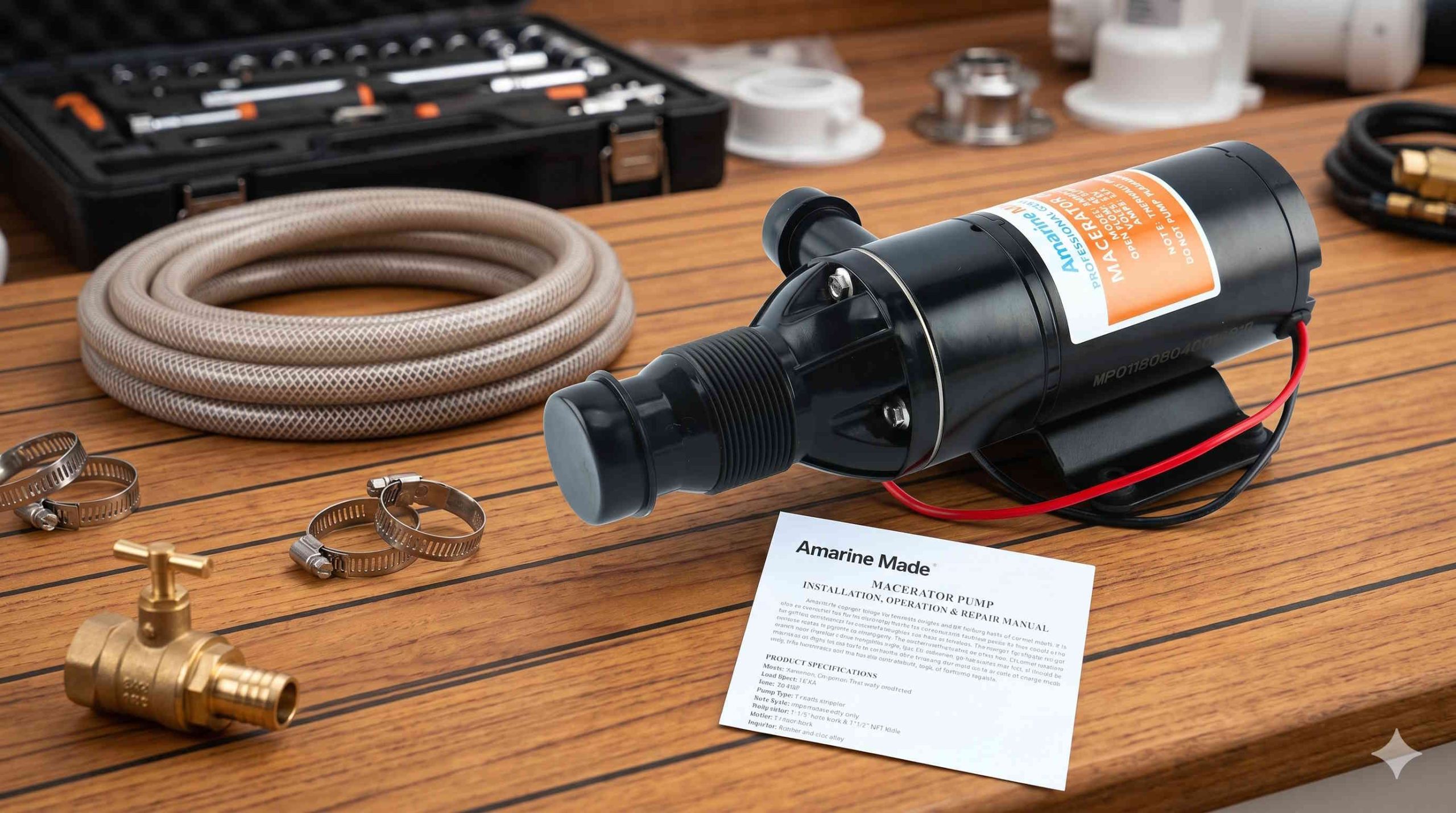
A macerator pump grinds waste into a slurry and pumps it out — letting you empty a black (or grey) tank faster than gravity, often into a portable tote or remote dump point. In plain terms: the Amarine Made is a low-cost 12V macerator built to drop into the same footprint as popular name-brand pumps.
What it isn’t:
- It isn’t a high-lift pump. Despite “self-priming” language, owners repeatedly find it struggles to lift more than a foot or two. It shines moving waste downhill or level, not up.
- It isn’t a sealed, RV-ready-out-of-the-box kit for everyone. Several RV buyers found it came configured marine-first and needed adapters or connectors they didn’t expect.
- It isn’t a lifetime unit. Plenty of owners get a season or a few years; plenty of others don’t. Treat it as value-priced, not bulletproof.
Key Specs That Actually Matter for RVers
- Mounting height relative to the tank — the single biggest predictor of satisfaction. Owners who keep it low report fast flow; those who mount it high report weak or no suction.
- Inlet/outlet sizing and connections — many marine installs are true drop-ins, but some RVers need adapters or have to trim/modify the outlet. Confirm your hose and thru-hull sizes before install.
- The manual turn-screw on the back — a genuinely useful design touch. It lets you hand-spin a stuck impeller to free it, which owners value for un-sticking the pump after it sits.
- Amp-draw behavior — a healthy unit runs steady; a failing one is described as whining, spiking amps, and tripping the breaker. Treat rising amp draw as your early warning.
Feature-by-Feature Breakdown (Truth vs Marketing)
| Feature | What the Manufacturer Says | What It Actually Means (User Experience) | Compared to Competitors |
|---|---|---|---|
| Self-priming | Self-priming, lifts several feet | Owners widely report it barely lifts — often inches to about a foot before it stops. Great below or at tank level. | Name-brand pumps (Jabsco/Johnson) are repeatedly described as priming and lifting better. |
| Flow rate | High GPM throughput | When mounted right, owners call it fast and powerful; some still feel real-world flow is lower than advertised. | Roughly comparable to name brands when mounted low; the gap shows up under lift. |
| Anti-clog macerating | New anti-clog feature | Mixed — some report it handles waste fine; others say small solids or a single strand of hair can stall it. | Owners with name-brand units on the same RV often report fewer clog stalls. |
| Durability | Built to last | Highly variable — some get years, many report failure around or just past a year, sometimes just past the return window. | The recurring owner refrain is to “just buy the Jabsco” for longevity. |
| Drop-in replacement | Universal fit | For many marine swaps it’s genuinely plug-and-play; RV buyers more often need adapters or mods. | Often the easiest part of the experience, and a real selling point. |
Real-World Owner Experience (Deep Pattern Analysis)
Pattern 1: The “great until it isn’t” lifespan — and the return-window timing
This is the pattern owners obsess over most. A striking number describe the pump working fine for a stretch, then failing — and an uncomfortable cluster of those failures land right around or just after the return window or first season.
- In a nutshell: It often works on day one and dies sooner than you’d hope.
- Hidden strength: When it works, even skeptics admit the value is hard to beat for the price.
- Hidden weakness: The failure timing erodes trust — several owners feel the lifespan is suspiciously short relative to the warranty.
- What to do about it: Test hard and early. Run it through real cycles within your return window instead of installing and forgetting. If it’s going on a black-water line, treat early performance as your go/no-go checkpoint.
Pattern 2: The impeller is the weak link (information gain most reviews miss)
Here’s what most reviews won’t tell you: at least one owner who is an engineer took the pump apart and traced failures to the pump section, not the motor. The motor is frequently described as strong; the flexible plastic/rubber impeller is what wears, so the unit keeps spinning while pumping less and less.
- In a nutshell: Motors usually survive; impellers degrade.
- Hidden strength: Because the motor is robust, a “weak flow over time” symptom often points to a serviceable wear part, not a dead unit.
- Hidden weakness: Owners report the design uses shortcuts that make it hard to service or find replacement parts — even basic paper gaskets are tough to source.
- What to do about it: If flow fades over months, suspect the impeller before scrapping the pump. Keeping a spare unit (a strategy several owners adopt) can be cheaper than chasing parts.
Pattern 3: Lift is the silent dealbreaker
Owner after owner discovers the hard way that this pump doesn’t lift well. Several ran their own bucket-and-hose tests and found it stopped pumping once raised much above the water line.
- In a nutshell: Mount it high and you’ll fight it; mount it low and it flies.
- Hidden strength: Below tank level, owners describe genuinely fast, powerful emptying — one drained a small tank in well under a minute.
- Hidden weakness: The “self-priming to several feet” expectation sets people up for disappointment and returns.
- What to do about it: Plan your install so the pump sits at or below the tank’s bottom. If your RV layout forces height, this likely isn’t your pump.
Pattern 4: RV vs. marine — the fitment fork in the road
A quieter but important pattern: this unit pleases boat owners more reliably than RVers, partly because so many marine installs are true drop-ins for failed Jabsco/Shurflo pumps. RV buyers more often hit adapter and configuration surprises.
- In a nutshell: Marine swaps tend to be clean; RV installs can need extra parts.
- Hidden strength: If you’re replacing a same-style marine macerator, expect same connections, piping, and screw holes for many setups.
- Hidden weakness: Some RVers returned it specifically because it needed too many added parts to suit their setup.
- What to do about it: Confirm RV adapter needs before you start. Validate your hose sizes and connector type against your existing dump setup early — the macerator setup-and-compatibility guide helps you check fitment before your return window closes.
The Good, The Bad & The Ugly (Pros/Cons)
Pros
- Value & price: Repeatedly called half (or a third) the price of name brands, with many owners delighted at the savings.
- Easy drop-in: For many marine swaps, identical connections and screw holes make for a 15-minute job.
- Strong when mounted right: Fast, powerful flow at or below tank level; the manual turn-screw is a smart un-sticking aid.
- Good as a backup: Cheap enough that several owners buy a spare to keep on board.
Cons
- Durability variance: Too many “died after a few months / just past return” reports to ignore.
- Weak lift/priming: Struggles above a foot or so; sets up false expectations.
- Clog sensitivity: Some report small solids or hair stalling the motor.
- Support gaps: Owners widely report unreachable customer service and dead warranty links.
Mini Toolkit: Decide + Fix (Fast)
Issue-Tag Box
#weak-lift— barely primes / won’t lift above ~1 foot#early-failure— quits around or just past the return window#impeller-wear— spins but pumps less over time#clog-stall— small solids or hair stop the motor#no-support— unreachable service / dead warranty link#rv-adapter-gap— needs extra parts for RV use
Fitment/Adapter Mini-Matrix
| Your setup | Likely experience | Action |
|---|---|---|
| Marine swap of same-style macerator | Often a true drop-in | Reuse existing wiring/hoses; verify screw holes |
| RV black tank, pump mounted low | Strong flow | Confirm connector/adapter needs first |
| Pump must mount above tank | Weak/no suction | Choose a higher-lift pump instead |
Mini Decision Tree
- If you can mount at/below tank level → it’s a reasonable budget pick.
- If you need vertical lift → skip it.
- If you’re replacing a same-style marine pump → likely an easy swap.
- If you need dependable support/warranty → buy a name brand.
- If you want insurance against failure → buy it and keep a spare.
Troubleshooting Quickflow
- Pump hums but no flow → check it isn’t mounted too high.
- Still nothing → use the rear turn-screw to free a stuck impeller.
- Flow weak over time → suspect impeller wear, not the motor.
- Amps spiking / breaker tripping → stop running it; it may be failing.
- Leaks at pump end → inspect gaskets/seals.
- No luck → test within return window and exchange before it’s too late.
Mini Return-Window Reality Check
- Run real waste cycles, not just a clean-water test — some failures only show under load.
- Confirm it actually lifts/primes for your mounting height before you commit.
- Watch for rising amp draw, whining, or breaker trips — early death signals.
- Check flow strength matches your expectations now, while you can still return it.
- If it stalls on minor solids or hair, treat that as a red flag, not a quirk.
- For a deeper pre-purchase validation routine, the macerator buyer’s reference walks through what to confirm before the clock runs out.
Installation / Setup Tips (RV-Realistic)
- Mount at or below tank level. The most common “it won’t suck” complaint traces straight to height — keep it low.
- Confirm RV adapter needs first. Some RVers returned it purely because it needed extra parts; sort connectors before you start.
- Reuse your old bracket where possible. Owners drill an extra hole to catch the second mounting screw and line up to existing boat/RV holes.
- Check accessibility before committing. One marine owner warned that a hard-to-reach bilge install turned a quick job miserable — plan the removal too.
- Verify port alignment on a trickle-flow unit. A few owners found inlet/outlet ports misaligned from the factory; the casing can bolt up wrong. If flow is weak from day one, this is worth inspecting.
- Keep some water in the black tank. An experienced owner notes a bit of standing water helps the macerator work better and keeps it from drying out.
- Run it periodically. Letting it sit can cause sticking; occasional use keeps it free — and the rear turn-screw helps restart a stuck impeller.
- RV toilet paper only, no wipes. Owners tie clogs and stalls to the wrong paper and foreign objects.
- Don’t over-tighten the housing. One owner’s pump wouldn’t start until they loosened the bolts so the impeller could spin freely.
- Consider corrosion protection at install. Since these often live in damp areas, some owners coat internals with a corrosion protectant before mounting.
- For anything beyond basic checks — rewiring, relays, drilling into structure, or re-plumbing — verify against the manufacturer instructions or consult a qualified RV tech/electrician.
Owner Stories
The stories below are composite scenarios reflecting repeated patterns across owner feedback.
- The happy marine swapper: Their old Jabsco failed (again), they grabbed the Amarine for a fraction of the price, and it bolted into the exact same holes and hoses in about 15 minutes. Months later it’s still humming along — and they bought a spare just in case.
- The disappointed lifter: They needed to pump up from a low tank, trusted the self-priming claim, and watched it barely move water above a foot. After a bucket test confirmed the limit, they returned it and went name-brand.
- The just-past-return casualty: Light use, worked fine, then started whining and tripping the breaker right after the return window — with no one answering the support line. They chalked it up to a cheap-but-risky gamble.
SEE MORE OWNER FEEDBACK ON AMAZON
Who This Is For (and Who Should Skip It)
Buy it if…
- You’re replacing a same-style marine macerator with identical connections.
- You can mount the pump at or below tank level.
- You want big savings over name-brand pumps and accept some risk.
- You’re handy enough to free a stuck impeller or swap a wear part.
- You like the idea of a cheap spare on hand.
Skip it if…
- You need genuine vertical lift in your layout.
- You want a true install-and-forget unit for years.
- You depend on responsive warranty/customer support.
- Your RV setup can’t easily accommodate adapters.
If you’re comparing options, start here: Top RV Macerator Pump Picks
Alternatives (Quick Comparisons)
- Name-brand macerators (Jabsco/Johnson-style): The repeated owner recommendation for longevity and real support, at a notably higher price.
- Portable macerator kits with run-dry protection: Worth a look if you want a self-contained dumping solution rather than a bare replacement pump.
- Higher-lift pumps: If your install demands lift, prioritize a pump owners actually praise for priming and head height — this isn’t that pump.
- A reliable water-system pairing: If you’re upgrading the whole dump-and-fill setup, our roundup of dependable RV water pumps covers the pressure side of the system.
Deep-Dive FAQ
What should I test immediately after delivery?
Test real performance within your return window — don’t just install and forget. Run actual waste (not only clean water), confirm it primes and pumps at your mounting height, and watch for whining, amp spikes, or breaker trips. Several failures only appear under load or just after the return period, so early, honest testing is your best protection.
What are the most common problems and fixes?
The big three are weak lift, early failure, and clog stalls. For weak lift, mount the pump lower. For a stuck or stalled impeller, use the rear turn-screw to free it and avoid wipes/non-RV paper. For fading flow over months, suspect impeller wear rather than the motor. If amps spike and the breaker trips, stop running it — that’s often a dying unit.
Will this work with my RV setup?
Often yes if you can mount it low and handle a possible adapter, but RV installs are less plug-and-play than marine ones. Multiple RV owners needed extra connectors or returned it for an RV-specific unit. Confirm your hose sizes and connector type first; marine drop-ins tend to be cleaner.
Does it really lift several feet like the listing suggests?
In practice, no — owners consistently report it struggles above roughly a foot. It moves water fast at or below tank level but loses suction with height. If your design needs vertical lift, choose a pump specifically praised for priming.
How long does it actually last?
It’s highly variable. Some owners get multiple seasons or years; many report failure around a year, and a notable cluster fails near or just past the return window. Treat lifespan as a gamble and consider keeping a spare.
Is the cheaper price worth the risk versus a name brand?
For the right buyer, yes. If you mount it low, do an easy swap, and accept it as a value consumable, the savings are real. If you need reliability and support, owners overwhelmingly point you toward the pricier name brands.
Why won’t my pump turn or prime even though the motor runs?
Two common culprits: an over-tightened housing or a stuck/misaligned impeller. Loosen the casing bolts so the impeller spins freely, use the rear turn-screw to free it, and on weak-from-new units, check that the inlet/outlet ports are aligned correctly.
Final Verdict
The Amarine Made macerator pump is a classic budget play: a genuine money-saver and easy swap for the right setup, undermined by weak lift, inconsistent lifespan, and thin support. If you can mount it at or below tank level, you’re replacing a same-style pump, and you treat it as an affordable consumable — ideally with a spare on the shelf — it earns its place. If you need vertical lift, multi-year dependability, or a support line that actually answers, spend up for a name brand and skip the gamble.
For the budget-minded, low-mount, swap-it-yourself owner, it’s a reasonable buy. For everyone else, go in with eyes open.