Kohree 30A/50A RV Surge Protector Review: Great Value… With a Few “Know-This-First” Gotchas
Affiliate Disclaimer: This article contains affiliate links. If you click through and make a purchase, I may earn a small commission at no extra cost to you. This helps support my deep-dive research.
Quick Summary
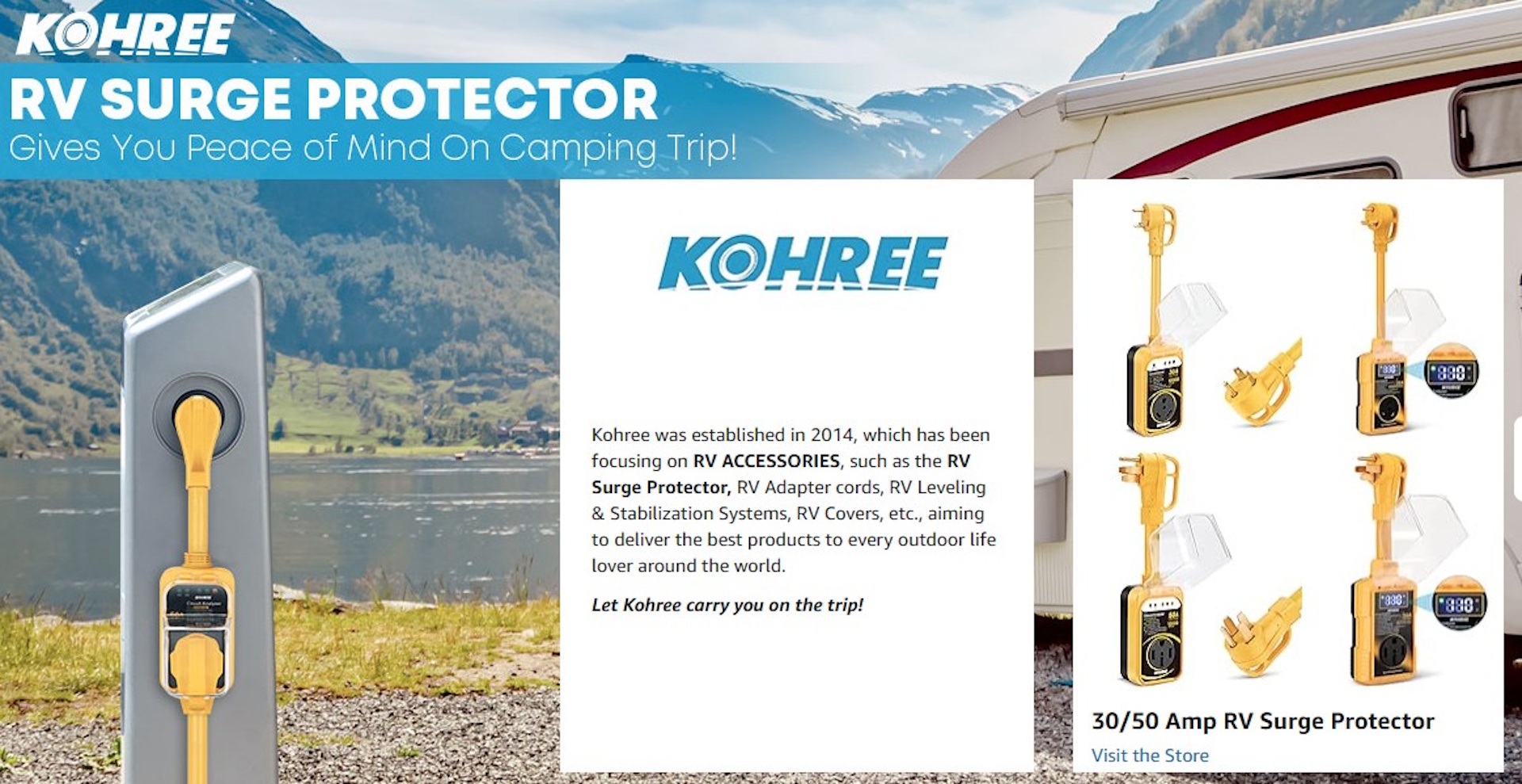
If you want basic shore power protection without paying premium-EMS money, the Kohree RV surge protector is one of the most commonly “good enough” picks I see owners sticking with—especially for weekenders and seasonal campers.
- Best for: Budget-minded RVers who still want voltage monitoring + basic fault detection
- Big win: The LED voltage display and “plug-in first, verify, then connect the RV” workflow is genuinely helpful
- Big risk: Some owners report early failure/QC issues, plus a couple design quirks (more on that below)
- My bottom line: Solid value when you get a good unit, but not my first choice for full-time, mission-critical use
At-a-glance comparison (owner-backed reality)
| Version | What owners love most | Common “wish it was better” | Who it fits best |
|---|---|---|---|
| Kohree 30A (10000J) | Easy setup, voltage readout, peace-of-mind | Cover fit on some plugs, occasional early defects | Travel trailers, smaller rigs, weekend camping |
| Kohree 50A (12000J) | Helpful diagnostics, solid build feel | Display/monitoring limitations (50A nuance), occasional failures | Class A/C, 5th wheels—if you understand the limitations |
One Bad Pedestal Can Ruin Your Trip (and Your Wallet)
If you’ve camped long enough, you’ve seen it: a tired campground pedestal with questionable wiring, low voltage when everyone cranks their A/C, or that one site where things “just feel off.” The scary part? Your RV’s electronics often don’t fail politely. They fail expensively—converter/charger, A/C control boards, microwave, fridge boards, inverter… the list is painful.
So I went deep into real owner experiences with the Kohree RV surge protector to answer the only question that matters:
Does it actually protect your rig in the real world—or is it just a fancy blinking light?
Quick Verdict (TL;DR)
The Kohree RV surge protector is a legit budget option that many owners use successfully for voltage monitoring, basic pedestal fault detection (like reverse polarity/open ground), and low-voltage shutoff that can save sensitive appliances when campground power gets sketchy.
Confidence Score: 7.4/10 🔌
It’s a strong value, but the consistency isn’t “premium EMS-level.” If you’re full-time or you camp in older parks constantly, you’ll want to read the limitations section carefully.
👉 See the Kohree RV Surge Protector price on Amazon
Technical Deep Dive: What This Surge Protector Actually Does
Let’s define terms quickly, because marketing around “surge protectors” gets messy.
Surge protector vs EMS (why the label matters)
- A surge protector primarily defends against voltage spikes (surges).
- An EMS (Electrical Management System) typically does more—monitoring power quality continuously and disconnecting power when voltage/frequency/wiring faults are detected.
From real-world owner feedback, the Kohree behaves like a surge protector with some EMS-style protections, mainly:
- Circuit analysis (detecting wiring faults like reverse polarity/open ground)
- High/low voltage protection (disconnecting when power becomes unsafe)
- Voltage display (so you can see what the pedestal is delivering)
That’s a meaningful set of protections for the money—just don’t assume it’s identical to the “top-tier” boxes that RV electricians rave about.
30A vs 50A service (USA/Canada note)
- 30A RV service is typically 120V (single hot).
- 50A RV service is typically 120/240V split-phase (two 120V legs).
This matters because a 50A protector ideally monitors both legs clearly and disconnects both legs reliably when something goes wrong. And yes—one of the most important owner discussions around the 50A model is exactly about that nuance.
(Australia note: Most AU caravans run 230V systems with different plug standards—this style of 30A/50A North American RV surge protector generally isn’t the right match.)
Key Features That Matter (Benefit-Driven + Comparative)
Here’s the owner-reality version of the “feature list.”
Feature Reality Table (what you’ll actually feel in use)
| Feature | What the manufacturer implies | What it actually means (owner experience) | Compared to competitors |
|---|---|---|---|
| Joule rating (10000J / 12000J) | “Strong surge protection” | Owners treat it like cheap insurance—you hope you never “test” it, but many like having it there | Competitive for budget class; premium units may add more protection layers |
| LED voltage display | “Easy monitoring” | One of the most-loved features: you can see low voltage before it hurts your A/C | Better than ultra-basic protectors with only indicator lights |
| Wiring fault detection | “Safer hookups” | Many owners report it quickly flags reverse polarity/open ground so you can avoid a bad pedestal | Similar to many mid-tier protectors; less granular than high-end diagnostics |
| Low/high voltage shutoff | “Protects your appliances” | Recurring theme: it cuts power when voltage dips, which can prevent damage | This is the big step up from “surge-only” units |
| Weather cover | “Waterproof protection” | Often appreciated—but some owners mention fit issues depending on plug/handle style | Some premium units have larger/stronger covers and better sealing |
| Anti-theft ring | “Secure it at the pedestal” | Owners like the idea, but you still need a cable/lock strategy | Common feature; effectiveness depends on your lock setup |
You’ll notice a pattern: the core concept is solid—but durability/QC and a few design details are what separate “budget good” from “buy once cry once.”
Real User Experience Analysis (Deep Pattern Breakdown)
Across the owner feedback I analyzed, a recurring theme is that people buy Kohree for one reason: practical protection at a non-painful price.
First impression (what most owners notice immediately)
- Feels sturdy / has a satisfying weight. Many buyers mention it doesn’t feel like a toy.
- The display is bright and readable. People like being able to glance at voltage without guessing.
- Setup is simple. Plug it into the pedestal first, confirm it’s happy, then connect your rig.
That “simple ritual” turns out to be a big part of why owners feel calmer using it.
✅ Want the same “check-before-you-connect” workflow? Grab the Kohree on Amazon
The hidden strength: It’s a diagnostic tool, not just a protector
In the reviews I went through, I kept seeing owners describe a very specific win: the Kohree helps you discover pedestal problems instantly.
Common examples owners report:
- Finding a dead leg on a 50A pedestal before blaming the RV
- Catching reverse polarity/open ground and moving to a different site
- Noticing low voltage during peak A/C hours and avoiding damage
If you’ve ever spent an hour troubleshooting “why the A/C won’t start,” you’ll understand why that’s valuable.
The hidden weakness: Not everyone gets the same longevity
This is where the Kohree story gets real.
One pattern that comes up repeatedly is inconsistent long-term reliability:
- Some owners report months to a year+ of daily/regular use without issues
- Others report early failure (sometimes within a season, sometimes within months)
That inconsistency is the single biggest reason I can’t rate it in the 9/10 range.
What “failure” looks like in real life
Based on aggregated owner experiences discussed in these reviews, failures tend to show up as:
- Error codes that persist across multiple pedestals
- The unit refusing to pass power even when the pedestal tests good
- Physical wear like faceplate/label peeling earlier than expected
- Rarely, water intrusion concerns if sealing loosens over time
The 50A “Two-Leg” Reality Check (Important)
This is the most technical—and most important—conversation around the Kohree 50A version.
A frequent buyer surprise is that some budget 50A protectors display/monitor only one leg clearly, even though a 50A RV service has two 120V legs.
One detailed tester noted that the display behavior can be misleading on 50A setups if you assume it’s showing the whole picture. The practical takeaway isn’t to panic—it’s this:
- Treat the 50A display as a helpful indicator, not a full lab instrument.
- Always shut off the pedestal breaker before plugging/unplugging.
- If anything looks inconsistent, don’t troubleshoot the pedestal yourself—notify campground staff or use a qualified tech.
If you’re the type who wants “total visibility” into both legs at all times, that’s where higher-end EMS units justify their cost.
Common Pain Points (What Owners Complain About Most)
1) Faceplate/label peeling (cosmetic… but annoying)
A noticeable number of owners mention the display label/faceplate starts peeling or curling, sometimes surprisingly early. Most describe it as a “looks ugly but still works” situation—but if you’re hard on gear or leave it outside full-time, it’s worth knowing.
Practical impact: Mostly cosmetic, but it can hint at how the unit handles heat/sun/time.
2) Cover fit depends on your plug style
Some owners love the rain cover… others find:
- It doesn’t close fully with certain bulky adapters
- It can struggle with power cords that have a molded handle (more common on newer/higher-end rigs)
If your RV cord has a big pull-handle: assume you may have fit issues unless you’ve confirmed clearance.
3) Voltage display accuracy (usually close, not perfect)
A few owners compare it to a multimeter and notice it may read a couple volts high/low. In real-world use, that’s not usually a deal-breaker.
What matters more: spotting unsafe conditions like chronic low voltage under load.
4) “Did it really protect me?” uncertainty
This is universal to surge protectors: you often don’t know it worked… because nothing blew up. Some owners only gain confidence after it trips during a bad power event.
The Good, The Bad & The Ugly (Pros / Cons)
✅ Pros (what owners consistently praise)
- Excellent value for the money. Many buyers compare it favorably to much pricier units—at least in day-to-day function.
- Easy to use. The “plug in → verify → connect RV” workflow is simple and repeatable.
- Voltage monitoring you’ll actually use. Owners like seeing voltage during A/C-heavy periods.
- Helpful fault detection. Reverse polarity/open ground warnings have saved people from plugging into bad pedestals.
- Low-voltage shutoff can be a trip-saver. Multiple owners describe it cutting power when voltage dropped, likely preventing damage.
❌ Cons (where the budget shows)
- Inconsistent reliability/QC. Some units arrive defective or fail early—this is the #1 trust hit.
- Cosmetic durability issues. Peeling faceplate/label complaints show up repeatedly.
- Cover/clearance quirks. Not every plug/handle/adapter combo fits cleanly under the rain cover.
- 50A nuance: Some owners want more transparent monitoring of both legs at all times.
😬 The “Ugly” (rare, but serious)
- A small cluster of owners report the protector didn’t prevent damage during a surge event, or the unit failed in a way that left them frustrated.
- A few report overheating/false faults. Even if uncommon, it’s why I recommend a higher tier for full-time living.
Owner Stories (The Human Side)
Here are a few scenarios that came up repeatedly—paraphrased into real-life moments you can picture.
Story 1: “My A/C wouldn’t run… and it wasn’t my RV.”
One owner plugged in, went inside, fired up the A/C—and nothing. Instead of tearing into the RV, they checked the Kohree first and realized a pedestal leg wasn’t delivering power correctly. That turned a potential hour-long RV panic into a quick site/pedestal fix.
🗣️ See more owner feedback on Amazon
Story 2: “I ignored weird power for too long—this finally exposed the real problem.”
Another owner described a slow chain of electrical weirdness over time—until they finally used a protector that flagged a wiring fault. That clue pushed them to stop guessing and address the power source before more damage stacked up.
🗣️ Read additional real-world experiences on Amazon
Story 3: “It failed… but the replacement experience mattered.”
A few owners reported failure after months, sometimes linked to moisture concerns or wear. But a consistent bright spot: several mention responsive customer service and replacements, which softened the blow—especially for a budget-priced unit.
🗣️ Browse more owner reports here
Expert Tips & Setup Hacks (Stuff Owners Wish They Knew Earlier)
These are the practical “do this and you’ll be happier” patterns.
1) Do the safe hookup routine every single time
Step-by-step (simple, safer habit):
- Turn OFF the pedestal breaker before connecting anything.
- Plug the Kohree into the pedestal.
- Turn the breaker ON and let the unit run its check.
- If it shows a fault (reverse polarity/open ground), don’t use that pedestal—request a different site or notify staff.
- Turn breaker OFF again, plug in your RV cord, then turn breaker ON.
This is the easiest way to reduce arcing, heat at the plug, and surprise faults.
2) If you tow often, re-check weather sealing and strain points
Owners who haul frequently mention vibration can loosen things over time. If you’re constantly on the move:
- Periodically inspect the cover, cable entry, and general tightness
- Store it so the cord/plug isn’t bent sharply in a bin
(No need to modify anything—just inspect like you would any outdoor electrical gear.)
3) Know your plug “handle” situation before you buy
If your RV cord has a chunky molded handle, clearance under some covers can be tight. Owners who avoided frustration either:
- Verified clearance before relying on the cover, or
- Chose a model/design known for larger cover clearance
4) Don’t obsess over exact voltage—watch for the danger zones
A couple volts off doesn’t matter nearly as much as consistent low voltage under heavy load. The real win is noticing when power is getting sketchy before your A/C compressor hates you for it.
Want to go deeper on protection strategy?
- RV Surge Protectors 101: Safeguarding Your RV’s Electrical System
- RV Electrical Safety Tips: Avoiding Fires, Shocks & Power Damage
Who This Is For (and Who Should Skip It)
✅ Buy the Kohree if you’re this kind of RVer
- You want budget-friendly protection that still feels practical and “real”
- You camp on weekends/seasonally and want to avoid bad pedestals
- You value a bright voltage display and basic fault checks
- You like the idea of low-voltage shutoff protection without premium pricing
⚡ Buy the Kohree RV Surge Protector on Amazon
🚫 Skip it if…
- You’re full-time living in your rig and you need maximum reliability day after day
- You want the most transparent, robust monitoring on 50A split-phase power
- Your campsite power is consistently old/sketchy and you want the “best of the best” protection layer
If you want the higher-confidence shortlist instead, start here:
Comparison: Where the Kohree Fits in the Market
| Category | What you get | Typical buyer | How Kohree compares |
|---|---|---|---|
| Ultra-basic surge protector | Minimal surge protection, limited diagnostics | Occasional campers | Kohree offers more real-time info (voltage + checks) |
| Mid-tier protector with voltage cutoff | Surge protection + voltage shutoff + basic fault detection | Most RVers | Kohree competes strongly on value, but consistency varies |
| Premium EMS | More robust monitoring/control + higher long-term confidence | Full-timers / high-risk parks | Kohree is cheaper, but not the same confidence tier |
Deep-Dive FAQ
1) Should I buy 30A or 50A?
Match your RV service:
- Travel trailers and many smaller rigs: 30A
- Larger 5th wheels / Class A/C: 50A
If you’re unsure, check your shore power cord end: 30A and 50A plugs are physically different.
2) Will this protect against low voltage at crowded campgrounds?
From real-world owner feedback, it often does what people want most: disconnect when voltage drops into unsafe territory, then allow you to reconnect once power stabilizes (behavior can vary by model/event).
3) Does the display stay on all the time?
Many owners note the voltage display remains lit while powered. If bright light bothers you at night, plan placement accordingly (some people keep it in a compartment or angled away from sleeping areas).
4) What should I do if it shows “open ground” or “reverse polarity”?
Treat that as a no-go condition:
- Don’t plug your RV into that pedestal
- Notify campground staff
- Request a different site
It’s not worth gambling with your rig’s electrical system.
5) Is this a true “buy-it-for-life” EMS?
No. Think of it as strong budget protection with real utility—but not the same long-term certainty as higher-end EMS gear designed for full-time abuse.
Final Verdict
If you want an affordable way to stop trusting random campground pedestals with your RV’s electronics, the Kohree RV surge protector is a genuinely useful upgrade. Owners repeatedly praise the simple workflow, the voltage display, and the way it flags bad power before you blame your rig.
But here’s the honest truth: the Kohree experience is best when you treat it like budget insurance with real benefits, not a flawless, full-time professional EMS. If you’re a weekender, it’s a smart buy. If you’re full-time and your power source is unpredictable, you’ll likely outgrow it.