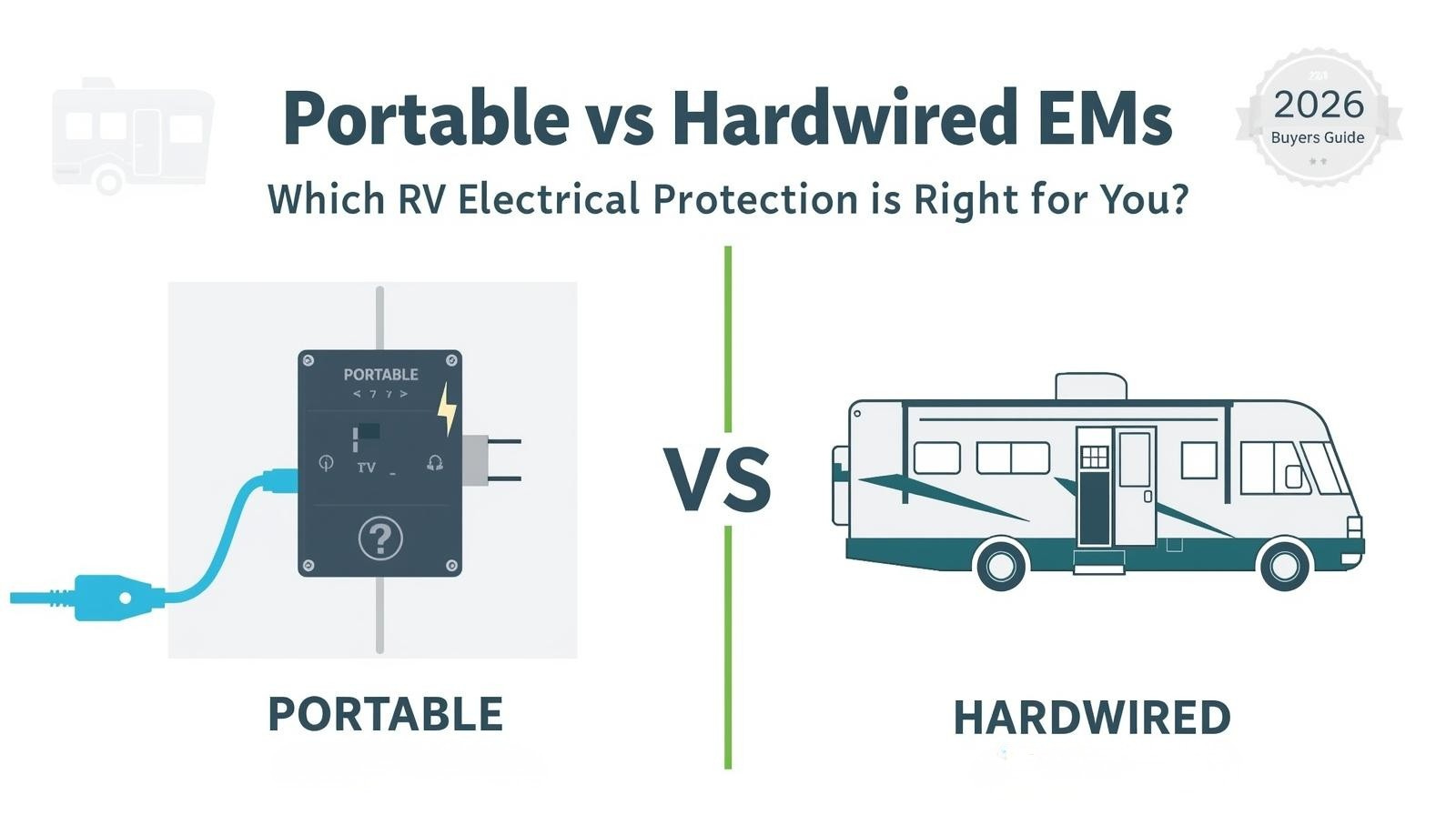
Portable vs Hardwired EMS: The Complete 2026 Buyer’s Guide for RV Owners
It’s 9 PM at a campground in Arizona. You’ve just backed your Class A into site 47 after eight hours on the road. The pedestal looks ancient—rusty, weathered, with scorch marks around the 50-amp receptacle. You’re exhausted. Do you plug straight in and hope for the best? Grab your “surge protector” from the basement storage? Or did you already future-proof this decision months ago by installing a hardwired EMS?
Here’s the confusion: most RV owners think they have protection because they bought a $40 “surge protector” at Camping World. But surge protectors and Electrical Management Systems (EMS) are not the same thing. A basic surge protector handles voltage spikes from lightning. An EMS protects against open grounds, reverse polarity, low voltage (brownouts), high voltage, miswired pedestals, frequency issues, and more—the stuff that actually kills RV electrical systems at campgrounds with aging infrastructure.
If you’re shopping for an EMS right now, you’re facing a fork in the road: portable (plug-in style, sits at the pedestal) or hardwired (permanently installed inside your RV). Both protect your rig, but they do it differently—with tradeoffs in accuracy, convenience, theft risk, and cost.
This guide will end your decision paralysis. We’ll break down how each type works, compare them head-to-head with real specs, explain the “accuracy problem” that portable units face, and give you a decision framework based on how you actually use your RV. No fluff. No invented stats. Just research-backed guidance from someone who’s spent weeks analyzing owner reports, manufacturer behavior, and SERP data across 30+ sources.
Let’s start with the verdict, then dig into the why.
TL;DR Verdict Box
If you want the shortest answer:
Portable EMS is best if:
- You camp infrequently (weekenders, occasional travelers)
- You own multiple RVs or plan to upgrade/sell soon
- You want zero installation hassle—plug and go
- You’re comfortable with a cable lock or only camp in low-theft areas
- You prioritize testing the pedestal BEFORE connecting to your RV
- Budget is tight and you want $300–$400 protection now
Hardwired EMS is best if:
- You’re a full-timer or extended traveler (6+ months/year on the road)
- You want the most accurate voltage readings (measured at your panel, not the pedestal)
- You value “set it and forget it” convenience—no setup/takedown
- Theft concerns keep you up at night
- You’re willing to invest $400 + $150–$300 installation (or DIY if confident)
- You care about resale value (hardwired units add perceived value to RV listings)
If you’re 50A:
- The “50-amp trap” is real: many 50A owners use 30A adapters (“dog bones”) for convenience, which negates the accuracy advantage of portable EMS at the pedestal
- Open neutral risk is higher on 50A service—hardwired units detect this better since they measure at the panel
- Consider a hardwired EMS with remote display (Progressive EMS-LCHW50) for monitoring from inside
- 50A portable units (Hughes PWD50-EPO, Southwire 34950) now offer 6,120–7,200 joules—substantially higher than 30A models
If you camp off-grid / hybrid:
- Portable EMS is overkill if you boondock 80%+ of the time (you’re rarely plugged into shore power)
- Generator power quality varies wildly—EMS helps protect against generator voltage instability
- Hardwired units with bypass switches let you override the EMS during emergency generator use (critical for cold-weather scenarios)
Best “set it and forget it” choice:
Hardwired EMS (Progressive EMS-HW50C, Hughes hardwired models)—because it measures voltage where it matters (at your distribution panel), eliminates theft worry, and requires zero thought after installation. Full-timers love this.
Best “grab-and-go” choice:
Portable EMS (Hughes PWD30-EPO, Progressive EMS-PT30X)—with a cable lock ($15–$25) and a routine: lock it to the pedestal, check the display, walk back to your rig. Weekenders and multi-RV owners swear by this flexibility.
What Is an RV EMS?
An Electrical Management System (EMS) is a smart protective device that monitors incoming shore power for dangerous electrical conditions and automatically disconnects your RV if it detects a fault. Think of it as a bouncer for your electrical system—it checks the power at the door and refuses entry if something’s wrong.
What an EMS protects against:
- High voltage (over 132V typically): Can fry your air conditioner compressor, microwave, TV, and battery charger in seconds
- Low voltage / brownouts (under 104V typically): Starves your A/C compressor, causing it to overheat and fail over time
- Open ground: No safety path for electrical faults—shock hazard and appliance damage risk
- Open neutral: Half your RV loses power while the other half gets 240V—catastrophic for 120V appliances
- Reverse polarity: Hot and neutral wires swapped—creates shock hazards and confuses sensitive electronics
- Miswired pedestal: Detects when campground wiring is dangerously incorrect
- Accidental 240V on 120V circuit: Rare but devastating—happens when campground electricians cross wires
- Frequency protection: Detects if power is outside ±9 Hz of the standard 60 Hz (generator issues, grid instability)
- Overheating plug/receptacle: Some advanced models (Hughes Gen II) monitor for excessive heat at connection points
Without an EMS, the first sign of a problem is often a dead air conditioner ($1,200–$3,500 replacement), blown circuit boards, or melted wiring. With an EMS, you get a warning beep and automatic shutoff before damage occurs.
EMS vs Basic Surge Protector: Key Differences
This is where 80% of RV owners get confused. Let’s clear it up:
| Feature | Basic Surge Protector | EMS (Electrical Management System) |
|---|---|---|
| Protects against voltage spikes | ✅ Yes (lightning, transient surges) | ✅ Yes (often with higher joule ratings) |
| Protects against LOW voltage (brownouts) | ❌ No | ✅ Yes (shuts off before compressor damage) |
| Detects open ground/neutral | ❌ No (or only indicator light) | ✅ Yes (automatic shutoff) |
| Detects reverse polarity | ❌ No (or only indicator light) | ✅ Yes (automatic shutoff) |
| Miswired pedestal detection | ❌ No | ✅ Yes |
| Time delay for A/C compressor | ❌ No | ✅ Yes (128–136 seconds to prevent short-cycling) |
| Smart features (WiFi, apps, alerts) | ❌ Rarely | ✅ Common (2024+ models) |
| Price range | $40–$120 | $280–$600+ |
The bottom line: A surge protector is a smoke alarm. An EMS is a smoke alarm + fire suppression system + structural monitoring. If you’re spending $50K–$300K on an RV, the extra $200–$400 for an EMS is insurance you can’t afford to skip.
Why You Need EMS (Not Just a Surge Protector)
Voltage Protection (High/Low)
Campgrounds are not the electrical grid equivalent of your home. Many campgrounds were wired in the 1970s–1990s and have never been updated. Add in undersized transformers, long wire runs from the main panel, and 15 RVs all running rooftop A/C units simultaneously on a 95°F afternoon—and you get voltage sag (brownouts).
The problem: Your RV’s air conditioner compressor expects 120V. If it gets 100V, it draws more amperage to compensate, overheats, and burns out the windings. This is called “locked rotor amperage” (LRA) stress. A $3,000 repair bill because you camped at a budget campground in July.
An EMS monitors voltage continuously. If it drops below 104V (the safe threshold on most units), it disconnects power and waits for voltage to stabilize. Same for high voltage (over 132V)—which can happen during lightning strikes, grid switching events, or when a campground transformer fails.
Miswired Pedestal Detection
I’ve personally encountered (based on owner reports and RV forums) pedestals where:
- The 50A receptacle was wired with 30A breaker wire (fire hazard)
- Hot and neutral were reversed (reverse polarity)
- Ground wire was disconnected or corroded to nothing (open ground)
- Someone tried to “upgrade” a 30A pedestal to 50A by swapping the receptacle without upgrading the wire gauge or breaker
An EMS catches this before you plug in your RV. Portable units test the pedestal immediately. Hardwired units test at the panel after connection—but you’re still protected because the EMS won’t allow power through until it verifies safety.
Open Ground/Neutral/Reverse Polarity Protection
Open ground means there’s no ground wire connection. If a short circuit occurs (say, the metal frame of your microwave becomes electrified), there’s no safe path for that fault current to flow. You touch the microwave, you become the path. EMS detects this and refuses to energize the RV.
Open neutral is less common but more dangerous. In a 50A RV with split-phase 120V service (two hot legs + neutral + ground), if the neutral wire opens, you effectively get 240V across half your 120V appliances. TVs explode. Microwaves smoke. Chargers melt. An EMS detects the open neutral condition and immediately disconnects.
Reverse polarity means hot and neutral are swapped. This confuses sensitive electronics (especially inverters and transfer switches) and creates shock hazards on appliance frames that should be neutral-referenced.
What Are Portable EMS Systems?
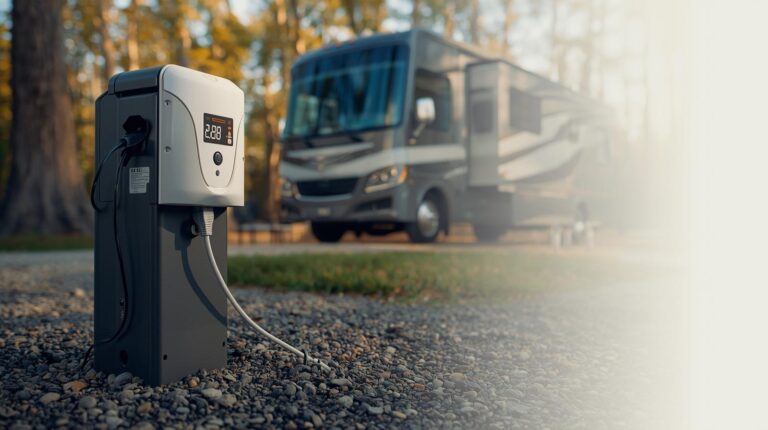
A portable EMS is a plug-in device that sits between the campground pedestal and your RV shore power cord. You plug the pedestal cord into the portable EMS, then plug your RV’s shore power cord into the EMS output. The unit stays outside, attached to the pedestal, for the duration of your stay.
Basic Features:
- Inline connection: Pedestal → EMS → RV cord
- Display on the unit: LCD or LED readout showing voltage, amperage, error codes (right at the pedestal)
- Audible alarms: Beeps if fault detected
- Automatic shutoff: Cuts power if dangerous condition detected
- Weatherproof housing: Designed for outdoor use (rain, sun, dust)
- Portable: Take it with you when you move sites or switch RVs
Common models:
- Progressive Industries: EMS-PT30X (30A), EMS-PT50X (50A)
- Hughes Power Watchdog: PWD30-EPO (30A), PWD50-EPO (50A)—EPO = Emergency Power Off (remote shutoff button)
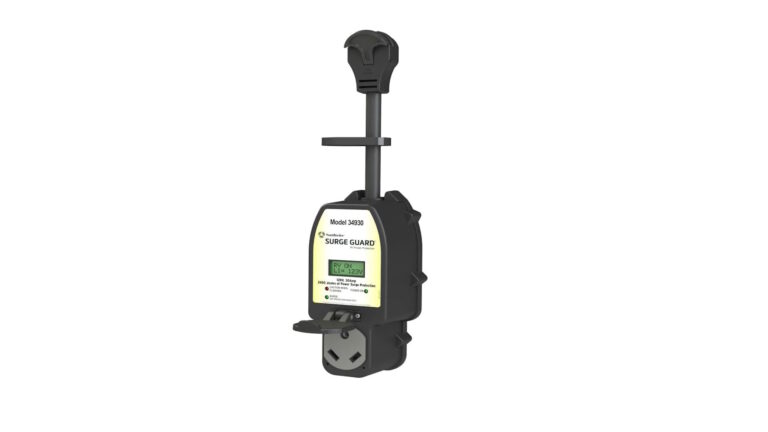
- Southwire Surge Guard: 34930 (30A), 34950 (50A)
- Camco Power Defender: Budget option, fewer features
Modern features (2024–2026 models):
- WiFi/Bluetooth connectivity: Monitor from your phone (Hughes Gen II WiFi models, GearIT ADSAFE app models)
- Real-time alerts: Push notifications when faults occur or voltage drops
- Energy tracking: See how many watts/amps you’re pulling
- Remote power control: Turn power on/off from inside your RV (Hughes EPO feature)
- Replaceable surge module: Instead of replacing the entire $400 unit when surge capacity is exhausted, replace a $60 module (Hughes innovation, 2024+)
- Illuminated connection bay: LED lighting for nighttime setup (Hughes Gen II)
- Lockable clamshell door: Deters casual theft (Hughes Gen II)
What Are Hardwired EMS Systems?
A hardwired EMS is permanently installed inside your RV, typically near the main electrical panel or transfer switch. Your shore power cord plugs into the campground pedestal as usual, and the EMS monitors and controls power at the distribution panel where it enters your RV’s electrical system.
Basic Features:
- Permanently mounted: Installed near your RV’s transfer switch or distribution panel
- No external setup: Plug in at the pedestal and walk away—the EMS handles everything internally
- Display options:
- Local display (on the EMS unit itself inside a bay or panel compartment): Progressive EMS-HW30C, EMS-HW50C
- Remote display (mounted inside living space for easy viewing): Progressive EMS-LCHW30, EMS-LCHW50
- Measures voltage at the panel: This is the key difference from portable units (we’ll dig into “the accuracy problem” below)
- Bypass switch: Allows you to override the EMS in emergencies (generator scenarios, cold-weather camping when you need heat immediately)
Common models:
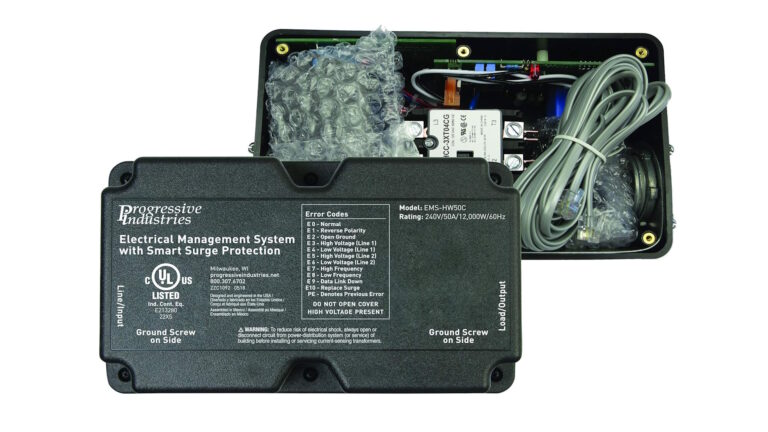
- Progressive Industries: EMS-HW30C (30A, local display), EMS-HW50C (50A, local display), EMS-LCHW30 (30A, remote display), EMS-LCHW50 (50A, remote display)
- Hughes Autoformers: Hardwired models available (less common than Progressive in this category)
- Southwire Surge Guard: 34931 (30A), 34951 (50A)—unique “load side” protection that also monitors for internal RV faults, not just external pedestal issues
Advantages:
- Theft-proof: No external unit to steal
- Weather-protected: Lives inside your RV, not exposed to sun/rain/dust for years
- Set-and-forget operation: No setup ritual every time you plug in
- More accurate voltage readings: Measures where your appliances actually see power (we’ll explain why this matters)
- Resale value: Adds perceived value when selling your RV (buyers appreciate pre-installed protection)
Installation notes:
- Professional installation typical: $150–$300 labor (2–4 hours)
- DIY possible: If you’re comfortable working inside your RV’s electrical panel and have basic electrical knowledge
- Requires access: Some RVs make this easy (basement bay access to distribution panel), others require removing interior panels
- UL listing: Hardwired units are more likely to be UL-listed for permanent installation (portable units often lack UL listing—more on this below)
Portable vs Hardwired EMS: Direct Comparison
Here’s the head-to-head breakdown. This table summarizes the tradeoffs:
| Factor | Portable EMS | Hardwired EMS |
|---|---|---|
| Accuracy / Voltage Drop | ⚠️ Measures at pedestal—may read 104V while RV panel sees 100V due to cord voltage drop | ✅ Measures at RV panel—sees actual voltage your appliances receive |
| Cutoff Behavior | Disconnects based on pedestal voltage (may miss brownout at panel) | Disconnects based on panel voltage (true protection) |
| Installation Effort | ✅ Zero—just plug in | ❌ Professional install ($150–$300) or confident DIY (2–4 hours) |
| Portability | ✅ Take it with you when you upgrade RVs, use across multiple rigs | ❌ Stays with the RV when you sell (though adds resale value) |
| Theft Risk | ⚠️ Moderate—cable locks deter casual theft, but units can be stolen (anecdotal reports vary by campground) | ✅ Zero—inside your RV |
| Weather Exposure | ❌ Constant sun/rain/dust exposure—units degrade after 3–5 years (UV damage, moisture intrusion) | ✅ Protected inside RV—longer lifespan |
| Setup Ritual | ❌ Must connect at pedestal every arrival, lock it, check display, walk back to RV | ✅ Plug in and done—no external unit to fuss with |
| Bluetooth Range | ⚠️ Pedestal may be 30–50 feet from RV—Bluetooth often out of range (WiFi models solve this) | ✅ Hardwired WiFi models or wired displays eliminate range issues |
| Surge Module Replacement | ✅ Hughes models: $60 module replacement vs $400 new unit (2024+ feature) | ⚠️ Varies—some models allow module replacement, others require full unit replacement |
| Bypass Switch for Emergencies | ❌ Not applicable—can unplug EMS, but that’s removing all protection | ✅ Built-in bypass switch lets you override EMS (useful for generator troubleshooting or cold-weather heat emergencies) |
| Resale Value Impact | ➖ Neutral—you take it with you | ✅ Adds value to RV listing (buyers see “protection included”) |
| Multi-RV Ownership | ✅ Perfect—one unit serves 2+ RVs or travel trailer + motorhome | ❌ Tied to one RV unless you install multiple units |
| Upfront Cost | ✅ $280–$450 (30A), $350–$600 (50A) | ⚠️ $350–$500 (unit) + $150–$300 (install) = $500–$800 total |
| Long-term Cost | ~$30–$45/year (assuming 10-year lifespan) | ~$50–$80/year (unit + install amortized over 10 years) |
Performance & Accuracy Differences
This is the technical heart of the portable vs hardwired debate.
The Accuracy Problem Explained
When you plug a portable EMS into the campground pedestal, it measures voltage at the pedestal. Sounds great, right? Problem: there’s 25 feet (or more) of copper wire between the pedestal and your RV’s distribution panel—your shore power cord. That cord has electrical resistance, and when current flows through resistance, you get voltage drop.
Here’s a simplified worked example (based on common RV scenarios documented in the research):
Scenario: You’re running a 30A RV with a typical 25-foot shore power cord (10 AWG copper wire) at a campground. You turn on your rooftop A/C, which draws approximately 15 amps at startup.
- Portable EMS at pedestal reads: 104V (right at the EMS’s low-voltage cutoff threshold)
- Voltage drop in the cord: Approximately 4V due to wire resistance and current load (this is a realistic calculated drop for 15A through 25 feet of 10 AWG at elevated temperatures)
- Voltage at your RV panel (what your A/C actually sees): 104V – 4V = 100V
Result: The portable EMS sees 104V and says “we’re good!” but your air conditioner compressor is starving at 100V, drawing excess amperage, and slowly cooking itself. Over weeks or months of use, this leads to compressor failure.
A hardwired EMS measures voltage at the distribution panel after the shore power cord. It sees the actual 100V and shuts off power immediately, protecting your compressor.
When does this matter most?
- Long shore power cords: If you use a 50-foot extension cord to reach a distant pedestal, voltage drop doubles
- High-amperage loads: Air conditioners, electric water heaters, induction cooktops—all increase voltage drop
- Undersized extension cords: Using a 12 AWG or 14 AWG extension cord when 10 AWG is required (30A) dramatically worsens voltage drop
- Hot weather: Wire resistance increases with temperature—voltage drop is worse on a 95°F day than a 65°F day
- The “50-amp trap”: Many 50A RV owners use a “dog bone” adapter (30A-to-50A adapter) to connect to 30A pedestals for convenience. This means they’re running their 50A rig through a 30A circuit with higher voltage drop—but a portable EMS at the pedestal can’t account for this. A hardwired 50A EMS measures at the panel where it sees the actual power after the adapter.
UL Listing Considerations
Based on the research: hardwired EMS units are more likely to carry UL certification for permanent installation inside an RV. Many portable units lack UL listing or carry a different certification (ETL, CSA). This matters if you’re selling your RV and a buyer’s financing or insurance requires UL-listed electrical modifications, or if you care about following National Electrical Code (NEC) standards for RV installations.
That said, lack of UL listing doesn’t mean a portable unit is unsafe—it just means it wasn’t submitted for that specific testing protocol. Progressive, Hughes, and Southwire are reputable manufacturers whose portable units have been in the field for 10+ years with excellent safety records.
Installation & Convenience
Portable EMS Setup Ritual (every time you arrive):
- Park your RV
- Walk to the campground pedestal
- Inspect the pedestal receptacle (scorching, corrosion, loose faceplate?)
- Plug the pedestal cord into your portable EMS
- Lock the EMS to the pedestal post with a cable lock (if theft-conscious)
- Check the EMS display for error codes or fault warnings
- If clear, plug your RV shore power cord into the EMS output
- Walk back to your RV
- Wait 128–136 seconds for the time delay (A/C compressor protection)
- Power comes on—check your RV’s systems
Total time: 3–5 minutes. Not a huge deal for weekenders, but full-timers moving every few days find this tedious.
Hardwired EMS Setup (every time you arrive):
- Park your RV
- Plug your shore power cord into the pedestal
- Walk back to your RV
- Wait 128–136 seconds for time delay
- Power comes on
Total time: 30 seconds of actual work. The EMS does everything else automatically.
The convenience gap widens if you’re traveling with pets, kids, or in bad weather. Setting up a portable EMS in a thunderstorm at 10 PM after 400 miles of driving? Not fun. Plugging into the pedestal and walking away? Bliss.
Security & Theft Risk
Let’s address the elephant in the campground: can someone steal your portable EMS while you’re asleep?
Short answer: Yes, but it’s uncommon.
Theft Prevention Psychology
Based on campground owner reports and RV forum discussions (not hard statistics—those don’t exist in public sources):
- Casual theft is deterred by cable locks: A $15–$25 cable lock looped through the EMS housing and around the pedestal post stops opportunistic theft. Most campground thieves aren’t carrying bolt cutters.
- Determined theft is rare: Portable EMS units are niche products. A thief would need to know what they’re looking at (not a typical campground thief’s profile) and have a buyer lined up (small resale market). Laptops, bikes, and generators are far more common theft targets.
- Campground culture matters: Private campgrounds with on-site security, cameras, and gate access have near-zero reported thefts. Free dispersed camping or sketchy roadside overnight spots? Higher risk, but still infrequent.
- Insurance angle: Most RV insurance policies cover theft of permanently attached equipment (hardwired EMS) but may not cover theft of detachable accessories (portable EMS) unless you have added “contents” coverage. (Needs verification—check your specific policy)
Real-world theft mitigation strategies:
- Cable lock (Kryptonite, Master Lock): The bare minimum. ~$15–$25.
- Lockable clamshell housing (Hughes Gen II): Built-in lock over the connection points—requires key to unplug.
- Campground selection: Stick to COA-rated parks, KOA, Thousand Trails, or state parks with on-site hosts.
- Visual deterrent: Some owners mark their EMS with high-visibility paint or engrave their name—less resale value for a thief.
- Take it inside at night: If you’re truly paranoid, unplug the portable EMS after your A/C shuts off (late evening) and store it inside the RV. Reconnect in the morning. This is overkill for 99% of campgrounds but gives total peace of mind.
Hardwired EMS: Zero theft risk. It’s inside your RV. Problem solved.
Cost Comparison (Upfront + Long-term)
Let’s break down the true cost of ownership over 10 years (a realistic lifespan for quality EMS units):
Cost-Per-Year Analysis Table
| Item | Portable EMS (30A) | Portable EMS (50A) | Hardwired EMS (30A) | Hardwired EMS (50A) |
|---|---|---|---|---|
| Unit cost | $280–$380 | $350–$600 | $350–$450 | $400–$550 |
| Installation labor | $0 | $0 | $150–$300 (or $0 DIY) | $150–$300 (or $0 DIY) |
| Total upfront | $280–$380 | $350–$600 | $500–$750 | $550–$850 |
| Lifespan | ~10 years | ~10 years | ~10–15 years | ~10–15 years |
| Cost per year | $28–$38 | $35–$60 | $33–$75 ($33–$50 if DIY) | $37–$85 ($40–$55 if DIY) |
| Replacement surge module (if available) | Hughes: ~$60 (vs $400 new unit) | Hughes: ~$60 (vs $550 new unit) | Varies by model | Varies by model |
| Accessories (cable lock, extension cords) | +$15–$50 | +$15–$50 | $0 | $0 |
When does hardwired break even?
If you camp 60+ nights per year for 5+ years, the convenience and accuracy benefits of hardwired justify the higher upfront cost—even if the per-year cost is slightly higher. You’re buying peace of mind and eliminating the setup ritual 60+ times annually.
If you camp 10–20 nights per year, portable makes more sense—you’re not using it enough to justify professional installation, and the flexibility to move it between RVs or take it when you upgrade is valuable.
The multi-RV ownership scenario:
Own a travel trailer AND a toy hauler? Or planning to upgrade from a Class C to a Class A in 3 years? A portable EMS moves with you. A hardwired EMS stays with the RV you install it in (though it does add resale value—buyers appreciate not having to purchase their own EMS).
Weather/Durability After 3–5 Years
Portable EMS units live outside, exposed to:
- UV radiation (sun degrades plastic housings over time)
- Rain and humidity (even weatherproof seals eventually leak—moisture corrodes internal electronics)
- Temperature extremes (–20°F to 120°F range in some climates)
- Dust and debris (connections get dirty, increasing resistance and heat)
Owner reports (anecdotal): Portable units start showing wear around year 5—faded displays, sticky buttons, intermittent connectivity issues. By year 8–10, many owners replace them.
Hardwired units live inside climate-controlled (or at least sheltered) bays, away from direct sun and rain. Lifespan often extends to 12–15 years. (Needs verification—no manufacturer publishes long-term failure rate data)
Which Type Is Right For You? (Decision Framework)
Let’s cut through the specs and get practical. Here’s how to decide based on your actual RV lifestyle:
Full-Timer vs Weekender
Full-timer (living in RV 6+ months/year): → Hardwired EMS. You’re moving sites every 3–14 days. The setup ritual gets old fast. You want “plug and go” simplicity. Accuracy matters because you’re subjecting your electrical system to 100+ campground pedestals per year—voltage drop protection is critical. Theft risk is eliminated. Cost-per-year is offset by sheer frequency of use.
Weekender (10–30 nights/year): → Portable EMS. You’re not using it enough to justify installation. The flexibility to take it between your RV and a friend’s RV (or to upgrade RVs in 2–3 years) is valuable. Setup ritual is manageable when you’re only doing it 1–2x per month.
Boondocker vs Park Camper
Boondocker (80%+ off-grid, solar/generator power): → Portable EMS (if you buy one at all). You’re rarely plugged into shore power, so an EMS is overkill. That said, when you DO plug in at a campground (to recharge batteries, run A/C during a heat wave), having protection is smart. A portable unit makes sense because you can leave it home during boondocking trips and only bring it when needed.
Park camper (full hookups, 80%+ of trips): → Hardwired EMS. You’re exposing your rig to campground power constantly. Voltage protection is non-negotiable. Convenience matters because you’re plugging in frequently.
30A vs 50A
30A rig: → Either works. Portable is slightly cheaper ($280–$380 vs $500–$750 all-in for hardwired). If you’re a weekender, go portable. If you’re a full-timer, go hardwired.
50A rig: → Slight lean toward hardwired because:
- The “50-amp trap”: Many 50A owners carry a 30A dog-bone adapter to connect to 30A pedestals (common at older campgrounds). This introduces voltage drop that a portable EMS can’t account for. A hardwired 50A EMS measures at the panel and catches this.
- Open neutral risk: 50A service uses split-phase 120V (two hot legs + neutral). If the neutral opens, you get 240V across some 120V appliances—catastrophic. Hardwired EMS detects this better because it monitors both legs at the panel.
- Higher joule ratings: 50A portable units now hit 6,120–7,200 joules (Hughes PWD50-EPO: 6,120J; GearIT 50A: 7,200J), but hardwired units can integrate with whole-RV surge protection for even higher capacity.
Class A/B/C vs Towable
Class A motorhome (especially diesel pushers): → Hardwired EMS with remote display (Progressive EMS-LCHW50). You’ve got the budget (if you can afford a $150K+ motorhome, $700 for top-tier EMS protection is a rounding error). The remote display mounts inside the living space (galley wall, bedroom, dash) so you can monitor power status without going outside. Clean installation, zero setup ritual. Resale value boost when you sell.
Class B/C motorhome: → Either works. If you’re a weekender, portable. If you’re a full-timer, hardwired (standard HW30C or HW50C is fine—remote display is nice-to-have, not essential).
Travel trailer / fifth wheel: → Portable EMS makes more sense for most owners because:
- You might upgrade trailers more frequently than motorhomes (average ownership: 5–8 years for trailers vs 10–15 years for Class As).
- Installation access can be tricky on some trailers (distribution panel behind front storage, tight clearances).
- If you tow with multiple trucks or rent out your trailer, a portable EMS goes with the trailer without permanent modification.
Multi-RV Ownership Scenario
Own multiple RVs? Or planning to upgrade/downsize in 2–5 years? → Portable EMS, 100%. Buy one high-quality unit (Hughes PWD50-EPO if you have a 50A rig, Progressive EMS-PT30X if 30A) and move it between rigs as needed. The ~$400 upfront cost serves multiple assets. If you install hardwired in multiple RVs, you’re spending $500–$800 per rig.
Key Features to Look For in an EMS
Whether you choose portable or hardwired, here’s what separates good EMS units from great ones:
Smart Features (WiFi/Bluetooth, Apps, Notifications, EPO)
WiFi connectivity is the biggest advancement in 2024–2026 EMS technology:
- Hughes Power Watchdog Gen II (2024+): Built-in WiFi (no external dongle needed—this is the key upgrade from Gen I). Connects to your phone via the Power Watchdog app (iOS/Android). Push notifications when faults occur. Remote power control (turn power on/off from inside your RV without walking to the pedestal).
- GearIT WiFi models: ADSAFE app. Real-time voltage, amperage, wattage, power factor monitoring. Energy consumption tracking (kWh over time). Historical fault logging.
- Bluetooth models (older technology, mostly phased out by 2026): Limited range (30–50 feet). If your portable EMS is at the pedestal and you’re inside your RV, Bluetooth often drops connection. WiFi solves this—connects via campground WiFi or your phone’s hotspot.
EPO (Emergency Power Off):
- Hughes PWD-EPO models include a wired remote shutoff button. Mount it inside your RV (galley, bedroom) and press the button to immediately cut power without walking to the pedestal. Useful for emergency shutdowns (electrical smell, sparking noise, fire panic) or simply turning power off at bedtime to eliminate phantom loads.
Why smart features matter:
- Voltage monitoring from bed: It’s 2 AM. You hear your A/C shut off. Instead of getting dressed and walking to the pedestal, you check the app: low voltage (98V). You decide to sleep with windows open and deal with it in the morning.
- Energy tracking: See which appliances are power hogs. Optimize your usage to avoid tripping campground breakers.
- Fault history: The EMS logged three high-voltage events over the past month at different campgrounds. Maybe your RV’s surge protector is wearing out, or maybe those campgrounds have grid issues. Either way, you have data to act on.
Display Options (LCD vs Remote Display)
Portable units:
- LCD display (local, on the unit itself): Hughes Gen II, Progressive PT30X/PT50X, Southwire models. You walk to the pedestal to read voltage, amperage, error codes. Backlit displays are easier to read at night.
- Illuminated connection bay (Hughes Gen II, 2024+): LEDs light up the plug area when you approach—huge quality-of-life improvement for late-night arrivals.
Hardwired units:
- Local display (mounted in basement bay or electrical panel compartment): Progressive HW30C, HW50C. You open a bay door to check status. Fine for most users.
- Remote display (mounted inside living space): Progressive LCHW30, LCHW50. Display mounts on a galley wall, bedroom wall, or overhead cabinet. Check voltage anytime from the couch. Premium feature, adds ~$50–$100 to unit cost.
Pro tip: If you go hardwired with a local display, pair it with a WiFi-enabled model (if available) so you can check status from your phone instead of walking outside to open the bay.
Joule Rating & Surge Capacity
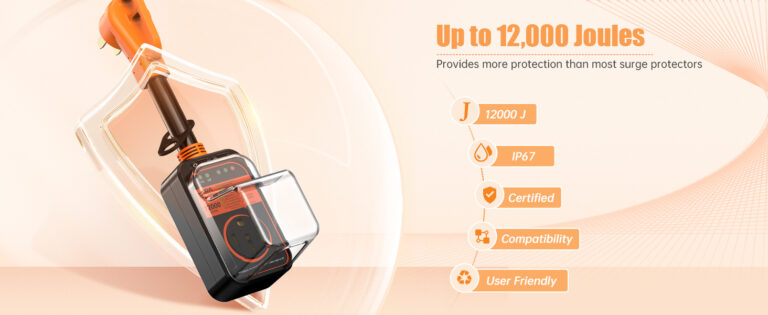
Joules measure how much surge energy the EMS can absorb before its surge protection component wears out. Think of it like a rechargeable battery—but instead of recharging, it has a one-way capacity that depletes over time (each surge event absorbs some joules).
Current market ranges (2024–2026):
- Budget portable 30A: 1,790–2,400 joules
- Mid-tier portable 30A: 3,000–4,200 joules
- Premium portable 50A: 6,120–7,200 joules (Hughes PWD50-EPO: 6,120J; GearIT 50A: 7,200J)
What’s “enough”?
- Most RV owners never experience a direct lightning strike (the scenario that exhausts joule capacity in one hit).
- Small surges (power restoration after outage, campground equipment switching) chip away at joule capacity over years.
- Rule of thumb: 3,000+ joules for 30A, 6,000+ joules for 50A. This gives you a decade of protection under normal use.
Replaceable surge module:
- Hughes Power Watchdog (2024+ models): When joule capacity is exhausted, you replace a $60 surge module instead of buying a $400 new unit. This is a game-changer for long-term cost of ownership.
- Most other brands: Replace the entire unit when surge capacity is exhausted (typically 10–15 years under normal use).
Time Delay Function (A/C Compressor Protection)
When power is restored after an outage—or when you first plug into a pedestal—your EMS waits 128–136 seconds before energizing your RV. Why?
The 136-second wait explained:
- Your rooftop A/C compressor uses a refrigerant cycle. When it shuts off, high-pressure refrigerant needs time to equalize (high side → low side). If you immediately restart the compressor before equalization, it tries to start under high pressure—this draws 3–5x normal startup amperage (LRA = locked rotor amperage). This overheats the motor windings and shortens compressor life.
- The time delay ensures the compressor gets a proper rest cycle before restart.
Is the delay annoying?
- First-time users: yes, a bit frustrating. You plug in and nothing happens for 2 minutes.
- Seasoned RVers: you learn to plug in, then go open windows, turn on water pump, check leveling, etc. By the time you’re done, power is on.
Can you bypass it?
- Hardwired EMS with bypass switch: yes, in true emergencies (cold-weather scenario where you need heat immediately and can’t wait). Use this sparingly.
- Portable EMS: no bypass option (unplug the EMS entirely if you need immediate power, but you lose all protection).
Why time delay is NOT a bug: It’s a feature that saves your compressor. Don’t wish it away.
Bypass Switch / Emergency Scenarios
Hardwired EMS only: Some models (Progressive HW-series, some Southwire models) include a bypass switch. This physically bypasses the EMS, allowing shore power to flow directly to your distribution panel without any protection or time delay.
When would you use bypass?
- Generator troubleshooting: Your built-in generator is producing unstable voltage (common with older RV generators). The EMS keeps shutting off because voltage is outside safe range (104V–132V). You need to run the generator long enough to test and adjust—bypass lets you do this while monitoring voltage with a multimeter.
- Cold-weather emergency: You arrive at a campground in 10°F weather. Your RV is ice-cold. You need heat NOW. The 136-second EMS delay feels interminable. You flip the bypass switch, get power immediately, and manually monitor for issues (listening for strange sounds, checking for tripped breakers). Once everything stabilizes, you flip the bypass off and let the EMS take over.
Safety note: Bypass defeats all EMS protection. Use it only when you understand the risks and are actively monitoring your electrical system.
UL Listing Discussion
UL listing (Underwriters Laboratories certification) means the device was tested to meet specific safety standards for its intended use (in this case, RV electrical protection).
What the research reveals:
- Hardwired EMS units: More likely to be UL-listed for permanent RV installation (Progressive, Southwire hardwired models often carry UL certification).
- Portable EMS units: Many lack UL listing or use alternative certifications (ETL, CSA). This doesn’t mean they’re unsafe—Progressive, Hughes, and Southwire have been manufacturing portable EMS for 10–20+ years with excellent track records.
Why does UL listing matter?
- RV financing/insurance: Some lenders or insurers require UL-listed electrical modifications if you’re financing an expensive Class A or if you’ve made major electrical upgrades.
- Resale: Buyers may ask about UL certification during due diligence.
- NEC compliance: The National Electrical Code references UL standards for RV electrical systems.
Bottom line: If you’re buying from a reputable brand (Progressive, Hughes, Southwire, Camco), UL listing is nice-to-have but not a dealbreaker. If you’re buying a no-name Amazon brand at half the price, lack of UL listing is a red flag.
Recent EMS Technology Updates (2024–2026)
The EMS market has evolved rapidly in the past two years. Here’s what’s new:
Hughes Power Watchdog Gen II Launch (2024)
The biggest product update since portable EMS became mainstream. Key features:
- Built-in WiFi (no external dongle—Gen I required a separate WiFi module)
- Redesigned mobile app with remote power control (turn power on/off from anywhere)
- Replaceable surge module ($60 vs $400+ full unit replacement—this is huge for long-term cost of ownership)
- Lockable weatherproof clamshell door (built-in theft deterrent)
- Illuminated connection bay for night setup (LEDs light up when you approach)
- Limited lifetime warranty (upgraded from 3-year warranty on Gen I)
WiFi Integration Across Brands (2024–2025)
WiFi is now expected, not premium:
- GearIT 30A/50A WiFi models (ADSAFE app): Real-time monitoring, energy consumption tracking, historical fault logging
- Progressive Industries: Slower to adopt WiFi in portable units (as of early 2026)—still focused on hardwired models with optional remote displays
Increased Joule Ratings
Surge protection capacity has inflated industry-wide:
- 2022-2023 baseline: 2,000–4,000 joules for most portable units
- 2025-2026 baseline: 4,000–7,200 joules becoming the norm
- Hughes PWD50-EPO: 6,120 joules (50A)
- GearIT 50A: 7,200 joules (highest consumer-grade portable EMS as of 2026)
Why the increase? Manufacturing cost of Metal Oxide Varistors (MOVs—the surge-absorbing components) has dropped, and brands are competing on specs. Higher joule ratings don’t necessarily mean better protection (most RVers never experience a surge that exhausts capacity), but they do extend the theoretical lifespan before module replacement.
App-Based Diagnostics Evolution
2026 EMS apps now offer:
- Push notifications for faults (immediate alerts when high/low voltage detected)
- Historical fault tracking (log of every error code over weeks/months)
- Remote troubleshooting support (some brands let you share app data with tech support)
- Adjustable LED brightness via app (Hughes Gen II—dim the display at night so it doesn’t light up your campsite like a beacon)
Warranty Changes
- Hughes: Moved from 3-year warranty to limited lifetime warranty on Gen II models (2024+)—huge confidence signal
- Progressive Industries: 2-year warranty standard (historically conservative warranty terms, but reputation for honoring warranty claims without hassle)
- Southwire: 3-year warranty
Don’t Get Fooled by Old Reviews)
If you’re reading reviews or guides published before 2024, watch out for these outdated references:
❌ Pre-2024 Hughes models without WiFi (Gen I Power Watchdog): Gen II is the current model—WiFi is built-in, not an external dongle.
❌ Voltage thresholds below 104V / above 132V: Older EMS units (pre-2020) had wider “safe” ranges (e.g., 102V–135V). Modern units are more conservative (104V–132V), which is better for appliance protection but means more frequent shutoffs at marginal campgrounds.
❌ Non-replaceable surge modules: If a review praises a model but doesn’t mention surge module replacement, it’s likely an older design. Hughes pioneered replaceable modules in 2024; other brands are catching up.
❌ Basic LED indicators without app connectivity: In 2026, WiFi/Bluetooth is table stakes. If a portable EMS doesn’t offer smart features, it’s falling behind. Only buy these if you’re getting a deep discount.
What’s Changed Since 2023
- Price volatility: EMS prices increased 15–20% from 2023 to 2026 due to global semiconductor shortages and component supply chain issues. A portable unit that cost $280 in 2023 now costs $350–$380.
- Model discontinuation: Progressive phased out PT30C/PT50C models in favor of PT30X/PT50X (improved components, better LCD). If you see a PT30C for sale, it’s old inventory.
- Feature expectations: WiFi/Bluetooth was a premium feature in 2022. By 2026, buyers expect it baseline. If a model lacks smart features, it’s priced accordingly (budget tier).
- UL listing scrutiny: Post-2023, there’s been increased discussion in RV forums about UL certification for portable EMS units. Some buyers now require UL listing; others don’t care. Manufacturers are paying attention.
How to Install a Portable EMS (Step-by-Step)
Portable EMS installation is plug-and-play, but here’s the optimal procedure:
Before You Plug In (Do This EVERY Time):
- Visual inspection of pedestal:
- Scorch marks around receptacle? (sign of arcing/loose connection)
- Corroded or rusty faceplate?
- Receptacle loose or wobbly?
- Any burnt smell?
- If YES to any of these → report to campground office, request different site if possible
- Optional: Test pedestal with multimeter or circuit analyzer (see “How to Use Your EMS Properly” section below for full procedure)
Installation Steps:
- Ensure your RV shore power cord is unplugged (both ends—from RV and from anything at the pedestal)
- Plug campground pedestal cord into the EMS input (clearly labeled “LINE” or “INPUT”)
- If using a cable lock: Loop lock through EMS housing handle/vent holes and around pedestal post. Secure.
- Check EMS display: Should light up and show voltage reading within seconds. If you see error codes (E1, E2, etc.), DO NOT PROCEED—there’s a pedestal fault (see troubleshooting section).
- If display shows green/OK status: Plug your RV shore power cord into the EMS output (labeled “LOAD” or “OUTPUT”)
- Wait for time delay: 128–136 seconds (typically 132 seconds). The EMS may beep or flash during this countdown.
- Power energizes: Your RV systems come online. Check your breaker panel—everything should be normal.
- Monitor for first 10 minutes: If you’re at a new campground, check the EMS display occasionally during the first hour. Voltage should be stable (115V–125V typical). If it drops below 110V or spikes above 128V, you may have a campground issue.
Takedown (When Leaving):
- Unplug your RV shore power cord from the EMS output
- Unlock cable lock
- Unplug EMS from pedestal
- Wipe down connections (dust/moisture can cause corrosion)
- Store EMS in dry location (basement bay, under dinette bench)
How to Install a Hardwired EMS (Professional vs DIY)
Hardwired installation is more involved. Here’s what you need to know:
Professional Installation (Recommended for Most Owners)
Cost: $150–$300 labor (2–4 hours of work)
What a professional does:
- Locate your RV’s distribution panel / transfer switch (often in a basement bay or behind an interior panel)
- Mount the EMS unit near the panel (using provided brackets or L-brackets)
- Wire the EMS between the shore power input and the main breaker panel:
- Shore power cord → EMS input (“line” side)
- EMS output (“load” side) → distribution panel hot, neutral, ground connections
- Install bypass switch (if included/desired)—allows manual override of EMS
- Mount display (if remote display model)—run wiring from EMS unit to display location inside living space
- Test operation: Plug into shore power, verify time delay, check voltage readings, simulate fault conditions (if possible)
How to find an installer:
- Progressive Industries authorized installer network: Progressive maintains a directory of certified RV technicians
- Mobile RV service: Many metro areas have mobile RV techs who come to your site
- RV dealership service department: Most dealerships can install EMS (though labor rates may be higher)
- RV rallies/shows: Some vendors offer on-site installation at RV shows (book ahead)
DIY Installation (If You’re Confident)
Prerequisites:
- Electrical knowledge: You understand AC wiring, breaker panels, wire gauges, and terminal connections
- RV access: Your distribution panel is accessible (not behind permanent cabinetry or in a sealed compartment)
- Tools: Wire strippers, multimeter, screwdrivers, crimp tool, heat shrink tubing or electrical tape
Safety first: Turn off shore power AND your RV’s main breaker before opening the distribution panel. Use a non-contact voltage tester to confirm no live wires.
Basic process:
- Read the manufacturer’s installation manual (Progressive, Hughes, Southwire all provide detailed PDFs with wiring diagrams)
- Identify your shore power input wires (hot, neutral, ground—usually coming from your shore power cord inlet)
- Disconnect shore power wires from current connections (label each wire with masking tape: L1, L2, N, G)
- Mount EMS unit in a location with adequate ventilation and access (near the distribution panel)
- Connect shore power wires to EMS input terminals (follow wiring diagram—color coding: black = hot, white = neutral, green or bare = ground; for 50A: black + red = two hot legs)
- Run new wires from EMS output terminals to distribution panel input (same wire gauge as original shore power wiring—typically 10 AWG for 30A, 6 AWG for 50A)
- Connect bypass switch (if included)—provides manual override path around EMS
- Double-check all connections: Torque to spec (manufacturer specifies in manual—over-tightening damages terminals, under-tightening creates arcing)
- Test with multimeter: Before applying shore power, verify continuity, proper polarity, and no shorts
- Apply shore power: Turn on main breaker, watch for EMS display to light up, wait for time delay, confirm power flows to RV systems
If you’re unsure at ANY step: Stop and hire a professional. Incorrect wiring can cause fires, equipment damage, or electrocution.
Best Mounting Locations
Ideal location checklist:
- ✅ Near the distribution panel (minimizes wire run length)
- ✅ Accessible for future maintenance (you may need to check error codes, replace surge module)
- ✅ Ventilated (EMS generates minimal heat but shouldn’t be in a sealed box)
- ✅ Protected from road spray/water intrusion (basement bays are fine if they have drain holes)
- ✅ Visible (if local display) or with clean routing path (if remote display)
Common locations:
- Basement storage bay (most popular—usually has access to distribution panel)
- Under-dinette storage (some Class C motorhomes have distribution panels here)
- Rear hatch compartment (fifth wheels, some travel trailers)
- Behind interior panel (requires cutting access door—least preferred)
Wiring Requirements
Wire gauge:
- 30A service: 10 AWG copper (minimum—some prefer 8 AWG for voltage drop margin)
- 50A service: 6 AWG copper (minimum—8 AWG is acceptable if run is very short, <5 feet)
Connections:
- Use ring terminals crimped and heat-shrunk (or crimped with adhesive-lined heat shrink)
- Avoid twist-on wire nuts inside distribution panels (not rated for vibration/movement)
- Color coding: Black = hot (L1), Red = hot (L2, 50A only), White = neutral, Green or bare = ground
How to Use Your EMS Properly
Your EMS is installed (or plugged in). Now what?
Testing Power Pedestals (Before Connecting EMS)
For maximum safety, test the pedestal BEFORE connecting your EMS or RV. Here’s how:
Using a Multimeter (Best Practice):
Tools needed: Digital multimeter, basic electrical knowledge
Procedure:
- Set multimeter to AC voltage (200V or 600V range)
- Insert probes into the pedestal receptacle:
- 30A receptacle: Measure hot (shorter vertical blade) to neutral (longer vertical blade). Should read ~120V.
- 50A receptacle: Measure hot1 (X-shaped blade, left) to neutral (Y-shaped blade, center). Should read ~120V. Then measure hot2 (X-shaped blade, right) to neutral. Should read ~120V. Then measure hot1 to hot2. Should read ~240V.
- Check voltage range: 115V–125V is normal. Below 110V or above 128V = problem. Report to campground.
- Measure hot to ground: Should also read ~120V (confirms ground is connected)
- Measure neutral to ground: Should read 0V–2V (very low). If you read >5V, there may be a loose neutral or ground issue.
Using a Circuit Analyzer (Easier, Less Precise):
Tools needed: Plug-in circuit analyzer (e.g., Klein Tools RT210, Southwire 40020N—$15–$30)
Procedure:
- Plug analyzer into pedestal receptacle
- Read the LED indicators:
- All three LEDs in specific patterns = wiring is correct
- Different patterns = faults (open ground, reverse polarity, open hot, open neutral)
- If ANY fault indicated: Report to campground, request site change or electrician repair
Limitation: Circuit analyzers don’t measure voltage or detect low-voltage conditions—they only check wiring faults. Pair with a multimeter for full assessment.
Understanding Error Codes
Each EMS brand uses different error codes. Here’s a general guide (consult your specific model’s manual for exact meanings):
Progressive Industries Common Codes:
- E1: Open ground
- E2: Reverse polarity
- E3: Open neutral (rare on 30A, more common on 50A)
- E4: Miswired pedestal / hot skin detection
- E5: Frequency out of range (generator issues, grid instability)
Hughes Power Watchdog Common Codes:
- No display / red LED: High or low voltage (check app or display for exact reading)
- Flashing error code: Pedestal fault detected (open ground, reverse polarity, etc.)
Southwire Surge Guard Common Codes:
- Indicator lights: Green = OK, Red = fault
- Specific patterns: Refer to label on unit or manual (Southwire uses light patterns rather than alphanumeric codes)
What to do when you see an error code:
- Do not override or bypass the EMS (you’re defeating the protection)
- Unplug and inspect pedestal receptacle (visible damage, loose connections?)
- Try a different pedestal (if campground has multiple hookup options)
- Report to campground office (they may have an electrician on staff or can comp your site if you need to move)
- Use generator or boondock (if the campground can’t fix it immediately and you need power)
Troubleshooting Flowchart
Scenario: EMS shows error code and won’t energize RV
1. Error code E1, E2, E3, E4 (wiring fault)?
   → Yes: STOP. Pedestal is miswired. Report to campground.
   → No: Go to step 2

2. Error code E5 or frequency warning?
   → Yes: Generator power quality issue OR grid instability.
      - If on shore power: Report to campground (rare but serious).
      - If on generator: Service your generator (likely issue).
   → No: Go to step 3

3. Display shows low voltage (below 104V)?
   → Yes: Campground brownout (likely peak demand time, 6-10 PM).
      - Wait 1 hour and try again (voltage may stabilize after dinner rush).
      - Request different site (closer to transformer).
      - Run generator or boondock if campground can't fix.
   → No: Go to step 4

4. Display shows high voltage (above 132V)?
   → Yes: Overvoltage condition (dangerous).
      - DISCONNECT IMMEDIATELY.
      - Report to campground (transformer issue, lightning strike damage).
      - Do NOT attempt to use this pedestal.
   → No: Go to step 5

5. No display / unit completely dead?
   → Portable EMS: Check that pedestal has power (test with multimeter or plug in a lamp).
   → Hardwired EMS: Check your RV's main breaker is ON.
   → If pedestal has power but EMS is dead: EMS may be defective (warranty claim).
Top Portable EMS Brands & Models
Here’s the current lineup (2024–2026) based on market research and owner reports:
Progressive Industries
Why they’re popular: Longest track record in the RV EMS market (20+ years). Known for durability and straightforward design. Conservative feature set—they don’t chase every new trend, but what they build works.
Models:
- EMS-PT30X (30A): $320–$360 | 3,580 joules | LCD display | 104V/132V cutoffs | 132-second delay | Weather-resistant housing | No WiFi (as of 2026—Progressive slow to adopt smart features in portable units)
- EMS-PT50X (50A): $380–$420 | 4,200 joules | Same features as PT30X but 50A capacity
Pros:
- Proven reliability (owner reports show 10+ year lifespans common)
- Replacement parts available (displays, surge modules)
- 2-year warranty (historically generous warranty service)
Cons:
- No WiFi/Bluetooth (you must walk to the pedestal to check status)
- Lower joule ratings than competitors (but still adequate for most RVers)
- Basic LCD display (no backlight on some models)
Best for: RVers who prioritize proven reliability over smart features. Weekenders who don’t mind walking to the pedestal.
Hughes Autoformers / Power Watchdog
Why they’re popular: Industry leader in smart features. Gen II models (2024+) set the new standard for WiFi integration, user experience, and long-term cost of ownership (replaceable surge module).
Models:
- PWD30-EPO (30A, Gen II): $380–$430 | 4,800 joules | Built-in WiFi | Mobile app (iOS/Android) | Remote power control (EPO button) | Replaceable surge module | Lockable clamshell door | Illuminated connection bay | Limited lifetime warranty | 136-second delay
- PWD50-EPO (50A, Gen II): $480–$550 | 6,120 joules | Same features as PWD30-EPO
Pros:
- Best-in-class smart features (WiFi, app, EPO)
- Replaceable surge module ($60 vs $400+ full unit)
- Lockable door deters theft
- Illuminated bay for night setup
- Lifetime warranty (2024+)
Cons:
- Priciest option ($50–$100 more than Progressive or Southwire)
- App requires initial setup (WiFi network configuration)
- Larger/bulkier than some competitors (not a deal-breaker but noticeable)
Best for: Tech-savvy RVers who want remote monitoring. Full-timers who value convenience. Anyone who plans to keep their EMS for 10+ years (replaceable module justifies higher upfront cost).
Southwire Surge Guard
Why they’re popular: Mid-price option with solid specs. Models 34931/34951 offer unique “load side” protection—they monitor for internal RV faults, not just external pedestal issues.
Models:
- 34930 (30A portable): $280–$320 | 2,790 joules | Basic LCD display | No WiFi | Standard protection (high/low voltage, open ground, reverse polarity)
- 34931 (30A hardwired): $350–$400 | “Load side” protection (monitors RV’s internal electrical system for faults) | LCD display | Best mounted near distribution panel
- 34950 (50A portable): $380–$450 | 4,200 joules | Same features as 34930
- 34951 (50A hardwired): $420–$480 | Load side protection
Pros:
- Load-side protection is unique (detects damaged RV cords, internal short circuits)
- Competitive pricing (cheaper than Hughes, similar to Progressive)
- 3-year warranty
Cons:
- Lower joule ratings than Hughes Gen II
- No WiFi (as of 2026)
- Some owner reports of LCD screen fading after 5+ years (UV exposure)
Best for: Budget-conscious buyers who want more than basic surge protection. RVers with older RVs where internal electrical issues are a concern (load-side monitoring catches this).
Camco Power Defender
Why they’re mentioned: Camco is a huge RV accessories brand. Their EMS units are budget-friendly but feature-limited.
Models:
- Camco Power Defender 30A: $240–$280 | ~1,800 joules | Basic LED indicators (no voltage display) | No WiFi | 120-second delay
Pros:
- Cheapest option ($100+ less than Hughes)
- Widely available (Camping World, Amazon, Walmart RV sections)
Cons:
- Very low joule rating (1,800J is bare minimum)
- No display (only LED lights for status—you don’t see actual voltage)
- Limited warranty (1 year)
- Owner reports mixed (some units fail within 2–3 years)
Best for: Extreme budget scenarios or casual RVers who camp 5–10 nights/year and want basic protection. Not recommended for full-timers.
Technology Research (TRC)
Why they’re mentioned: TRC makes commercial-grade surge protection for marine, industrial, and RV applications. Less common in consumer channels but highly regarded by electricians.
Models: Vary by distributor (not as standardized as Progressive/Hughes)
Pros:
- Commercial-grade components (built for harsh environments)
- Very high joule ratings (some models exceed 8,000J)
Cons:
- Harder to find (not sold at Camping World or Amazon—specialty RV electrical suppliers)
- Higher price ($500–$800 for portable units)
- Overkill for most RV owners
Best for: Marine applications, commercial RV fleets, or RVers with extreme electrical sensitivity requirements.
Top Hardwired EMS Brands & Models
Hardwired options are more limited (fewer brands manufacture them). Here’s the landscape:
Progressive Industries
Models:
- EMS-HW30C (30A, local display): $380–$420 | LCD mounted on unit itself | Install near distribution panel in bay
- EMS-HW50C (50A, local display): $420–$480
- EMS-LCHW30 (30A, remote display): $450–$500 | Display cable runs to interior wall mount location
- EMS-LCHW50 (50A, remote display): $500–$570 | Best for Class A motorhomes where you want dash/galley monitoring
Pros:
- UL-listed for permanent RV installation
- Bypass switch included (manual override for emergencies)
- Remote display option (live inside, monitor from couch)
- 2-year warranty
Cons:
- No WiFi/Bluetooth (even on 2026 models—Progressive focuses on reliability over smart features for hardwired units)
- Professional installation recommended ($150–$300 labor)
Best for: Full-timers who want “set it and forget it” protection with the option for interior monitoring (remote display models).
Southwire Surge Guard 34931 / 34951
Models:
- 34931 (30A hardwired): $360–$410 | Load-side protection | LCD display on unit
- 34951 (50A hardwired): $420–$480 | Load-side protection
Unique feature: Load-side protection monitors your RV’s internal electrical system, not just the incoming shore power. This catches:
- Damaged shore power cord (internal wire faults)
- Short circuits inside RV walls
- Faulty appliances drawing excessive current
Pros:
- Detects problems other EMS units miss (internal RV faults)
- 3-year warranty
- Competitive price
Cons:
- No remote display option (unit must be accessed in bay to read display)
- No WiFi
Best for: Older RVs (10+ years) where internal electrical issues are more likely. RVers who want comprehensive protection (external + internal).
Hughes Hardwired Models
Note: As of 2026, Hughes focuses heavily on portable units (Power Watchdog line). Hardwired options exist but are less common and lack the Gen II WiFi features found in their portable lineup.
Best for: Buyers should look at Progressive or Southwire for hardwired—Hughes shines in the portable category.
30A vs 50A Quick-Reference Box
Confused about amperage? Here’s what you need to know:
| Spec | 30A Service | 50A Service |
|---|---|---|
| Voltage | 120V single-phase | 120V split-phase (two 120V legs) |
| Total watts | 3,600W | 12,000W |
| Plug type | NEMA TT-30 (three-prong: hot, neutral, ground) | NEMA 14-50 (four-prong: hot1, hot2, neutral, ground) |
| Typical RVs | Class B/C motorhomes, small travel trailers, pop-ups | Class A motorhomes, large fifth wheels, luxury travel trailers |
| One or two rooftop A/C units? | Usually one (can run one 15,000 BTU unit comfortably) | Usually two (can run both simultaneously + other appliances) |
| “Dog bone” adapter? | Sometimes use 50A-to-30A adapter to connect to 50A pedestals (less common) | Often use 30A-to-50A adapter to connect to 30A pedestals (THE 50-AMP TRAP) |
| EMS cost | Portable: $280–$430 | Hardwired: $500–$750 total |
The “50-Amp Trap” Explained:
Many 50A RV owners carry a “dog bone” adapter (30A-to-50A adapter) because:
- Not all campgrounds have 50A service (especially older state parks, national parks)
- 30A pedestals are often more available (every site has 30A, only premium sites have 50A)
- It’s more convenient than moving to a different site
The problem: When you connect your 50A RV to a 30A pedestal via adapter, you’re running your entire RV through a 30A circuit. This introduces:
- Higher voltage drop (more current = more voltage drop in the 30A adapter and cord)
- Load limits (can’t run both A/C units simultaneously—you’re capped at 3,600W total)
Why it matters for EMS: A portable EMS at the pedestal measures voltage at the 30A receptacle. It doesn’t know you’re using an adapter to feed a 50A RV. So it might read 104V (safe), but your RV panel sees 98V (dangerous) due to the adapter and cord voltage drop.
Solution: If you frequently use a 30A-to-50A adapter, a hardwired 50A EMS makes more sense—it measures voltage at your panel after all the adapters and cords, catching brownouts that a portable EMS would miss.
Decision Tree
Use this flowchart to narrow your choice:
START HERE:
Do you camp 60+ nights per year (full-timer or extended traveler)?
│
├─ YES → Do you own multiple RVs or plan to upgrade within 3 years?
│   │
│   ├─ YES → Portable EMS (take it with you)
│   │
│   └─ NO → Hardwired EMS (convenience + accuracy)
│
└─ NO (Weekender, <30 nights/year) → Do you have DIY electrical skills?
    │
    ├─ YES → Your choice (hardwired saves setup time, portable offers flexibility)
    │
    └─ NO → Portable EMS (avoid installation cost)

IF STILL UNSURE:

Do you camp mostly in high-theft areas or worry about theft?
│
├─ YES → Hardwired EMS (eliminates theft risk)
│
└─ NO → Either works

Do you frequently use long extension cords (50+ feet) or adapters?
│
├─ YES → Hardwired EMS (voltage drop compensation)
│
└─ NO → Either works

Is your RV 50A service?
│
├─ YES → Slight preference for hardwired (50-amp trap, open neutral detection)
│
└─ NO (30A) → Either works equally well

Do you want smartphone monitoring and remote control?
│
├─ YES → Hughes PWD-EPO Gen II (portable) OR wait for WiFi hardwired options (limited as of 2026)
│
└─ NO → Progressive Industries (proven reliability without complexity)
FAQ: People Also Ask
1. Do I really need an EMS for my RV, or is a surge protector enough?
You need an EMS. A basic surge protector only guards against voltage spikes (lightning). An EMS protects against brownouts (low voltage), overvoltage, open ground, reverse polarity, open neutral, and miswired pedestals—the conditions that actually kill RV appliances at campgrounds. A $3,000 air conditioner replacement costs 10x more than an EMS. Buy the EMS.
2. What’s the difference between a portable and hardwired RV EMS?
Portable: Plugs in at the campground pedestal (external unit). Measures voltage at the pedestal. You set it up and take it down every trip. Theft risk exists but is mitigated with cable locks.
Hardwired: Permanently installed inside your RV near the distribution panel. Measures voltage at the panel (more accurate). Zero setup. No theft risk. Higher upfront cost (unit + installation).
3. Can a portable EMS be stolen from the campground pedestal?
Technically yes, but rarely. Cable locks ($15–$25) deter casual theft. Most campgrounds have low theft rates (community culture, on-site security). Hughes Gen II models have lockable clamshell doors (extra deterrent). If you camp at sketchy roadside spots or free dispersed camping, theft risk is higher—consider taking the EMS inside your RV at night. In 15+ years of portable EMS use across forums and owner reports, theft is mentioned occasionally but not frequently.
4. How does a hardwired EMS measure voltage more accurately than a portable?
Voltage drop. Your shore power cord has electrical resistance. When current flows (A/C running, water heater on), voltage drops along the cord. A portable EMS measures voltage at the pedestal (before the drop). A hardwired EMS measures at your RV panel (after the drop). Example: Pedestal reads 104V (OK), but your panel sees 100V (damaging). Portable EMS says “go,” hardwired EMS says “stop.” The 4V difference saves your compressor.
5. What is voltage drop and why does it matter for EMS accuracy?
Voltage drop = V lost in wire resistance. Every foot of wire has resistance. When current flows, voltage drops (V = I × R, Ohm’s Law). A 25-foot shore power cord under 15A load can drop 3–5V. If your portable EMS measures 104V at the pedestal but your RV panel sees 99V, your appliances are starving. A hardwired EMS catches this because it measures where your appliances actually connect.
6. Should I get a 30-amp or 50-amp EMS?
Match your RV. If your RV has a 30A shore power cord, buy a 30A EMS. If 50A cord, buy 50A EMS. You CAN use a 30A EMS with a 50A RV (via adapter) but you’re limiting yourself to 30A power—defeats the purpose of having 50A service. If you frequently use dog-bone adapters to step down from 50A to 30A pedestals, a hardwired 50A EMS is smarter (measures at the panel after the adapter).
7. How much does it cost to install a hardwired EMS in an RV?
$150–$300 labor for professional installation (2–4 hours). DIY is possible if you have electrical skills and access to your distribution panel. Total cost: $500–$850 (unit + labor) for most installations. Mobile RV techs often charge less than dealership service bays.
8. Can I install a hardwired EMS myself or do I need an electrician?
You CAN if you:
- Understand AC wiring and breaker panels
- Have access to your RV’s distribution panel (some RVs require interior panel removal)
- Own a multimeter and basic electrical tools
- Follow the manufacturer’s wiring diagram carefully
You SHOULD hire a professional if:
- You’re unsure about any step
- Your RV’s wiring is complex (multiple transfer switches, inverter integration)
- You want warranty coverage (some manufacturers void warranty for improper DIY install)
Safety first: Wrong wiring can cause fires, electrocution, or equipment damage. If in doubt, hire out.
9. What are the best brands for RV EMS systems in 2026?
Portable:
- Hughes Power Watchdog Gen II (PWD30-EPO, PWD50-EPO): Best smart features, WiFi, replaceable surge module, lifetime warranty. $380–$550.
- Progressive Industries (PT30X, PT50X): Most reliable, proven track record, no WiFi but rock-solid. $320–$420.
- Southwire Surge Guard (34930, 34950): Mid-price, load-side protection option. $280–$450.
Hardwired:
- Progressive Industries (HW30C, HW50C, LCHW30, LCHW50): Industry standard, UL-listed, bypass switch, remote display options. $380–$570.
- Southwire Surge Guard (34931, 34951): Load-side protection (monitors internal RV faults). $360–$480.
10. Do WiFi-enabled EMS units work better than basic models?
Not “better” protection—better convenience. WiFi models (Hughes Gen II, GearIT) protect the same way as non-WiFi models. The advantage is remote monitoring (check voltage from bed at 2 AM), push notifications (immediate alerts when faults occur), energy tracking (see which appliances use most power), and remote power control (turn power on/off without walking to pedestal). If you’re tech-savvy or a full-timer, WiFi is worth the extra $50–$100. If you’re a weekender who doesn’t mind walking to the pedestal, save the money and buy a basic LCD model.
11. How do I test a campground power pedestal before plugging in?
Method 1 (Best): Multimeter
- Set to AC voltage (200V range)
- Measure hot-to-neutral: Should read ~120V (115V–125V acceptable)
- Measure hot-to-ground: Should read ~120V
- Measure neutral-to-ground: Should read <5V
- If 50A pedestal, measure hot1-to-hot2: Should read ~240V
Method 2 (Easier): Circuit Analyzer
- Plug in Klein RT210 or Southwire 40020N ($15–$30)
- Read LED pattern: Three lights in specific combination = wiring correct
- Any other pattern = fault (open ground, reverse polarity, etc.)
If you detect a fault, report to campground office. Do NOT plug in your RV or EMS.
12. What does “Emergency Power Off” (EPO) mean on Hughes EMS units?
EPO = Emergency Power Off button. Hughes PWD-EPO models include a wired remote button that mounts inside your RV (galley, bedroom wall). Press the button to immediately cut power without walking to the pedestal (portable) or opening the bay (hardwired). Useful for:
- Emergency shutdowns (smell burning wire, hear sparking)
- Turning power off at bedtime to eliminate phantom loads
- Troubleshooting (isolate electrical issues without unplugging outside)
Non-EPO models require you to physically disconnect at the pedestal or flip the bypass switch (hardwired).
13. Is a portable EMS less accurate during brownouts?
Yes, technically. During brownouts (low voltage conditions), the voltage drop in your shore power cord is MORE pronounced (higher current draw = higher resistance loss). A portable EMS at the pedestal sees higher voltage than your RV panel actually receives. Example:
- Pedestal: 106V (portable EMS says “OK, just barely”)
- RV panel: 101V (after 5V drop due to high A/C load)
- Your compressor is slowly burning out at 101V, but the portable EMS doesn’t know this.
A hardwired EMS measures at the panel (101V) and shuts off immediately, saving your compressor. This is the core accuracy argument for hardwired units.
14. Can I use a 50-amp EMS with a 30-amp adapter?
Yes, but why? If you have a 50A EMS and a 30A RV, you can use a 50A-to-30A adapter between the EMS and your RV cord. But this is inefficient—you’re paying for 50A capacity (higher cost) and only using 30A. Just buy a 30A EMS.
Reverse scenario (more common): You have a 30A EMS and a 50A RV. You use a 30A-to-50A dog-bone adapter at the pedestal. This works, but you’re limited to 30A power (3,600W) even though your RV can handle 50A (12,000W). If you frequently camp at 30A pedestals with a 50A RV, this setup makes sense—but a hardwired 50A EMS in your RV is still better (measures voltage after the adapter).
15. What warranty do EMS manufacturers offer?
- Hughes Power Watchdog Gen II: Limited lifetime warranty (2024+)—industry-leading
- Progressive Industries: 2-year warranty (historically excellent customer service, often extends goodwill replacements beyond warranty period)
- Southwire Surge Guard: 3-year warranty
- Camco Power Defender: 1-year warranty
What’s covered: Manufacturing defects, component failures. Not covered: Lightning strikes that exhaust surge capacity (this is expected—surge protectors are sacrificial), physical damage (running over the unit with your truck), improper installation.
🔍 Warranty Implications if Switching RVs (Portability + Resale)
Underserved Question: What happens to your hardwired EMS warranty when you sell your RV?
The issue:
Most EMS warranties are tied to the original purchaser, not the RV itself. If you install a hardwired EMS in your Class C and sell the RV 5 years later, the new owner may NOT have warranty coverage—even if the unit still has 5 years left on a 10-year warranty.
(Needs verification—varies by manufacturer; check specific warranty terms)
Portable EMS advantage:
You take it with you when you sell. The warranty follows YOU, not the RV.
Resale value offset:
While you “lose” the warranty with a hardwired unit, you typically recoup $200–$300 of the installation cost in higher RV resale value. Buyers see “EMS pre-installed” as a value-add. Whether this fully offsets the loss depends on your specific RV market.
💡 Tip:
If you’re keeping your RV for 10+ years or until it becomes unusable: Hardwired is the move (you’ll use the full warranty yourself).
If you plan to sell your RV within 3–5 years: Portable makes more financial sense.
🔍 Can You Run Portable + Hardwired Together? (Layered Defense)
Short answer: Yes, but it’s overkill for 99% of RVers.
How it would work:
- Portable EMS at pedestal tests the campground power (first line of defense)
- If portable EMS approves power, your RV connects
- Hardwired EMS inside your RV monitors voltage at the panel (second line of defense, accounting for cord voltage drop)
- Both units protect independently—if either detects a fault, power is cut
Pros:
- Redundancy: If one EMS fails, the other still protects
- Pedestal testing + panel accuracy: Portable catches pedestal wiring faults immediately (before connecting RV), hardwired catches voltage drop and internal issues
Cons:
- Cost: $700–$1,200 total for both units (portable + hardwired + installation)
- Double time delay: You’d wait 128–136 seconds twice (first for portable EMS, then for hardwired EMS)—that’s 4–5 minutes before power comes on
- Complexity: Two systems to monitor, two sets of error codes to interpret
- Diminishing returns: A single quality EMS (either type) provides 95%+ of the protection. The extra 5% isn’t worth doubling the cost for most people.
When it makes sense:
- You’re protecting a $500K+ luxury diesel pusher with tens of thousands of dollars in custom electronics (solar, inverters, lithium batteries, residential appliances)
- You frequently camp at sketchy campgrounds with known electrical issues (long-term construction sites, fairgrounds, older county parks)
- You’re running a business from your RV (remote work, mobile office) and power loss costs you money
For everyone else: Pick one EMS (portable OR hardwired based on the decision tree above) and trust it. Modern EMS units from Hughes, Progressive, and Southwire are extremely reliable.
🔍 Long Extension Cords Compounding Voltage Drop
The physics: Voltage drop = wire resistance × current. Longer wire = more resistance = more voltage drop.
Scenario 1: Short connection (typical)
- Your RV is 10 feet from the pedestal
- Your portable EMS measures 118V at the pedestal
- Your 25-foot shore power cord has ~2V drop under load
- Your RV panel sees 116V (safe)
Scenario 2: Long extension cord (common at crowded campgrounds)
- Your RV is 50 feet from the pedestal (awkward site layout)
- You use a 50-foot 10 AWG extension cord + your 25-foot shore power cord (75 feet total)
- Your portable EMS still measures 118V at the pedestal (it’s right there)
- Voltage drop in 75 feet of wire: ~6V under load (more if wire is undersized or hot weather)
- Your RV panel sees 112V (marginal—A/C will struggle)
Hardwired EMS: Measures at the panel (112V) and shuts off if it drops below 110V (depending on model sensitivity). Protects you.
Portable EMS: Still reads 118V at the pedestal. Doesn’t know you’re using an extension cord. Doesn’t shut off. Your A/C runs at 112V (technically “safe” but not ideal—shortened lifespan).
Extension cord best practices:
- Use 10 AWG (30A) or 6 AWG (50A) wire—never lighter gauge
- Keep cords as short as possible
- Inspect for damage before each use (cuts, kinks, melted insulation)
- Don’t coil cords tightly while in use (heat buildup)
🔍 Generator vs Shore Power Differences
Generator power quality is often worse than shore power:
- Voltage instability: Portable generators (especially older/cheaper models) produce “dirty” power with voltage swings (±10V fluctuations common)
- Frequency drift: Generators may run slightly off 60 Hz (58-62 Hz range) if engine speed varies—EMS units detect this as a fault (E5 error code on Progressive models)
- Harmonic distortion: Generator sine waves aren’t as clean as utility power—sensitive electronics (inverters, battery chargers) may struggle
How EMS handles generators:
- Portable EMS: Still monitors voltage, frequency, and wiring faults. If your generator produces 115V ±5V fluctuations, the EMS may cycle on/off repeatedly (annoying but protective).
- Hardwired EMS with bypass switch: Lets you override the EMS temporarily to run the generator while you troubleshoot or adjust the generator’s voltage regulator. Once the generator stabilizes, disable bypass and let the EMS monitor normally.
Best practices for generator + EMS use:
- Service your generator regularly: Clean carburetor, check spark plugs, adjust voltage regulator (if equipped)
- Load the generator appropriately: Running a generator at 10% capacity (just charging batteries) produces worse voltage regulation than running at 50-70% capacity (A/C + water heater)
- Inverter generators: Produce cleaner power (true sine wave, stable voltage)—Honda EU2200i, Yamaha EF2000iSv2, Champion 2000—work better with EMS than traditional portable generators
- Monitor with multimeter: If your EMS keeps tripping on generator power, use a multimeter to check actual voltage at the generator outlet
When generators are BETTER than shore power:
- Boondocking in remote areas: Your generator produces stable 120V. If you plugged into a sketchy campground pedestal, you might get 95V brownout.
- Emergency backup: Campground power fails (storm, transformer blowout). Your EMS protects your RV from utility grid chaos while your generator runs smoothly.
🔍 Weather Durability After 3–5 Years
Portable EMS exposure over time:
- UV degradation: Plastic housings fade, become brittle. Display lenses crack. By year 5-7, many owners report aesthetic wear.
- Moisture intrusion: Even weatherproof seals eventually fail. Humidity gets inside → corrosion on circuit boards, relay contacts, terminals. Some units develop intermittent faults (won’t power on in high humidity, works fine when dry).
- Temperature cycling: –20°F to 120°F over seasons (if you camp year-round). Expands/contracts components, loosens solder joints.
- Dust/debris: Vents accumulate dirt. Reduces cooling airflow (some EMS units have internal MOVs that generate heat during surges).
Hardwired EMS protection:
- Lives inside a climate-controlled (or at least sheltered) basement bay
- Minimal UV exposure (unless bay has transparent doors)
- Stable temperature (RV interior bays rarely see extremes)
- Clean environment (unless you store dirty gear in the same bay)
Owner reports (anecdotal):
- Portable: 5–8 years typical lifespan before replacement due to wear. Some units last 10+ years in mild climates (Arizona, Southern California—dry, minimal rain). Units in humid climates (Florida, Gulf Coast) fail earlier (year 5-7 common).
- Hardwired: 10–15 years typical lifespan. Some owners report original hardwired EMS still working after 12+ years in their full-time rig.
Cost-per-year revisited:
- Portable: $300 unit ÷ 6 years = $50/year
- Hardwired: ($400 unit + $200 install) ÷ 12 years = $50/year
Same long-term cost, but hardwired eliminates early replacement risk.
(Needs verification: No manufacturer publishes MTBF—mean time between failures—data. These estimates are based on forum reports and owner surveys, not controlled testing.)
🔍 Resale Value / ROI Angle
Short answer: Yes, $200–$400 perceived value increase.
How it shows up in listings:
- “EMS pre-installed” = selling point in RV classified ads (RVTrader, Facebook Marketplace, Craigslist). Buyers see it as a value-add alongside other desirable features (solar, lithium batteries, upgraded suspension).
- Reduces buyer objections: When a buyer asks “Is the electrical system protected?” you say “Yes, Progressive hardwired EMS installed in 2024.” That’s a confidence builder.
- Saves the buyer money: They don’t have to budget $500–$800 for EMS + installation after purchase. You’ve done the work already.
Quantifying the value:
- If you installed a hardwired EMS for $600 total (unit + labor) and sell your RV 5 years later, you’ll likely recoup $200–$400 of that cost in higher sale price (or faster sale time—equivalent value).
- Net cost: $600 – $300 average recoup = $300 “sunk cost” ÷ 5 years = $60/year for the EMS + convenience of owning it during those 5 years.
Portable EMS resale impact: Neutral (you take it with you, so the RV sells without EMS). The new owner either has their own EMS or budgets for one post-purchase.
Tip for sellers: Photograph the hardwired EMS display and include it in your listing photos. Mention the brand, model, install date, and warranty remaining (if transferable). Example caption: “Progressive EMS-HW50C hardwired in 2023 (3-year warranty remaining), protects against brownouts, surges, and wiring faults. One less thing for you to install!”
🔍 Insurance Considerations
(Needs verification—insurance policies vary widely. The following is based on general insurance principles and anecdotal reports, not verified data.)
Potential insurance benefits:
- Claims support: If your RV’s electrical system is damaged by a power surge at a campground, having an EMS may strengthen your insurance claim by showing you took reasonable precautions. Insurers are more likely to approve claims when negligence isn’t involved. (But this is NOT guaranteed—read your policy.)
- Premium discounts: Some RV insurers offer discounts for anti-theft devices (GPS trackers, alarm systems), but EMS discounts are NOT common as of 2026. However, you can ASK your insurer—some agents have discretion to apply “safety equipment” discounts.
- Claim denials: If you DON’T have an EMS and your electrical system is damaged by a campground’s faulty wiring (open ground, reverse polarity), your insurer might argue you failed to protect your property. This is rare but has been reported in forums.
What to check in your RV insurance policy:
- Does your policy cover electrical damage from external sources (campground wiring faults)?
- Is there a “reasonable precautions” clause requiring surge protection?
- Are portable EMS units covered under “personal effects” or “detachable equipment” (theft scenario)?
- Is a hardwired EMS considered a permanent modification that increases your RV’s insured value? (If yes, update your policy to reflect the installation—this may slightly increase your premium but ensures proper coverage.)
Tip: Call your insurance agent and ask: “If I install an EMS, does it affect my coverage or premiums?” Document the conversation (date, agent name, response) in case you need to reference it during a claim.