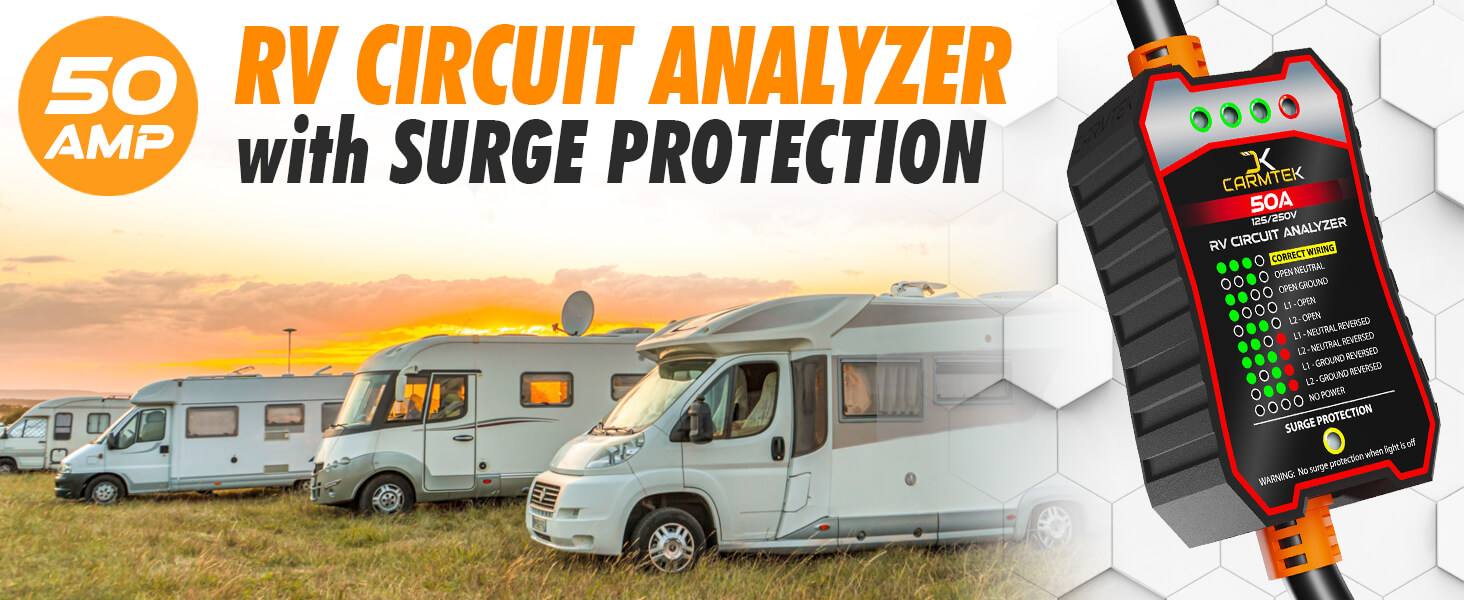
CARMTEK RV Surge Protector (30A/50A) Review: Real Owner Patterns—Worth It, or Step Up to an EMS?
Affiliate Disclaimer: This article contains affiliate links. If you click through and make a purchase, I may earn a small commission at no extra cost to you. This helps support my deep-dive research.
Quick Summary
If you’re shopping for a CARMTEK RV surge protector, here’s the honest snapshot from real-world use:
- It’s best thought of as a RV circuit analyzer + basic surge protection in one body—not a full RV EMS (Electrical Management System).
- Owners love how fast it answers the only question that matters at setup: “Is this pedestal safe enough to plug into?”
- The biggest “watch-outs” are fit/security (tight plugs, slipping at the pedestal for some), weather exposure concerns, and a smaller-but-real set of false fault or early-failure reports.
- If you want a “set-it-and-forget-it” guardian that actively disconnects for more conditions, you may be happier skipping this tier and moving up to a full EMS (I’ll link that list below).
One Bad Pedestal Can Turn Your Weekend Into a Repair Bill
I don’t care how dialed-in your RV setup is—shore power is the wild card. The campground pedestal might be perfect… or it might have a loose neutral, reversed wiring, or voltage weirdness that cooks sensitive gear slowly (or instantly).
That’s why so many RVers end up buying a 30 amp surge protector or 50 amp surge protector right after their first “electrical surprise.” Across the owner feedback I analyzed, a recurring theme is that people didn’t buy protection because they love gadgets—they bought it because they love their RV’s A/C, fridge boards, and converter staying alive.
And that’s exactly what the CARMTEK RV surge protector is trying to be: a quick, simple “before you plug in” safety filter.
Quick Verdict (TL;DR)
My take: The CARMTEK RV surge protector is a solid “value-tier” option for RVers who want clear pedestal diagnostics and basic surge defense—without paying full EMS money.
Confidence Score: 7.8/10 ⚡
Why not higher? Because the praise is massive, but there are enough consistent complaints about fit/weather exposure and a small cluster of reliability/accuracy issues that you should go in with eyes open.
What This Device Actually Is (And What It Isn’t)
Let’s define this clearly, because a lot of buyer disappointment happens right here.
What you’re buying
In real-world use, many users find this works like:
- A pedestal wiring “go/no-go” checker (hot/neutral/ground issues, lost leg indications on 50A units, polarity faults)
- A basic surge suppression layer meant to help absorb certain surge events
What you’re not guaranteed to be buying
Owners commonly report confusion between a surge protector and a true EMS.
A full EMS (Electrical Management System) usually aims to disconnect power when it detects dangerous sustained conditions (like high/low voltage) and may cover more fault scenarios. Several owners specifically noted (sometimes the hard way) that this tier is not the same thing as those more protective systems.
Practical takeaway: If your priority is “diagnose the pedestal fast and add a protection layer,” this product fits. If your priority is “auto-shutoff guardian for lots of electrical problems,” you should be looking at a higher tier.
If you want the bigger-picture breakdown first, you can also read:
- RV Surge Protectors 101: Safeguarding Your RV’s Electrical System
- Portable vs Hardwired RV Surge Protectors: Which Should You Choose?
30A vs 50A: Choosing the Right Version
A frequent buyer surprise is simply ordering the wrong amperage. Here’s the quick chooser.
| Shore Power Service | Common RV Types | Typical Plug Style (North America) | Buy This If… |
|---|---|---|---|
| 30A (120V) | Many travel trailers, smaller Class C | TT-30 | Your RV cord is 30A and you use 30A pedestals most often |
| 50A (split-phase capable) | Many 5th wheels, Class A, larger rigs | 14-50 | Your RV is wired for 50A service and you want to verify both legs |
Region note: This style of device is built around USA/Canada RV shore power standards. If you’re in Australia/NZ (typically 230V setups), you’ll want equipment designed for those electrical standards.
Key Features (Benefit-Driven & Comparative)
Here’s the “what it does” table—translated into real camping life.
| Feature | What the Listing Emphasizes | What It Actually Means (User Experience) | Compared to Competitors |
|---|---|---|---|
| Circuit analyzer lights | “Checks wiring faults” | You plug it in first and instantly see if something looks off before risking your RV | Faster/simpler than using a multimeter for most RVers |
| Surge protection | “Protects your RV” | Adds a protection layer that owners describe as “peace of mind” during storms and sketchy park power | Typically less comprehensive than a full EMS with auto-shutoff behaviors |
| Bright indicators | “Easy to read” | Many owners love that you can see status clearly—even from a bit away | Some premium units use digital displays; lights are simpler (and usually tougher) |
| Grip handles/loops | “Easy to unplug” | Usually helpful—especially with stiff RV plugs—but doesn’t fully solve tight pedestal fit for everyone | Better ergonomics than tiny “brick” protectors with no grab points |
| Compact body | “Portable / travel-friendly” | Owners frequently mention it’s easy to pack and doesn’t feel bulky | Hardwired EMS options disappear into your rig (but require install) |
| Warranty + support reputation | “Backed by service” | Roughly a handful of reviews explicitly praise fast replacements/refunds; a smaller group says support didn’t follow through | Premium brands may have longer track records, but also higher price tags |
Real User Experience Analysis (Deep Pattern Analysis) ✅
In the reviews I went through, I kept seeing two big themes battling each other:
- “Simple, works, peace of mind.”
- “Fit/accuracy/reliability quirks—sometimes serious.”
Let’s break that down in the way you’ll actually experience it.
First Impressions: “Feels like real gear, not a toy”
A strong majority of owners describe the unit as sturdy in hand—good weight, solid build, bright lights, and straightforward “plug in and read” usability.
If you’re new to RV electrical protection, this matters. The best protection device is the one you’ll actually use every single time. And simplicity is what CARMTEK keeps winning on.
The “This Paid for Itself” Moments
Based on aggregated owner experiences discussed in these reviews, the most satisfying wins happen when the analyzer catches a bad pedestal before the RV cord gets plugged in.
Owners commonly report finding:
- reversed polarity indicators
- “something not right” wiring faults at a campsite
- issues with home receptacles friends/family wired “almost correctly”
That’s the real value proposition: you’re not just buying surge suppression—you’re buying a fast decision tool that helps you avoid plugging into something sketchy.
🔌 Grab the CARMTEK on Amazon if you want the simplest “check first, plug later” workflow.
The Fit & Handling Complaints (They’re Not Rare)
Here’s where the pattern gets practical:
- Some owners say the RV plug can be very tight to remove, even with grip handles.
- A smaller cluster reports the unit doesn’t stay snug in certain pedestals—bump it and it can start slipping out.
- A few people worried about prong length or how securely it seats.
This matters because a loose connection isn’t just annoying—it can contribute to heat buildup over time.
My advice if you’re in this camp: treat “snug fit” as a safety check, not a convenience feature. If your pedestal is worn-out, the best surge protector in the world won’t make that pedestal mechanically tight.
Weather Exposure: “I Don’t Love This Getting Rained On”
A frequent buyer surprise is how exposed many portable protectors are in the real world—especially when they hang under the pedestal cover line.
Owners mentioned:
- wishing for a cover over the indicator area
- concern about rain/sun fading labels over time
- DIY “boot/tape” approaches to reduce water exposure at the connection
Important nuance: some people report using it in rainy conditions without issue. Others just don’t like taking the chance.
This is a good moment to remind you: a portable RV electrical protection device is still living outside—at the worst point in the system. Treat moisture management like part of the install.
Accuracy & “False Fault” Readings: The Most Polarizing Issue
This is the biggest credibility divider in the feedback.
Most owners say it’s dead simple and reads correctly. But a noticeable minority describe:
- reverse polarity warnings that “flicker”
- 50A leg (L2) reported as disconnected even though both legs test fine with a meter
- a “locked” fault state that persisted across pedestals
A couple of reviewers did the right thing: they verified with other testers/meters and concluded the CARMTEK reading was wrong.
What this means for you: If the device throws a fault, you should treat it seriously—but also verify before you burn an hour hunting for a new site. Even a cheap plug-in outlet tester (for your RV receptacles) can help you sanity-check the situation.
Reliability Extremes: Mostly “Fine”… But Some Ugly Outliers
Most ratings are positive, and many people run it season after season.
But there’s a small set of reviews describing serious failures:
- overheating behavior
- smoke/crackle events
- melted components or damaged plugs
- early internal shorts
You don’t ignore that. Electrical gear gets zero “cute” mistakes.
Safety-first rule: If anything looks hot, smells odd, crackles, or behaves inconsistently—disconnect power immediately and don’t keep testing “just to see.”
For more prevention-focused habits, this pairs well with:
The Good, The Bad & The Ugly (Pros/Cons)
Pros (What owners consistently praise)
- Simple, fast diagnostics: Plug it in, read lights, make a decision. That’s why people buy a RV circuit analyzer.
- Great value perception: Many owners frame it as “mid-priced insurance” that feels like it should cost more.
- Bright, readable indicators: Commonly appreciated for quick visual confirmation.
- Support stories are often excellent: In roughly “around ten” separate reviews, owners mention replacements/refunds that happened quickly and with minimal hassle.
- Works well as a “spare” protector: Several 50A buyers describe it as a backup unit or second rig option.
Cons (The recurring complaints you should take seriously)
- Tight or loose fit depending on pedestal: A frustrating split—some say too tight to unplug, others say it slips out too easily.
- Weather exposure anxiety: Multiple owners dislike the display/connection being exposed to rain and sun.
- Occasional false faults / flicker behavior: A minority report reverse polarity or L2 loss readings that don’t match real measurements.
- Not a full EMS: If you expect comprehensive protection behaviors, this may feel like the wrong tool.
- A few severe failure reports: Rare, but serious enough that I’m calling it out plainly.
CARMTEK vs Premium EMS vs Basic Surge Protector: Which Lane Are You In?
This table is the “buying clarity” piece most people wish they had before purchase.
| Option Type | Best At | Typical Behavior | Who It’s For | Trade-Offs |
|---|---|---|---|---|
| CARMTEK-style analyzer + surge | Quick pedestal checks + surge layer | Shows wiring status; provides suppression; doesn’t guarantee full shutoff logic | You want simple, portable, and affordable protection with visible diagnostics | Not the most comprehensive protection; fit/weather quirks reported |
| Full EMS (portable or hardwired) | More complete RV power management | Often monitors and can disconnect for more sustained conditions | You want maximum “hands-off” electrical protection | Costs more; hardwired requires install |
| Basic surge-only device | Spike suppression | Minimal diagnostics | You already know your power sources are consistent | Less insight; easier to miss wiring issues |
If you’re leaning toward that “full guardian” tier, this is your next click:
- 5 Best RV Surge Protectors and EMS Units (mandatory reading if you’re deciding between basic surge vs true EMS)
How to Use It (So It Actually Protects You)
This is the workflow owners keep recommending because it prevents the most expensive mistakes.
Safe Hookup Order (Do this every time)
- Turn the pedestal breaker OFF.
- Plug the CARMTEK RV surge protector into the pedestal.
- Read the indicator lights and confirm the power looks correct.
- Plug in your RV shore cord to the protector.
- Turn the pedestal breaker ON.
- Glance back after a minute—make sure lights are stable and nothing is warming up.
If you want a deeper safety checklist mindset, see:
Expert Tips & “Owner-Tested” Installation Hacks
These are the practical little moves that keep showing up in real-world camping setups.
Tip 1: Treat pedestal “snug fit” like a safety requirement
If the unit feels loose in the pedestal, don’t just shrug. A loose connection can lead to heat. Try a different outlet, a different pedestal, or move sites if needed.
Tip 2: Manage rain like it’s part of the install
Several owners used simple DIY approaches (like wrapping the connection area) to reduce water exposure. The goal is a drip-resistant connection, not a sealed submarine.
Tip 3: If you get a fault, verify before you waste your night
If the device claims reverse polarity or a missing leg but your RV seems fine, verify with a secondary tester. A few owners reported flickering/false readings that sent them on unnecessary site-hunting missions.
Tip 4: Assume surge protectors are consumables
One experienced full-timer mentioned that daily use can mean replacement in as little as months—because these devices can “take a hit” and weaken over time. That’s not always a defect; it’s part of how sacrificial protection works.
Tip 5: Theft prevention is real
If your campground is high-traffic, consider a simple deterrent strategy. Owners mentioned locking approaches because portable units can walk off.
Owner Stories
These are the “I get it now” moments that make people turn into surge-protector evangelists.
Story 1: The home outlet that was wired wrong (and the lesson was expensive)
One owner described trusting a newly wired home RV outlet… and finding out it wasn’t what they expected after plugging in. That experience pushed them into “never plug in without checking first” mode.
Story 2: Storm season peace of mind
A few owners camped through repeated thunderstorms and felt the unit earned its keep simply by being the buffer between unpredictable power and expensive RV electronics.
Story 3: Warranty replacement—fast and painless (most of the time)
Several owners described emailing support and getting replacements quickly, sometimes after months of use. But to keep it balanced: there is also at least one report claiming support stopped responding. That’s why I call the support “often excellent,” not “perfect.”
Want to skim more owner experiences yourself?
📌 See more Amazon review feedback here
Who This Is For (And Who Should Skip)
Buy it if…
- You want a straightforward RV circuit analyzer + surge layer you’ll actually use every time.
- You like “simple lights” over complex screens.
- You’re budget-conscious but still want RV electrical protection beyond “hope and vibes.”
- You camp at state parks, older private parks, fairs, or family driveways where wiring quality is unpredictable.
✅ Get the CARMTEK RV surge protector on Amazon
Skip it if…
- You specifically want full EMS behavior (more comprehensive monitoring + shutoff logic).
- You’re extremely sensitive to any risk of false fault readings and want a higher-confidence diagnostic system.
- You camp long-term in harsh weather and want a unit built with more weather-protection design focus.
If that sounds like you, start here instead:
Deep-Dive FAQ
1) Is this an EMS or just a surge protector?
From real-world owner feedback, it looks like most buyers experience it as a surge protector + circuit analyzer, not a full EMS. If you want broader auto-disconnect protection, look at an EMS-tier unit.
2) Should I get 30A or 50A?
Match your RV cord/service. If you have a 30A rig, get the 30 amp surge protector version. If you have a 50A rig, get the 50 amp surge protector version so you can monitor both legs.
3) What if it says “reverse polarity” but everything seems fine?
Treat it as a real warning first—then verify. A few owners reported flickering/false readings, so having a secondary tester (or checking a different pedestal) can save time.
4) Can I leave it outside in the rain?
Some owners did without issues, but many dislike the exposure. Best practice is to minimize direct rain on the connection area and avoid setups where water can run down into the plug interface.
5) How long does it last?
Many owners get multiple seasons. A smaller set reported early failures, and at least one long-term user described protectors as consumables under heavy daily use. The safest mindset is: if it ever behaves oddly, replace it.
Final Verdict
If you want a simple, visible “pedestal truth check” that adds a surge protection layer, the CARMTEK RV surge protector earns its spot—especially for weekenders and casual travelers who value quick, readable diagnostics.
But if you’re chasing maximum protection and you want the device to actively manage more types of shore power problems, you’ll likely be happier stepping up to an EMS-tier pick.