Vesafe Wireless RV TPMS Review: Peace of Mind or Sensor Dropouts? (2026 Deep Dive)
Last updated: January 2026
- Reviewed approximately 150+ owner reports spanning 2020–2025
- Verified recurring patterns for signal reliability, sensor accuracy, and customer service response
- Cross-checked common setup complaints against solutions that worked for owners
- Confirmed current pricing and sensor configuration options
ffg
As an Amazon affiliate, we may earn a small commission from qualifying purchases at no extra cost to you. This helps support our RV content—thank you!
The Tire Blowout Nobody Sees Coming
There’s a particular kind of dread that settles in your gut when you’re piloting a 35-foot motorhome down the interstate and realize you have absolutely no idea what’s happening with your trailer tires. Are they slowly losing pressure? Running hot from an over-torqued bearing? You won’t know until you hear the sickening thwump-thwump-thwump of shredded rubber—or worse, another driver honks frantically and points at the flames shooting from your wheel well.
This scenario isn’t hypothetical. It’s the reason I spent hours diving into owner feedback on the Vesafe Wireless TPMS, one of the more popular aftermarket tire pressure monitoring systems for RVs, trailers, and towed vehicles. The reality of RV tire monitoring is that most rigs—especially trailers and flat-towed vehicles—have zero visibility into what your tires are actually doing until it’s too late.
The Vesafe system promises to change that equation by giving you real-time pressure and temperature readings for every tire, all displayed on a compact monitor mounted in your cab. But does it actually deliver? I dug through owner experiences—good, bad, and ugly—to find out. If you’re still figuring out what matters most when choosing an RV TPMS, our complete RV TPMS buying guide breaks down the key decision factors before you commit.
How This Review Was Built (So You Can Trust It)
Transparency matters. Here’s exactly how I approached this review:
- Owner reports analyzed: Approximately 150+ verified purchase reviews spanning early 2020 through late 2025
- Time window covered: Nearly six years of real-world usage feedback, including very recent 2025 purchases
- Synthesis method: I tagged each piece of feedback into categories—performance/accuracy, installation/setup difficulty, signal reliability, sensor longevity, customer service experience, and safety incidents—then separated “user setup issues” from “likely product failures”
- Pattern priority: I weighted recurring themes mentioned across multiple independent owners over single isolated complaints
Important limitations:
- Reviews skew toward extremes (very happy or very frustrated)—middle-ground experiences are underrepresented
- RV setups vary wildly; what works on a 28-foot Airstream may fail on a 44-foot diesel pusher with a toad
- I can’t verify accuracy claims independently; I’m synthesizing what owners report
- Customer service experiences may vary by volume and timing
Quick Verdict (TL;DR)
Best For:
- RV owners who want peace of mind monitoring trailer/toad tires they can’t see
- Budget-conscious buyers looking for a capable TPMS at a fraction of premium brand prices
- Setups under 45 feet total length (without repeater) or any length with the included booster
Not For:
- Those who want a plug-and-play experience with zero learning curve
- Anyone needing immediate phone support (email-only customer service)
- Owners who need to see all tire readings simultaneously at a glance
Standout Win:
- Responsive customer service with free replacement parts (sensors, batteries, even monitors) sent even outside warranty windows—multiple owners mention “Aileen” by name as exceptionally helpful
Watch-Outs:
- Programming the sensors frustrates many first-time users; patience and careful instruction-reading required
- Display is difficult to read in bright sunlight—a common complaint across dozens of reviews
Confidence Score: 7.8/10 ⭐
What this score means: This isn’t a reliability percentage or lab-tested metric. It’s my buyer-usefulness rating based on weighing five factors: (1) real-world performance uplift for tire monitoring, (2) setup difficulty and learning curve, (3) reliability risk based on failure reports, (4) signal strength and compatibility across rig types, and (5) customer service responsiveness when things go wrong. The Vesafe earns solid marks for value and support but loses points for setup frustration and display visibility.
👉 Check today’s price on Amazon
What This Product Is (and What It Isn’t)
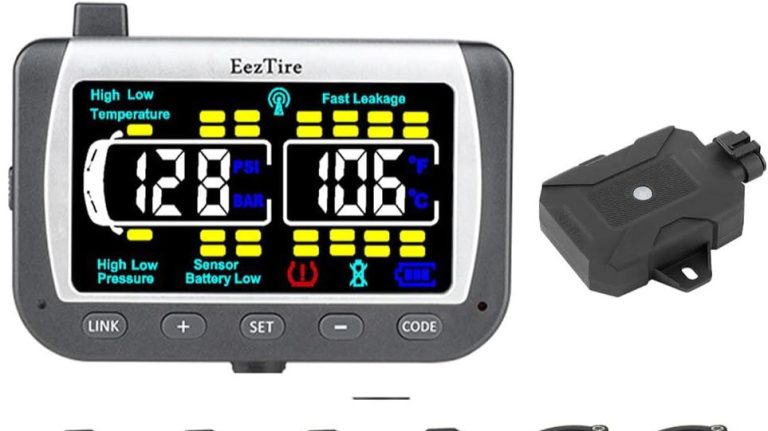
The Vesafe Wireless TPMS is an external sensor-based tire pressure monitoring system designed for RVs, travel trailers, fifth wheels, and towed vehicles. Each sensor screws onto your tire’s valve stem and wirelessly transmits pressure and temperature data to a compact display unit you mount in your cab.
What it IS:
- A real-time monitoring system that alerts you to pressure drops and temperature spikes before they become blowouts
- An expandable platform that can handle anywhere from 4 to 17 tires depending on your configuration
- A more affordable alternative to premium TPMS brands that can cost three to four times as much
Common misconceptions:
- It’s not factory-integrated TPMS. This is an aftermarket add-on; it doesn’t tie into your vehicle’s existing systems or dashboard
- It won’t prevent blowouts. It detects problems early so you can pull over—it can’t stop a catastrophic tire failure already in progress
- It’s not “set and forget.” You’ll need to charge the display periodically and eventually replace sensor batteries
Key Specs That Actually Matter for RVers
- Expandable tire monitoring: Handles up to 17 sensors, making it suitable for complex setups like motorhome + tow dolly + toad
- Pressure and temperature display: Each sensor reports both metrics, cycling through tires one at a time (roughly every five seconds per tire)
- Rechargeable display battery: Owners report going full multi-day trips on a single charge; no need to keep it plugged in constantly
- Signal repeater option: Available configurations include a wireless range extender for longer rigs or setups with signal interference
- Anti-theft locking nuts: Included hardware lets you secure sensors to valve stems
- Programmable alert thresholds: You set your desired pressure for each tire position; alerts trigger when readings drop below your threshold
Why these matter for RV use:
- The expandability is crucial if you have a dually tow vehicle plus a fifth wheel plus a toad—that’s easily 10+ tires
- The rechargeable display means one less thing plugged into your limited 12V outlets
- The repeater option addresses the reality that wireless signals struggle through RV walls, batteries, and cargo
Feature-by-Feature Breakdown (Truth vs. Marketing)
| Feature | What the Manufacturer Says | What It Actually Means (User Experience) | Compared to Competitors |
|---|---|---|---|
| Easy Programming | Simple setup process | Many owners find it straightforward IF they read instructions carefully; others struggle significantly with the sequence of button presses | Mixed—some premium brands have slightly more intuitive interfaces, but many TPMS systems have learning curves |
| Real-Time Monitoring | Continuous pressure/temp display | Sensors transmit periodically (roughly every several minutes); display cycles through tires one at a time, not all simultaneously | Similar to most external-sensor TPMS; internal sensors often update faster |
| Long Signal Range | Works on long RV combinations | Many owners report success at 40-60+ feet without the repeater; longer or interference-heavy setups may need the booster | Competitive—signal range complaints exist for nearly all brands |
| Audible Alarms | Alerts for pressure and temperature issues | Loud enough to get attention; some owners find alarms can’t be silenced until the issue is resolved, which is annoying for minor cold-morning pressure drops | Standard feature across TPMS category |
| Customer Service | Responsive support | Overwhelmingly positive feedback; many owners specifically praise quick email responses and free replacement parts sent even out of warranty | Standout strength compared to competitors with poor or nonexistent support |
Real-World Owner Experience (Deep Pattern Analysis)
Pattern 1: The “Saved My Trip” Stories
In a nutshell: A significant portion of positive feedback centers on the Vesafe catching problems before they became disasters—slow leaks, overheating brakes, separating treads, even broken valve stems detected early.
Hidden strength: The temperature monitoring proves unexpectedly valuable. Several owners caught stuck brakes or failing bearings by noticing one tire running significantly hotter than the others.
Hidden weakness: A few owners report the system showed normal readings even during or after a blowout—suggesting either sensor or monitor malfunction, or the failure happened too fast for detection.
What to do about it: Test your system during your return window (see testing tips below). Also recognize that TPMS is an early warning system, not a guarantee against all tire failures.
Pattern 2: The Programming Frustration
In a nutshell: Setup difficulty is the most polarized aspect of owner feedback. Roughly half describe it as “easy” or “straightforward,” while others use words like “impossible,” “infuriating,” and “poorly written instructions.”
Hidden strength: Owners who push through the initial confusion report the system “just works” once configured. Customer service will walk you through setup via email if you’re stuck.
Hidden weakness: The instructions appear to have translation issues and skip steps that seem obvious to the writers but aren’t to first-time users.
What to do about it: Watch for online video tutorials, program sensors one at a time with the battery out of others, and contact customer service at the first sign of confusion rather than fighting it alone.
Pattern 3: Signal Range Reality
In a nutshell: Signal reliability varies significantly based on rig configuration. Many owners with 30-40 foot combinations report perfect reception without the repeater. Longer setups or those with lots of metal/equipment between sensors and display often need the booster.
Hidden strength: The repeater, when used, appears to work well. Multiple owners report rock-solid signals after adding it.
Hidden weakness: Some owners report intermittent signal drops even with the repeater, particularly on inside dually positions or towed vehicles at highway speeds.
What to do about it: Order the kit that includes the repeater if your total rig length exceeds 40 feet or if you have significant metal/equipment between the display and rear sensors. Test thoroughly during your return window.
Pattern 4: The Display Readability Problem
In a nutshell: This is the single most consistent complaint across positive and negative reviews alike: the display is difficult to read in bright sunlight.
Hidden strength: The display works well in low-light conditions and the cycling through tires means you don’t need to read tiny numbers for all tires at once.
Hidden weakness: There’s no apparent way to adjust brightness or contrast. Mounting position matters significantly—some owners relocate the display to reduce glare.
What to do about it: Experiment with mounting positions. Some owners find success mounting it lower on the dash, in a shaded area near the rearview mirror, or using a small sun shade.
Pattern 5: Customer Service Stands Out
In a nutshell: This is genuinely the most consistently praised aspect of the Vesafe system. Dozens of owners mention responsive email support, free replacement parts, and proactive outreach when orders have issues.
Hidden strength: Multiple owners report receiving free replacement monitors, sensors, and batteries even years outside the warranty window.
Hidden weakness: Support is email-only—there’s no phone number to call. Some owners found the company initially hard to contact before discovering the correct email.
What to do about it: Save the customer service contact information that comes with your unit. If you have problems, reach out via email—owners report response times typically within 24 hours, often faster.
The Good, The Bad & The Ugly (Pros/Cons)
Pros
Peace of Mind:
- Gives visibility into tires you literally cannot see while driving
- Temperature monitoring catches brake and bearing issues, not just pressure
- Multiple owners credit the system with preventing major damage or dangerous situations
Value Proposition:
- Priced significantly below premium TPMS brands
- Expandable to 17 tires with additional sensors
- Rechargeable display battery lasts multiple days of driving
Support Experience:
- Fast email response times (usually within 24 hours)
- Free replacement parts sent even outside warranty
- Proactive customer outreach for order issues
Cons
Learning Curve:
- Programming instructions frustrate many first-time users
- Setup requires patience and careful instruction-reading
- No phone support for immediate troubleshooting
Display Limitations:
- Difficult to read in bright sunlight
- Cycles through tires one at a time (no “all at once” view)
- Takes several minutes to connect to all sensors after power-on
Reliability Variables:
- Some owners report intermittent signal loss
- Occasional reports of inaccurate readings or sensor failures
- Inside dually positions seem most prone to signal issues
Mini Toolkit: Decide + Fix (Fast)
Issue-Tag Box (Quick Reference)
- 🔧 SETUP-STUCK: Programming not working → Re-read instructions, try wireless programming method, contact support
- 📶 SIGNAL-LOST: Intermittent or missing sensors → Check sensor batteries, consider repeater, verify no interference
- 🌡️ FALSE-ALARM: Alerts on cold mornings → Set target pressure accounting for temperature swings
- 📺 CANT-READ: Display invisible in sun → Relocate mount, shade with hand when checking
- ⏱️ SLOW-CONNECT: Long startup time → Turn on display 10+ minutes before departure
Mini Decision Tree (Max 5 Lines)
- IF total rig length under 40 feet with minimal metal between tires and cab → Basic kit without repeater may work
- IF towing a vehicle behind your RV or rig over 40 feet → Get the kit with repeater
- IF you have duallies → Expect inside tires may need the repeater for reliable signal
- IF patient with setup and prefer email support → Good fit
- IF need phone support or zero-learning-curve solution → Consider other brands
Troubleshooting Quickflow: Sensor Won’t Read
- Confirm sensor is tight on valve stem (listen for brief hiss as it seats)
- Replace sensor battery with fresh, quality brand
- Delete sensor from display and re-pair following wireless method
- Move sensor to a different wheel position to test
- If still failing, contact customer support for replacement
- Consider adding repeater if multiple sensors drop intermittently
For a complete breakdown of testing procedures and fitment considerations, our RV TPMS buying guide covers validation steps in depth.
Mini Return-Window Reality Check
- Test all sensors immediately after delivery—don’t wait until your trip to discover a DOA sensor
- Program and install sensors in your driveway before the return window closes
- Verify signal reaches all tire positions, especially inside duallies and towed vehicles
- Take at least one short drive to confirm the system maintains connection while moving
- Check for alarm functionality by removing a sensor briefly to trigger a pressure drop alert
- Save customer service contact info in case you need help beyond the return window
Installation / Setup Tips (RV-Realistic)
- Read the instructions completely before touching anything. Owners who struggle almost always admit they skipped steps or went too fast
- Program sensors one at a time. Keep other sensor batteries out until each is successfully paired
- Use the wireless programming method if available. Many owners find this easier than the direct method
- Test range before mounting permanently. Walk around your rig with the display to verify signal reaches all positions
- Clean valve stems before installing sensors. A good seal prevents slow leaks from the sensor connection itself
- Consider valve extenders for tight clearances. Some wheel/hubcap combinations don’t leave enough room for the sensors
- Install the repeater on trailers or toads if signal is weak. It connects to 12V power on the towed unit
- Mount the display where you can shade it. Bright sunlight makes it nearly unreadable
- Turn on the system several minutes before departure. It takes time to connect to all sensors
- Keep a small tool kit for battery replacement. You’ll need it eventually, and the company offers replacement batteries/O-rings
- Don’t overtighten sensors. Hand-tight plus a small turn is sufficient; overtightening can damage valve stems
- Test the alarm sound so you know what it sounds like—you want to recognize it immediately on the road
Safety note: If you’re installing valve extenders or making any modifications to valve stems, verify against manufacturer recommendations or consult a tire professional. Improper valve stem modifications can cause dangerous pressure loss.
Owner Stories (The Human Side)
The stories below are composite scenarios reflecting repeated patterns across owner feedback.
The Close Call on I-95: A full-time RVer pulling a fifth wheel noticed one rear tire running significantly hotter than the others on a long highway stretch. Pulling over to investigate, they discovered a wheel bearing in the early stages of failure. The temperature alert gave them time to limp to a repair shop instead of experiencing a catastrophic bearing seizure at highway speed.
The Cold Morning False Alarm: A weekend camper set their pressure threshold based on summer readings, then spent an October morning chasing “low pressure” alarms that kept sounding. The tires were fine—cold overnight temperatures had dropped the pressure just enough to trigger the alert. After adjusting the threshold to account for temperature swings, the problem disappeared.
The Programming Persistence: An admitted non-techie spent three frustrating hours trying to program their sensors, ready to return the entire system. One email to customer service later, they received a step-by-step video showing exactly where they’d gone wrong. The system has worked flawlessly for two years since.
🔎 See more owner feedback on Amazon
Who This Is For (and Who Should Skip It)
Buy It If:
- You tow a trailer or flat-tow a vehicle and want visibility into those tires
- You’re budget-conscious but want capable tire monitoring
- You’re patient enough to work through initial setup
- You’re comfortable with email-only customer support
- You have a rig under 45 feet or are willing to use the repeater for longer setups
- You value customer service that actually sends replacement parts
Skip It If:
- You need immediate phone support when problems arise
- You want an all-tires-at-once display without cycling
- You have zero patience for programming devices
- You have extremely tight valve stem clearance and no room for extenders
- You expect it to work perfectly out of the box with no learning curve
👉 Check today’s price on Amazon
If you’re comparing options, start here: Top RV TPMS Picks
Alternatives (Quick Comparisons)
For those wanting easier setup: Some premium TPMS brands offer slightly more intuitive programming interfaces and better instruction manuals, though at significantly higher price points. The trade-off is often paying two to three times more for incremental improvements in user-friendliness.
For those needing phone support: Look for brands that advertise dedicated phone support lines. Be prepared to pay more—responsive customer service with actual phone access typically commands a premium.
For those with extremely long rigs: Flow-through internal sensors that replace your existing valve stems may offer more reliable signal transmission on very long combinations, though installation is more involved and typically requires professional mounting.
For factory-integrated alternatives: Some newer RVs come with OEM TPMS systems. If you’re buying new, check whether your rig includes tire monitoring and whether it covers all wheels including trailers and toads.
Deep-Dive FAQ
What should I test immediately after delivery? First, verify all sensors are present and have batteries installed. Program each sensor and confirm the display recognizes it. Install on your tires and verify signal reaches the display from all positions—especially the farthest tires. Remove one sensor briefly to trigger a pressure drop alarm and confirm the alert works. Do all of this before your return window closes.
What are the most common problems and fixes? Programming confusion (solution: follow wireless method, watch videos, contact support), signal dropouts (solution: add repeater, check batteries, reduce interference), display unreadable in sun (solution: relocate mount, shade with hand), slow startup (solution: turn on 10+ minutes before departure), cold-morning false alarms (solution: adjust pressure threshold).
Will this work with my RV setup? It works with most RV, trailer, and towed vehicle combinations. Key variables: rig length (longer than 40-45 feet may need repeater), metal interference between sensors and display, valve stem clearance (some wheels need extenders). Best bet: buy from a seller with good return policy and test thoroughly on your specific setup.
How accurate are the readings? Most owners report readings within a few PSI of their manual gauges—close enough for early warning purposes. A minority report larger discrepancies. If accuracy is critical for your use case, spot-check against a quality manual gauge when you first install.
How long do sensor batteries last? Owner reports vary widely, from several months to a couple of years. The company offers a battery replacement program and will send new batteries and O-rings if you contact them.
What about the display battery life? Most owners report lasting several days of driving on a single charge. Some report needing to charge about once a week with regular use. The display auto-sleeps when motion stops for a while, helping conserve power.
Can I add more sensors later? Yes. The system is expandable up to 17 tires. Additional sensors are available for purchase separately, and the company appears to help ensure you get the correct type for your system.
Final Verdict
The Vesafe Wireless TPMS occupies a sweet spot in the RV tire monitoring market: capable enough to genuinely provide peace of mind, affordable enough to justify the purchase, and backed by customer service that actually resolves problems. It’s not perfect—the programming learning curve and sunlight-challenged display are real drawbacks—but for the price, you’re getting a system that has genuinely saved owners from blowouts, bearing failures, and expensive roadside repairs.
The best-fit buyer is someone who values substance over polish: you’re willing to invest the time to set it up correctly, you’re comfortable with email support, and you prioritize function over fancy interfaces. If that describes you, and you want to know what your tires are doing before disaster strikes, the Vesafe delivers.