Thetford Porta Potti 565E Review: Comfort Champ With One Big Catch
Last updated: June 2026
Here’s what I re-checked for this update:
- Pulled the most recent owner feedback through spring 2026 to see if the recurring complaints had shifted (they mostly haven’t).
- Re-weighted the electric-pump failure pattern against the manual-pump praise, since that single decision drives most of the regret I see.
- Cross-checked the “leaking” complaints to separate true product defects from setup-and-tilt issues.
- Updated the support/warranty notes, including owner mentions of unreliable customer service and a reported Thetford bankruptcy filing surfacing in newer reviews.
Affiliate disclosure: This article contains Amazon affiliate links. If you buy through them, I may earn a small commission at no extra cost to you. It doesn’t change what I write—my job is to tell you the truth so you buy the right thing once.
The Real Problem This Solves
If you’ve ever crawled out of a warm sleeping bag at 2 a.m. to hunt for a campground pit toilet—or worse, a dismal festival porta-john—you already understand the appeal of a private, comfortable toilet you control. The trouble is that “portable RV toilet” covers everything from a glorified bucket to a near-household-height cassette unit, and the marketing photos all look reassuringly similar. Figuring out which one actually earns its place in your van, camper, boat, or cabin is genuinely confusing.
The Thetford Porta Potti 565E Curve sits at the premium end of the cassette-toilet world, and it has a near-cult following for one reason above all: it’s tall, comfortable, and feels like a real toilet rather than a squat-and-pray plastic box. But it also carries one persistent, well-documented weakness that can turn fans into ex-fans fast. This review is a synthesis of real owner experience—the praise, the pain points, and the buying mistakes—so you can decide with your eyes open. If you’re still weighing the whole category, it helps to pair this with a broader framework like the complete RV toilet selection walkthrough before your return window closes.
How this review was built (so you can trust it)
I went through a large pool of owner feedback—several hundred reviews spanning roughly 2020 through mid-2026, including both the most enthusiastic five-star write-ups and the angriest one-star complaints, from U.S. and international buyers.
Here’s the plain-English method: I tagged every piece of feedback into categories—comfort/performance, install and setup sensitivity, the flush/pump mechanism, fitment and compatibility, reliability symptoms, and support/returns experience. Then I separated “setup-driven issues” (things a user could prevent or fix) from “likely product failures” (things that point to a design or quality weakness). For deeper category context beyond this single model, the RV toilet decision framework covers the trade-offs I won’t fully repeat here.
Important limitations:
- Online reviews skew toward extremes—delighted buyers and furious ones both write more than the quietly satisfied middle.
- RV setups vary enormously (van wet bath vs. cabin vs. boat vs. tent), so one person’s “leak” can be another’s tilt-and-fill-level mistake.
- I prioritized patterns that came up repeatedly, not isolated one-off stories.
Quick Verdict (TL;DR)
Best for:
- Vanlifers and campers who want true household seat height and a comfortable, full-size oval bowl.
- Anyone replacing a cramped, shallow “bucket-style” portable toilet.
- Cabin, boat, tiny-house, or guest-room use where a clean, low-odor, self-contained toilet matters.
Not for:
- Buyers who refuse to use the recommended holding-tank chemicals (you’ll be miserable).
- Ultra-compact builds with a tight cabinet—measure first, because owners report real fitment surprises.
- People who specifically want the battery-flush version and won’t consider the manual pump.
Standout win:
- Comfortable, real-toilet ergonomics plus genuinely low odor and easy dumping when used correctly.
Watch-outs:
- The electric flush pump is the single most reported failure point, and replacement parts are pricey and sometimes hard to find.
- Thetford’s customer service and warranty follow-through draw frequent complaints.
Confidence Score: 🟢 8/10 (High buyer-usefulness)
This score reflects how confident I am that you’ll know what you’re getting—not a reliability percentage. I weighed the volume and consistency of owner feedback, how cleanly the strengths and weaknesses separate, and how preventable the common problems are. The comfort and odor wins are extremely consistent; the deductions come almost entirely from the electric-pump and support patterns.
👉 Check today’s price on Amazon
What This Product Is (and What It Isn’t)
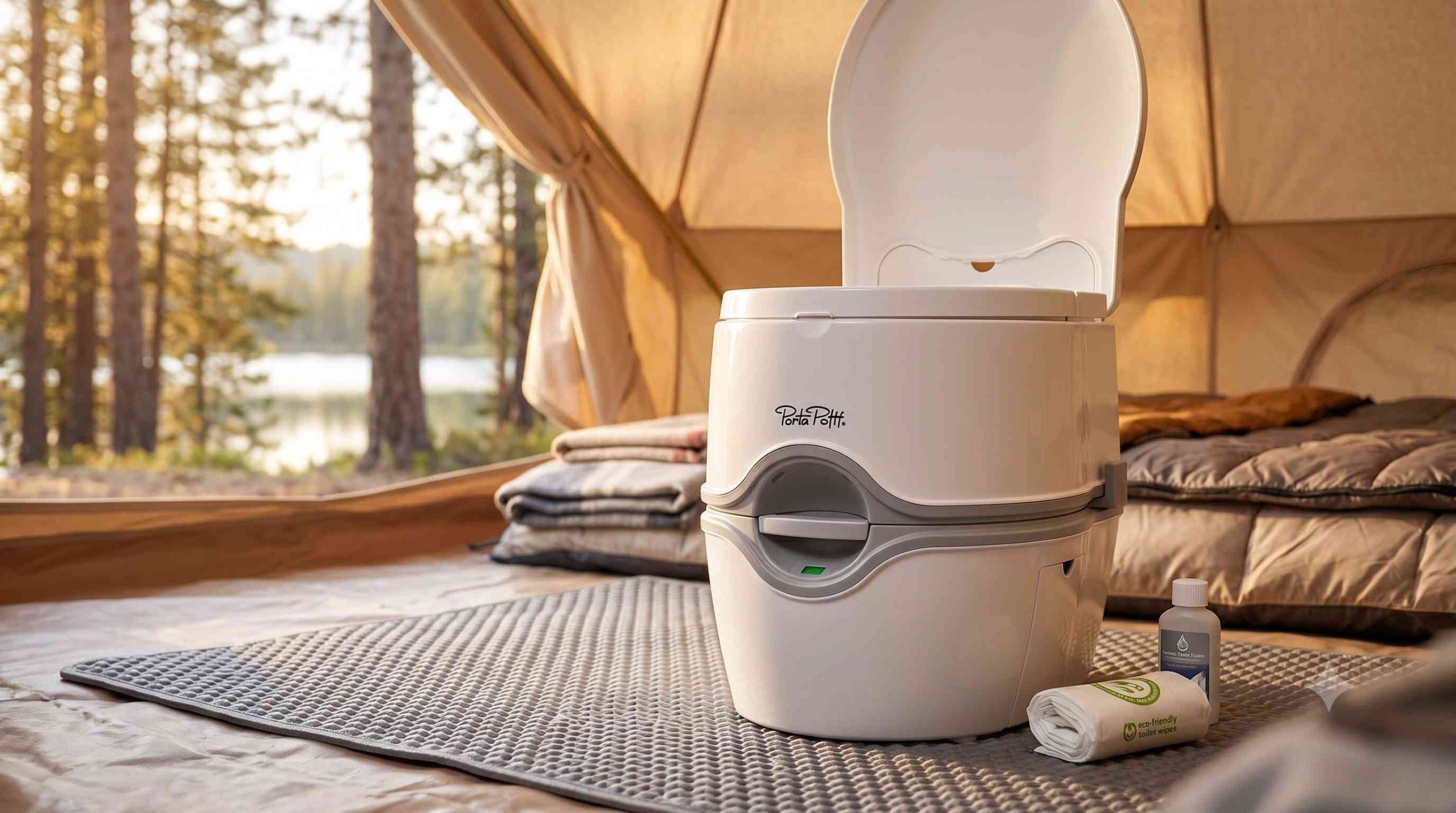
The 565E Curve is a self-contained cassette toilet: a sealed clean-water flush tank on top, a detachable waste tank on the bottom, and a sliding blade valve between them. You add a measured amount of water and toilet chemical, use it, slide the valve open to flush, then close it to seal in odor. When the bottom fills, you unclip it, carry it to a dump point or regular toilet, and empty it through a pour spout. No plumbing, no black tank, no hookups required.
A few misconceptions worth clearing up:
- It isn’t a composting or “dry” toilet. It uses water and chemical to control odor; if you skip the chemical, owners consistently report it gets unpleasant fast.
- It isn’t maintenance-free. It’s easy, but you still dump, rinse, and occasionally deep-clean it.
- The “565E” and “565P” are not the same experience. The E is the electric (battery) flush; the P is the manual piston pump. That distinction matters more than almost anything else in this review.
Key Specs That Actually Matter for RVers
I’m deliberately not inventing numbers here—these are the attributes owners actually talk about and why they matter:
- Seat height: Repeatedly praised as close to a household toilet. This is the headline reason people love it—no painful crouching on sore knees.
- Bowl shape: A deeper, oval, household-style bowl. Owners coming from cheap round shallow bowls describe this as a real upgrade in comfort and cleanliness.
- Flush mechanism (electric vs. manual): The fork in the road. Electric is convenient until it fails; the manual version is widely described as more reliable.
- Detachable waste tank with pour spout: Generally praised as easy to carry and empty—when you release the internal air pressure first (more on that below).
- Built-in toilet paper holder and tank-level indicator: Small touches owners genuinely appreciate; the level indicator saves you from guessing when to dump.
- Mounting/hold-down compatibility: A locking base plate keeps it from sliding in a moving vehicle. Several owners note this plate can be hard to source separately.
Feature-by-Feature Breakdown (Truth vs Marketing)
| Feature | What the Manufacturer Implies | What It Actually Means (Owner Experience) | Compared to Competitors |
|---|---|---|---|
| Seat height & comfort | “Full-size comfort” | Consistently the most-loved trait; feels like a normal toilet, easy for older or taller users | A clear step up from budget cassette toilets with low, shallow bowls |
| Electric flush | Push-button convenience | Convenient when working, but the most common failure point; some report it running on and overflowing | The manual-pump rivals (and the 565P) are seen as more dependable long-term |
| Odor control | “No odor” | Genuinely low odor with the right chemicals; without them, owners report it stinks | On par with other quality cassettes; chemical discipline matters more than brand |
| Dumping/emptying | “Easy to empty” | Easy once you learn to release air pressure and mind the angle; otherwise splash-back happens | Comparable; the pour-spout design is liked, though some report spout leaks |
| Seals & leak resistance | “Leak-proof” | Solid for most, but a repeated minority report seal/cap leaks, especially on tilt or when full | Mixed—competitors have similar seal complaints; not uniquely bad, not flawless |
| Spare parts & support | Backed by warranty | A recurring sore spot; pricey pumps, scarce manual-pump parts, and frustrating service | A real weakness; some smaller brands are easier or cheaper to keep running |
Real-World Owner Experience (Deep Pattern Analysis)
Pattern 1: The comfort is the whole point—and it delivers
In a nutshell: Across the owner feedback I analyzed, the single most consistent praise is the seat height and bowl comfort. People describe it as the closest thing to a home toilet in the portable world.
Hidden strength: It’s a quality-of-life upgrade for older RVers, people with knee or mobility issues, and anyone who’s tired of hovering over a tiny bucket.
Hidden weakness: That comfort comes with bulk. A frequent buyer surprise is that it’s bigger and heavier (especially full) than the photos suggest.
What to do about it: Measure your cabinet or wet-bath space before buying, and plan to dump before the tank is completely full so it stays manageable to carry.
Pattern 2: The electric pump is the Achilles’ heel
In a nutshell: One pattern that comes up repeatedly is electric-flush failure—pumps that quit after a season or two, especially after winter storage, and in some cases pumps that stay on and overflow.
Hidden strength: When it works, the electric flush is quiet, effortless, and feels premium.
Hidden weakness: Owners report the pump can fail well before you’d expect, and replacement pumps cost a meaningful fraction of a whole new unit—when you can find them at all.
What to do about it: Pull the batteries during storage, keep moisture out of the battery compartment, and seriously consider the manual-pump 565P if long-term reliability matters more than push-button convenience. If anything beyond battery swaps and basic cleaning is involved, verify against the manufacturer instructions or consult a qualified RV tech.
Pattern 3: Odor control is excellent—if you respect the chemicals
In a nutshell: In real-world use, many owners report essentially no smell, including during dumping. The common thread among the happy ones is that they always use a holding-tank treatment and RV-friendly toilet paper.
Hidden strength: With the right products, even multi-day family use stays surprisingly fresh.
Hidden weakness: Skip the chemical and a minority of owners describe genuinely awful experiences—gagging, splash-back, the works.
What to do about it: Budget for chemicals from day one, use a recommended treatment, and add a little to the flush water too. Quick-dissolve RV toilet paper reduces clogging and cleanup hassle.
Pattern 4: Dumping has a learning curve
In a nutshell: From real-world owner feedback, the emptying process trips up first-timers—splash-back, awkward tilt angles, and the occasional dramatic story.
Hidden strength: Veterans describe the actual process as fast (often under ten minutes) and not gross once you’ve done it a few times.
Hidden weakness: That first dump can be unpleasant if you don’t know the air-pressure trick.
What to do about it: Open the air-release button before pouring, hold the spout close to the water surface, and angle slowly. Always remove toilet paper before hosing out the lower chamber.
Pattern 5: Leaks—real, but often situational
In a nutshell: A minority-but-repeated theme is leaking: fresh-water filler caps that don’t seal, or liquid escaping when the unit is parked on a slope or carried full.
Hidden strength: The majority report no leaks at all over years of use, which suggests this isn’t universal.
Hidden weakness: When it happens, it’s a mess—stained carpets and ruined rugs show up in the worst reviews.
What to do about it: Test it with plain water before your return window ends, don’t overfill, check the filler cap seal, and avoid leaving it full on steep tilts.
Pattern 6: Support and warranty frustration
In a nutshell: Based on aggregated owner experiences, getting help from Thetford—or unauthorized sellers—is a recurring complaint, with warranty promises that some owners feel went unhonored.
Hidden strength: A few owners report good service and honored warranties, so it’s not universal.
Hidden weakness: Long hold times, unanswered emails, “just buy a whole new unit” responses, and seller runaround appear often enough to take seriously.
What to do about it: Buy from a reputable, authorized seller, keep your order records, and test everything immediately so any defect surfaces inside the return window.
The Good, The Bad & The Ugly (Pros/Cons)
Pros
- Comfort & ergonomics: Household-like seat height, deep oval bowl, sturdy and stable to sit on.
- Odor & cleanliness: Very low odor with proper chemicals; easy to wipe down and rinse.
- Practical design: Detachable waste tank, pour spout, TP holder, tank-level indicator, optional hold-down plate.
- Versatility: Loved across vans, campers, boats, cabins, tiny houses, and guest rooms.
Cons
- Electric pump reliability: The most common failure, especially after storage.
- Parts & cost: Replacement pumps are expensive and sometimes unavailable; manual-pump parts can be scarce.
- Support experience: Customer service and warranty follow-through draw frequent criticism.
The Ugly
- Worst-case scenarios: A handful of owners describe leaks ruining carpets, brand-new units arriving defective, or seals failing within months—paired with difficult returns.
Mini Toolkit: Decide + Fix (Fast)
Issue-Tag Box
- 🔌
electric-pump-failure - 💧
seal-or-cap-leak - 👃
odor-if-no-chemical - 🧰
pricey-scarce-parts - 📏
fitment-too-big - 📞
support-runaround
Fitment / Adapter Mini-Matrix
| Your Space | Likely Fit | Watch For |
|---|---|---|
| Van wet bath / cabinet | Often tight | Measure all three dimensions; owners report it’s wider/taller than expected |
| Cabin, tiny house, guest room | Usually great | Plan a spot for the hold-down plate if you want it anchored |
| Boat / pontoon | Generally good | Secure it so it doesn’t shift underway |
Mini Decision Tree
- If reliability matters more than convenience → choose the manual-pump 565P, not the electric 565E.
- If you’ll store it through winter → pull batteries and keep the compartment dry.
- If your cabinet is tight → measure first or pick a smaller cassette model.
- If you won’t use chemicals → this isn’t the toilet for you.
- If push-button flush is a must → buy the 565E but test it immediately and keep your receipt.
Troubleshooting Quickflow (electric flush won’t work)
- Confirm fresh batteries are installed correctly and the compartment is dry.
- Check the clean-water tank actually has water in it.
- Listen—if the pump hums but no water moves, the line or pump may be blocked or failing.
- Inspect the hose connection at the pump for a slipped or detached fitting.
- If it runs continuously or overflows, stop using it and remove power.
- If basic checks fail, verify against the manufacturer instructions or consult a qualified RV tech rather than forcing it.
Mini Return-Window Reality Check
- Fill the clean-water tank and run the flush several times—confirm the electric pump actually pumps and shuts off properly.
- Pour plain water through, then tilt gently to check the filler cap and seals for leaks before any waste ever goes in.
- Open and close the blade valve to confirm it slides fully and seals.
- Dry-fit it in your actual space so a measurement surprise doesn’t become a non-returnable problem.
- Keep packaging and your order record until you’re satisfied it’s defect-free.
- For a fuller pre-purchase checklist that applies across models, the category-wide vetting checklist is a useful companion to this product-specific test.
Installation / Setup Tips (RV-Realistic)
- Measure width, depth, and height of your intended space—then add margin. Owners repeatedly report it’s bigger than expected.
- If you want it anchored, source the hold-down/locking base plate early; it can be hard to find later.
- Add holding-tank chemical from the very first use, and put a little in the flush water too.
- Use quick-dissolve RV toilet paper to reduce clogs and make cleanup easier.
- For battery (565E) units, store with batteries removed and the compartment dry to dodge the most common failure.
- In freezing conditions, don’t leave water sitting in it; some owners add RV antifreeze to the water when temps drop—verify this approach against the manufacturer instructions first.
- Before dumping, press the air-release button so pressure doesn’t spray waste back at you.
- Hold the pour spout close to the water and tilt slowly to minimize splash-back.
- Always remove toilet paper before rinsing the lower chamber, or you’ll fish out soggy paper.
- Don’t overfill the waste tank—dump earlier so it stays light enough to carry safely.
- If you ever modify mounting, drill, or alter the unit, consult a qualified RV tech rather than improvising.
See It in Action: Visual Reality Check
Specs and bullet points are useful, but watching the unit get set up and used in a real RV tells you more than any list can. It’s the fastest way to gauge whether the size, flush, and dumping process match your expectations.
What to look for in this video (based on owner patterns):
- 📏 Scale Check: Notice how much room it actually occupies—owners are often surprised by the footprint, so compare it to the person’s hands and surrounding cabinetry.
- 🔊 Flush Check: Listen to the electric pump as it runs. Does it sound healthy and shut off cleanly, or does it strain?
- 💧 Seal Check: Watch how the blade valve and filler cap close. These are the spots owners report leaking on a tilt.
- 🧰 Dump Check: Pay attention to whether they release the air pressure before pouring—that single step prevents most splash-back complaints.
Keep in mind this video shows the initial setup, but it won’t show the electric-pump failure after storage that some owners report many months down the line.
Owner Stories
The stories below are composite scenarios reflecting repeated patterns across owner feedback.
The full-timer who found their gold standard. A van-dweller had cycled through pricey “premium” toilets that were hard to dump and smelled bad. Switching to the Porta Potti, they settled into a weekly dump routine that takes minutes, stays odor-free with the right chemical, and finally feels like a real toilet. For them, it became the obvious benchmark.
The owner burned by the electric pump. A camper bought the 565E, loved it for a season, then pulled it out of winter storage to a dead pump. The replacement cost a big chunk of a new unit and was hard to find, and support was slow. Their takeaway, echoed by many: if they did it again, they’d buy the manual-pump version from the start.
The buyer who didn’t measure. Someone reserved a tidy cabinet spot based on the listed dimensions, only to discover the unit was wider than expected and wouldn’t fit without modifying the cabinet. The toilet itself was fine—the planning wasn’t.
🔎 See more owner feedback on Amazon
Who This Is For (and Who Should Skip It)
Buy it if…
- You want genuine household-style seat height and comfort in a portable toilet.
- You’re outfitting a van, camper, boat, cabin, tiny house, or guest space.
- You’re replacing a shallow, low, uncomfortable bucket-style unit.
- You’re disciplined about using holding-tank chemicals.
- You’re willing to choose the manual pump for reliability, or to baby the electric one.
Skip it if…
- You want a truly tiny, ultralight unit for a cramped build.
- You refuse to deal with chemicals and maintenance.
- You need bulletproof long-term electric flush with zero fuss.
- You want cheap, easy, always-available spare parts.
👉 Check today’s price on Amazon
If you’re comparing options, start here: Top RV Toilet Picks
Alternatives (Quick Comparisons)
- The manual-pump sibling (565P): Same comfortable body, hand-pump flush. The pick for owners who prioritize reliability over push-button convenience.
- A smaller cassette toilet: If the 565E is too big for your cabinet, a more compact portable unit trades seat height for fit—worth it in truly tight builds.
- A fixed/permanent RV toilet: If you have a black tank and plumbing, a bowl-style fixed toilet removes the carry-and-dump routine entirely. Useful if you’re rethinking the whole bathroom rather than just the toilet.
- A composting/dry toilet: A different philosophy—no water or chemical—but typically pricier and with its own learning curve and maintenance trade-offs.
Deep-Dive FAQ (High-Intent)
What should I test immediately after delivery?
Fill the clean-water tank, run the electric flush several times to confirm the pump works and stops on its own, and pour plain water through while gently tilting to check the filler cap and seals. Do all of this before any waste goes in, and before your return window closes.
What are the most common problems and fixes?
The big one is electric-pump failure, often after storage—prevent it by removing batteries and keeping the compartment dry. The next is odor, which is almost always a “no chemical” problem, not a product flaw. Leaks are usually tied to overfilling, a poorly seated filler cap, or steep tilt.
Should I get the electric (565E) or manual (565P) version?
If convenience is your priority and you’ll test and maintain it, the electric is lovely to use. If long-term reliability is your priority, a recurring theme in owner feedback favors the manual pump—fewer moving electronics to fail.
Will it fit my RV or van?
Maybe—but measure first. Several owners report it’s larger than the photos and even the listed dimensions suggest. Check width, depth, and height in your actual space before committing.
Does it really control odor?
Yes, very well, if you use a holding-tank treatment and RV-friendly toilet paper. Owners who skip the chemical are the ones describing bad smells.
How often will I need to empty it?
It depends on how many people use it and how often. Solo or couple use can stretch to several days; a family will dump more frequently. The built-in level indicator tells you when it’s time.
Is dumping as gross as people say?
There’s a learning curve. Release the air pressure first, hold the spout close to the water, and tilt slowly—veterans describe the routine as quick and not unpleasant once they’ve got the rhythm.
How’s the warranty and customer service?
Mixed, leaning frustrating. Some owners get good support; many report slow responses, unhonored warranty claims, or being told to buy a whole new unit. Buy from an authorized seller and keep your records.
Final Verdict
The Porta Potti 565E Curve earns its reputation where it counts: it’s the most comfortable, most “real toilet” feeling unit in the portable cassette class, and with proper chemical use it stays genuinely low-odor and easy to live with. That’s not marketing—it’s the most consistent thread in years of owner feedback.
The catch is equally consistent: the electric flush pump is the part most likely to let you down, parts are pricey, and support can be a headache. The clean way through that risk is to either choose the manual-pump 565P or treat the electric version’s batteries and storage with care—and to test everything the day it arrives.
If you want household comfort in a portable package and you go in with eyes open about the pump and the chemicals, this is an easy unit to recommend. If you want bulletproof electronics and cheap parts, look harder at the manual version or an alternative.