HumsiENK 12V 100Ah LiFePO4 Battery Review – Budget-Friendly Power for RVs (Worth It?)
Affiliate disclosure: This post contains affiliate links. If you buy through them, we may earn a commission at no extra cost to you.
If you’ve ever watched your RV battery sag the moment you turn on a load (inverter, fridge, fan, CPAP, you name it), you already know the pain: the “battery” is technically charged… but it doesn’t feel usable.
That’s exactly why so many RVers are moving to lithium iron phosphate (LiFePO4) batteries—and why the HumsiENK 12V 100Ah LiFePO4 Battery is getting attention as a budget-friendly option that can still deliver real performance in campers, trailers, vans, and solar setups.
Quick Summary
- Best for: RVers who want more usable power than lead-acid without paying premium lithium prices.
- What owners like most: Value, lightweight feel, strong voltage under load, and solid day-to-day performance (especially for solar + inverter setups).
- Biggest watch-outs: Model confusion (Bluetooth vs non-Bluetooth), occasional shipping/QA issues, and BMS “sleep” behavior that may require a “wake-up” if you drain too low.
- If you’re building solar: Pair this with a proper charging profile and good monitoring. Start here: How to Size Your RV Solar System (Panels + Batteries)
Quick Verdict
If you want a 100Ah lithium upgrade that owners regularly describe as “small but powerful” and “a bargain,” the HumsiENK 12V 100Ah is a strong contender—especially for weekend campers and budget-focused full-timers.
You should skip it if you need bulletproof QC consistency, must have reliable Bluetooth, or you don’t want to deal with potential BMS “wake-up” quirks when the battery hits low-voltage cutoff.
👉 Check today’s HumsiENK 12V 100Ah LiFePO4 Battery price on Amazon
What This Battery Is (In Plain English)
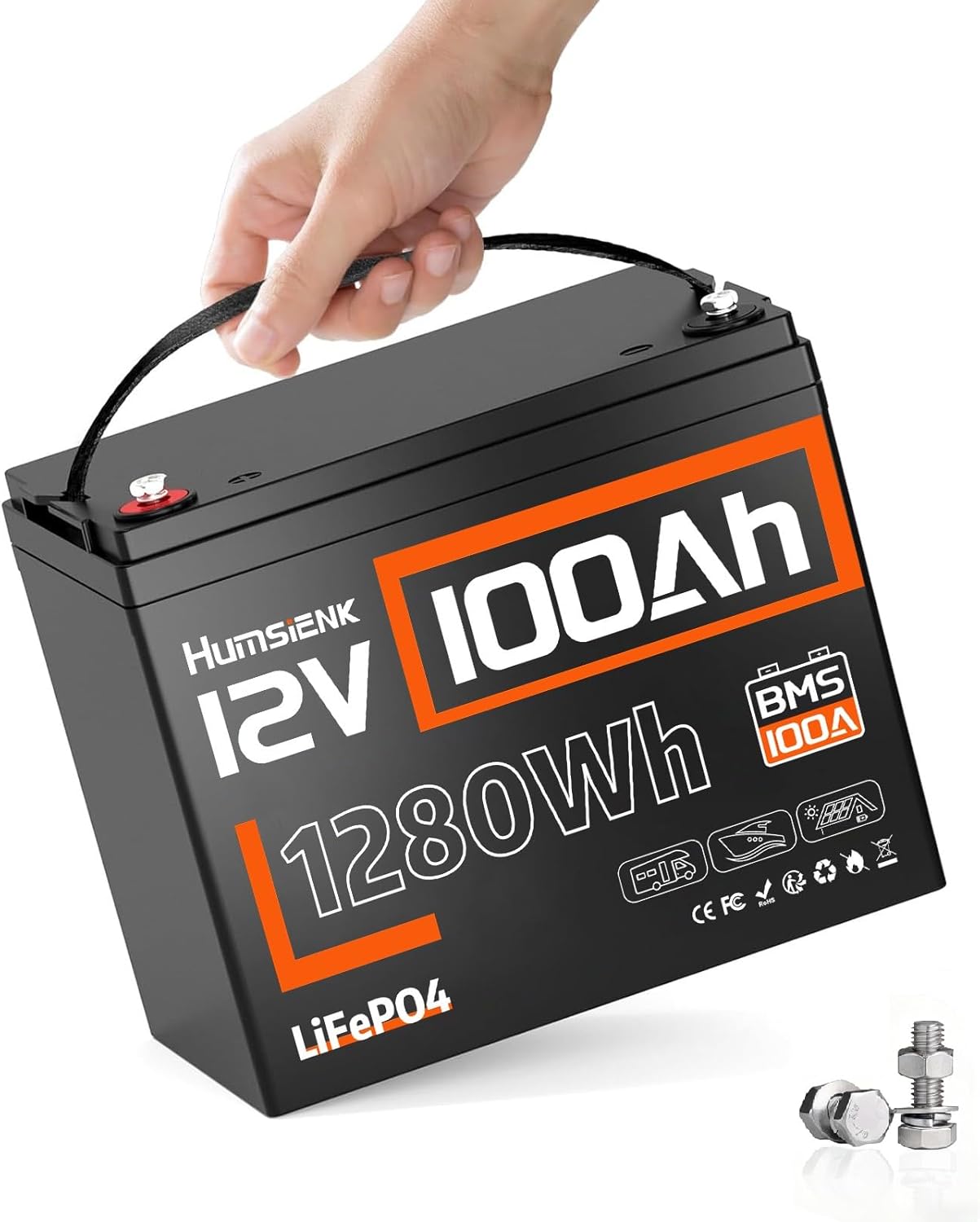
The HumsiENK 12V 100Ah LiFePO4 battery is a deep-cycle lithium battery designed to replace (or outperform) traditional RV lead-acid/AGM batteries.
Where lead-acid batteries typically “feel weak” as voltage drops, LiFePO4 batteries tend to hold a more stable working voltage for longer—so your inverter, fridge, or sensitive electronics often run more consistently.
Key Features RV Owners Actually Care About
Here’s what matters in real RV use—not just marketing copy.
1) 100Ah class capacity with “more usable” energy
Many RVers move from lead-acid to LiFePO4 because you can typically use more of the battery’s capacity without wrecking it. In practical terms, a lithium 100Ah often feels like a bigger upgrade than it looks on paper.
2) Lightweight, easy to handle
Multiple owners highlight how easy it is to lift and install compared to lead-acid. One buyer specifically called out a weight around 23 lb (about 10.4 kg) for a 100Ah class battery—very doable for a one-person install in most rigs.
3) Built-in Battery Management System (BMS)
BMS (battery management system) is the onboard protection circuitry that helps guard against overcharge/over-discharge and other unsafe conditions. Owners generally like that it protects the pack—but several point out the trade-off: if you drain too low, the BMS may shut down hard and require a wake-up step.
4) Works well for RV solar + inverter setups (when configured correctly)
Owners describe using these in parallel banks for higher capacity, and some talk about series/parallel plans for 24V systems. That’s a good sign: people aren’t just buying one—they’re building systems around them.
Spec Snapshot Table (What Owners Commonly Mention)
Because Amazon listings often include multiple variants (Group sizes, Bluetooth vs non-Bluetooth, mini/high-capacity versions), treat this as a practical “what owners are seeing” snapshot—not a lab spec sheet.
| Spec / Detail | What it means for you | What owners commonly report |
|---|---|---|
| Nominal system voltage | Standard RV house system | 12V class (LiFePO4 typically ~12.8V nominal) |
| Capacity | How much energy storage you’re buying | 100Ah class (some report tests near rated, others report shortfalls) |
| Energy (math) | Useful for runtime estimates | ~12.8V × 100Ah ≈ 1280Wh (theoretical) |
| Weight | Install + handling | Many highlight “lightweight”; one mentions ~23 lb / 10.4 kg |
| BMS low-voltage cutoff behavior | What happens if you drain too far | Some report needing a 12V “wake-up” after shutdown |
| Bluetooth | Monitoring convenience | Some variants have it, some don’t; some buyers report connection issues |
How It Stacks Up vs Common Alternatives (Quick Comparison)
This is the practical “what are you really buying” view.
| Option | Upfront cost | Usable energy feel | Monitoring | Best for |
|---|---|---|---|---|
| Basic 100Ah AGM | Low–mid | Lower (voltage sags) | External meter recommended | Occasional RV use, mild loads |
| Budget 100Ah LiFePO4 (HumsiENK style) | Mid | High (stable voltage) | Better with shunt; Bluetooth varies | RVers upgrading on a budget |
| Bluetooth LiFePO4 (premium-ish) | Mid–high | High | App + data | People who want visibility + troubleshooting |
| Premium LiFePO4 | High | High | Usually strong support + consistency | Full-timers who want lowest hassle |
Real-World Owner Feedback Snapshot
Based on the reviews you provided, the overall pattern is clear: a lot of buyers are thrilled, and a smaller (but important) group reports serious issues.
Most loved
- Strong value for money (“bargain,” “affordable,” “no-brainer upgrade”)
- Lightweight handling
- Good real-world performance in RV + solar + inverter use
Common gripes
- Occasional dead-on-arrival / very low voltage delivery issues (some got replacements quickly)
- Missing screws/manual complaints from a few buyers
- Bluetooth confusion or unreliable connection (depending on the version)
- BMS shutdown/wake-up requirement if the battery hits low-voltage cutoff
Best for
- RVers who want more usable power for fridge + lights + inverter basics
- Solar users who can monitor state of charge and avoid draining to shutdown
Not ideal for
- Anyone who wants “set it and forget it” with zero troubleshooting
- Buyers who require dependable Bluetooth monitoring
👉 Check today’s HumsiENK 12V 100Ah LiFePO4 Battery price on Amazon
What Real Owners Like Most (Pros)
1) “It just works” for common RV power needs
Several owners describe straightforward installs in campers/trailers and immediate improvements—especially when replacing tired lead-acid banks that couldn’t hold voltage.
You’ll see this theme repeatedly: more confidence running real loads (inverters, 12V refrigerators, electronics) without the battery feeling like it’s collapsing.
2) Great value—especially on sale
A number of buyers bought multiple units and plan to expand their battery bank when pricing dips. That pattern matters: repeat purchases usually mean the battery is delivering enough value to justify scaling up.
3) Lightweight upgrade from lead-acid
Owners repeatedly call out how much easier these are to move and install than traditional batteries. In RV life, that’s not a small benefit—especially if your battery compartment is awkward.
4) Strong performance in solar setups (with the right expectations)
Owners mention using these in parallel for higher capacity, and some describe larger solar charging systems and inverter usage. The takeaway: people are using them for real off-grid work, not just as “backup lights.”
5) Customer service can be responsive (for replacements and questions)
Multiple reviews describe quick responses through Amazon messaging and fast replacement when something arrived bad. That does not erase the inconvenience—but it’s a meaningful positive if you’re buying budget gear.
What Real Owners Complain About (Cons)
1) Occasional quality/shipping issues (DOA, 0 volts, won’t take a charge)
A handful of reviews describe batteries arriving at 0 volts, not charging, or failing early. Some buyers received replacements that worked fine—but if you’re the unlucky one, it’s still downtime and hassle.
What you should do: test the battery promptly when it arrives (simple steps below).
2) BMS shutdown “sleep” behavior can surprise you
One detailed owner explains that when the battery drops to low voltage, the BMS can shut down and stay off even after removing the load—until you “wake” it by briefly applying a 12V input (like from a jump pack).
That’s not “wrong,” but it means you must avoid pushing the battery into deep shutdown repeatedly, and you need a plan for monitoring.
3) Bluetooth confusion (and in some cases, Bluetooth disappointment)
Some buyers specifically recommend paying extra for Bluetooth because it’s “mission critical” for state-of-charge visibility. Others complain the Bluetooth version won’t connect.
This points to a key reality: HumsiENK appears to sell multiple variants, and the experience depends heavily on exactly which one you buy.
4) Documentation can be mediocre or confusing
At least one buyer notes the manual quality and “too many models in one manual” problem, making it harder to quickly confirm specs for your exact unit.
5) A small set of buyers report capacity falling short
Some reviews claim test results closer to ~89Ah or lower-than-expected watt-hours under load. Other owners report tests at or slightly above rated capacity. That spread suggests either unit-to-unit variance, test-method differences, or both.
Who This Battery Is Best For (and Who Should Skip)
Best for you if…
- You want a cost-effective lithium upgrade for typical RV use: lights, fans, water pump, charging devices, fridge support, and moderate inverter use.
- You’re building (or expanding) a battery bank for solar and you’re willing to use proper monitoring.
- You can handle basic setup details like charging profile, wiring, and avoiding deep shutdown.
If you’re planning solar, these two guides will save you time:
- DIY RV Solar Installation Guide (Step-by-Step Setup for Beginners)
- RV Solar Maintenance & Troubleshooting Guide
Skip this if…
- You need maximum consistency and you’ll be furious if you have to exchange a unit.
- You depend on Bluetooth and you don’t want to risk app/connection hassles.
- You run high-demand loads constantly and can’t tolerate potential BMS shutdown surprises.
Mini Real-World Stories (Paraphrased From Owners)
- One owner built a larger battery bank over time and used the system with solar charging and an inverter to keep important equipment running, noting the batteries did what the BMS is designed to do—but also explaining the “wake-up” requirement after a deep shutdown.
- Another buyer running a CPAP reported multi-night use while still having reserve left, specifically calling out that lithium’s voltage curve helped keep equipment running more consistently than lead-acid.
- Several RV and marine users describe the batteries as compact, easy to install, and good performers for the price—often buying multiples after a good experience.
Installation & Usage Tips (Owner-Informed, RV-Friendly)
Step-by-step: how to install a 12V 100Ah LiFePO4 in an RV
- Confirm fit (Group size + terminal orientation).
Battery compartments vary. Measure first, especially if you’re moving from tall 6V golf cart batteries or a different group size. - Check your charging equipment.
Your RV converter/charger may need a lithium mode (or at least appropriate voltage behavior) to charge LiFePO4 correctly. If your system is “old school,” you may still be fine—but you might not get full performance. - Use proper protection close to the battery.
Add an appropriately sized fuse or breaker near the positive terminal. This protects your wiring if something shorts downstream. - Secure the battery.
Don’t let it bounce. RV vibration is real. Strap it down. - Do a full initial charge before you judge it.
Several owners mention arriving partially charged (common for shipping). Give it a proper full charge, then evaluate. - Monitor state of charge the smart way.
If you don’t have reliable Bluetooth, consider a shunt-based monitor so you’re not guessing from voltage alone. - Avoid deep shutdown if possible.
BMS low-voltage cutoff exists to protect the pack, but repeatedly hitting hard cutoff is not how you want to live day-to-day.
If your battery “shuts off” and won’t charge: quick wake-up checklist
- Remove the load (turn off inverter and major 12V loads).
- Connect a known-good 12V charging source briefly (some owners mention a jump starter pack).
- Reconnect your regular charger and confirm charging resumes.
- Then adjust your habits: add alerts, improve monitoring, and avoid draining into hard cutoff.
What You Can Realistically Power (Simple Runtime Thinking)
A 12V 100Ah LiFePO4 battery is often thought of as roughly:
- Energy (math): 12.8V × 100Ah ≈ 1280 watt-hours (Wh)
- In real life, your usable energy depends on inverter losses, how hard you discharge, temperature, and BMS behavior.
Practical examples (easy mental math)
- A 60W load could run roughly ~17 hours on ~1020Wh usable (conservative approach).
- A 100W load might run ~10 hours under similar assumptions.
- Inverter loads can chew through energy faster than people expect—especially if you’re running AC appliances.
The key takeaway: 100Ah lithium is a meaningful upgrade, but it’s not magic. If you want the system to feel effortless, you size the bank correctly. Start here: How to Size Your RV Solar System (Panels + Batteries)
FAQ (Common Buyer Questions)
1) Is this a good replacement for lead-acid RV house batteries?
For many RVers, yes. Owners commonly report better usable power and a lighter install. The biggest “gotcha” is making sure your charging setup plays nicely with lithium so you’re not undercharging or hitting low-voltage cutoff unexpectedly.
2) Should you buy the Bluetooth version?
If you rely on accurate state-of-charge data and troubleshooting, Bluetooth can be a major advantage. That said, some buyers report connection issues. If monitoring matters to you, consider Bluetooth plus a solid backup plan (like a shunt monitor).
3) What happens if you drain it too low?
Some owners describe a hard shutdown where the BMS protects the battery and may require a “wake-up” with a brief 12V input before it will accept charging again. The practical solution is avoiding deep shutdown through monitoring and alerts.
4) Can you run an inverter with this battery?
Many owners do—especially around the 100Ah RV variant in common inverter use cases. Just remember that higher inverter loads will drain any 100Ah battery quickly, and wiring/fusing becomes more important.
5) What should you do when it arrives?
Test it right away:
- Inspect for shipping damage
- Confirm it shows voltage
- Charge fully
- Run a controlled load test (even a modest one)
If anything is clearly wrong out of the box, you want to catch it early.
Final Verdict: Is the HumsiENK 12V 100Ah LiFePO4 Battery Worth It?
For a lot of RVers, the answer is yes—because the value proposition is strong and many owners report real satisfaction after installing it in campers, trailers, solar banks, and inverter setups. The “lightweight power density” upgrade from lead-acid is the most consistent win.
The reason it isn’t a universal recommendation is also clear in the reviews: a smaller group reports serious failures, capacity disappointment, or monitoring frustrations (especially around Bluetooth and BMS behavior).
If you’re comfortable doing basic setup correctly and you’ll monitor your system like a grown-up (not like a hopeful optimist), this battery can be a very cost-effective RV lithium upgrade.
👉 Check today’s HumsiENK 12V 100Ah LiFePO4 Battery price on Amazon