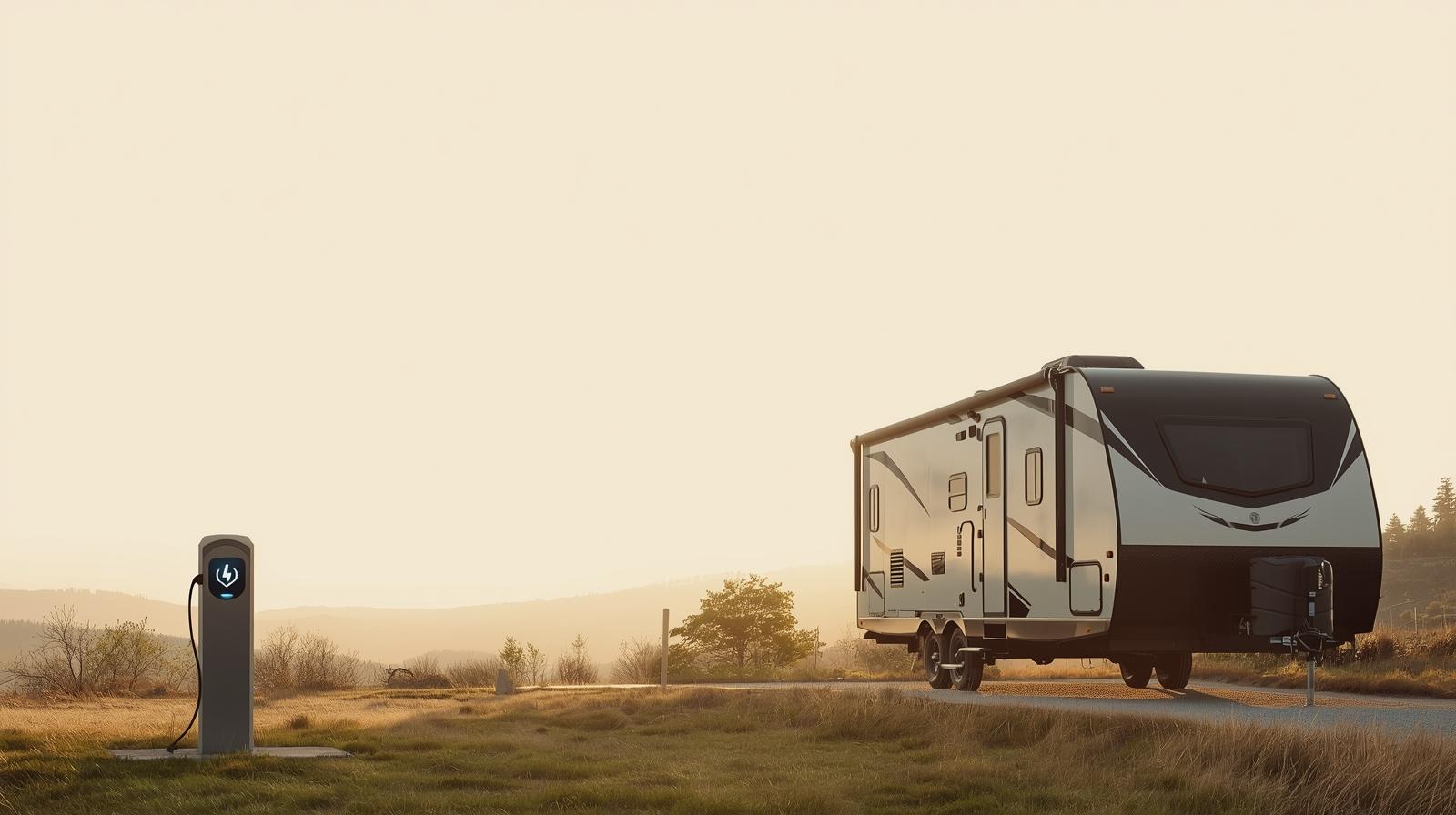
Surge Protector vs EMS: Which RV Power Protection Do You Actually Need?
Last updated: January 21, 2026
Affiliate disclosure: This post may contain affiliate links. If you buy through them, we may earn a commission at no extra cost to you.
Quick Summary
- If you want real protection from bad campground power: get a true EMS (Electrical Management System) that can disconnect power for low voltage and wiring faults (open neutral, reverse polarity, open ground). Progressive’s EMS guides document shutoff behavior like <104V and >132V, plus a 136-second delay to protect A/C compressors.
- If you mainly camp at newer parks and want basic “spike insurance”: a surge protector can be enough—but it won’t cover every dangerous pedestal condition.
- If your problem is chronic low voltage (peak summer weekends): consider EMS + Autoformer (voltage booster). Surge protection is not voltage correction.
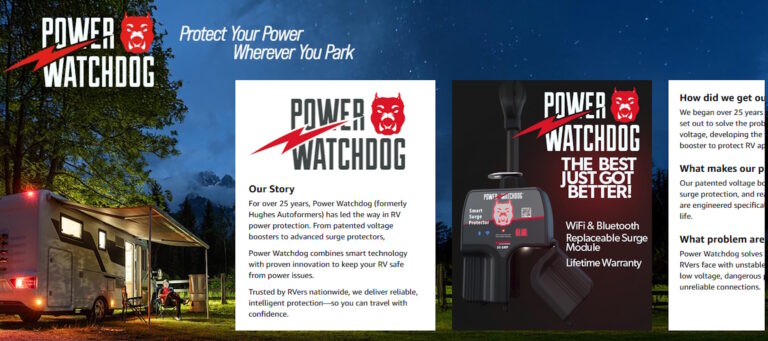
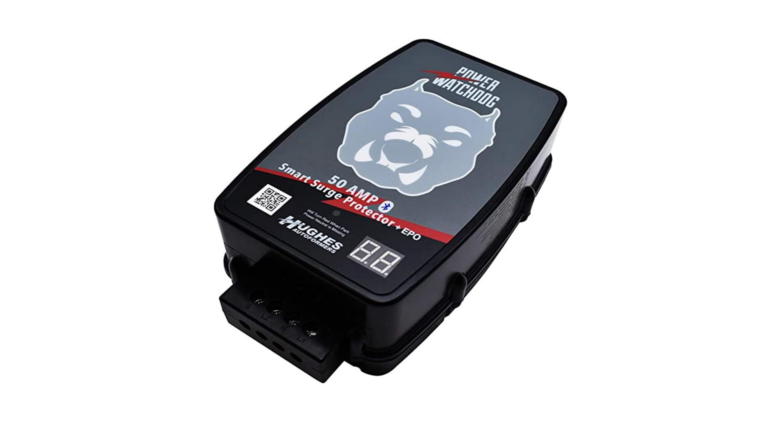
- If you’re tempted by Wi-Fi/app monitoring: treat it as a convenience feature. The real ROI is still fault shutoff + low-voltage protection. Hughes’ Gen II Watchdog line specifically promotes built-in Wi-Fi + Bluetooth.
The Simple Analogy: Bouncer vs. Security Team
Think of a basic surge protector like a nightclub bouncer. It mainly stops one troublemaker: voltage spikes (lightning, utility switching).
A true EMS is more like a full security team. It watches voltage, checks wiring faults, and if anything looks unsafe, it cuts power to protect your rig. That “disconnect” capability is the difference between warning lights and actual prevention.
Surge Protector vs EMS vs Autoformer (What Each One Actually Solves)
| Pedestal problem | What can happen | Surge Protector | True EMS (auto shutoff) | Autoformer (voltage boost) |
|---|---|---|---|---|
| Surge/spike | Electronics damage | ✅ | ✅ | ❌ |
| Low voltage / brownout | A/C motors/compressors run hot and wear faster | ❌ | ✅ (disconnects below ~104V typical) | ✅ (raises voltage) |
| Reverse polarity | Shock/short risk | sometimes indicator-only | ✅ (blocks power) | ❌ |
| Open neutral | Dangerous voltage imbalance on 50A | ❌ | ✅ (blocks power) | ❌ |
| Open ground | Increased shock risk | sometimes indicator-only | ✅ (blocks power) | ❌ |
Simple rule:
- Surge protector = spikes
- EMS = spikes + shutoff for unsafe power
- Autoformer = helps when voltage is consistently low
Why RV Power Is Different (USA/Canada vs Australia)
USA/Canada: 30A vs 50A in plain English
- 30A RV service is typically NEMA TT-30R: 30A, 125V.
- 50A RV service is typically NEMA 14-50R: 50A, 125/250V, 3-pole/4-wire.
Why that matters: 50A is split-phase. If the neutral is compromised, voltages on each leg can drift in unsafe ways (the “open neutral” hazard).
Australia/NZ note
Most AU/NZ RV setups are 230V/50Hz with different standards and protection devices (RCDs). Many North American surge/EMS units are not designed for AU systems—buy region-correct gear.
The 4 Electrical Hazards RVers Actually Face
1) Surges/spikes (instant damage)
These are short events. A surge protector (and EMS) attempts to clamp or absorb them.
2) Low voltage/brownouts (silent motor damage)
This is where EMS earns its money. Progressive’s documentation describes disconnecting power when voltage drops below 104V (after a brief window) and restoring power after a 136-second delay.
3) Reverse polarity (wiring fault)
A real EMS will refuse to energize the rig if polarity is wrong.
4) Open neutral/open ground (serious safety fault)
Progressive EMS manuals list open neutral and open ground as lockout conditions (no power allowed).
Open neutral on 50A is especially scary because split-phase depends on a solid neutral reference.
Surge Protectors Explained (What They Do, What They Don’t)
A lot of surge protectors (and many EMS units) use MOVs (metal oxide varistors) to absorb surge energy.
Surge protection can wear out
MOVs are widely described as “self-sacrificing” components—they can weaken after absorbing surge energy over time.
That doesn’t mean a surge protector is useless. It means:
- It’s not “forever protection.”
- After a major event (or years of small events), replacement may be necessary.
Surge protector: quick pros/cons
Pros
- Lower cost
- Simple plug-and-play
- Good baseline defense against spikes
Cons
- No low-voltage shutoff on many basic units
- Limited wiring fault protection (model-dependent)
- Components can degrade after surge events
EMS Explained (Why It Costs More)
A true EMS monitors incoming power and can disconnect your RV before damage happens.
The “auto shutoff” is the whole point
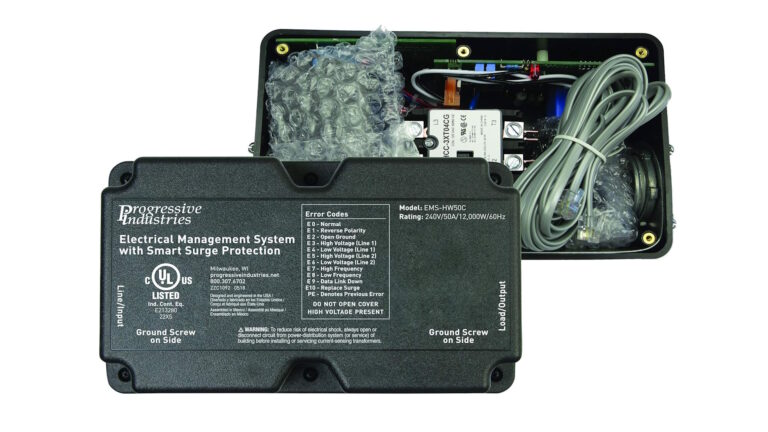
Progressive’s EMS-PT operating guide documents:
- low voltage shutdown behavior starting below 104V (with timing conditions),
- high voltage shutdown above 132V (with timing conditions),
- and a 136-second delay before reconnecting power after faults/interruptions.
EMS: quick pros/cons
Pros
- Protects against low voltage + wiring faults
- Prevents expensive “mystery failures”
- Better set-and-forget protection for frequent campers
Cons
- Costs more
- Hardwired installs can be tight and technical
- May shut you down more often in sketchy parks (that’s protection doing its job)
Portable vs Hardwired: Which Install Style Fits You?
Portable (plug-in) units
Best if you:
- move between rigs
- like checking pedestal status before connecting
- want quick transfer between RVs
Watch-outs:
- theft risk
- pedestal clearance
- weather exposure (keep it off wet ground; use a drip loop)
Hardwired units
Best if you:
- full-time or travel constantly
- want “always-on” protection
- want less exterior exposure
Watch-outs:
- install access can be tight
- if you have a complex inverter/charger setup, placement matters (talk to your installer)
The Math: Why a $300 EMS Can Be Cheaper Than a $100 Surge Protector
Here’s the conversion truth: protection is about total cost of ownership, not sticker price.
Scenario A: Basic surge protector (replace the whole thing)
- You buy a $100 surge protector.
- A big surge hits.
- The unit fails (or is no longer trustworthy).
- You replace it. Total after two big events: ~$200.
Scenario B: Serviceable units with replaceable surge modules
Some systems sell replacement modules so you don’t toss the entire device after a major event. For example, etrailer lists a replacement surge module for certain Power Watchdog models at about $35.99.
So your long-term spend can look more like:
- Device upfront + one module replacement instead of whole-unit replacement.
The bonus savings: low voltage prevention
Low voltage is the sneaky one. If your EMS disconnects your rig during repeated low-voltage conditions (documented behaviors like <104V in some EMS designs), you’re reducing the odds of killing expensive loads like A/C compressors.
⚠️ Critical Safety Alert: Progressive Industries Recall (Aug 23, 2024)
The U.S. NHTSA posted a recall report (24E-073) affecting Progressive Industries RSM-30 and PSK-30 surge protectors produced July 1, 2020 – June 12, 2024. The report describes a potential open ground condition that could lead to “hot skin” (exterior electrification) and an electrical hazard.
If you’re buying used (or already own one): verify your model and the affected production window before using it.
Quick Brand Decision Matrix (Fast “Which One Should I Buy?”)
| Brand | Best for… | Key advantage | Watch-outs |
|---|---|---|---|
| Hughes Power Watchdog (Gen II) | Tech lovers, monitoring fans | Built-in Wi-Fi + Bluetooth + serviceable approach | App/network expectations; price |
| Progressive Industries (EMS-PT / EMS-HW) | Full-timers, reliability-first buyers | Documented shutdown logic + compressor delay | Hardwired install complexity |
| Southwire Surge Guard | General campers | Wide availability | Features vary by model—spec-check required |
| Budget tier (Camco/Kohree/etc.) | Budget shoppers | Lower entry price | Verify protections + safety certifications before buying |
Decision Framework by RVer Profile (This is the honest “permission” part)
If you’re a weekend warrior (newer parks, short trips)
Usually enough: a quality surge protector
Upgrade to EMS if: you run A/C hard, camp in older parks, or see frequent voltage dips.
If you road-trip a lot (unknown pedestals, mixed parks)
Best fit: portable EMS
You’re exposed to more wiring variation, so fault lockout matters.
If you’re a full-timer
Best fit: hardwired EMS
More time plugged in = more exposure = higher ROI.
If you have a high-end rig (inverter/charger, sensitive electronics)
Best fit: EMS + thoughtful integration
You’ll also care about compatibility quirks (next section).
The Specs That Actually Matter (Ignore the Marketing Noise)
1) Low-voltage cutoff behavior
This is the real “appliance saver” feature. Progressive’s guide documents how it responds around 104V thresholds (with time conditions).
2) Open neutral/open ground/reverse polarity protection
If a device only “shows an LED” but doesn’t lock out power, it’s not giving you the same protection as an EMS that refuses to connect under fault. Progressive EMS manuals list these protections clearly.
3) Replaceable parts and serviceability
If you’re buying premium, it’s fair to care about what happens after a big event. Some platforms sell replacement modules and position them as “swap instead of replace.”
4) Safety certification anchors
In North America, SPDs are commonly evaluated to UL 1449 (surge protective device safety standard). UL itself describes SPD evaluation and UL 1449 as a key standard.
60-Second Power Pedestal Check (Safe, No Wiring)
- Plug your surge protector/EMS into the pedestal first (before your RV cord).
- Read the fault code/indicator (reverse polarity, open ground, open neutral, high/low voltage).
- If it flags a fault, don’t connect your RV—request another site or notify the host.
- After connecting, check voltage under load (turn on a heavy load briefly if appropriate) and see if voltage dips.
For more practical safety habits, see RV Electrical Safety Tips
For Advanced Setups: Solar, Inverters & Generators
This is where a lot of “why does my EMS hate my setup?” questions come from.
1) The “floating neutral” generator quirk
Some portable generators are configured with floating neutral vs bonded neutral, and certain EMS units may interpret that as an “open ground” style condition and refuse to connect. The safe move is to check your generator manual and, if you’re unsure, consult a qualified electrician or RV tech.
I’m intentionally not giving step-by-step modification instructions here—this is a safety-sensitive area.
2) Victron MultiPlus II + Power Watchdog “nuisance trip” reports
There are owner discussions describing Power Watchdog devices triggering “missing neutral” style errors in some MultiPlus II configurations, sometimes with reported workarounds or settings changes (varies by firmware and wiring).
If you’re running a high-end Victron stack: treat EMS selection and placement as part of the system design. Confirm with your installer.
Common Mistakes RVers Make (That Cause Real Damage)
- Buying the wrong amperage model (30A TT-30 vs 50A 14-50)
- Assuming “surge protector = EMS” (not true—EMS adds fault shutoff)
- Ignoring repeated low-voltage events (“it keeps shutting off”)—that’s usually a warning sign, not a nuisance
- Expecting Wi-Fi/Bluetooth to be the main value (it’s convenience; protection is the value)
Standards & Authority (E-E-A-T Layer)
If you want an authoritative anchor for RV safety systems, NFPA 1192 establishes fire and life safety criteria for recreational vehicles and includes guidance that touches electrical systems among other safety-related systems.
FAQ
Do I really need a surge protector for my RV?
If you plug into campground power, you’re exposed to spikes and wiring faults. A surge protector is the baseline; an EMS is the safer “full coverage” approach.
What’s the difference between a surge protector and an EMS?
A surge protector mainly handles spikes. An EMS monitors power and can disconnect your RV when voltage or wiring is unsafe (examples include low voltage cutoff behaviors documented in EMS guides).
When is a basic surge protector actually sufficient?
When you camp infrequently, mostly use newer parks, and you’re comfortable with fewer protections in exchange for lower cost.
How do surge protectors wear out?
MOV-based surge components are often described as self-sacrificing and can weaken after absorbing surge energy.
Portable or hardwired—what should I choose?
Portable is flexible and easy to verify before connecting. Hardwired is always-on and ideal for frequent campers and full-timers.
Will an EMS work with generators and solar/inverters?
Usually yes, but generator neutral configuration and advanced inverter systems can create compatibility edge cases. Check manuals/installer guidance if you have a complex setup.
Final Take
If you want the most broadly correct recommendation: get a true EMS. The documented low-voltage shutdown behavior and reconnection delay logic are exactly what protect expensive appliances and electronics when campground power gets sketchy.
A surge protector still has a place—just treat it as a baseline option when your risk profile is low and your budget is tight.