Aqua-Magic Residence (Thetford 42169) Review: Worth It in 2026?
Freshness / Update Log
Last updated: June 2026
- Re-read the latest owner feedback through early 2026, including recent critical notes about pedal/valve durability and a steady stream of “easy install, comfortable height” praise.
- Re-checked the recurring split between people who love the bigger seat and people frustrated by water-retention and pedal failures.
- Updated the troubleshooting and return-window guidance to reflect what owners keep running into out of the box.
- Verified that the “plastic vs. porcelain” debate is still the single biggest expectation gap buyers report.
Affiliate Disclosure
Quick heads-up: some links here are Amazon affiliate links, which means I may earn a small commission if you buy through them — at no extra cost to you. It never changes what I tell you about a product. If something has a real weak spot, you’ll read about it here.
The Problem Nobody Warns You About Until Your RV Toilet Fails
If you’ve ever stood in your camper’s tiny bathroom staring at a toilet that won’t hold water, leaks at the base, or has a foot pedal that suddenly does nothing, you already know the special kind of dread an RV toilet failure brings. There’s no quick run to the hardware store when you’re parked at a lake, and a leaking or non-sealing toilet doesn’t just make a mess — it lets tank odors drift straight up into your living space. That’s the exact pain point the Aqua-Magic Residence (Thetford 42169) is sold to solve: a lightweight, taller, residential-feeling replacement that drops into most existing setups without a porcelain toilet’s weight.
Here’s the confusion, though. This toilet is genuinely beloved by one group of owners and genuinely cursed by another, and the reviews swing hard between five stars and one. So instead of trusting a single rating, I went deep into a large body of real owner experience to figure out who tends to love it, who regrets it, and what actually predicts which camp you’ll land in. If you want the full shopping framework before you commit, the complete RV toilet selection walkthrough lays out the criteria this review assumes you already care about.
How this review was built (so you can trust it)
I synthesized a large pool of owner feedback — on the order of several hundred reviews spanning roughly 2015 through early 2026 — to find patterns rather than cherry-pick anecdotes.
Here’s the method in plain English: I tagged feedback into categories — flush/water-retention performance, install and setup sensitivity, fitment and water-line compatibility, reliability symptoms (pedal, valve, seals), comfort and seat design, and support/returns experience. Then I separated “setup-driven issues” (like a water line that needs an adapter) from “likely product failures” (like a pedal mechanism breaking from normal use). If you want to see how those categories map onto a broader buying decision, the RV toilet decision framework is the companion piece to this hands-on review.
Important limitations:
- Reviews skew toward extremes — thrilled buyers and angry buyers post more than neutral ones.
- RV variability is huge: water pressure, line routing, floor flange condition, and install quality all change the outcome.
- I prioritized recurring patterns over one-off complaints, but no synthesis can predict your specific unit.
Quick Verdict (TL;DR)
Best for:
- RVers who want a taller, residential-height seat that’s easier to stand up from
- People replacing a heavy porcelain or failed unit who value light weight and fast install
- Budget-minded buyers who’d rather pay less now and accept plastic construction
Not for:
- Full-timers wanting long-haul durability and a “feels like home” porcelain bowl
- Heavier users worried about flex, creak, and pedestal sturdiness
- Anyone who can’t tolerate a unit that might arrive with a seal or valve issue
Standout win:
- Genuinely easy, fast install (many owners report a 15–30 minute swap) with a comfortable, taller seat
Watch-outs:
- Recurring reports of water-retention failures and foot-pedal/valve breakage over time
- Customer service and warranty experiences come up as a frequent frustration
Confidence Score: ⚖️ 6/10 — “Useful but uneven”
This score reflects buyer usefulness, not a reliability statistic. I weighed how consistent the recurring patterns are, how severe the failure modes get, how well the product matches its stated purpose, and how predictable the owner experience is. It lands mid-pack because the upside (price, weight, install, height) is real and repeatable, but the downside (water-holding and pedal/valve issues, plus support headaches) is also repeated often enough to take seriously.
👉 Check today’s price on Amazon
What This Product Is (and What It Isn’t)
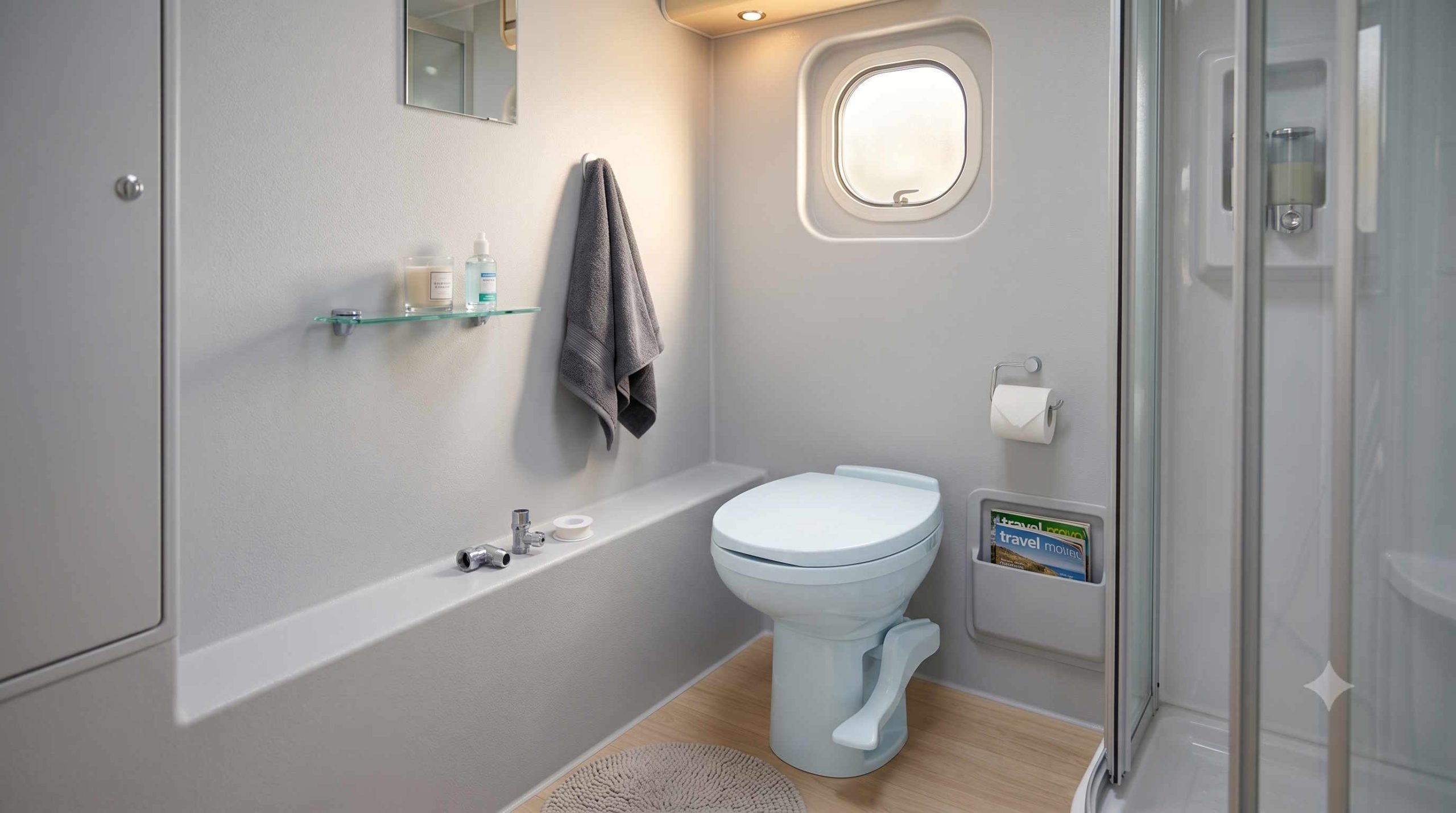
The Aqua-Magic Residence is a gravity-flush RV toilet with a foot-pedal flush, a taller “residence” height, a wider full-size seat, and an all-plastic body. It’s designed as a direct-ish replacement for many existing RV toilets, connecting to your rig’s water supply and dropping onto the floor flange over the black tank.
A few misconceptions worth clearing up:
- It’s not porcelain. This trips up more buyers than anything else. Owners repeatedly describe the bowl and body as plastic, which means lighter weight but a different, less “solid” feel than a home toilet.
- “Residence” doesn’t mean residential-grade. The name signals a taller, home-like height and seat, not heavy-duty residential construction. Several owners note it’s roughly a couple inches taller — not a true home fixture.
- It’s not a guaranteed drop-in. Many installs are painless, but a meaningful share of owners had to adapt the water-line connection, add a fitting, or pick up extra hardware.
Key Specs That Actually Matter for RVers
I’m only listing the attributes owners say actually change the experience:
- All-plastic construction — keeps it light (a big plus for solo installs) but is the root of the “creaky/flimsy” complaints. Matters because it shapes both install ease and long-term feel.
- Taller “residence” height — repeatedly praised by older users and anyone with sit/stand difficulty. One owner even valued the height for meeting accessibility expectations in a rental.
- Foot-pedal flush with a water-saving flush pattern — convenient and hands-free, but the pedal/valve mechanism is also the most-reported failure point.
- Full-size, wider seat with soft-close lid — a comfort win for many; a few find the opening oddly large or the lid mechanism short-lived.
- Rear water-line connection — owners flag that the inlet location can sit higher or stiffer than the old toilet, so plan for a possible adapter or flexible line.
- Bowl water retention via a sealing flapper/ball valve — when it works, it keeps tank gas out; when it fails (a recurring theme), the bowl won’t hold water and odor enters the RV.
Feature-by-Feature Breakdown (Truth vs Marketing)
| Feature | What the Manufacturer Implies | What It Actually Means (User Experience) | Compared to Competitors |
|---|---|---|---|
| “Residence” height & full-size seat | Home-like comfort | Mostly delivers — taller seat is a frequent favorite, especially for older users; a few find the bowl shape/opening odd | Comparable to other residential-height RV toilets; Dometic equivalents feel similar in comfort |
| Lightweight design | Easy handling & install | Strongly confirmed — many report fast, one-person installs | Lighter than porcelain options; that lightness is also why it feels less solid |
| Easy installation | Quick swap | Often true (15–30 min), but water-line fitment sometimes needs an adapter or extra trip | On par with rivals; porcelain Dometic units are heavier to maneuver |
| Foot-pedal flush | Reliable, hands-free | Convenient when healthy, but pedal/valve breakage is the top long-term complaint | A recurring weak spot owners contrast unfavorably with porcelain Dometic models |
| Bowl water retention | Keeps odors sealed | Hit-or-miss — a notable cluster of “won’t hold water” reports | Where owners most often say a Dometic held up better |
| Plastic bowl & body | Durable & light | Light, yes; durable is debated — creak, flex, and surface scratching come up | The single biggest gap vs porcelain alternatives |
Real-World Owner Experience (Deep Pattern Analysis)
Pattern 1: The install is the easy part
In a nutshell: Easy, fast installation is the most consistent praise across the entire body of feedback.
Hidden strength: Because it’s so light, plenty of owners — including some in their 80s and self-described non-plumbers — did the swap solo in well under an hour.
Hidden weakness: “Easy” assumes your water-line connection matches. A recurring subgroup needed a flexible line, a 90-degree fitting, plumber’s tape, or a quick hardware run.
What to do about it: Before install day, inspect your existing water-line route and have a flexible supply line and thread tape on hand. Apply sealant/tape at the inlet to avoid the most common first-flush leak.
Pattern 2: Water retention is the make-or-break
In a nutshell: When owners are furious, it’s usually because the bowl won’t hold water — which lets tank odor into the living space.
Hidden strength: When the seal seats correctly, owners report it holds water indefinitely and keeps smells down.
Hidden weakness: A real cluster of buyers report the bowl draining dry shortly after install, sometimes despite replacing seals multiple times.
What to do about it: Test water retention immediately (see the troubleshooting flow below). If a fresh unit won’t hold water after a proper seal check, treat it as a likely defect and act inside your return window rather than fighting it for months.
Pattern 3: The foot pedal/valve is the long-term risk
In a nutshell: The most common durability failure is the pedal/flush-valve mechanism — sticking open, popping off, or breaking from normal pressing.
Hidden strength: Owners who don’t hit this issue tend to be happy for years; the mechanism is fine when it lasts.
Hidden weakness: Plastic internal parts in the pedal/valve are repeatedly described as the breaking point, sometimes within months, occasionally causing a stuck-open flood.
What to do about it: Press the pedal gently and fully, avoid stomping, and know where your toilet water shutoff is. Several owners specifically credited a nearby shutoff with saving them from a flood when the valve stuck.
Pattern 4: Plastic feel divides buyers
In a nutshell: The plastic body is light and easy, but it creaks, flexes, and feels less sturdy than porcelain.
Hidden strength: That same plastic is why it’s so easy to carry and install, and some find the bowl easier to keep clean than ceramic.
Hidden weakness: Heavier users especially report creaking and a “might break” sensation, and the underside seat grid can be a pain to clean.
What to do about it: Secure it firmly to the flange, sit deliberately rather than dropping onto it, and if you’re a heavier user or full-timer, weigh a porcelain option before buying.
Pattern 5: Support and returns frustrate people
In a nutshell: A frequent theme is difficulty getting warranty help or returning a faulty unit.
Hidden strength: A minority did get replacement parts eventually.
Hidden weakness: Many describe slow or unresponsive support, short warranty coverage, and non-returnable listings — a bad combination when a unit fails.
What to do about it: Inspect and fully test the toilet the day it arrives, not at the start of camping season, so problems surface while you still have options.
The Good, The Bad & The Ugly (Pros/Cons)
The Good
- Install & weight: Fast, light, often a one-person job; frequently a true time-saver.
- Comfort & height: Taller seat and full-size feel win over older users and those with mobility needs.
- Value: Priced below many porcelain rivals; “good for the money” recurs often.
- Convenience touches: Soft-close lid and water-saving flush pattern please many owners.
The Bad
- Plastic feel: Creak, flex, and a less-solid sit; surface can scratch with harsh cleaners.
- Fitment surprises: Water-line connection sometimes needs adapters or extra parts.
- Cleaning quirks: Honeycombed seat underside and partial bowl rinse mean more scrubbing for some.
The Ugly
- Water-retention failures: Bowl won’t hold water → tank odor in the RV, sometimes from day one.
- Pedal/valve breakage: The signature long-term failure, occasionally causing stuck-open flooding.
- Support & warranty pain: Slow help, short coverage, and non-returnable listings reported repeatedly.
Mini Toolkit: Decide + Fix (Fast)
Issue-Tag Box (most-reported themes):
WON'T-HOLD-WATER— bowl drains dry, odor enters RVPEDAL/VALVE-FAIL— sticks open, pops off, or breaksWATER-LINE-FITMENT— inlet needs adapter/flex linePLASTIC-FLEX— creak/wobble, feels flimsySUPPORT/RETURN— warranty and returns frictionCLEANING— seat underside and partial bowl rinse
Fitment/Adapter Mini-Matrix:
| Your existing setup | Likely fix |
|---|---|
| Rigid line straight up to old toilet | Add a flexible supply line or 90° fitting |
| Inlet leaks on first flush | Apply thread tape/sealant at the rear connector |
| Old unit was 2-bolt different footprint | Confirm flange/bolt pattern and seal before mounting |
Mini Decision Tree:
- If you want porcelain feel and long-haul durability → consider a porcelain alternative instead.
- If you need light weight + taller height + low price → this is a reasonable pick.
- If you’re a heavier user worried about flex → lean toward a sturdier-base model.
- If the bowl won’t hold water after a seal check → treat as defective, use your return window.
- If the pedal sticks open → shut off toilet water supply, then diagnose the valve.
Troubleshooting Quickflow (won’t hold water / leaks):
- Confirm the bowl was filled and the flush ball/flapper fully closed.
- Inspect the bowl seal/ball-valve seal for warping or debris; clean and reseat.
- Check the rear inlet connection and add thread tape if it weeps.
- Verify water pressure is within a normal range (a regulator helps).
- If it still won’t hold water after reseating the seal, stop fighting it.
- Document it and start a return/warranty claim while you’re in-window.
For anything beyond basic seal checks and line fittings — like modifying plumbing or chasing a persistent valve fault — verify against the manufacturer instructions or consult a qualified RV tech.
Mini Return-Window Reality Check
- Open and inspect the box the day it arrives — several owners missed returns by waiting for camping season.
- Do a real water-retention test immediately; don’t assume a dry-looking bowl is “settling.”
- Confirm all install hardware and the seal are present before you start.
- Press the pedal a few times to check the valve seats and releases cleanly.
- Note that some listings are non-returnable, so treat early testing as your main safety net.
- If you want a structured pre-purchase checklist, the pre-buy evaluation guide for RV toilets walks through what to verify before your window closes.
Installation / Setup Tips (RV-Realistic)
- Turn off your RV water supply (pump and city water) before removing the old toilet.
- Inspect the floor flange and replace the closet bolts and seal if they look worn.
- Have a flexible water supply line ready in case the rear inlet doesn’t line up with a rigid line.
- Keep thread tape handy and seal the rear water connector — a common first-flush leak point.
- Leave a few inches of clearance at the rear connection so you don’t put tension on the line.
- Hand-tighten mounting bolts evenly; don’t overtighten plastic — it can crack or distort.
- After mounting, fill the bowl and watch for water retention before celebrating.
- Test the pedal for full open and clean close; listen for the valve seating.
- Avoid harsh/abrasive toilet cleaners on the plastic; baking soda or vinegar is gentler on the surface.
- Common mistake: skipping thread tape and discovering a slow drip after the first flush — tape first.
- Common mistake: stomping the pedal; press deliberately to protect the plastic mechanism.
- If your old footprint differs, confirm the bolt pattern and seal seat before fully committing the install.
Owner Stories
The stories below are composite scenarios reflecting repeated patterns across owner feedback.
The fast-and-happy swap: A weekend camper pulls a heavy, failing original toilet and is shocked when the lightweight Residence drops in within 20 minutes. The taller seat is an instant win for tired knees, the soft-close lid feels like a small luxury, and after several seasons it’s still doing its job. For this owner, the value-to-effort ratio is exactly what they hoped.
The slow-leak heartbreak: Someone installs it in the off-season, checks the connections, and only discovers at first real use that the bowl won’t hold water and the RV smells like the tank. They swap the seal more than once, get nowhere with support, and end up past the return window — stuck nursing a toilet that should have just worked.
The pedal that quit: After months of normal use, a flush pedal suddenly sticks open or snaps, and water keeps running. A previously installed shutoff valve near the toilet turns a potential flood into a minor annoyance — and a hard lesson in why that shutoff matters.
🔎 See more owner feedback on Amazon
Who This Is For (and Who Should Skip It)
Buy it if…
- You want a taller, residential-height seat that’s easier to get up from.
- You’re replacing a heavy or broken unit and value a light, fast install.
- You’re price-conscious and fine with plastic construction.
- You camp part-time and don’t put a home’s worth of use on it.
- You’ll inspect and test it immediately on arrival.
Skip it if…
- You’re a full-timer who wants porcelain durability and feel.
- You’re a heavier user worried about flex and creak.
- You can’t tolerate any chance of a seal/valve defect out of the box.
- You want dependable, fast warranty support as a safety net.
- You hate fiddly cleaning around a honeycombed seat underside.
👉 Check today’s price on Amazon
If you’re comparing options, start here: Top RV Toilet Picks
Alternatives (Quick Comparisons)
- If you want porcelain feel & durability: A porcelain-bowl RV toilet (the kind several owners switched to after frustration) trades weight for a more solid, home-like sit and often better long-term water retention.
- If you want a sturdier base for heavier users: Look for a model with a wider mounting base — a few owners explicitly wished they’d spent a bit more for that stability.
- If you want maximum simplicity off-grid: A composting or portable toilet sidesteps the water-valve failure mode entirely, at the cost of a different maintenance routine.
- If you want a like-for-like light plastic unit: Another lightweight plastic RV toilet may install just as easily; just scrutinize its water-retention and pedal-durability track record the same way.
For a structured side-by-side, the RV toilet comparison hub lines these categories up by need.
Deep-Dive FAQ
What should I test immediately after delivery?
Fill the bowl and confirm it holds water, press the pedal for clean open-and-close, check the rear water connection for leaks on the first flush, and verify all hardware and the seal are included. Doing this on arrival — not at the start of camping season — is the single best way to stay inside your return window.
What are the most common problems and fixes?
The two big ones are the bowl not holding water (reseat or replace the bowl/ball-valve seal, clean any debris, confirm it closes fully) and the foot pedal/valve sticking or breaking (press gently, keep a nearby water shutoff, and treat a broken plastic mechanism as a likely replacement rather than an easy DIY fix). If basic seal and line checks don’t solve it, consult the manufacturer instructions or an RV tech.
Will this work with my RV setup?
Usually, but plan for the water-line connection. Many owners install it in 15–30 minutes, while others needed a flexible supply line, a 90-degree fitting, or thread tape because the rear inlet sat higher or stiffer than their old toilet. Confirm your flange/bolt pattern and have an adapter ready just in case.
Is it really plastic, not porcelain?
Yes — the bowl and body are plastic. That’s why it’s so light and easy to install, but it also explains the creak, flex, and less-solid feel some owners dislike. If a porcelain feel matters to you, this isn’t the one.
Why does my bowl smell after a day?
If water isn’t staying in the bowl, tank gases come up. That points to a water-retention/seal issue — check and reseat the seal first. Some owners also note the flush only wets part of the bowl, so light manual rinsing or brushing can help between flushes.
Is it sturdy enough for heavier users?
Several heavier owners report noticeable flex and creaking, though many still found it usable when securely mounted. If you’re concerned, a porcelain unit or one with a wider base will feel more reassuring.
How’s the cleaning?
The plastic bowl resists some sticking, but avoid abrasive cleaners that can scar the surface — baking soda or vinegar is gentler. The honeycombed seat underside is a common cleaning gripe, so expect a little extra attention there.
What about warranty and returns?
This is a frequent frustration. Owners report slow support, short warranty windows, and some non-returnable listings. The practical takeaway: front-load your inspection and testing so any defect surfaces while you still have recourse.
Final Verdict
The Aqua-Magic Residence (Thetford 42169) is a genuinely useful, genuinely uneven product. For the right buyer — someone who wants a light, taller, budget-friendly toilet that installs in minutes and only sees part-time use — it delivers exactly what’s promised, and those owners tend to be delighted. For the wrong buyer — a full-timer or heavier user who needs porcelain-grade durability, rock-solid water retention, and dependable warranty backup — the recurring water-holding and pedal/valve failures, plus the support friction, are real risks worth respecting.
My honest bottom line: buy it with eyes open, install it well, and test it the day it arrives. If it holds water and the pedal seats cleanly out of the gate, you’re likely in the happy camp. If it doesn’t, act fast while you still have options.