Nature’s Head Composting Toilet Review (2026): Worth $1,000 or Overhyped?
Freshness / Update Log
Last updated: June 2026
- Re-checked the “urine crossing into the solids” complaint against owners who report zero issues — the dividing line is technique and stream control, not luck
- Re-read multi-year owner reports to separate honeymoon-week praise from what people actually feel after a year of cleanouts
- Re-verified the climate threshold owners keep hitting: this unit behaves very differently in dry vs. humid air
- Re-confirmed the “missing parts at delivery” pattern (power adapter, vent cover) still dominates early-ownership frustration
Affiliate Disclosure
Quick note: some links below are Amazon affiliate links, and I may earn a small commission if you buy through them — at no extra cost to you. It doesn’t shape the verdict; the patterns here come from what owners actually report.
The Black-Tank Problem Nobody Wants to Talk About
Anyone who’s knelt in the cold to wrestle a sewer hose at a dump station knows why “waterless” sounds like freedom. The black tank is heavy, smelly, chemical-dependent, and it chains your travel days to the next dump.
Quick answer: the Nature’s Head is worth it if you’re one or two users in a dry-to-moderate climate who’ll learn the technique and don’t mind a hands-on cleanout — and a poor fit for big households, humid climates, or anyone wanting a quick-empty toilet.
That nuance matters, because this is the unit almost everyone lands on first — and its reviews are wildly split. Half call it the best money they ever spent; half call it an overpriced plastic box. The thing most reviews won’t tell you: those two camps are often using the same toilet completely differently. Below, I’ve synthesized real owner feedback to show you exactly which camp you’d land in. If you want the category-wide trade-offs first, this waterless-toilet selection walkthrough frames the decision before you spend a dime.
This review is a synthesis of real owner experience — not a spec sheet, and not marketing copy.
How this review was built (so you can trust it)
- Owner reviews analyzed: A large pool of owner feedback — on the order of a few hundred reviews spanning glowing and scathing experiences (approximate).
- Time window covered: Roughly several years of ownership, including reviews as recent as 2026 and others going back years — capturing both first-week and long-haul impressions (approximate).
- How I synthesized it: I tagged feedback into categories — odor performance, install/setup sensitivity, urine-diversion behavior, cleaning/maintenance, pest issues, fan reliability, and support/returns — then deliberately separated setup-driven issues (technique, climate, missing vent) from likely design issues (basin geometry, glued-in parts, unreachable crevices).
- Important limitations:
- Reviews skew toward strong emotions — lovers and haters both write more than the indifferent middle.
- Van, RV, cabin, and boat setups vary enormously; humidity and occupancy change everything.
- I prioritized patterns that repeated again and again over one-off stories.
Quick Verdict (TL;DR)
Best for:
- Off-grid setups where escaping the black tank or septic is the entire point
- One or two users who can be disciplined about technique
- Dry or moderate climates with proper outside venting
Not for:
- Households of four or more in heavy daily use
- Humid climates without a serious airflow plan
- Anyone wanting a quick, mess-free empty — or with back/hand/mobility limits
Standout win:
- Set up right, owners overwhelmingly report no sewage smell — many say it beats their old black tank outright
Watch-outs:
- Urine crossing into the solids and hard-to-reach crevices are the two complaints that repeat endlessly
- It does not arrive ready to use — the power adapter and vent cover are commonly bought separately
Confidence Score: 🟡 6.5/10 — “Great for the right buyer, genuinely frustrating for the wrong one.” This score reflects buyer-usefulness, not a reliability rating. I weighed how sharply the feedback splits, how much of the bad experience traces to fixable technique versus baked-in design, and how steep the learning curve is. It loses points for being unforgiving and labor-intensive; it earns them for genuinely solving the odor problem when used correctly.
👉 Check today’s price on Amazon
What This Product Is (and What It Isn’t)
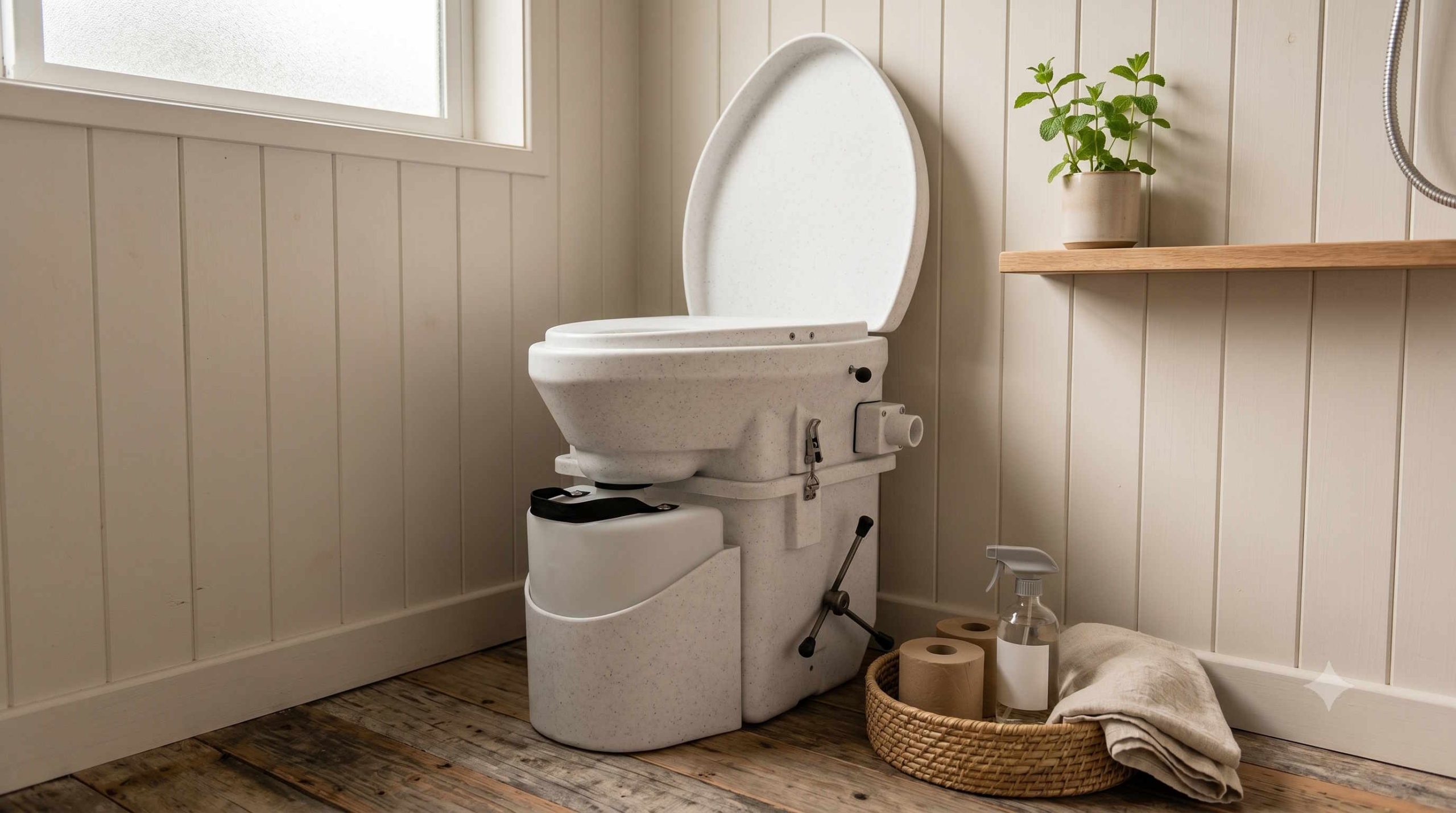
In one line: a self-contained, urine-diverting dry toilet that splits liquid into a front bottle and solids into a fan-vented chamber where you mix in a dry medium (coco coir or peat moss). No water, no black tank.
Misconceptions worth killing before you buy:
- It’s not really “composting” the way the name suggests. A recurring owner point is that with regular use the solids never finish composting before you empty them — you get waste mixed with medium, not finished compost. Treat it as a dry, odor-managed holding system.
- It doesn’t arrive plug-and-play. Owners are repeatedly blindsided that the fan power adapter and an exhaust vent cover aren’t in the box.
- It’s not “set it and forget it.” Technique is part of the product — which is exactly why the love-it and hate-it camps exist.
Key Specs That Actually Matter for RVers
Owners talk in outcomes, not lab numbers. Here’s what actually decides your happiness:
- Urine-vs-solids separation: The entire value proposition. When it works, no sewage smell. When it fails, liquid reaches the solids and the whole thing sours. This single factor explains most of the split.
- Fan + outside venting: The fan is small. Owners insist it must run continuously and vent outside. Underpowered or poorly vented (especially humid climates) = trouble.
- Your dry medium: Coco coir is the common favorite; some switch to peat moss for cost. The moisture ratio is the line between “earthy, fine” and “soupy, smelly.”
- Cleanout design: The whole unit comes apart and goes outside to empty solids — no quick-pull liner bucket. This is the #1 long-term gripe.
- Build material: Sturdy molded plastic. Owners agree it feels solid, but many report it stains and never scrubs back to white.
Feature-by-Feature Breakdown (Truth vs Marketing)
| Feature | What the Marketing Implies | What It Actually Means (Owner Experience) | Compared to Alternatives |
|---|---|---|---|
| “Composting” toilet | Waste becomes compost | With regular use it doesn’t fully compost before emptying — it’s a dry holding system; owners stress this | Same limitation hits most units in this class |
| Urine diversion | Clean separation, no smell | Flawless for some; for others urine crosses into solids unless you aim carefully — a top complaint | A cited weak point vs. simple bag-and-bucket setups |
| Low odor | “Smells like earth” | Truly odor-free for many when vented and used right; smelly in humid climates or with poor venting | When it works, owners say it clearly beats a black tank |
| Easy to empty | Simple maintenance | Solids cleanout means disassembling and hauling the unit outside; owners call this the worst part | DIY liner buckets are easier — why some owners revert |
| Sturdy build | Premium quality | Agreed — solid and well-made; but the plastic stains and crevices trap residue | A genuine plus over flimsy RV plastic toilets |
Real-World Owner Experience (Deep Pattern Analysis)
Pattern 1: Odor — the feature everyone’s actually buying
In a nutshell: The most polarized topic, and the one owners obsess over most. A huge share of happy owners say there’s simply no sewage smell — better than the black tank — and that’s the whole reason they’d buy again.
Hidden strength: With urine separated and the fan venting outside continuously, owners describe at most a faint “earthy” smell, and only with the lid open.
Hidden weakness: In humid air, and with a weak or unvented fan, the solids stay wet, never dry, and the unit can smell like a porta-potty.
What to do about it: Run the fan 24/7, vent it outside (never into a cabinet), keep the medium dry, and consider a vinegar-water spritz. In humid regions, solve airflow before blaming the toilet.
Pattern 2: The urine-diversion split (what most reviews won’t tell you)
In a nutshell: Here’s the insight buried in the star ratings: the people who hate this toilet and the people who love it are frequently divided by one thing — whether urine stays out of the solids chamber. It’s not random; it’s stream control and seating position.
Hidden strength: Owners who scoot forward and aim deliberately — and women who handle #1 and #2 separately — report the diversion works for years.
Hidden weakness: The separating geometry is unforgiving. A strong stream, carelessness, or toilet paper pushed into the urine holes causes crossover and backflow, turning the solids into wet, ammonia-smelling sludge.
What to do about it: Treat technique as part of ownership. Sit forward, keep TP out of the urine path, rinse the diverter with a little water/vinegar after use. Some handy owners hard-plumb the urine line to a tank to skip the bottle — but anything involving drilling or re-plumbing should be verified against the manufacturer instructions or done with a qualified RV tech.
Pattern 3: The cleanout reality
In a nutshell: Even many positive reviewers admit the cleanout is the worst part. The solids chamber doesn’t lift out as a liner — you disassemble and carry the whole unit outside.
Hidden strength: Owners who let it sit a couple of days, add a cup of medium, and dump into a doubled trash bag say it’s “like dumping dirt” and quick.
Hidden weakness: The mixing arm misses the square corners, so medium packs and cakes; the lid underside and crevices trap residue and stain; in winter without a hose, it’s genuinely hard.
What to do about it: Some owners line the chamber with a trash bag (off-label), clean with vinegar or mild disinfectant, and time emptying for when they’ll be away. Set expectations: this is a hands-on chore, period.
Pattern 4: Pests in the places you can’t reach
In a nutshell: A repeated, maddening theme — tiny flies or fungus gnats find the molded voids and crevices and lay eggs where no brush reaches.
Hidden strength: Plenty of owners never see this, especially in dry climates with diligent cleaning and a screened outside vent.
Hidden weakness: Others describe persistent infestations that survive repeated cleaning, with the suggested fix being to caulk the molded voids.
What to do about it: Screen the intake and exhaust, keep the medium properly moist (not wet), and clean diligently. Your broader year-round RV moisture and climate habits matter more here than people expect.
Pattern 5: Fan reliability and the box-opening surprises
In a nutshell: Two early shocks repeat: the fan power adapter and a vent cover aren’t included, and some fans fail or feel underpowered.
Hidden strength: Many owners report the fan running continuously for a year-plus, and the company replacing failed fans.
Hidden weakness: Others report fans that quit or never worked, finicky wiring (a bare lead needing an adapter), and the sting of buying parts before a pricey toilet even works.
What to do about it: Budget for the adapter and vent cover up front. Wiring into 12V? Follow the manual exactly and treat unfamiliar wiring as a verify-with-a-qualified-tech step, not guesswork.
The Good, The Bad & The Ugly (Pros/Cons)
The Good
- Odor control (done right): Repeatedly described as no sewage smell — the #1 reason owners say it’s worth it
- Black-tank freedom: No dump stations, no sewage chemicals
- Build quality: Solid, sturdy, durable-feeling molded plastic
- Liquid emptying is simple: Most find the urine bottle quick to empty if done before it’s too full
- Support (often positive): Many report the company replacing fans/parts, sometimes free
The Bad
- Technique-dependent diversion: Carelessness puts liquid in the solids
- Cleanout is a real chore: No pull-out liner; you disassemble and haul it outside
- Staining plastic and unreachable crevices: Rarely looks pristine after a year
- Not complete out of the box: Adapter and vent cover commonly bought separately
The Ugly
- Pest infestations in molded voids: For some, persistent and near-impossible to fully clear
- Humid-climate performance: Wet, non-drying solids and odor repeat
- Price vs. perceived value: Many feel the cost is steep for a mechanically simple device
Mini Toolkit: Decide + Fix (Fast)
Issue-Tag Box (the recurring themes):
- 🔴 Urine-in-solids crossover
- 🔴 Hard-to-clean crevices / staining
- 🟠 Pests in molded voids
- 🟠 Humid-climate moisture/odor
- 🟡 Missing adapter + vent cover at delivery
- 🟡 Fan underpowered / occasional failures
Fitment / Adapter Mini-Matrix:
| Your Setup | Likely Reality | Plan For |
|---|---|---|
| Van / compact build | Taller than expected; needs venting routed out | Headroom check + floor/wall vent path |
| RV replacing a flush toilet | Sits higher on the old platform; must mount to floor | Floor mounting + adapter + vent cover |
| Off-grid cabin / boat | Works well dry; humidity is the enemy | Continuous fan + screened outside vent |
Mini Decision Tree:
- If you’re 1–2 users in a dry/moderate climate → strong fit
- If you’re a household of 4+ in daily use → likely undersized; expect frequent emptying
- If you live somewhere humid → only proceed with a serious airflow plan
- If you have back/hand/mobility limits → the cleanout may be too physical
- If you want a quick liner-bag empty → a DIY bucket system may suit you better
Troubleshooting Quickflow (solids smell / stay wet):
- Confirm the fan is actually spinning and running continuously
- Confirm exhaust vents outside, not into a cabinet
- Check the medium — too wet? Add dry coir/peat to balance
- Check for urine crossover (wet, ammonia smell = diversion issue)
- Adjust technique: sit forward, keep TP out of the urine path
- If crossover persists, inspect the diverter/seal — and verify any modification against manufacturer instructions
For the full framework on matching a unit to your rig before the return window closes, the complete dry-toilet selection walkthrough covers sizing, venting, and climate fit in depth.
Mini Return-Window Reality Check
In your first days, pressure-test these before returning gets hard:
- Confirm the box has everything; order the adapter + vent cover immediately if not
- Power the fan and verify continuous airflow out the exhaust before ever sitting down
- Do a deliberate “aim test” — does urine clearly divert, or pool/cross over?
- Empty the urine bottle once early to feel whether the spill-prone pour is tolerable
- In a humid climate, watch whether solids dry between uses in week one
- Be honest about the first solids cleanout — that’s the long-term reality, not the novelty
Installation / Setup Tips (RV-Realistic)
- Watch a real install walkthrough first — owners repeatedly call the included docs thin
- Budget for the power adapter (fan) and an exhaust vent cover — commonly not included
- Mount it to the floor. Owners warn an unmounted unit can tip
- Vent the exhaust outside — floor or wall; many prefer the floor to avoid roof penetrations
- Add a screen over the outside vent opening to block bugs — a direct fix for the pest pattern
- Leave a couple of inches of clearance around the unit so you can disassemble it for cleaning
- Learn your medium’s moisture ratio early; err dry — soupy compost is the root of most odor complaints
- Set a urine routine: empty every couple of days, add a splash of vinegar to cut odor and scale
- Tell every user to sit forward — technique is part of the product, not optional
- Wiring into 12V? Follow the manual exactly; the lead can need an adapter. Treat anything beyond a basic plug-in as a verify-with-a-qualified-RV-tech step
- Don’t overtighten the fan — owners note over-tightening stops it from spinning
- Keep toilet paper out of the urine path (some bin it separately) to avoid clogs and backflow
See It in Action: Visual Reality Check
Specs only get you so far — watching the unit installed and used in a real rig fills the gaps a description can’t. Here’s a walkthrough worth your time before committing.
What to look for in this video (based on owner patterns):
- 🔌 Wiring reality: Watch how the fan power lead is handled — owners trip over the fact that it isn’t plug-and-play. Do you have what that connection needs?
- 🌬️ Vent routing: Notice where the exhaust hose goes. It must run outside and the fan must run continuously — see how much space that routing eats.
- 📏 Scale & clearance: Watch how tall the unit sits and how much room is left around it. You need clearance to disassemble it for cleaning.
- 🧴 Diverter geometry: Look closely at the two-stream opening. The top complaint is urine crossing into the solids — see how shallow that separation really is.
Keep in mind this video shows the initial setup — it won’t show the long-term reality owners report after months: the staining that won’t scrub out, the crevices that trap residue, and the pests that, for some, find the molded voids.
Owner Stories
The stories below are composite scenarios reflecting repeated patterns across owner feedback.
The off-grid convert (the happy fit). A couple living off-grid in dry country ditches the black tank and is stunned — no sewage smell, no dump runs, just an occasional dirt-like cleanout. Fan nonstop, medium dry, careful technique. A year in, they’d buy it again instantly.
The climate mismatch. A full-timer who loved this toilet out West moves somewhere humid and watches it fall apart — solids stay wet, odor creeps in, medium swaps multiply. Same unit, wrong environment, and eventually they conclude the two just don’t get along.
The usage mismatch. A family of four expects long intervals and instead empties constantly, fights urine crossing into the solids, and finds corners packing with un-mixed medium. They drift back to a bucket-and-liner setup for daily use and keep the Nature’s Head as a backup.
🔎 See more owner feedback on Amazon
Who This Is For (and Who Should Skip It)
Buy it if…
- You’re going off-grid and the whole goal is no black tank or septic
- It’s 1–2 users, or a small, technique-disciplined household
- You live in a dry or moderate climate
- You can vent outside and run the fan continuously
- You value build quality and accept a hands-on cleanout
Skip it if…
- You’ve got 4+ daily users and want long emptying intervals
- You’re in a humid climate without a strong airflow plan
- You have back, hand, or mobility limits that make lifting/disassembly hard
- You want a quick, liner-bag empty with no fuss
- You’re price-sensitive and a DIY bucket-and-diverter would satisfy you
👉 Check today’s price on Amazon
If you’re comparing options, start here: Top RV Toilet Picks
Alternatives (Quick Comparisons)
- DIY bucket-and-diverter (sawdust/coir) system: Many owners say a simple bucket with a urine diverter and biodegradable liners is cheaper and easier to empty. Best if you prioritize low cost and quick cleanout over a finished-toilet look.
- Another brand of composting/dry toilet: Some cross-shopped rivals; a few preferred the Nature’s Head for its smooth bowl and horizontal churn, others found competitors comparable for less. Weigh it if cleanout design is your top concern.
- Traditional RV flush toilet + black tank: If dump stations are convenient and you don’t need waterless, a conventional setup skips the learning curve. For broader plumbing context, see how owners plan their overall RV water and waste systems.
- Incinerating toilet: A few owners moved to propane/electric incinerating units, especially for freezing climates where composting stalls.
Deep-Dive FAQ
What should I test immediately after delivery?
First, confirm the box actually contains everything — owners are frequently surprised the fan power adapter and vent cover aren’t included. Then power the fan, verify continuous airflow out the exhaust, and do a deliberate urine-diversion “aim test” before committing. Catching a missing-part or diversion problem inside the return window saves real pain.
What are the most common problems and fixes?
The two biggest, by far: urine crossing into the solids (fix with forward seating, careful aim, keeping TP out of the urine path, and a vinegar-water rinse) and hard-to-clean crevices and staining (manage with diligent cleaning and realistic expectations). Pests in the molded voids and humid-climate wetness come next — screen your vents, keep the medium properly moist, and run the fan 24/7.
Will this work with my RV setup?
Often yes, with planning. It sits taller than many flush toilets, so on an existing platform it can feel high — confirm headroom. You’ll need to mount it to the floor, route the exhaust outside, and run the fan continuously. Vans, RVs, cabins, and boats all appear in owner feedback; humidity and occupancy matter more than vehicle type.
Does it actually turn waste into compost?
Not really, with regular use. Owners repeatedly note the solids don’t finish composting before emptying — you get medium-mixed waste, not finished compost. Think of it as a dry, odor-managed holding system. Not a dealbreaker for most happy owners, but it resets expectations.
How often will I empty it?
It varies sharply with occupancy. The urine bottle commonly needs emptying every couple of days for one or two people; the solids chamber stretches much longer for light use but fills fast with a full household. Heavy daily use by several people is where owners feel it’s undersized.
Does it work in cold weather?
Owners report it struggles below freezing — the medium can solidify and the churn stops. For unheated, sub-freezing spaces, plan around that limit or look at alternatives built for the cold.
Is the cleanout really that bad?
It’s the most common gripe even among fans. There’s no pull-out liner bucket — you disassemble and carry the unit outside to empty solids. Owners who time it well and let it sit a couple of days find it manageable; those expecting a quick swap are disappointed.
Final Verdict
The Nature’s Head earns its polarized reputation honestly. Used the way it wants to be used — one or two disciplined users, a dry-ish climate, fan running and vented outside, medium kept dry, sensible technique — owners overwhelmingly say there’s no sewage smell and they’d never go back to a black tank. That’s a real win, and it’s why so many people love it.
But it asks a lot in return. The diversion is unforgiving, the cleanout is a genuine chore, the plastic stains, pests can find the voids, and humid climates expose its weaknesses. It also doesn’t arrive ready to use. If you’re a large household, live somewhere humid, or want a fuss-free empty, you’ll likely land among the frustrated reviewers.
Best-fit buyer: the off-grid or full-time minimalist who wants out of the black-tank cycle, will learn the technique, and values build quality over convenience. If that’s you, it’s worth it. If it isn’t, a simpler system will probably make you happier for less.
👉 Check today’s price on Amazon