Jabsco 12V Macerator Pump Review (2026): Worth It, or Buy the Stainless Kit First?
Last updated: June 2026
- Re-checked the “studs corrode and the pump falls apart” complaint against the newer-stock reports, and confirmed a real split between older brass-stud units and recent stainless-fastener batches.
- Re-read the self-priming feedback to separate genuine prime failures from install-height mistakes (intake mounted above tank level).
- Re-verified the “arrived used/refurbished” cluster against happy first-install owners to gauge how often it’s a fulfillment problem vs. a product problem.
Affiliate disclosure: As an Amazon Associate, I may earn a small commission if you buy through links on this page, at no extra cost to you. It never changes what I report from real owner feedback.
The black-tank dump that turns into a bilge cleanup
If you run a macerator, your nightmare isn’t slow pumping. It’s the day you open the bay and find the pump has split at its seam and dumped tank contents into the compartment it’s mounted in. That single failure mode is what owners of this Jabsco pump talk about more than anything else, and it’s also the thing most product listings won’t explain to you before you buy.
So is it worth it? Yes, but conditionally: it’s a strong, genuinely powerful pump that’s worth buying only if you confirm you’re getting the current stainless-fastener version and you mount it correctly. Buy the wrong-era unit or install it above tank level and you inherit the exact problems that fill its critical reviews.
This review is a synthesis of real owner experience, not a spec rewrite or a hands-on bench test. I went deep on the recurring patterns so you can tell which complaints are design flaws and which are avoidable setup mistakes. For the bigger picture on sizing, fitment, and how this slots against other grinder pumps, the macerator pump selection framework is a useful companion before your return window closes.
How this review was built (so you can trust it)
I analyzed roughly 200+ owner reviews spanning both strongly positive and strongly critical feedback, covering a long window from the mid-2010s through early 2026. That long timeline matters more here than for most products, because this pump’s design clearly changed over the years.
My method: I tagged every piece of feedback into categories — pumping performance, install/setup sensitivity, power/wiring, fitment and compatibility, reliability symptoms, and support/returns — then separated “setup-driven issues” (intake mounted too high, run dry, weak 12V supply) from “likely product/design issues” (corroding fasteners, shaft-seal leaks).
Important limitations:
- Reviews skew toward extremes — thrilled owners and furious owners both write more than the quietly satisfied middle.
- RV and marine setups vary enormously (lift height, hose diameter, salt vs. fresh, weekend vs. full-time), so one person’s failure can be another’s install error.
- I prioritized patterns that recurred across many owners over dramatic one-off stories.
Quick Verdict (TL;DR)
Best for
- RVers replacing an older Jabsco and wanting an exact-footprint, near plug-and-play swap.
- People who want raw grinding power and fast tank evacuation over a budget price.
- Owners willing to mount the intake at or below tank level and do light seasonal maintenance.
Not for
- Anyone wanting “install it and forget it for a decade” with zero upkeep.
- Buyers who can’t verify they’re getting a current (stainless-fastener) unit.
- Setups that force the pump to self-prime through a long vertical lift.
Standout win
- It chews through waste and empties a typical black tank fast — owners repeatedly call it noticeably stronger than the cheaper pump it replaced.
Watch-outs
- Older/legacy stock with brass or bronze fasteners that corrode and let the pump separate.
- A recurring “I was shipped a used or refurbished unit” complaint tied to returns handling.
Confidence Score: 7.5/10 🛠️
This score reflects buyer usefulness, not a reliability statistic. It’s high because the pump’s strengths (grinding power, exact-fit replacement, repairability via rebuild kits) are consistent and well documented, and because the worst failure mode has a known fix. It’s held back because longevity is genuinely inconsistent across eras, and because the fulfillment/used-unit problem isn’t something you can fully control. I weighed performance consistency, failure severity, fixability, and how avoidable the common problems are.
What This Product Is (and What It Isn’t)
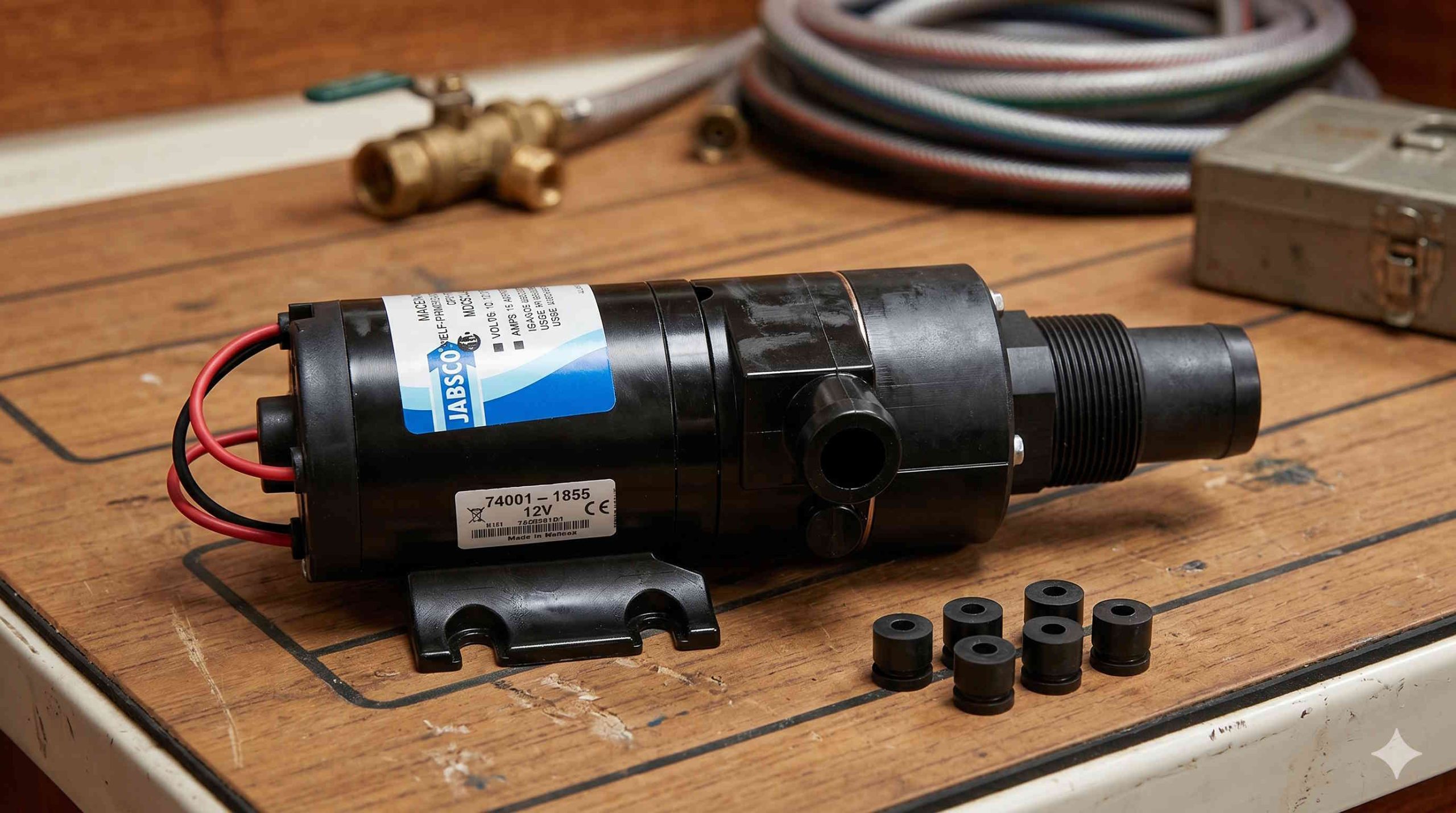
A macerator pump is a self-priming grinder pump: it chops solid waste into slurry and pushes it out under low pressure so you can empty a black (or gray) holding tank through a smaller hose than a gravity dump would need. This Jabsco is the long-running, name-brand version of that part, commonly used as a direct replacement for a failed OEM macerator in RVs and boats.
A few misconceptions worth clearing up:
- “Self-priming means it’ll pull from anywhere.” Owners consistently find it primes best when the intake sits at or below the tank’s minimum level. Ask it to lift waste up through a tall vertical run and the prime gets slow or fails — and dry running while it struggles is what cooks the impeller.
- “It’s heavy-duty, so it handles anything.” It’s strong for waste, but several owners note it bogs down or overheats on heavy continuous loads and isn’t meant to chew foreign material.
- “Buying Jabsco guarantees the latest design.” Not always. Stock from different eras shows up with different fasteners, which is the single most important thing to verify.
Key Specs That Actually Matter for RVers
- Fastener material (brass/bronze vs. stainless): The most outcome-determining detail on the whole pump. Corroding studs are the dominant failure story; stainless ones largely solve it.
- Mounting footprint and port sizing: Its biggest selling point for replacers is matching older Jabsco footprints and screw patterns, making swaps near plug-and-play.
- Prime behavior relative to mount height: Determines whether you get instant suction or a frustrating, impeller-risking dry-run on every cycle.
- 12V supply quality: Owners who keep a strong, non-dipping 12V feed report far fewer stalls and blown fuses than those on weak power.
- Rebuildability: Impeller and rebuild kits exist, so a tired pump is often a cheap fix rather than a throwaway — if you can reach it.
I’m deliberately not quoting amp or flow numbers here unless they show up in real-world use, because the outcomes owners actually care about come down to the points above.
Feature-by-Feature Breakdown (Truth vs Marketing)
| Feature | What the Manufacturer Says | What It Actually Means (User Experience) | Compared to Competitors |
|---|---|---|---|
| Grinding/chopping | Powerful multi-blade chopper | Owners repeatedly say it out-grinds and out-pumps the cheaper unit it replaced; empties a typical tank quickly | Generally stronger and more trusted than budget no-name grinder pumps owners tried first |
| Self-priming | Self-priming, dry-run protected | Primes fast when mounted at/below tank level; struggles and risks the impeller on tall lifts or after long storage | More demanding about mount height than its marketing implies; budget pumps often prime even worse |
| Build/housing | Compact, robust design | Strong core motor, but the seam fasteners are the weak link on older stock | Cheaper rivals fail faster overall; the failure here is specific and (now) fixable |
| Fit as a replacement | Drop-in compatibility | A standout — matches older Jabsco footprints so many owners do a clean swap with no modifications | Beats generic pumps that force you to re-plumb or re-drill |
| Longevity | Long service life | Wildly era-dependent: some owners get 12–15+ seasons, others a few months | Inconsistent; this is where it loses ground to owners’ memories of older units |
Real-World Owner Experience (Deep Pattern Analysis)
Pattern 1: The corroding fasteners that make the pump split open (the one owners obsess over)
In a nutshell: Across the critical feedback, the loudest, most repeated theme by far is that the studs holding the grinder section to the motor housing corrode, weaken, and break — and once they go, the pump separates at its main flange and leaks tank contents into the compartment. Owners describe finding broken-off studs in the bilge, sometimes in under a year.
Hidden strength: This is a known, documented issue that Jabsco addressed. Many owners report newer units arriving with what appear to be stainless fasteners, and Jabsco has offered a stainless service kit specifically to replace the failure-prone studs. So unlike a mystery defect, this one has a clear path to prevention.
Hidden weakness — and the information most reviews won’t give you: The trap is that you can’t always tell which era you’re getting from the listing alone, and the fasteners aren’t visible without partial disassembly. Worse, some owners report even the “stainless” hardware corroding on the nuts. So the fix exists, but verifying you got it is on you.
What to do about it: Before installing, inspect the fasteners. A simple field test some owners use: a magnet won’t stick to true stainless. If you’re at all unsure — or you keep the rig in salt or humid conditions — proactively source a stainless fastener/rebuild kit and swap the hardware before first install, while everything is clean and dry. Anything beyond basic hardware replacement, verify against the manufacturer instructions or consult a qualified RV tech.
Pattern 2: Prime failures that are really mounting-height failures
In a nutshell: A big share of “it ran but wouldn’t pump” complaints trace back to the pump being asked to pull waste up a vertical lift, or to dry-running after sitting.
Hidden strength: When mounted right, owners describe near-instant prime — power on, tank empties in roughly a minute. Several who switched from a no-name pump that couldn’t hold prime say this one “sucks it up right away.”
Hidden weakness: The dry-run protection isn’t a license to run it dry. Extended dry running while it fights for prime is exactly what burns out impellers.
What to do about it: Mount the intake at or below the tank’s minimum level. If a cycle starts and you hear the motor running with no flow, kill it quickly rather than letting it run dry. Owners who briefly feed a little water into the outlet to break a stubborn prime report it then catches immediately.
Pattern 3: The “I was sent a used pump” cluster
In a nutshell: A recurring and genuinely unsettling complaint is units arriving with no red protective caps, loose internal parts, spliced wires, residual water — or, in the worst reports, sewage smell — suggesting a returned item was resold without inspection.
Hidden strength: When owners flagged it, replacements generally went out fast, and a clean new unit usually behaved well.
Hidden weakness: This is a fulfillment/returns problem riding on top of an expensive part, and it can sour an otherwise good purchase on day one.
What to do about it: Inspect immediately on delivery for intact red end caps, included instructions, dry interior, and untouched wiring. If anything looks pre-installed, return it before you wire it in — don’t try to make a suspect unit work.
Pattern 4: Shaft-seal leaks and impeller fatigue over time
In a nutshell: Beyond the studs, the next most common wear story is leaking from the shaft seal and impellers that lose suction or seize, especially on pumps that sit unused for long stretches.
Hidden strength: Both are rebuildable. Owners routinely fix a dead unit with an inexpensive impeller or seal kit rather than buying a whole pump.
Hidden weakness: Long idle periods are hard on it — impellers can dry out, swell, or stick after months of sitting.
What to do about it: Run the pump briefly once or twice a month to keep internals lubricated and free. Some owners flush a small amount of oil through after the season to keep water from sitting inside. Keep an impeller kit on the shelf if you depend on the pump.
The Good, The Bad & The Ugly (Pros/Cons)
Pros
Performance
- Strong grinder; empties a typical tank fast and out-pumps budget replacements.
- Primes quickly and reliably when mounted at or below tank level.
Fit & serviceability
- Exact-footprint replacement for many older Jabsco units — frequently a no-modification swap.
- Rebuild/impeller kits make it repairable instead of disposable.
Brand confidence
- Owners who tried cheap knock-offs first repeatedly came back to this as the unit that actually lasted.
Cons
Reliability
- Corroding fasteners on older stock can let the pump separate and leak — the defining complaint.
- Longevity is inconsistent and era-dependent; some units fail within months.
Power & heat
- Can bog down, slow, or blow a fuse under heavy continuous load or on a weak 12V supply.
Purchase experience
- A real cluster of “arrived used/refurbished” reports tied to returns handling.
Mini Toolkit: Decide + Fix (Fast)
Issue-Tag Box
FASTENER-CORROSION— studs rust/break, pump splits at flangePRIME-FAIL— runs but won’t pull; usually mount-height relatedDRY-RUN-IMPELLER— impeller cooked from running dry while primingSEAL-LEAK— weeping from the shaft seal over timeUSED-UNIT— missing caps, water inside, spliced wires on arrivalPOWER-STALL— slows/blows fuse on weak or dipping 12V
Fitment/Adapter Mini-Matrix
| Your situation | Likely outcome |
|---|---|
| Replacing an older Jabsco of similar size | Often a direct, no-mod footprint match |
| RV 3″ sewer connector | May need an adapter/fitting; the pump port won’t always mate cleanly |
| Tall vertical lift from tank to pump | Expect prime struggles; relocate intake lower if possible |
Mini Decision Tree
- If you can verify stainless fasteners and mount at/below tank level → strong buy.
- If you can’t verify the fasteners → buy a stainless kit and swap before install.
- If your setup forces a tall self-prime lift → reconsider placement first.
- If it arrives with no red caps or water inside → return immediately, don’t install.
- If an old unit just lost suction → try an impeller/seal kit before replacing.
Troubleshooting Quickflow
- Motor runs, no flow → confirm intake is at/below tank level.
- Still no prime → power off, feed a little water into the outlet, retry once.
- Catches → good; if not, stop before it dry-runs and check for a stuck/dried impeller.
- Blows fuse / slows → check for a strong, non-dipping 12V feed and any binding.
- Leaks at the seam → inspect fasteners for corrosion; plan a stainless swap.
- Leaks at the shaft → plan a seal/rebuild kit rather than scrapping the pump.
Mini Return-Window Reality Check
- Inspect for intact red end caps, dry interior, and factory (un-spliced) wiring the moment it arrives.
- Check the seam fasteners with a magnet — non-magnetic suggests stainless; magnetic is a red flag on this pump.
- Do a quick bench or holding-tank prime test before final installation, while a return is still easy.
- Confirm the footprint and port sizing actually match your existing setup before you commit hoses.
- If it won’t prime at/below tank level on the bench, treat that as a defect, not a quirk.
For how these checks fit into broader buying criteria, the grinder-pump evaluation guide lays out the full decision framework.
Installation / Setup Tips (RV-Realistic)
- Mount the intake at or below the tank’s minimum level. The single biggest cause of “won’t prime” failures owners report.
- Inspect fasteners before install. If they’re not clearly stainless, swap in a stainless kit while the pump is clean and accessible — retrofitting after a leak is the dirty job nobody wants.
- Leave yourself access to the back of the motor. Owners who can reach the rear plug can free a stuck motor with a screwdriver instead of pulling the whole pump.
- Warm the connecting hoses before fitting. A heat gun makes stiff hoses pliable; cold hoses turn a clean job into a struggle (and a mess).
- Verify your port/fitting match early. RV 3″ sewer connections often need an adapter; sort this before you’re committed.
- Wire to a strong 12V source. Weak or dipping power drives the stalls and blown fuses in the critical reviews.
- Don’t let it run dry. If it’s running with no flow, stop quickly rather than waiting it out.
- Exercise it monthly. A short run once or twice a month keeps the impeller from drying out or sticking during storage.
- Keep a rebuild/impeller kit on hand if you rely on the pump, especially for long trips.
- Don’t feed it foreign material. It grinds waste well but isn’t built for anything else.
Anything involving wiring upgrades, relays, drilling, or re-plumbing beyond basic checks should be verified against the manufacturer instructions or handled by a qualified RV tech or electrician.
Owner Stories
The stories below are composite scenarios reflecting repeated patterns across owner feedback.
The clean swap. An RVer’s old discontinued Jabsco finally dies. They order this one, find the footprint and screw pattern identical, bolt it in with no modifications, run water from the holding tank, and it primes and empties fast. Their main reaction is relief that the dreaded job was nearly plug-and-play.
The bilge surprise. A boater mounts an older-stock unit high and dry, thinking they’ve protected it. A season or two later the brass studs corrode through, the pump separates at the flange, and tank contents leak into the compartment. The pump itself was strong — the fasteners were the failure, and a stainless kit beforehand would have prevented the whole mess.
The phantom prime. A weekend owner installs the pump above tank level. Every cycle the motor runs but barely pulls, and after a few dry-running episodes the impeller is shot. Nothing was wrong with the pump — the mounting height quietly destroyed it.
SEE MORE OWNER FEEDBACK ON AMAZON
Who This Is For (and Who Should Skip It)
Buy it if…
- You’re replacing an older Jabsco and want an exact-fit, low-hassle swap.
- You value grinding power and fast tank evacuation.
- You can mount the intake at/below tank level.
- You’re willing to verify fasteners and do light seasonal upkeep.
- You want a pump that’s repairable with kits, not disposable.
Skip it if…
- You want zero-maintenance, set-and-forget reliability.
- You can’t confirm you’re getting a current stainless-fastener unit.
- Your layout forces a tall vertical self-prime.
- You’re unwilling to inspect on arrival and return a suspect unit.
- You need a pump rated for heavy continuous duty or non-waste material.
If you’re comparing options, start here: Top RV Macerator Pump Picks
Alternatives (Quick Comparisons)
- A diaphragm-style “Gulper” pump — for owners who only move gray/shower water and don’t need grinding. Several frustrated Jabsco owners switched to this type for trouble-free, leak-free service, accepting that it doesn’t macerate.
- A budget self-priming grinder pump — cheaper upfront, but owners who tried no-name look-alikes first overwhelmingly report short lifespans and prime trouble, then came back to a name-brand unit.
- A higher-flow portable RV macerator kit — if you’d rather have a self-contained, cart-style pump-out system than a hardwired in-line pump.
Deep-Dive FAQ
What should I test immediately after delivery?
Inspect for intact red protective end caps, a dry interior, and factory wiring that hasn’t been spliced. A surprising number of owners report receiving what look like used or refurbished units, so if anything seems pre-installed, return it before wiring it in. Then bench-test the prime before final installation while a return is still easy.
What are the most common problems and fixes?
The most common serious problem is corroding fasteners that let the pump separate and leak; the fix is replacing them with a stainless kit, ideally before install. The second is failure to prime, which is usually a mounting-height issue solved by relocating the intake to at or below tank level. Shaft-seal leaks and worn impellers are common over time but are cheaply repairable with rebuild kits.
Will this work with my RV setup?
Often yes if you’re replacing a similar older Jabsco, since the footprint and screw pattern frequently match exactly. Be aware that RV 3″ sewer connectors don’t always mate cleanly to the pump’s port, so you may need an adapter or fitting. Confirm port sizing and mount height before committing your hoses.
How do I keep it from failing early?
Mount the intake low, feed it strong non-dipping 12V power, never let it run dry, and exercise it once or twice a month so the impeller doesn’t dry out or stick. Owners who follow these habits report the longest lifespans by a wide margin.
How can I tell if I’m getting the newer, better version?
The fasteners are the tell. Newer units tend to ship with stainless hardware (a magnet won’t stick), while the failure-prone older stock used brass or bronze studs. Since you can’t always tell from the listing, plan to inspect on arrival and keep a stainless kit handy as insurance.
Is it worth the higher price over a cheap macerator?
For most owners, yes. The cheap knock-offs show up repeatedly in this product’s own reviews as the thing people tried first and abandoned after quick failures. You’re paying for grinding power, replacement-part availability, and footprint compatibility.
Why do some owners get 12+ years and others a few months?
Mostly era and install. Units with stainless fasteners, mounted at the right height on strong power and exercised regularly, can run many seasons. Older brass-stud units, mounted high, run dry, or left idle for long stretches, are the ones that fail fast.
Final Verdict
The Jabsco 12V macerator is a genuinely strong pump wrapped around one well-known weakness and one fulfillment headache. When you get a current stainless-fastener unit, mount the intake at or below tank level, and give it decent power and the occasional run, owners reward it with fast, reliable tank evacuation across many seasons. When any of those conditions slip — old hardware, a tall lift, a dry run, or a suspect “new” unit — it produces exactly the messy failures that dominate its worst reviews.
So it’s worth it for the replacer who’ll do a little homework: verify the fasteners, mount it right, inspect on arrival. If you want a truly maintenance-free pump or can’t control which version you receive, look harder at the alternatives first.