LATCH.IT V2.0 Macerator Pump Review: Long-Distance Power vs. Early-Failure Risk
Last updated: June 2026
- Re-checked the “burns out in the first month” complaints against owners reporting multi-year service, and the split is sharper than a star rating suggests — the early failures cluster hard, while survivors often run for years.
- Re-examined the fuse-blowing and adapter-melting reports to separate the wiring/power issues from the actual pump failures (they’re not the same problem).
- Verified the “leaves a gallon on the ground” pattern multiple owners describe, and the rinse-mode workaround that fixes it.
- Confirmed the lifetime-warranty gasket-replacement experiences are real and recurring — but so are the “company went silent” reports. Both happen.
Affiliate disclosure: This review contains Amazon affiliate links. If you buy through them, I may earn a small commission at no extra cost to you. It doesn’t change what I write — the analysis below is driven entirely by what owners actually report.
The pain point this solves (and the honest verdict)
If you’ve ever wrestled a “stinky slinky” sewer hose at an awkward downhill site, or parked your RV at home with the septic clean-out maddeningly uphill from your dump valve, you already know the problem the LATCH.IT V2.0 is built to solve. A macerator pump grinds waste into slurry and pushes it through a small garden-style hose — uphill, around corners, and hundreds of feet if needed — so you’re not dependent on gravity or a nearby dump station.
Quick answer: Is the LATCH.IT V2.0 worth it? For most RVers who dump weekly and want long-distance, uphill transfer at a budget price, yes — but treat its early-life reliability as a coin toss and keep your return window in mind.
That tension is the whole story here, and it’s exactly what this review digs into. I spent hours going through real owner feedback — the glowing five-star reports and the furious one-stars — to figure out who ends up happy with this pump and who ends up shopping for a replacement. If you want to validate fitment and power needs against the broader category before you commit, the macerator pump selection framework is a useful companion to this hands-on look.
How this review was built (so you can trust it)
I synthesized roughly 180+ owner reviews for this specific pump, spanning from mid-2022 through mid-2026 — so the feedback covers several seasons of real use, multiple model batches, and a wide range of setups.
Here’s how I worked through it. I tagged every piece of feedback into categories: performance (distance, lift, grind quality), install/setup sensitivity, power and wiring behavior, fitment and compatibility, reliability symptoms, and support/returns experience. Then I separated setup-driven issues (wrong fuse, sketchy car-adapter power, misaligned gasket) from likely product or design issues (motors that slow and die, housings that overheat). That distinction matters more on this pump than almost any I’ve looked at, because a lot of the “junk” reviews and a lot of the “best purchase ever” reviews are describing the same hardware — just different luck and different power setups.
Important limitations to keep in mind:
- Reviews skew toward extremes — thrilled owners and furious owners write more than the indifferent middle.
- RV setups vary enormously (battery vs. car adapter, hose diameter, lift, run length), and that variability drives a huge share of the outcomes here.
- I prioritized patterns that showed up repeatedly across many owners, not one-off anecdotes.
Quick Verdict (TL;DR)
Best for:
- RVers who need to move waste a long distance or uphill to a home septic, cistern, or portable tote.
- Boondockers and seasonal/full-time parkers who dump on a predictable weekly rhythm.
- Budget-minded buyers who’d rather pay once at a lower price (and accept some reliability risk) than spend roughly double on a premium brand.
Not for:
- Anyone who wants a buy-it-once-for-a-decade guarantee with zero hassle.
- Owners who can only power it from a car cigarette-lighter adapter (this is a recurring failure point — more below).
- People who want to leave the gray tank cracked open for showers (no macerator allows this).
Standout win: When it works, owners repeatedly describe quiet, fast operation pushing waste 100+ feet and up real grades — often outperforming pricier name brands they’d owned before.
Watch-outs: A meaningful minority report early motor death or overheating, and the included/upstream fuse and the 12V power source are where a lot of “it failed” stories actually start.
Confidence Score: 7/10 🛠️
What that score means: this is a buyer-usefulness rating, not a reliability statistic. I weighed how clearly the pump serves its core job (high), how consistent the experience is across owners (mixed — that’s what pulls it down), how recoverable the common problems are (often recoverable with the right power setup), and how the support experience nets out (genuinely good for some, a black hole for others). A 7 means “very capable and well-priced, but go in with eyes open and a backup plan.”)
What This Product Is (and What It Isn’t)
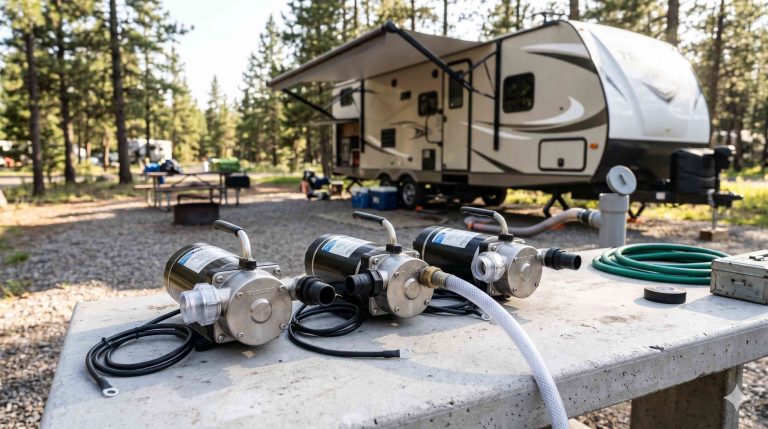
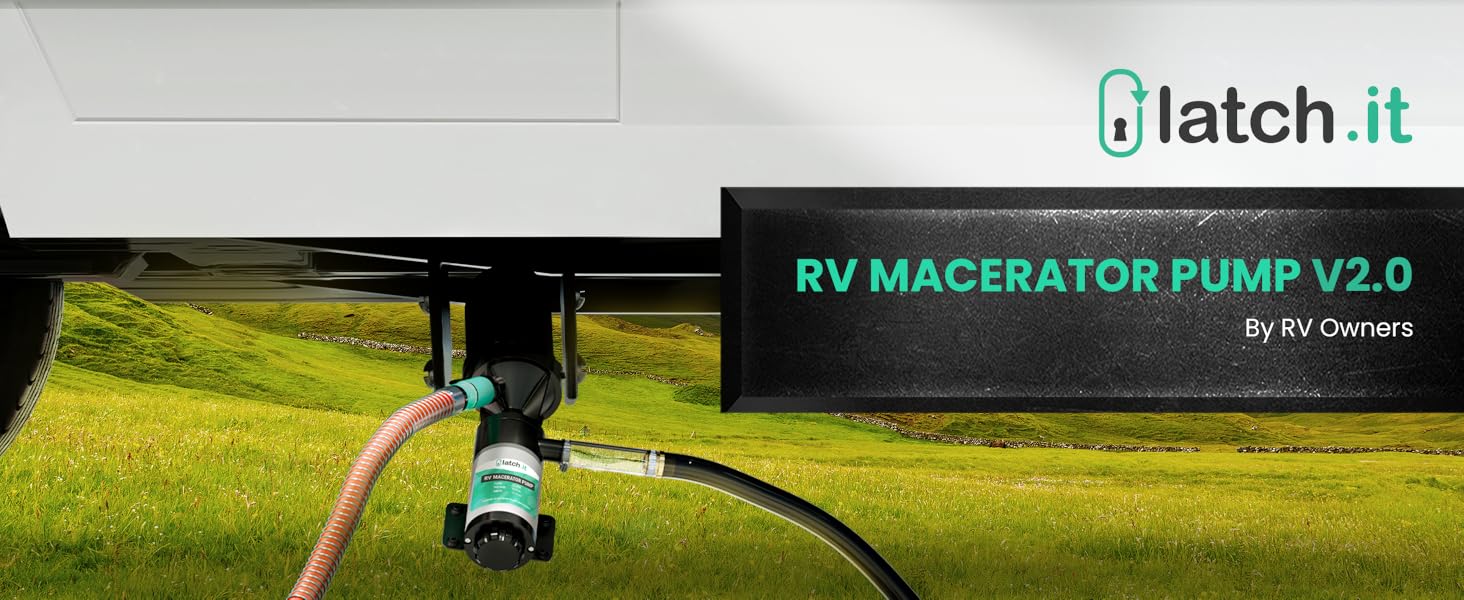
A macerator pump is a 12-volt grinder-and-pump combo: it liquefies RV black- and gray-tank waste, then pumps that slurry through a small-diameter hose to a sewer clean-out, septic riser, or portable tote. The LATCH.IT V2.0 is the self-priming, portable version of that idea, shipping with hoses, fittings, clamps, and a carry case.
What it isn’t, and where owners get tripped up:
- It is not a high-volume gravity replacement. Despite the headline flow rating, owners consistently note real-world throughput is lower than the number implies. It trades speed for reach — the win is distance and lift, not raw gallons-per-minute.
- It is not a “leave the gray open and shower” device. Several owners specifically wanted this; a macerator’s plumbing makes it impossible. If continuous gray drainage matters to you, this whole category is the wrong tool.
- It is not a sealed, fail-proof appliance. It’s a budget motor doing a brutal job. Owners who treat it as a serviceable tool with a backup plan stay happiest.
Key Specs That Actually Matter for RVers
I’m only listing the things owners tie directly to outcomes:
- Lift and distance capability: This is the headline strength. Owners report pushing waste up multi-foot grades and across very long runs — many describe runs around 100 feet, with some going well beyond on level ground. If your clean-out is uphill or far away, this is the spec that earns the purchase.
- Hose diameter sensitivity: Outcomes change dramatically with hose size. Owners report best results matching the manufacturer’s hose-size guidance to run length; undersized or mismatched hose is tied to slow, frustrating dumps.
- Power source and fuse behavior: The single most outcome-determining “spec” here isn’t on the box. How you power it — a solid battery connection versus a car adapter — strongly predicts whether you join the happy camp or the burned-out camp.
- Self-priming + included accessory kit: Owners value that it primes itself and arrives with extra connectors, spare switches, and a case. The kit completeness is a genuine plus versus barer competitors.
- Run-dry tolerance: Mixed but leaning positive — some owners report running it dry briefly with no harm, and the design includes a tone change you can hear when it runs dry, which helps you shut it off in time.
Feature-by-Feature Breakdown (Truth vs Marketing)
| Feature | What the Manufacturer Says | What It Actually Means (User Experience) | Compared to Competitors |
|---|---|---|---|
| Flow rate | High GPM throughput | Owners broadly agree real-world flow is lower than advertised; it’s adequate, not a fire hose. The reach is the real benefit. | Similar “optimistic GPM” gap exists across budget macerators; not unique to this unit |
| Lift / distance | Strong lift, long pumping | Consistently praised — owners routinely report long, uphill runs that surprised them | Several owners say it out-pushes pricier name brands they’d owned |
| Reliability | Durable, lifetime warranty | Polarized: many run for years, a notable minority die within weeks to months | Owners switching from a major competitor often found this more durable; others found the opposite |
| Power/wiring | Plug-and-go 12V with adapters | The included car adapter and inline fuse are the weak links; battery-clamp power is the happy path | Premium kits more often include robust direct-battery leads out of the box |
| Accessories/case | Complete portable kit | Genuinely appreciated — spare switches, extra connectors, carry bag | More generous than several barer-boxed rivals |
| Customer support | Lifetime warranty support | Real and responsive for many (free gasket kits mailed out); silent and unreachable for others | Inconsistent — a coin flip, where premium brands are more uniform |
Real-World Owner Experience (Deep Pattern Analysis)
This is where the pump’s true character shows up. I’m leading with what owners obsess over most for this product — longevity — because it’s the deciding factor in nearly every review.
Pattern 1: The bimodal lifespan — it either dies young or lasts for years
In a nutshell: There’s almost no middle ground. A large group of owners report years of weekly use without a hiccup; a smaller but loud group report failure within their first weeks or months — slowing down with each use until it quits, sometimes just past the return window.
Hidden strength: Among the long-term survivors, the consistency is striking — owners describing 50+ dump cycles, multi-year daily-grade use, and “still going strong” reports are common. This isn’t a pump that’s mediocre for everyone; for most it’s quietly excellent.
Hidden weakness: The early failures cluster suspiciously around the same symptom — gradual slowdown then a hot motor or blown fuse — which reads more like unit-to-unit quality variance (or a power mismatch cooking the motor) than normal wear.
What to do about it: Test hard and early, inside your return window. Run multiple full dump cycles in the first weeks, not just one. If it slows or the motor runs very hot, don’t nurse it — return it immediately while you still can. And buy with a backup plan in mind; treating it as “probably great, occasionally a dud” is the realistic posture.
Pattern 2 (information gain): Your fuse and power source cause more “failures” than the pump does
In a nutshell: This is what most reviews won’t tell you. A striking number of “it burned out / it blew the fuse / the plug melted” reports trace back to the car-style 12V adapter and inline fuse housing — not the pump motor itself.
Hidden strength: Owners who hard-wire to a battery with proper clamps, or who upgraded the fuse appropriately, report dramatically better outcomes — including one owner who got a “dead on arrival” replacement working simply by correcting the fuse. The motor is often fine; the power delivery is the bottleneck.
Hidden weakness: The pump ships leaning on a cigarette-lighter-style adapter that owners repeatedly describe overheating, smoking, or melting, plus an inline fuse housing that several say melted on first use. That’s a design weak point, not user error.
What to do about it: Power it from a clean 12V source — battery clamps or a dedicated battery — rather than a car adapter whenever possible. If you blow a fuse repeatedly, that’s a diagnostic signal, not just bad luck; verify the fuse rating and wiring against the manufacturer instructions, and if you’re upgrading fuse ratings or wiring, confirm it with a qualified RV tech or electrician before pushing more current.
Pattern 3 (information gain): It always leaves a hose-full to dump on the ground — unless you rinse first
In a nutshell: The pump stops the instant it loses suction, which means there’s always a gallon-plus of material left sitting in the discharge tube. When you detach the pump, that pours out — onto your driveway, your shoes, wherever you’re standing.
Hidden strength: Once you know it, it’s completely manageable and the unit otherwise cleans itself well.
Hidden weakness: Nobody warns you, and the first-time surprise is exactly as unpleasant as it sounds.
What to do about it: After you’ve closed the tank valves at the end of the dump, run the pump in rinse mode with clean water for a few minutes so whatever’s left in the tube is closer to clean water before you disconnect. This single habit removes the worst “mess” complaint about the pump.
Pattern 4: Overheating and partial-tank shutdowns on big tanks
In a nutshell: A subset of owners — often those with large (e.g., 50-gallon) black tanks — report the pump clearing most of a tank, then shutting down on what they assume is thermal protection, needing a long cool-down before finishing.
Hidden strength: That same thermal cutoff is arguably protecting the motor, and plenty of large-tank owners report no overheating at all, which points back to power quality and duty cycle.
Hidden weakness: For the affected owners, a 15-minute job balloons into hours of stop-start.
What to do about it: Don’t run it bone-dry for long stretches, keep enough liquid moving through it, and if you’re consistently overheating, scrutinize your power source and hose sizing before blaming the motor. Persistent overheating despite a clean setup is a return-worthy signal.
Pattern 5: The gasket/o-ring is the small part that decides your day
In a nutshell: A recurring theme is the rubber gasket/o-ring at the discharge connection — if it goes missing or misaligns, you get leaks “everywhere,” and if you lose it entirely there’s no part on the shelf at the hardware store.
Hidden strength: This is the brightest spot in the support story: owners who contacted the company through Amazon repeatedly report fast, free replacement gaskets (sometimes whole kits) mailed under the lifetime warranty.
Hidden weakness: Other owners couldn’t reach anyone at all, and there’s no easy off-the-shelf replacement, so your experience hinges on support being responsive that week.
What to do about it: Register/sign up for the warranty right away, keep the o-ring seated and aligned every time, and don’t lose it. If it fails, contact support through Amazon first — that’s the channel owners had the most luck with.
The Good, The Bad & The Ugly (Pros/Cons)
Pros — Performance & reach:
- Strong real-world lift and long-distance pumping, the standout reason owners keep it.
- Grinds and liquefies waste effectively; many call cleanup easy and relatively mess-free.
- Genuinely quiet for the job it’s doing, by repeated owner account.
Pros — Value & kit:
- Priced well below premium rivals, often at roughly half the cost owners cite for comparable name brands.
- Complete kit: hoses, fittings, clamps, spare switches, extra connectors, carry case.
- Self-priming and easy to set up once you’ve sorted your connections.
Cons — Reliability variance:
- A real minority of early motor failures, sometimes just past the return window.
- Overheating/partial shutdowns on larger tanks for some owners.
Cons — Power & parts:
- Car-adapter power and inline fuse housing are weak points prone to overheating/melting.
- A missing gasket can sideline you, with no easy local replacement.
- Support is excellent for some owners and unreachable for others.
Mini Toolkit: Decide + Fix (Fast)
Issue-Tag Box
EARLY-FAILURE— motor slows then quits within weeks/monthsOVERHEAT— shuts off before finishing a large tankFUSE/PLUG— blown fuses or melted car adapterGASKET-LEAK— discharge connection drips or spraysTUBE-DRAINBACK— gallon left in hose dumps on detach
Fitment/Adapter Mini-Matrix
| Your setup | What owners report works |
|---|---|
| Long or uphill run to clean-out | Match manufacturer hose-size guidance to run length; this is the pump’s strong suit |
| Powering the unit | Direct 12V battery clamps beat the car-style adapter for reliability |
| 4″ RV dump-port connection | A standard gray-water drain adapter / elbow bridges the pump to the port |
Mini Decision Tree
- If your clean-out is uphill or far away → this pump’s reach is the reason to buy it.
- If you can only power it from a car adapter → fix that first, or expect trouble.
- If it slows down or runs very hot early → return it now, don’t wait.
- If it leaks at the discharge → reseat the gasket before assuming it’s broken.
- If you want zero-hassle, decade-long reliability → buy a premium brand instead.
Troubleshooting Quickflow Pump hums but won’t move water → 1) Confirm clean 12V power (battery, not weak adapter). 2) Check the inline fuse and rating. 3) Reseat/align the discharge gasket. 4) Clear the impeller area per the manual (rubber-off, turn clockwise). 5) Re-prime and test with water. 6) Still dead or motor very hot → return within window.
For a fuller compatibility and power-sizing walkthrough before your window closes, the category buying framework covers the decisions this product-level review intentionally doesn’t repeat.
Mini Return-Window Reality Check
- Run multiple full dump cycles in the first weeks, not a single test — the failures show up under repeated use.
- Watch motor temperature: very hot early is the strongest predictor of a short life.
- If it blows a fuse more than once, treat that as a real signal and diagnose power before the window closes.
- Confirm the discharge gasket is present and sealing before you commit; a missing one is hard to source later.
- If performance degrades cycle-over-cycle, return immediately — that pattern rarely reverses.
Installation / Setup Tips (RV-Realistic)
- Power it from a battery, not a car adapter. The most common “failure” stories trace back to the cigarette-lighter adapter overheating; battery clamps are the happy-owner default.
- Match hose size to distance. Owners report following the manufacturer’s hose-size-to-length guidance is the difference between fast and painfully slow dumps.
- Don’t undersize for long runs. Long-distance owners who used appropriately sized hose report flawless results; mismatches drag the job out.
- Add an adapter for the 4″ port if needed. Many owners couldn’t connect directly and bridged with a sewer hose plus a gray-water drain adapter — plan for that fitting.
- Rinse before you disconnect. Run clean water through in rinse mode after closing valves so the tube isn’t full of waste when you detach it.
- Dump black first, then gray. Owners report the gray water flushes debris through the pump and leaves the blades cleaner.
- Listen for the dry-running tone. The pump’s sound changes when it runs dry — that’s your cue to shut it off rather than cook it.
- Keep the gasket seated and spare-protected. The o-ring falls out easily; losing it is a common, avoidable headache.
- Consider a longer/dedicated power lead. Several owners on long rigs wished for more reach or alligator clamps and built their own — a known, easy upgrade.
- Register the warranty immediately. It’s your best path to a free gasket or kit if something small fails later.
- Safety guardrail: Anything beyond basic checks — upgrading fuse ratings, re-wiring, adding relays or remote controllers — should be verified against the manufacturer instructions or done with a qualified RV tech/electrician.
Owner Stories
The stories below are composite scenarios reflecting repeated patterns across owner feedback.
The thrilled long-hauler: A full-timer parks behind family with the nearest dump station closed and the septic riser uphill. They run 100-plus feet of correctly sized hose, power it off the battery, and are “thoroughly impressed” — fast, quiet, no mess. Years and dozens of dump cycles later it’s still going. This is the owner the pump was built for, and they’d buy it again without hesitation.
The power-mismatch casualty: A weekend camper relies on the included car adapter, notices the plug getting hot, and within a few weeks the pump slows with each use until it dies — sometimes blowing a fuse on the way out, sometimes just past the return window. They write a furious one-star review. The frustrating part: the motor may well have been fine, undone by the power path rather than the pump.
The usage-mismatch buyer: Someone wants to leave the gray tank open for showers, or expects a gravity-fast gusher of flow. The macerator can’t do the first and was never going to do the second. The pump performs as designed; the expectation didn’t match the tool.
SEE MORE OWNER FEEDBACK ON AMAZON
Who This Is For (and Who Should Skip It)
Buy it if:
- Your dump point is uphill, far away, or you’re transferring to a tote/cistern/home septic.
- You dump on a regular weekly-ish schedule and want to ditch the sewer-hose dance.
- You can power it from a battery or dedicated 12V source.
- You want premium-style reach at a budget price and accept some reliability risk.
- You’re comfortable doing basic fitting/fuse setup and keeping a backup plan.
Skip it if:
- You need guaranteed multi-year reliability with no fuss.
- Your only realistic power is a car cigarette-lighter adapter.
- You want to leave the gray tank open for showers.
- You won’t have time to stress-test it inside the return window.
- You’d rather pay double for more uniform quality and support.
If you’re comparing options, start here: Top RV Macerator Pump Picks.
Alternatives (Quick Comparisons)
- The premium name-brand macerator: Costs roughly double, with more uniform reliability and support. Notably, several owners switched to the LATCH.IT after a premium pump overheated or died early — so “premium” isn’t automatically “lasts longer,” but it’s generally more consistent.
- A run-dry-protected branded kit: If thermal/overheat behavior worries you most, a competitor specifically marketing run-dry protection may suit large-tank, long-session dumping better.
- The dump-and-haul combo (no macerator): Some owners abandoned macerators entirely — quick-dumping to a portable tote or IBC tank, then hauling it. Slower and more manual, but no motor to burn out. Worth considering if reliability anxiety outweighs convenience.
Deep-Dive FAQ
What should I test immediately after delivery?
Run several full dump cycles within your return window and watch motor temperature and consistency. The failures that define this pump show up under repeated use, not on the first test — so a single successful dump isn’t enough. If the motor gets very hot, slows cycle-over-cycle, or blows a fuse, return it right away rather than hoping it settles.
What are the most common problems and fixes?
The most common real problems are early motor failure, overheating on large tanks, blown fuses or a melted power adapter, and discharge-gasket leaks. The biggest fixable one is power: switch from the car adapter to a direct 12V battery connection, which resolves a large share of “it burned out” reports. For leaks, reseat the gasket before assuming the unit is defective.
Will this work with my RV setup?
Most likely yes, if you can power it from 12V and match your hose to the run length. Owners successfully use it on travel trailers, fifth wheels, and motorhomes, pumping to clean-outs, septic risers, cisterns, and portable totes — including long and uphill runs. The two setups it can’t serve are car-adapter-only power (unreliable) and any desire to leave the gray tank open for showers (impossible with any macerator).
How far and how high can it really pump?
Far and high enough to be the main reason people buy it. Owners routinely report long runs around 100 feet and pumping up multi-foot grades, with some going well beyond on level ground. Real-world flow is slower than the headline rating, so it trades raw speed for impressive reach.
Why does it leave waste on the ground when I disconnect?
Because it stops pumping the moment it loses suction, leaving a tube full of material that pours out on detach. Run it in rinse mode with clean water for a few minutes after closing your tank valves, so what’s left in the hose is closer to clean water before you disconnect.
Is the lifetime warranty actually honored?
Sometimes excellently, sometimes not at all. Many owners report fast, free gasket or kit replacements after contacting the company through Amazon, while others couldn’t reach anyone. Sign up for the warranty immediately and use the Amazon contact channel, which has the best track record in owner reports.
Should I get extended protection?
If you’re risk-averse, it’s reasonable. Because failures cluster early but survivors often last years, several owners specifically recommend buying extra protection — one noted theirs failed just past the standard window. It’s a hedge against this pump’s defining trait: inconsistent early-life reliability.
Final Verdict
The LATCH.IT V2.0 is a genuinely capable, well-priced macerator pump that excels at the one thing macerators exist for: moving waste a long way, uphill, when gravity won’t. For the majority of owners — especially those powering it cleanly off a battery and matching hose to distance — it delivers premium-style reach at a budget price and quietly lasts for years. The honest catch is its bimodal reliability: a real minority of units fail early, and the included car adapter and fuse setup cause more of those “failures” than the motor does. Buy it if your dump point is uphill or distant, you can give it clean 12V power, and you’ll stress-test it inside the return window with a backup plan in mind. Skip it if you need guaranteed, hands-off, decade-long reliability and would rather pay double for it.