RV Surge Protector & EMS Buyer’s Guide: What 200+ Owners Won’t Tell You (2026)
Editor’s Note: This guide is based on a deep-dive analysis of real owner feedback, forum discussions, and long-term usage reports. We cut through the marketing specs to tell you what actually matters.
Already know what you need? Jump straight to our tested recommendations in the 5 Best RV Surge Protectors & EMS Units list. 🔌
Why This Upgrade is Harder Than It Looks
You’re not buying a fancy adapter. You’re putting a digital bouncer between your RV and campground power that can be… wildly inconsistent.
Across the owner feedback I analyzed, the same frustrations show up over and over:
- The Fitment Gamble: A rugged, “premium” portable unit may be too bulky for some pedestal boxes (doors won’t close), forcing awkward workarounds like a short extension cord.
- The Sensitivity Debate: Some owners praise “protective” shutoffs for low voltage/open neutral. Others call the same behavior “nuisance trips.” It depends on your camping style and tolerance for interruptions.
- The Monitoring Expectation Gap: Bluetooth/Wi-Fi features sound like remote monitoring magic. In real-world use, many users find range, pairing, and 2.4 GHz network limits can turn “anywhere access” into “sometimes access.”
- Weather & Heat Reality: “Outdoor-ready” doesn’t mean “ignore rain and loose connections.” Moisture intrusion and hot plug stories are recurring themes—especially when the unit hangs in a bad orientation or seats loosely.
Big takeaway: Success isn’t about buying the most expensive brand. It’s about matching your risk tolerance, your power setup (30A vs 50A), and your monitoring style (none vs display vs app) to how you actually camp.
Quick Summary: The 30-Second Verdict
- The Golden Rule: Buy for your worst-case campsite, not your average one. The older park with sagging voltage is where a good EMS earns its keep.
- 5 Questions to Ask Before Buying:
- Do I need surge-only protection, or a true EMS (Electrical Management System) that disconnects for low voltage and wiring faults?
- Am I on 30A (120V) or 50A split-phase service—and do I need visibility into both legs?
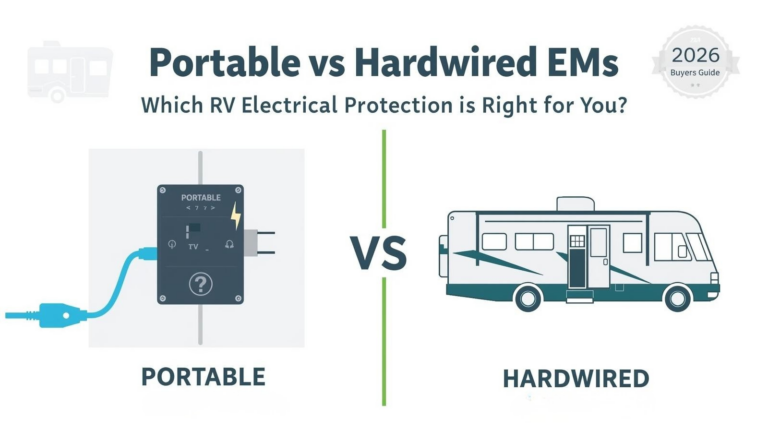
- Do I want portable convenience, or hardwired “always-on” protection (and theft resistance)?
- Will I actually use monitoring (display/app), and am I okay with occasional pairing/network quirks?
- What’s my plan if it fails on a trip—bypass, spare, or quick replacement?
- The “Don’t Do This” Warning: Don’t ignore a loose or awkward connection. Owners repeatedly connect plug fit to heat issues. If it doesn’t seat securely—or the unit slips—switch pedestals or fix the physical setup before you power up.
1. Pick Your Lane (Risk vs. Convenience)
There is no “one best” RV surge protector/EMS. Owners tend to fall into three practical lanes:
| Lane Name | Who It’s For | What You Give Up |
|---|---|---|
| Budget Analyzer + Surge | Weekenders who want a fast “is this pedestal safe?” check and basic surge defense. | Less comprehensive shutdown logic, more variability in long-term reliability, and fewer tools for diagnosing “why did power drop?” |
| Portable EMS (Display/Remote) | Travelers who bounce between unknown parks and want pedestal testing + auto shutoff without installing anything. | Bulkier hardware, weather/theft exposure, and occasional quirks (pairing, false/annoying alerts, nuisance trips). |
| Hardwired EMS Guardian | Full-timers and “set-it-and-forget-it” owners who want permanent protection, less theft risk, and fewer outdoor exposure headaches. | Installation complexity (tight bays, stiff cable), potential relay hum concerns, and it becomes a single point of failure unless you have bypass strategy. |
2. Fit, Compatibility & Sizing (The “Boring” Stuff That Matters)
This is where trip-ruining surprises happen—often on night one.
- The Checklist:
- Service type: 30A vs 50A (ordering the wrong amperage is still a common buyer mistake).
- Pedestal box clearance: Some portable units are deep/bulky and prevent the pedestal door from closing.
- Cord-end shape: Big molded handles or certain grip styles can clash with weather flaps/covers.
- 50A monitoring expectations: A recurring buyer surprise is that some budget 50A units don’t make “two-leg reality” as clear as owners expect.
- Storage & strain relief: Hanging weight + cord tension matters. Owners frequently emphasize supporting the connection (not letting it dangle into wet grass).
- Hardwired space planning: 50A installs often involve stiff cable in a cramped bay—plan routing before you commit to mounting.
- Generator behavior: Some setups (especially bonding/floating neutral scenarios) can trigger faults unless you understand the bypass/bonding situation.
- Common Regret: Owners repeatedly describe arriving at a campsite and discovering the new unit is too bulky or the cover blocks their plug. The most common workaround: a short extension cord or re-orienting the setup so the pedestal door can close and water doesn’t run into the connection.
3. Real-World Performance: What Actually Happens?
Marketing focuses on joules, buzzwords, and “complete protection.” Owner reality is more practical—and sometimes messier.
Protection Type: “Surge Protector” vs “EMS”
- Marketing Claims: “Protects your RV.”
- Owner Reality: Many buyers only feel truly protected once they understand that:
- A basic surge protector mainly addresses spikes.
- A true EMS actively disconnects for sustained dangers like low voltage (brownouts) and miswired pedestal conditions (open ground, reverse polarity, neutral problems).
Low Voltage: The Silent RV Killer
Owners commonly report that low voltage is what they fear most—especially when the whole campground runs A/C.
- One pattern that comes up repeatedly is EMS units cutting power when voltage drops into the low-100V range, with multiple owners mentioning shutoffs around ~103–104V.
- This creates the classic emotional split: some owners celebrate the shutoff as “it saved my rig,” while others hate the interruption.
Monitoring: Display vs App vs “No-Drama”
- Marketing Claims: “Monitor from anywhere.”
- Owner Reality:
- Displays get consistent praise because they turn mystery power into numbers (volts/amps/Hz/error codes).
- Bluetooth monitoring is frequently described as helpful inside or near the rig—but not “across the campground” reliable.
- Wi-Fi monitoring is loved in concept but often constrained by 2.4 GHz network compatibility and campground network quirks.
Auto Delay & Auto Restore
A frequent buyer surprise is thinking a unit is dead because it doesn’t instantly pass power.
- Owners often describe a normal startup sequence: test → countdown/delay → energize.
- Many also like units that auto-retry after a fault instead of forcing constant unplug/replug rituals.
Weather Exposure: “Outdoor-Ready” Has Conditions
Owners are split on rain performance:
- Many report successful outdoor use when they hang it correctly, keep it off the ground, and reduce direct water flow into seams.
- A meaningful number still report moisture inside the unit over time—especially if it sits low, lies in wet grass, or water runs along the cord into the housing.
Cold-Weather Fault Codes: The E6/E7 Problem (Display Units)
This is one of the most consistent “ruin your weekend” themes for certain display-based models:
- Owners commonly report that when temps drop into the 30s–40s °F, some units throw E6/E7 temperature-related faults and stop passing power.
- Practical takeaway: If you camp in cooler seasons—especially below ~40°F (≈4°C)—treat display models associated with E6/E7 as higher risk.
Heat at the Plug: Rare, But You Don’t Ignore It
Across multiple products, there’s a recurring warning category: hot plug ends, melting, or deformation.
- It’s not presented as “everyone’s experience,” but it shows up enough that it should shape how you buy and how you set up:
- Snug seating matters
- Worn pedestals are a problem
- Loose connections can become heat events
4. The Setup: Where Most Failures Happen
Owners who are happiest tend to follow a repeatable ritual. Here’s the best-practice setup pattern I kept seeing:
- Turn the pedestal breaker OFF before you connect anything.
- Plug the surge protector/EMS into the pedestal first (by itself).
- Turn the pedestal breaker ON and let it run the test + delay sequence.
- Confirm you have a good status (and readouts look normal).
- Turn the breaker OFF again.
- Plug in your RV shore cord firmly (straight alignment, fully seated).
- Turn the breaker ON and let the system stabilize before you slam heavy loads on.
- Support the connection (avoid hanging tension; keep it off wet ground; create a drip loop if rain is likely).
- After 15–30 minutes under load, do a quick warmth check at the plug connection.
The “Wake-Up” Call: “It’s dead” is often just the unit doing its startup delay. Owners who wait through the countdown frequently report everything works normally.
5. Reliability & Support: The Hidden Cost
This category isn’t just about protection—it’s about what happens when things go wrong.
Across the owner feedback I analyzed, reliability experience tends to spread into three buckets:
- Background Guardian: It just works for months/years and becomes invisible.
- Early Failure / DOA: A unit arrives defective or fails early—frustrating, but manageable if caught in the return window.
- Late Surprise Failure: The worst pattern: it fails after the easy-return window, sometimes right at a campsite, and support channels feel unclear or slow.
Buyer Protection Plan:
- Test immediately at home (don’t wait until your first trip).
- Run a high-load check (A/C or other heavy loads) and verify nothing is heating abnormally.
- Keep the box and inserts through the return window.
- If registration exists, register right away (owners mention this smoothing warranty conversations).
- Take a quick photo of model/serial info and your order details.
- If you go hardwired, know your bypass plan (owners value bypass capability when a protection unit trips or fails).
6. Pre-Purchase Checklist (Save This)
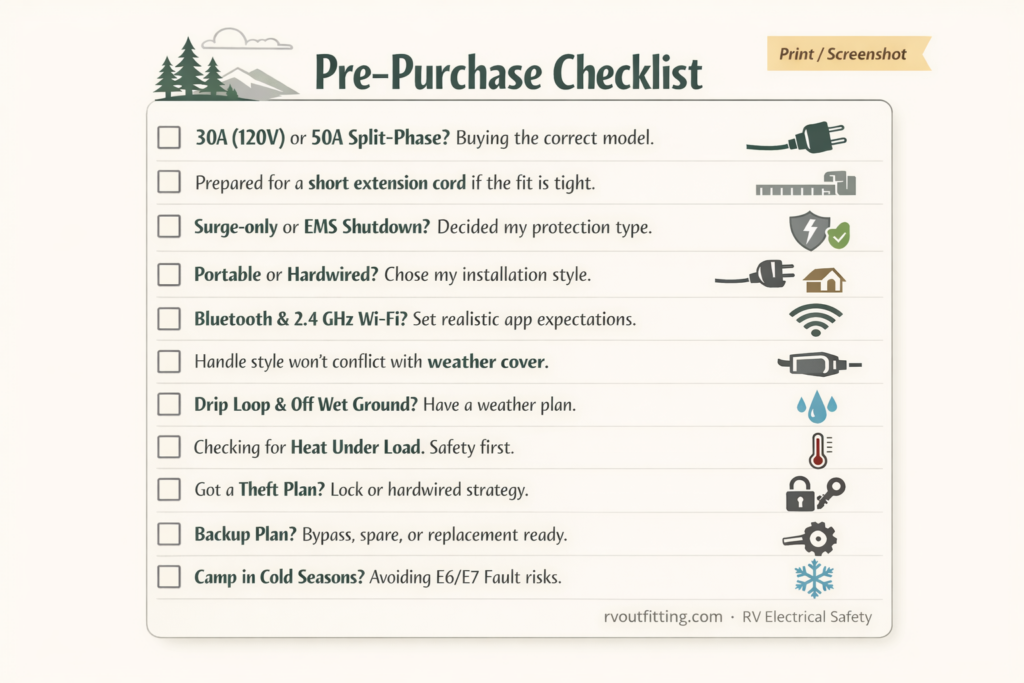
- I confirmed my RV service is 30A (120V) or 50A split-phase and I’m buying the correct model.
- I measured (or assumed tight) pedestal clearance and I’m prepared for a short extension cord if needed.
- I decided whether I need surge-only or true EMS shutdown for low voltage/wiring faults.
- I know whether I want portable convenience or hardwired “always-on” protection.
- If I want monitoring, I have realistic expectations about Bluetooth range and 2.4 GHz Wi-Fi limits.
- I checked that my cord end (handle/grip style) won’t conflict with the unit’s weather cover/flap.
- I have a plan to manage weather exposure (hang orientation, drip loop, keep it off wet ground).
- I will inspect for heat under load and I won’t ignore warm/hot plug symptoms.
- I have a theft plan for portable units (lock strategy) or I’m choosing hardwired to avoid it.
- I have a backup plan if the unit fails on a trip (bypass, spare, or replacement path).
- If I camp cold seasons, I’m avoiding models with recurring E6/E7 cold fault patterns.
7. Who Should Buy What? (Buyer Personas)
- The Weekender:
- Needs: Simple “go/no-go” pedestal check, basic surge defense, easy workflow you’ll actually use every time.
- Avoid: Overpaying for app features you won’t use, and display models with recurring cold-weather shutdown complaints if you camp shoulder seasons.
- The Heavy User (Full-Timer / Constant Travelers):
- Needs: True EMS behavior (low voltage + wiring fault protection), reliable monitoring, and less weather/theft hassle—often meaning hardwired makes sense.
- Avoid: Budget-tier units with inconsistent longevity or unclear support experience, and anything that makes you babysit power constantly.
- The Budget Hunter:
- Needs: The best “value per peace-of-mind” you can get—clear voltage readout, basic fault detection, and a consistent routine.
- Avoid: Expecting premium-level diagnostics, perfect two-leg transparency on 50A, or flawless durability at entry-level pricing.
FAQ (Data-Backed Answers)
1) What’s the difference between a surge protector and an EMS?
Based on aggregated owner experiences discussed in these reviews, a surge protector primarily handles spikes, while an EMS acts like a gatekeeper—testing the pedestal and disconnecting for sustained dangers like low voltage and serious wiring faults.
2) Why does my unit “shut off” when everything seems fine?
Owners commonly report two big causes:
- The unit is doing its job during low voltage or suspect wiring conditions.
- Or you’ve hit the sensitivity/expectation gap—what feels like a nuisance trip to one owner feels like insurance to another.
3) Is Bluetooth/Wi-Fi monitoring actually “remote monitoring”?
From real-world owner feedback, it looks like Bluetooth is short-range in RV conditions, and Wi-Fi monitoring often runs into 2.4 GHz-only compatibility plus campground network quirks. If remote monitoring is your main reason to buy, go in with realistic expectations.
4) Can I leave a portable unit outside in the rain?
Owners are split. Many do so successfully, but a meaningful number report moisture intrusion over time. The common “owner wisdom” is to hang it correctly, keep it off the ground, manage drip paths, and treat the connection area as weather-sensitive.
5) What are E6/E7 errors—and should I care?
Owners repeatedly associate E6/E7 with temperature-related faults on certain display models, often in cooler weather. The frustrating part is it can stop passing power even when the pedestal seems fine. If you camp below ~40°F (≈4°C), consider that a real buying constraint.
6) What’s the #1 way to avoid heat/melting issues at the plug?
A frequent buyer surprise is how much the physical connection matters. Owners repeatedly tie problems to loose/worn pedestals or imperfect seating. If it doesn’t fit snugly, don’t force it—switch pedestals, support the connection, and don’t ignore warmth.
7) Will an EMS cause issues with generator power?
In the reviews I went through, generator use is mentioned as a scenario where some owners see faults—especially related to bonding/floating-neutral situations. If you rely heavily on generator power, prioritize units and setups where you understand the bypass/bonding behavior.
Final Verdict
Choosing the right RV electrical protection isn’t about chasing a mythical “best.” It’s about picking the right lane—budget analyzer, portable EMS, or hardwired guardian—based on how you camp, how much protection you truly want, and what quirks you can tolerate.
Ready to choose a specific model? We’ve ranked the top performers based on these criteria. See the top picks: – 10 Best RV Surge Protectors & EMS Units Reviews