RV Macerator Pumps Buying Guide (2026): Choose One That Lasts
Last updated: June 2026
Editor’s Note: This guide is based on a deep-dive synthesis of real owner feedback and long-term usage patterns. We cut through marketing to focus on what actually changes outcomes.
Already know what you need? Jump straight to our tested recommendations in the 10 Best RV Macerator Pumps list.
Stop Hauling the Tote: How to Actually Choose an RV Macerator Pump
To choose the best RV macerator pump, match the pump to your dump geometry and your power, not to its marketing. Pick a unit whose real-world strength is the lift and distance you actually face, plan from day one to power it from a strong, fully-charged 12V battery instead of the included cigarette-lighter plug, mount the intake at or below your tank’s level so it primes instantly, and add a clear discharge elbow so you can stop the moment the flow runs clean. Then test it on plain water the day it arrives — never on a trip — because the most common regret in owner feedback isn’t a bad pump, it’s a good pump fighting the wrong setup, discovered after the return window closed.
If you’ve shopped these pumps, you already know the pain points. You’re staring at a sewer cleanout that’s uphill, a hundred feet away, or sitting higher than your dump valve, and gravity simply won’t cooperate. You’re tired of wrestling a 40-gallon “blue boy” tote across a lot or paying every time you visit a dump station. And you’re nervous because half the reviews for any given pump call it a miracle and the other half call it junk — with no obvious way to tell which camp you’ll land in.
That frustration is real, and it’s not your imagination. Across the owner feedback I analyzed, a recurring theme is that these pumps live or die on small setup decisions most listings never mention — power source, mount height, hose width, and one cheap accessory. Get those right and a budget pump can outlast its price several times over. Get them wrong and even a premium, trusted-brand unit can fail in a week.
This guide is grounded in real owner experience across many units and several brands — the five-year veterans and the “dead on arrival” buyers side by side. Rather than rewrite spec sheets, I tagged the patterns that actually separate happy owners from frustrated ones, and surfaced the “failure signatures” owners describe right before something goes wrong. The goal is simple: help you pick a pump that fits your rig, and set it up so it doesn’t become a return.
Quick Summary: The Fast Verdict
The Golden Rule: Buy for your geometry and power it properly. The pump that matches your lift, distance, and a strong battery feed beats the “best” pump fighting a bad setup every time.
5 Questions to Ask Before Buying:
How far and how high do I actually need to move waste? (This decides whether you need a lift-focused pump or a basic one.)
Where’s my battery, and can I feed the pump strong, non-dipping 12V power right out of the gate?
Can I mount the intake at or below my tank’s level, or am I forcing a tall vertical self-prime?
Will this live stowed indoors as gear, or bolted to the rig outdoors year-round?
Am I comfortable doing basic battery wiring and adding a clear elbow, or do I need true plug-and-play?
The “Don’t Do This” Warning: Don’t run it dry. Almost none of these pumps have real dry-run protection, and letting one idle empty — even for a few seconds after a tank finishes — is the single fastest way to cook the motor or impeller. The owners who skip the clear elbow are the ones who can’t see when to stop.
Owner Pattern Index (Fast Diagnosis)
Use this to translate a complaint into a likely cause and a first check. These rows reflect the problems that recur most across owner feedback, not one-off horror stories.
What owners complain about
What it usually points to
What to check first
“It died for no reason”
A failed cigarette-lighter plug or blown in-line fuse, not the motor
The fuse in the 12V adapter; then bypass the plug and clamp to a battery
“Motor runs but nothing pumps”
Intake mounted too high; lost or failing prime
Whether the intake sits at or below tank level
“Won’t grind / keeps clogging”
Hair from the grey tank, regular (non-RV) toilet paper, or run-dry damage
What’s going down the tanks; switch to RV paper, keep hair out
“It leaked all over the bay”
Brittle plastic tabs cracking, corroded fasteners splitting the seam, or a lost O-ring
The connector O-ring and the seam fasteners (magnet test for stainless)
“Dead within a few months”
Heavy year-round use, weather exposure, or weak/low-voltage power
Where it’s stored and how strong its power feed is
“Got slower over a season”
Worn impeller or shaft-seal fatigue, often after long idle storage
Whether an impeller/seal rebuild kit is available before scrapping it
The misleading symptom: “It worked perfectly on the test, then failed on the first real trip”
A marginal power feed or high mount that only shows under real load — looked fine parked, isn’t fine live
A live test under real flow, not just a “does it spin” bench check
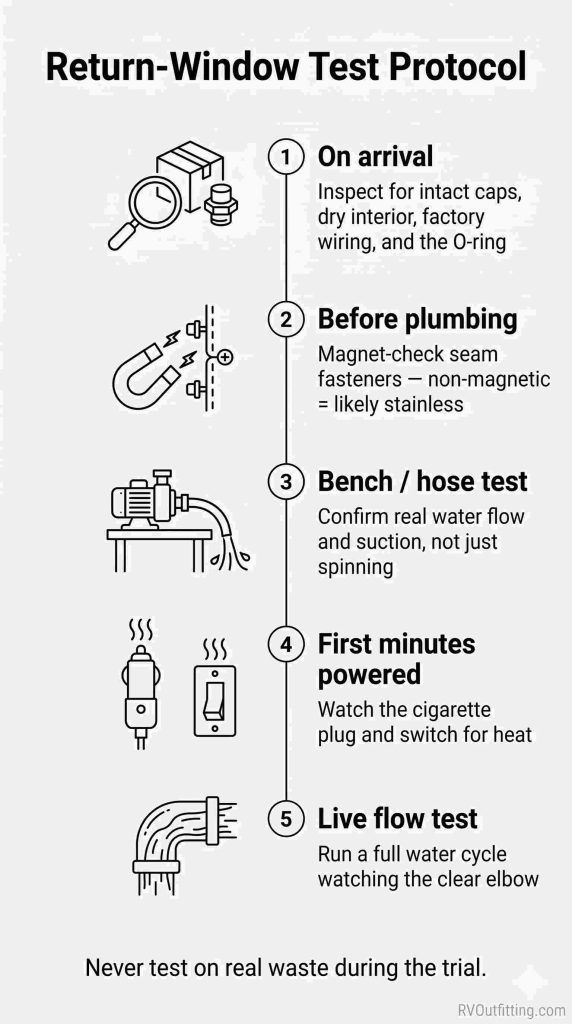
Return-Window Test Protocol (Do This Before You Toss the Box)
Prove it works on your rig before the return window closes
Test on plain water the day it arrives. The most painful pattern in owner feedback is people who waited for a camping trip to try the pump and only found the failure after returns closed.
Time window
Test
Pass looks like
Fail looks like
What to do next
First few minutes, unboxing
Inspect for intact protective caps, dry interior, factory (un-spliced) wiring, and the connector O-ring present
Clean, dry, sealed, complete
Missing caps, water or smell inside, spliced wires
Return immediately; don’t wire in a suspect unit
Before any plumbing
Magnet check on seam fasteners (where applicable)
Non-magnetic suggests stainless
Magnetic on a pump with a known corrosion history
Source a stainless kit or reconsider the unit
Bench / hose, dry geometry
Confirm it actually pumps water through your hose and pulls a real vacuum — not just spins
Strong, steady flow and suction
Spins but won’t move water or hold prime
Check mount height at/below tank level; if it still won’t prime, treat as defect
First few minutes powered
Watch the cigarette plug and switch for heat
Stays cool
Plug or switch overheats or melts
Bypass to battery clamps; treat the included plug as expendable
Live, under real flow (not parked-only)
Run a full water cycle as if dumping, watching the clear elbow
Pumps to clean water, you stop on cue, no overheating
Stalls, slows, or overheats under sustained load
Re-check power feed and hose width before committing
Don’t test on actual waste during the trial — owners warn that ends both your return option and your dignity.
1. Pick Your Lane (Risk vs. Convenience)
Lane
Who it’s for
What you give up
Budget grinder, set up smart
Occasional and seasonal RVers willing to wire to a battery and add a clear elbow
Guaranteed multi-year reliability; you accept a longevity gamble in exchange for low cost
Premium / trusted-brand pump
Owners who want stronger grinding, replacement-footprint fit, and a real support path
A noticeably higher price, and the need to verify you got the current design era
Built-in or hard-plumbed system
Full-timers wanting a permanent fixture they don’t stow
The most money and the biggest install; overkill for occasional users
2. The “Boring” Stuff That Matters
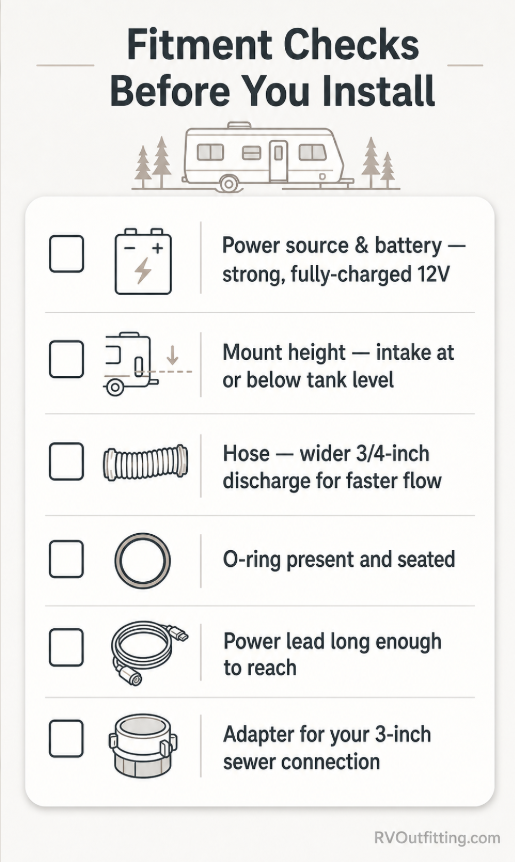
The fastest way to prevent install-day surprises is to verify fitment before you commit
These are the unglamorous constraints that decide outcomes. They’re worth checking before you fall for grinding-power claims.
Power source and battery health: low or dipping voltage is hard on brushed motors and drives stalls, blown fuses, and early death. A fully-charged, adequately-sized battery is non-negotiable.
Mount height relative to the tank: intake at or below tank level primes fast; a tall vertical lift turns every cycle into a dry-run risk.
Hose width and run length: a wider (3/4″) discharge hose flows meaningfully faster; long, thin hose runs slow it down and strain the motor.
The connector O-ring: a small gasket that’s notorious for falling out and getting lost — and forgetting it means a flooding mess.
Storage: stowed indoors as gear lasts; bolted to the rig and exposed to weather correlates with early failure.
Common regret pattern: Owners who treated the pump as a permanent outdoor fixture, powered from a marginal source, are heavily represented in the “dead in months” camp.
Install-day surprise: One pattern that comes up repeatedly is the stock power cord being too short — especially when the battery is on the tongue and the outlet is at the rear. Owners discover this exactly when they’re ready to dump, not before. Plan a longer lead up front. If you’re refining your whole water-and-waste setup, it’s worth reading alongside our broader RV water systems resources so the pieces work together.
Compatibility Matrix (What Owners Say Actually Fits)
Compatibility here is owner-reported patterns, not a spec sheet. These are the families that come up repeatedly in feedback.
Model / Family (as referenced by owners)
Common install/fitment notes owners mention
Noise sensitivity notes
Recurring failure or complaint theme
Best prevention step owners learned
Jabsco-style replacements
Often a direct, no-mod footprint match for older Jabsco units; RV 3″ sewer connections may need an adapter
Strong grinder, runs assertively
Corroding fasteners on older stock split the seam and leak
Verify stainless fasteners (magnet test) or swap a stainless kit before install
Flojet-type premium units
Drop-in for many fixed-base setups; pairs best with a fat 3/4″ hose
Capable, demands correct setup
Brittle plastic mounting tabs and a heat-sensitive motor punish careless installs
Don’t crank onto a tight fitting; wire it properly and avoid heat shutoffs
SEAFLO-type budget pumps
Easy, inexpensive starter pump; sensitive to lift and duty cycle
Audible but tolerable
“Locked up too soon” on high mounts or long runs
Keep the run reasonable; don’t force a high mount
Ristow-type value pumps
Garden-hose simple; capable distance and lift for the price
Standard for the class
A real subset ships wired backwards or with a dead fuse
Bench-test on water before trusting it; check polarity and fuse
Kitvance-type kits
Complete ready-to-run kit with rinse/backflush port
Heavy, solid-feeling motor
Cigarette plug and plastic switch overheat; no dry-run shutoff
Power from a battery, add a clear elbow, don’t hang it off the outlet
3. Real-World Performance: What Actually Happens?
What marketing says
What owners actually report
“Grinds waste for clog-free flow”
Handles black-tank waste and RV toilet paper well; struggles with hair and regular TP
“High-output, empties tanks fast”
Strong through wide hose, but noticeably slower than gravity, and very slow through thin or long hose
“Self-priming — pulls from anywhere”
Primes fast at or below tank level; struggles or fails on a tall vertical lift
“Durable, well-made”
Core motor often solid; the connectors, fasteners, and seals are the real question marks
“Convenient 12V power included”
The included cigarette plug is a common failure point; many owners hard-wire to fix it
The polarizing split — “great value” vs. “locked up too soon”: The same budget pump earns both five-star praise and one-star fury, and the divide is rarely random. Happy owners tend to run a designated, well-charged battery, keep the run short, use RV paper, and stop the moment flow runs clean. Frustrated owners tend to run marginal power, force a high mount or long thin hose, and let it idle dry. The pump didn’t change — the setup did.
A second split — premium pump, polar outcomes: Even a trusted-brand unit divides owners into multi-year veterans and one-week casualties. The veterans wired it properly, mounted a permanent clear adapter, ran a fat hose, and kept the intake low. The casualties cranked it onto a tight fitting or mounted it high. The brand was the same; the discipline wasn’t.
Failure signature (the sequence owners describe right before a part fails): With the budget kits, it’s almost a script — the cigarette plug gets hot within minutes, then melts or trips its in-line fuse, and the pump goes silent. Owners read it as “the motor died,” but the grinder is usually fine; it’s the power hardware that quit. With premium units, the signature is different: corroded studs weaken unseen, then the pump separates at its main flange and dumps tank contents into the bay, often with broken-off studs found later in the compartment.
Counter-intuitive finding: “Self-priming” does not mean “mount it anywhere.” Owners consistently find these pumps prime best at or below the tank’s minimum level, and the very act of asking one to lift waste up a tall run — while it dry-runs fighting for prime — is what cooks the impeller. The marketing word causes the failure it seems to promise against.
Nobody tells you this: The single best accessory isn’t a marketed feature at all — it’s a clear discharge elbow. Owners discovered it themselves. Because almost none of these pumps have real dry-run protection, being able to see the moment flow turns to clean water and stop immediately turns the biggest risk into a non-issue. It’s cheap insurance that listings never mention.
For the broader picture of safe waste handling and tank care, our bathroom and waste solutions hub gives general best-practice context that sits underneath any specific pump choice.
4. The Setup: Where Most Failures Happen
Most “bad pump” stories are really setup stories. Here’s the best-practice sequence drawn from the owners whose pumps lasted.
Power from a strong, fully-charged 12V battery, not the included cigarette plug. Bypassing the plug sidesteps the most common “it died” reports.
Size the battery up and keep it charged. Low voltage is hard on brushed motors and shortens their life.
Mount the intake at or below the tank’s minimum level so it primes instantly instead of dry-running for prime.
Don’t hang the pump’s weight off your plastic outlet. Run a short hose so it rests on the ground or blocks.
Add a clear discharge elbow and use a wider (3/4″) hose for faster flow and visible run-clean.
Check the connector O-ring every single time before you open the valve, and keep a bucket under the connection.
Start water flowing a few seconds before switching the pump on when backflushing, so it never catches up and runs dry.
Misread Risk: Owners often assume that because a pump is “self-priming” and runs, it’s working — but a motor running with no flow isn’t success, it’s the warning sign right before impeller damage. If you hear it running with nothing moving, kill it fast rather than waiting it out.
The one step owners skip: Testing on plain water the day it arrives. This is the most commonly skipped action, and it’s directly tied to returns and complaints. Owners who wait for a real trip discover failures after the window closes; owners who run a two-minute water test catch a dead fuse, a backward-wired unit, an overheating plug, or a high-mount prime failure while a return is still painless.
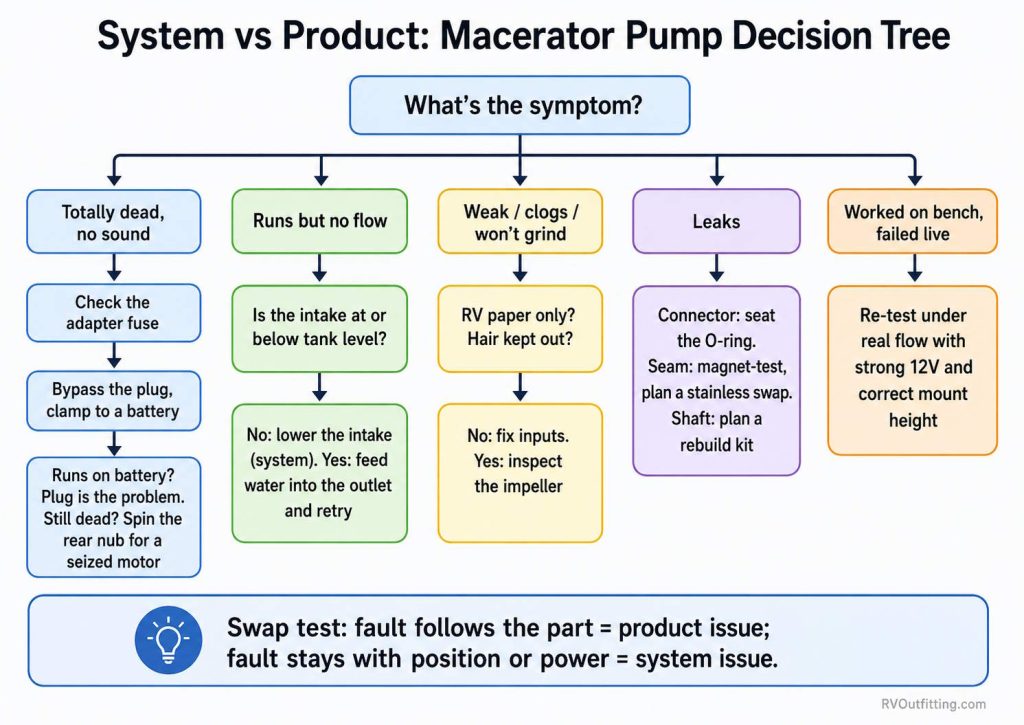
Use this quick decision tree to separate setup problems from product problems
RV MACERATOR PUMP: SYSTEM vs PRODUCT DECISION TREE

START: What's the symptom?

[1] Pump is totally dead, no sound
     -> Likely cause: power hardware, not the motor
     -> Confirm: check the in-line fuse in the 12V adapter; bypass the
        cigarette plug and clamp straight to a charged battery
     -> Swap test: does it run on battery clamps but not on the plug?
        YES -> the plug/switch is the problem (product hardware, cheap fix)
        NO  -> spin the rear manual-drive nub; if seized, motor issue

[2] Motor runs but nothing pumps
     -> Likely cause: lost prime from mount height (system), not the pump
     -> Confirm: is the intake at or below the tank's minimum level?
        NO  -> relocate intake lower; this is a SYSTEM problem
        YES -> feed a little water into the outlet, retry once
               Catches -> good. Won't catch -> check for stuck/dried impeller

[3] Pumps weakly / clogs / won't grind
     -> Likely cause: hair, regular TP, or run-dry damage
     -> Confirm: RV paper only? hair kept out of grey tank?
        NO  -> fix inputs first (SYSTEM/habit problem)
        YES -> inspect for a worn or fouled impeller (product wear)

[4] Leaks
     -> At the connector? -> check the O-ring is present and seated (system)
     -> At the seam/flange? -> inspect fasteners for corrosion;
        magnet test for stainless; plan a stainless swap (product/era)
     -> At the shaft? -> plan a seal/rebuild kit, don't scrap it (product wear)

[5] Worked on the bench, failed live on the first trip
     -> Likely cause: marginal power or a high mount that only shows
        under real, sustained load
     -> Confirm: re-test under live flow with a strong 12V feed and
        correct mount height before blaming the unit

SWAP TEST RULE: If the problem follows the PART when you move it to a
known-good position/power, it's a product issue. If it stays with the
POSITION or power source, it's a system issue.
How to validate a new RV macerator pump before the return window ends
Promise: A two-minute water test on arrival catches almost every failure while a return is still painless.
DO: Run plain water through your actual hose the day it arrives, confirming real flow and suction — not just that it spins.
WATCH: The cigarette plug and switch for heat in the first minutes, and the seam for any weep.
IF-FAIL: Bypass the plug to battery clamps; if it still won’t pump at or below tank level, treat it as a defect and return it.
Fitment checks that prevent install-day surprises
Promise: Verifying fit before you commit hoses saves the dump-day scramble owners describe most.
DO: Confirm mount height (intake at/below tank), port/adapter match for your 3″ sewer connection, and that your power lead actually reaches.
WATCH: For a too-short stock cord and a missing connector O-ring — two small things that derail an otherwise clean install.
IF-FAIL: Source a longer lead, the right adapter, or a replacement O-ring before first use, not during it.
When it’s a system problem vs a product problem
Promise: A simple swap test tells you whether to fix your setup or return the pump.
DO: Move the pump to a known-good power source and a correct mount height, then retest.
WATCH: Whether the fault follows the part or stays with the position/power.
IF-FAIL: Fault follows the part means product issue (return or rebuild); fault stays with position or power means a system fix on your end.
5. Reliability & Support: The Hidden Cost
Quality-control variance is the through-line in this category. From real-world owner feedback, it looks like most units are fine, but a real subset ships wired backwards, with a dead fuse, missing protective caps, or — on premium units — even resold as a returned item without inspection. That’s a fulfillment problem riding on top of the part itself.
Support experiences split too. Many owners report no findable phone number or website and feel scammed — yet a growing number get full replacements and refunds once they reach the seller the right way, often through the order page’s “contact seller” path rather than hunting for a direct site. The friction is real; so is the resolution if you push through it.
Buyer Protection Plan:
Inspect the moment it arrives; don’t wire in anything that looks pre-used.
Test on water immediately, inside the return window.
Keep spare fuses for the 12V adapter, and a clear elbow on hand.
For pumps with rebuild kits, keep an impeller/seal kit on the shelf if you depend on the unit.
If it fails, contact the seller through your order page before assuming it’s unsupported.
Expectation reset: Even a good macerator pump can’t guarantee multi-year, set-and-forget life in this price class. These are serviceable, setup-sensitive tools with brushed motors and wear parts, not sealed appliances. The owners happiest long-term are the ones who treated the pump as maintainable gear — stowed dry, exercised monthly, occasionally rebuilt — rather than expecting a decade of zero attention. That’s not a knock on the category; it’s the boundary that keeps your expectations honest.
6. Pre-Purchase Checklist (Save This)
RV Macerator Pump Pre-Purchase Checklist
I know my actual lift height and hose run distance.
I can power the pump from a strong, fully-charged 12V battery.
I can mount the intake at or below my tank’s minimum level.
My power lead will physically reach from battery to outlet.
I have (or will buy) a wider 3/4″ discharge hose.
I have (or will buy) a clear discharge elbow.
I’ve confirmed any adapter needed for my 3″ sewer connection.
I’m prepared to bypass the cigarette plug and wire to the battery.
I’ll test on plain water the day it arrives, not on a trip.
I’ve checked the connector O-ring is present.
For premium units, I can verify the current fastener/design era.
I’ll store it dry and indoors, not bolted outside year-round.
7. Who Should Buy What? (Buyer Personas)
The Weekender
Needs: A simple, affordable grinder for occasional uphill or distance dumps; light, intermittent use.
Avoid: Leaving it attached to the rig outdoors between trips, or relying on the included cigarette plug as a permanent power solution.
The Full-Timer
Needs: Consistent reliability, a real support path, and either a premium replacement-footprint pump wired properly or a built-in system; rebuildability matters.
Avoid: Budget units run hard year-round on marginal power, and any pump mounted above tank level.
The Budget Hunter
Needs: Maximum value, accepting a longevity gamble in exchange for low cost; willing to do basic battery wiring and add a clear elbow.
Avoid: Sending hair down the grey tank or flushing regular toilet paper, and skipping the day-one water test that protects the return window.
FAQ (Data-Backed Answers)
Why does my RV macerator pump run but not pump anything?
Almost always a prime problem from mounting too high, not a dead pump. Owners consistently find these pumps prime best with the intake at or below the tank’s minimum level; on a tall vertical lift the motor spins but can’t pull, and dry-running while it fights for prime is what damages the impeller. Lower the intake or feed a little water into the outlet to break the prime, then retest.
Why did my macerator pump die after only a few months?
Usually power and exposure, not bad luck. The pumps that fail early cluster around weak or dipping 12V supplies and units left bolted to the rig outdoors year-round, while the long-lived ones run on a strong, fully-charged battery and get stowed dry indoors. On budget kits, a “dead” pump is also frequently just a blown in-line fuse or a melted cigarette plug — the motor is fine.
Do RV macerator pumps have dry-run protection?
Generally no, and that’s the key thing to plan around. Most of these pumps will happily cook themselves if left running empty, which is exactly why a clear discharge elbow is the most recommended accessory — it lets you see the moment flow turns clean and shut off before the pump runs dry.
Can a macerator pump handle toilet paper and waste?
Yes for RV/septic-safe paper and normal black-tank waste, which owners report it chews through without drama. No for hair and regular household toilet paper — long hair wraps internal components over time, and regular TP can overwhelm the cutter and strain the motor. Keep hair out of the grey tank and use RV paper.
Is a premium macerator pump worth it over a cheap one?
It depends on what you’re protecting against. Premium, trusted-brand units offer stronger grinding, exact-footprint replacement fit, rebuildability, and a real support path — but they still demand correct setup and you have to verify you’re getting the current design era. Budget pumps can match the core job for far less if you wire them to a battery and set them up carefully, accepting a longevity gamble in return.
How do I stop my macerator pump’s connector from leaking?
Check the O-ring before every dump. The connector gasket is notorious for falling out and getting lost, and a missing O-ring is a common flooding cause. Keep a spare, confirm it’s seated each time, and don’t hang the pump’s weight off your plastic outlet — support it on the ground or blocks so the fitting isn’t stressed.
Why did my premium pump split open and leak into the bay?
On older-era stock, corroding fasteners are the culprit — the studs holding the grinder to the motor weaken and break, and the pump separates at its flange. This has a known fix: verify stainless hardware with a magnet (it won’t stick to true stainless) before install, or swap in a stainless kit while everything is clean and dry.
What to Re-Check Before You Buy (Listings Change)
Version and era drift: the same model can ship with different hardware over time, so the design you read about may not be the one in the box. Verify before you trust.
Missing parts: connector O-rings, protective caps, and adapters sometimes don’t arrive; confirm the kit is complete on day one.
Condition concerns: a real cluster of “arrived used or refurbished” reports exists on pricier units — inspect for intact caps, dry interior, and untouched wiring before installing.
Cord length: stock power leads are widely called too short; check whether you’ll need a longer lead for your battery-to-outlet distance.
Printable Cards (Save These)
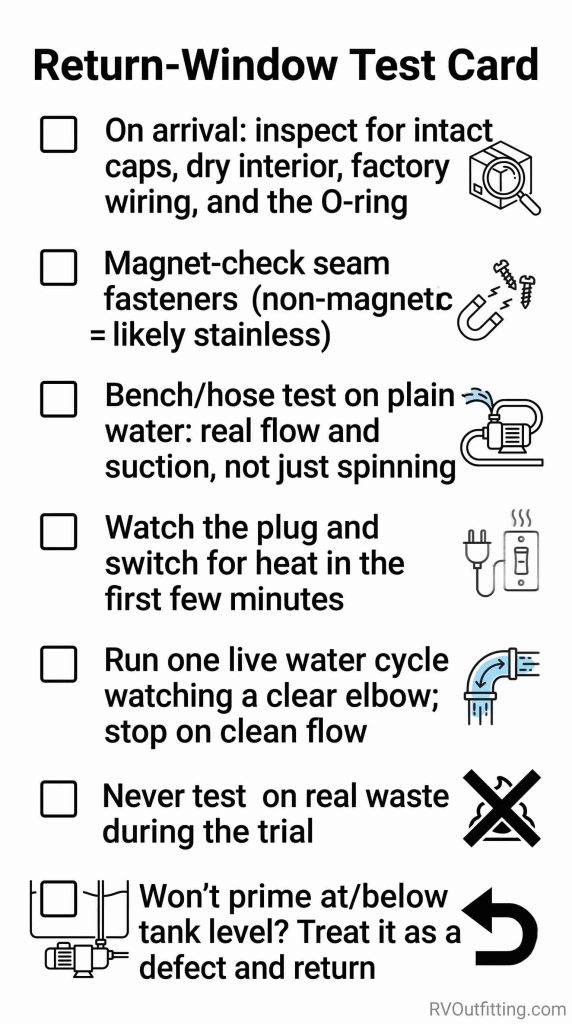
Return-Window Test Card
Print this card and run the trust test before you commit
On arrival: inspect for intact caps, dry interior, factory wiring, and the connector O-ring.
Bench/hose test on plain water: real flow and suction, not just spinning.
Watch the plug and switch for heat in the first few minutes.
Run one live water cycle watching a clear elbow; stop on clean flow.
Never test on real waste during the trial.
If it won’t prime at/below tank level, treat it as a defect and return.
RV Macerator Pump Problem Decision Card
Totally dead? Check the adapter fuse, then bypass the plug to a battery.
Runs but no flow? Lower the intake to at/below tank level; break the prime.
Won’t grind / clogs? RV paper only, keep hair out, check the impeller.
Leaks at connector? Seat the O-ring; support the pump’s weight.
Leaks at seam? Inspect fasteners; plan a stainless swap.
Got slower? Try an impeller/seal rebuild kit before scrapping it.
Update Log
June 2026: Published the Owner Pattern Index, Return-Window Test Protocol, and System vs Product Decision Tree as the category framework.
June 2026: Added the owner-reported Compatibility Matrix and both printable cards.
Final Verdict
Pick your lane honestly: a budget grinder set up smart, a premium replacement-footprint pump wired and mounted right, or a built-in system if you want a permanent fixture. Whichever lane you choose, the outcome comes down to the same Golden Rule — buy for your geometry and power it properly. The pump that matches your lift, distance, and a strong battery feed will quietly outlast the “best” pump fighting a bad setup. Add a clear elbow, test on water the day it arrives, and most of the heartbreak in the reviews simply won’t be your story.
Ready to choose a specific model? We’ve ranked the top performers based on these criteria. See the top picks: 10 Best RV Macerator Pumps Reviews
Last updated: June 2026 Editor’s Note: This guide is based on a deep-dive synthesis of real owner feedback and long-term usage patterns. We cut through marketing to focus on what actually changes outcomes. 🎯 Already know what you need? Jump straight to our tested recommendations in the 10 Best RV Toilets (Tested Picks) list. The…
Last updated: June 2026 Affiliate disclosure: This article contains Amazon affiliate links. If you buy through them, we may earn a small commission at no extra cost to you. It never changes what we recommend or how we read the feedback. The honest, quick answer If you’ve ever stood at a sewer cleanout that’s uphill,…
Last updated: June 2026 Affiliate disclosure: If you buy through links on this page, I may earn a small Amazon commission at no extra cost to you. It doesn’t change what I write — the patterns below come straight from real owner feedback. Emptying a black tank is nobody’s favorite chore, and it gets genuinely…
Editor’s Note: This guide is based on a deep-dive analysis of real owner feedback, forum discussions, and long-term usage reports. We cut through the marketing specs to tell you what actually matters. Already know what you need? Jump straight to our tested recommendations in the 5 Best RV Surge Protectors & EMS Units list. 🔌…
Last updated: June 2026 As an Amazon Associate, I earn from qualifying purchases. If you buy through links on this page, it costs you nothing extra and helps support the work that goes into these reviews. The Honest Truth About This Pump If you’ve ever stood at a packed dump station holding a sagging 3-inch…
Last updated: June 2026 Affiliate disclosure: This article contains Amazon affiliate links. If you buy through them, I may earn a small commission at no extra cost to you. It doesn’t change what I write — the analysis below is driven entirely by what owners actually report. Is the SEAFLO 01 Series Macerator Pump Worth…