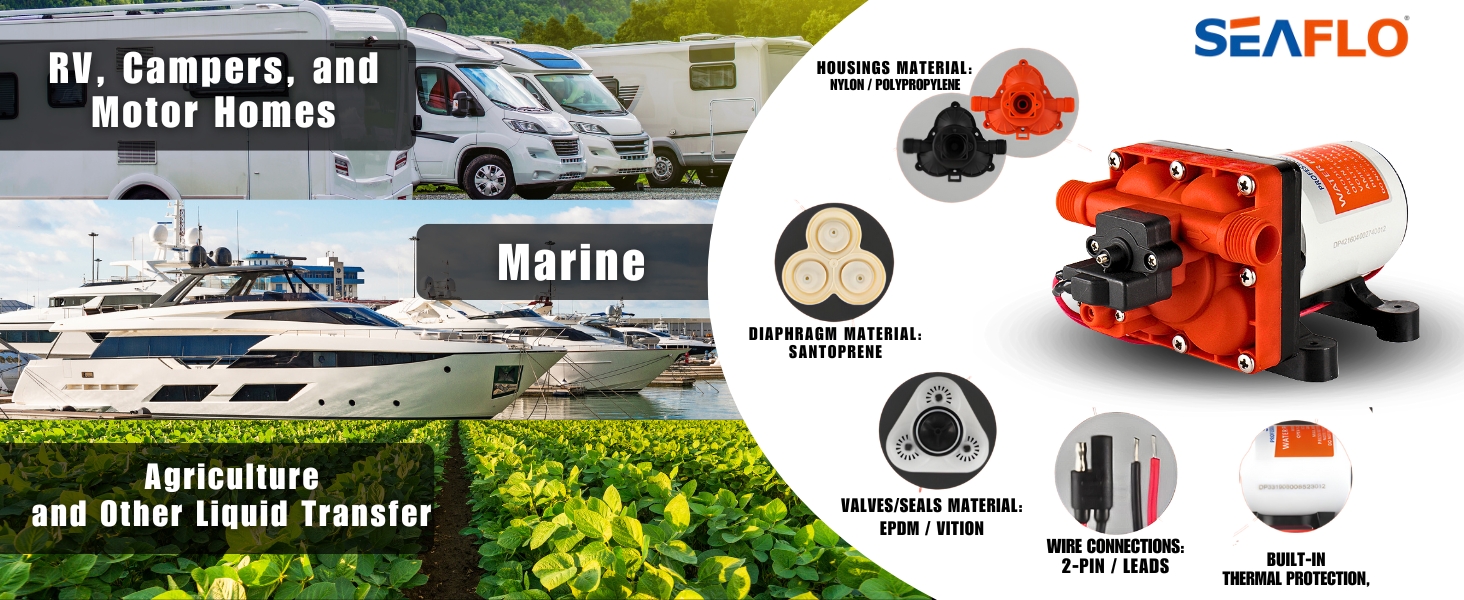
SEAFLO 42 Series 12V Diaphragm Pump Review: Quiet Pressure… or a Pressure-Switch Gamble?
Affiliate Disclaimer: This article contains affiliate links. If you click through and make a purchase, I may earn a small commission at no extra cost to you. This helps support my deep-dive research.
If you’ve ever been jolted awake by your RV pump machine-gunning on and off at 2 a.m., you already know the pain: you don’t just want “more pressure.” You want stable pressure, low noise, and a pump that won’t turn into a leaking, short-cycling headache halfway through the season.
So I did what most of us don’t have time to do. I went through a large volume of real owner feedback to figure out what actually happens once the SEAFLO 42 Series 12V diaphragm pump leaves the product page and gets bolted into an RV, camper van, cargo trailer conversion, or even a boat washdown setup.
This is not a marketing rewrite. It’s a pattern-based review of what owners commonly experience—good and bad—so you can decide if this pump fits your rig and your risk tolerance.
Quick Summary
- Best for: RVers who want a quieter pump with solid pressure and are comfortable doing a careful install (and possibly an exchange if they get a dud).
- Not ideal for: Anyone who needs maximum reliability with minimal fuss, or anyone with a history of pressure-switch problems and no patience for troubleshooting.
- The big theme: When it’s a good unit, owners often describe it as a “night-and-day” upgrade in noise and livability. When it’s a bad unit, the most repeated frustrations are pressure switch failures, mystery cycling, and leaks around the housing.
- If you’re comparing options, start here:
Quick Verdict (The TL;DR)
The SEAFLO 42 Series 12V diaphragm pump is a classic “high upside, real downside” product.
What I like most (based on owner patterns):
- A meaningful chunk of owners report noticeably quieter operation than older RV pumps (especially common “stock” pumps).
- Many report strong, usable pressure for normal RV life: showers, dishes, toilet flushing, and basic washdowns.
- The 4-chamber diaphragm design gets frequent credit for smoother flow—some owners even say they skipped adding an accumulator tank.
What you need to go in eyes-open about:
- Reliability is mixed. A recurring theme is the pressure switch being the weak link for some units.
- Leaks and early failures show up often enough that I’d treat the pump as slightly QC-dependent: many great experiences, but enough bad ones that you want a clean return window and a careful install.
Confidence Score: 7.4/10
(Strong day-to-day performance potential, but consistency/reliability keeps it from being a slam-dunk.)
If you want to check current pricing and the exact configuration being sold today:
At-a-Glance Comparison (Real-World Buyer View)
Here’s how the 42 Series tends to stack up against common alternatives RVers cross-shop. This is intentionally “buyer-first,” not spec-sheet theater.
| Pump Option | Noise & Vibration | Pressure Feel | Flow Smoothness | Reliability Consistency | Best For |
|---|---|---|---|---|---|
| SEAFLO 42 Series 12V diaphragm pump | Often reported quieter than older/stock pumps | Usually strong | Often smoother (4-chamber helps) | Mixed (pressure switch/leaks show up) | RVers who value quiet and can troubleshoot |
| Shurflo 4008-style pumps | Varies, often “noticeable” | Strong | Good with accumulator | Typically more consistent | Set-it-and-forget-it buyers |
| Budget 12V diaphragm pumps (generic) | Often louder | Varies | Often more pulsing | Often inconsistent | Strict budgets, backup installs |
If you’re chasing stable pressure specifically, also read:
Technical Deep Dive: What This Pump Is (And What That Means in an RV)
The SEAFLO 42 Series is a 12V DC diaphragm water pump. In plain English, it’s designed to:
- Pull water from your fresh tank (or a pickup line),
- Pressurize your RV plumbing,
- And automatically shut off when pressure is reached.
Diaphragm pumps in RV life
A diaphragm pump uses flexible diaphragms and check valves to move water. That design is popular in RVs because it can:
- Self-prime to a degree (helpful when the pump is slightly above the tank outlet),
- Run intermittently without constant damage (within reason),
- Provide decent pressure without needing city water.
The pressure switch is the “brain”
Most RV diaphragm pumps rely on a pressure switch that tells the pump when to start and stop. In the reviews I went through, the pressure switch is also the component most frequently blamed when owners report:
- The pump won’t shut off,
- It short-cycles randomly,
- Or it runs hot because it keeps trying to maintain pressure.
That’s not unique to this model—pressure switches are common failure points across many RV pumps—but it matters because this is where owner experiences split the most.
12V power notes (USA/Canada/Australia)
- Most RVs, caravans, and camper builds use 12V house systems even if your shore power is 120V (North America) or 230V (Australia).
- Real-world pump performance depends on voltage at the pump under load. If wiring is thin/long, you can end up with lower voltage and worse behavior (weak pressure, weird cycling, harder starting).
Safety note: RV electrical and plumbing work can cause leaks, shorts, and water damage. Follow the pump instructions, use proper fusing, and consider a qualified RV tech if you’re not comfortable.
Key Features (Benefit-Driven & Comparative)
Below is the “what it promises vs what it feels like” breakdown—written in the same way I’d explain it to a friend deciding whether to swap their pump before a trip.
| Feature | What the Listing Implies | What It Actually Means (User Experience) | Compared to Competitors |
|---|---|---|---|
| 4-chamber diaphragm design | Smoother flow, less pulsing | Owners often report a steadier feel at the faucet; some say they skipped an accumulator tank | Typically smoother than older 3-chamber style pumps |
| Automatic pressure switch | Turns on/off when you open/close taps | Works well when healthy; when it fails, owners report cycling, not shutting off, or running hot | Similar concept across brands, but reliability varies by model/QC |
| Quieter operation | “Low-noise” / RV-friendly | A frequent buyer surprise is how much quieter it feels than older/stock pumps—especially when mounted with vibration isolation | Often competitive with mid-tier pumps; usually better than cheap generics |
| Included strainer & fittings (common bundle) | Easier install, pump protection | Many users appreciate getting a strainer and new connectors; reduces install friction and helps protect the pump | Some competitors sell strainers separately |
| “No accumulator needed” (common owner claim) | Stable pressure without extra parts | In real-world use, many users find it acceptable without an accumulator—but tight plumbing and correct mounting matter | An accumulator still helps any pump feel smoother in some rigs |
Step 5: Real User Experience Analysis (Deep Pattern Analysis)
Across the owner feedback I analyzed, a recurring theme is that this pump is either a “why didn’t I do this sooner?” upgrade or a “never again” frustration—and the difference often comes down to three areas:
- Noise and mounting
- Plumbing tightness (micro-leaks = cycling)
- Pressure switch quality / reliability variance
If you want to see current versions and bundles being sold (because small bundle changes can matter), start here:
First impressions: quiet is the headline
In the reviews I went through, I kept seeing owners describe a noticeable drop in noise compared to what they replaced. This comes up especially in RV installs where the old pump was:
- Mounted hard to a thin wall (amplifying vibration),
- Located under a bed or dinette (noise feels louder at night),
- Or simply an older, noisier design.
What that means for you: If your current pump is a vibration monster, this model can feel like a comfort upgrade—especially with simple isolation tricks (more on that below).
Performance reality: “strong pressure” is common—but your plumbing matters
Owners commonly report good pressure for everyday RV tasks:
- Morning showers
- Sink rinsing and dish cleanup
- Toilet flush support
- Basic washdowns
But one pattern that comes up repeatedly is this: people blame the pump for cycling when the real culprit is a tiny leak or an air ingress point. Several owners essentially describe the same scenario:
- Pump turns on briefly when nobody is using water
- It seems “random”
- Later they find a loose fitting, seeping connector, or a line that lets pressure bleed off
Translation: This pump tends to behave best when your system is tight. If your RV has older fittings, cracked plastic connectors, or questionable hose clamps, fix those first or expect cycling.
If you’re still learning how your RV plumbing flows from tank to faucet, this primer helps:
The long-term story: reliability is the gamble area
From real-world owner feedback, it looks like the biggest long-term concerns cluster around:
- Pressure switch problems (cycling, not shutting off, erratic behavior)
- Leaks around the housing/body (often reported after months of use)
- Early failures / dead-on-arrival units (less common than the above, but present)
On the flip side, there are also owners reporting long runs—multi-season usage—and even long-term updates that suggest some units can last years. The frustrating part is the spread: it’s not a clean, predictable curve.
My honest read: The SEAFLO 42 Series 12V diaphragm pump can be an excellent value and comfort upgrade, but it doesn’t have “boring reliability” as its universal reputation. If you want boring, you generally pay more—or you pick a model with a tighter consistency track record.
Marine and harsh-duty use: use extra caution
A frequent buyer surprise is that what works great in an RV doesn’t always translate perfectly to marine compartments (especially enclosed engine spaces). In the reviews I went through, I saw a repeated caution: verify your use case and safety requirements if you’re installing this on a boat.
Practical note: If you’re using any pump in a compartment where ignition protection matters, confirm compliance for that environment. When in doubt, choose a pump specifically rated for it.
The Good, The Bad & The Ugly (Pros/Cons)
Pros (The Good)
Based on aggregated owner experiences discussed in these reviews:
- Quieter than many stock/older RV pumps
A meaningful portion of happy owners say noise reduction was the biggest win—especially at night. - Strong “everyday RV” pressure
For showers, sinks, and normal flow needs, many report it meets expectations. - Flow can feel smoother than expected
The 4-chamber diaphragm design gets credit for reducing pulsing. Some owners report skipping an accumulator tank and being satisfied. - Install friendliness (when bundled with fittings/strainer)
People often appreciate receiving a strainer and connectors because it reduces last-minute hardware runs.
Cons (The Bad)
Owners commonly report:
- Pressure switch issues are the #1 trust breaker
Cycling, not shutting off, and erratic on/off behavior show up often in negative experiences. - Leak reports aren’t rare
Especially around the body/housing in longer-term usage reports. Even a small leak is a big deal in an RV compartment. - Reliability variance
Some owners get a “home run.” Others get a unit that fails early or arrives defective.
The Ugly (Deal-breaker scenarios)
- Pump runs when it shouldn’t and gets hot
This is a safety concern. Any pump that runs unattended due to a switch fault or slow leak can overheat and potentially cause damage. Use correct fusing and don’t ignore weird cycling. - Frustrating warranty/support experiences (for some buyers)
Experiences vary widely. Some people report smooth replacements; others report the opposite.
Owner Stories (The Human Side)
I’m going to translate a few real scenarios into plain English. These are the kinds of stories that tell you more than any spec list.
Story 1: The off-grid “quiet matters” setup
One owner installed the pump in an off-grid water setup powered by a renewable source and focused on vibration control from day one—mounting in a way that reduced rattling and resonance. Their takeaway was simple: the pump felt powerful, the install was straightforward, and the quiet operation made the system feel “finished,” not janky.
Story 2: The “replaced my noisy RV pump—night and day”
Another common pattern: someone swaps out a loud older pump in a travel trailer or RV basement bay, then immediately notices the difference in livability. They describe it like upgrading from a clattering tool to an appliance. This story shows up again and again—especially from owners replacing a long-used, louder pump.
- More owner feedback: Amazon review page
Story 3: The “worked great… until it leaked months later”
On the other side, you’ll see stories where the pump performs well early on, then later develops a leak around the housing or starts acting up with pressure control. These owners often say the performance was fine—until reliability became the whole story.
Expert Tips & Installation Hacks (Stuff Owners Learn the Hard Way)
Here are practical tips that repeatedly show up in real-world installs—plus a few best practices I recommend for any RV pump replacement.
1) Mount it like you want it to be quiet
Noise complaints often aren’t “the pump,” they’re the pump vibrating the RV.
What works well:
- Use a rubber isolation pad under the pump base
- Avoid mounting directly to thin, resonant panels
- Use short flexible lines at inlet/outlet so vibration doesn’t transmit into rigid plumbing
2) Treat short-cycling as a plumbing problem first
In real-world use, many users find cycling disappears once they fix:
- A slightly loose fitting
- A seep at the strainer threads
- A cracked connector
- An air leak on the suction side
If you want a structured approach to diagnosing this, read:
3) Use the strainer—clean it—and place it smartly
If your bundle includes a strainer, that’s not “optional fluff.” It protects the pump valves and diaphragm from debris.
Placement tip: Put the strainer where you can actually access it for cleaning.
4) Wire it like voltage drop matters (because it does)
12V pumps are sensitive to poor wiring. Long runs and undersized wire can cause:
- Hard starting
- Weaker pressure
- More annoying behavior under load
Basic best practice: Use appropriate gauge wire for the run length, a solid ground, and a correctly sized fuse per the pump’s label/instructions. One owner specifically called out using a 10A fuse due to startup surge—always verify what your specific unit calls for.
5) Consider a simple shutoff strategy
If you’ve ever had a fitting fail while you were away from the rig, you already know this one.
- Turn the pump off when traveling or when leaving the RV unattended for long periods.
- If you frequently boondock, get in the habit of doing a quick “system check” before bed.
For more RV safety thinking (water + electrical), this is worth bookmarking:
How to Install the SEAFLO 42 Series Pump (Step-by-Step)
If you can swap a faucet or replace a battery, you can usually handle an RV pump—just go slow and keep it clean.
Step 1: Depressurize and de-power
- Turn off shore power (optional but safer if you’re near wiring)
- Turn off the pump switch
- Open a faucet to relieve pressure
Step 2: Drain and protect the work area
- Put down towels
- Have a small container ready for water in the lines
Step 3: Remove the old pump
- Label inlet vs outlet (a quick phone photo helps)
- Disconnect wiring (note polarity)
- Remove plumbing connections
Step 4: Mount with vibration control
- Use a rubber pad or isolators if possible
- Avoid thin wall panels that act like a speaker
Step 5: Install strainer on the inlet
- Ensure thread seal is appropriate for your fittings
- Don’t overtighten plastic fittings (cracks happen)
Step 6: Prime and test
- Fill fresh tank (if tank-fed)
- Turn pump on
- Open faucet until air purges
- Check every fitting for seeping
If you’re new to the whole “city water vs fresh tank” side of RV plumbing, these two guides will save you frustration:
- Hooking Up at the Campground: Using City Water in Your RV
- Filling and Using Your RV Freshwater Tank Off-Grid
Who Is This For? (And Who Should Skip It)
Buy the SEAFLO 42 Series 12V diaphragm pump if…
- You want a quieter RV pump experience and your current pump is loud enough to be annoying
- You’re comfortable doing a careful install and tightening every fitting properly
- You value strong daily-use pressure for normal RV routines
- You like the idea of a smoother-flow diaphragm design that may reduce the need for an accumulator tank (depending on your rig)
Skip it (or choose a more consistency-focused option) if…
- You want the highest likelihood of “install once, forget forever”
- You’ve had repeated pressure-switch issues in the past and never want to revisit that problem
- Your install environment is harsh (marine compartments, high heat, heavy continuous-duty washdown) unless you’ve verified it’s the correct pump rating for that environment
If you’re still deciding, use this shortlist as your baseline comparison:
Deep-Dive FAQ (High-Intent Questions)
1) Is the SEAFLO 42 Series actually quieter than typical RV pumps?
Based on the owner feedback I analyzed, “quieter than what I had before” is one of the most common positive themes—especially from RVers replacing older or stock pumps. Mounting style matters a lot.
2) Do I need an accumulator tank with this pump?
Some owners report they were satisfied without one, often crediting the multi-chamber diaphragm design for smoother flow. That said, an accumulator tank can still improve faucet feel and reduce cycling on many RV plumbing setups. If your rig is sensitive (long runs, lots of fixtures), an accumulator can still be worthwhile.
3) Why does my pump short-cycle when nobody is using water?
Most of the time, short-cycling is caused by a slow pressure bleed: a tiny leak, a seeping fitting, a cracked connector, or a check valve issue. Before blaming the pump, inspect every fitting—especially around the strainer and any threaded adapters.
4) What’s the most common failure point owners mention?
One pattern that comes up repeatedly is pressure switch trouble—including erratic operation or failure to shut off correctly. Leaks around the body/housing are another recurring complaint in longer-term negative experiences.
5) Is it okay for boondocking and off-grid use?
Yes—many owners use 12V diaphragm pumps successfully off-grid. Your key success factors are: solid wiring (minimize voltage drop), clean strainer, tight plumbing, and turning the pump off when unattended.
For keeping your water system clean (which helps pump life), also consider:
Final Verdict
If your top priority is a more comfortable RV experience—meaning less pump noise and solid daily pressure—the SEAFLO 42 Series 12V diaphragm pump can be a very satisfying upgrade when you get a good unit and install it carefully.
But I wouldn’t pretend it’s perfect. Based on aggregated owner experiences discussed in these reviews, the biggest “buyer beware” factor is reliability consistency, with the pressure switch and occasional leak issues showing up as repeat offenders in negative reports.
My practical recommendation is this: if you buy it, install it thoughtfully (isolation mounting, tight fittings, strainer access), test it hard during the return window, and don’t ignore any weird cycling behavior early.
- See the SEAFLO 42 Series on Amazon
- Want more options before you decide? Best RV Water Pumps for Reliable Pressure