RV Bathroom Storage Ideas (Zone-by-Zone) That Survive Travel
Last updated: February 2026
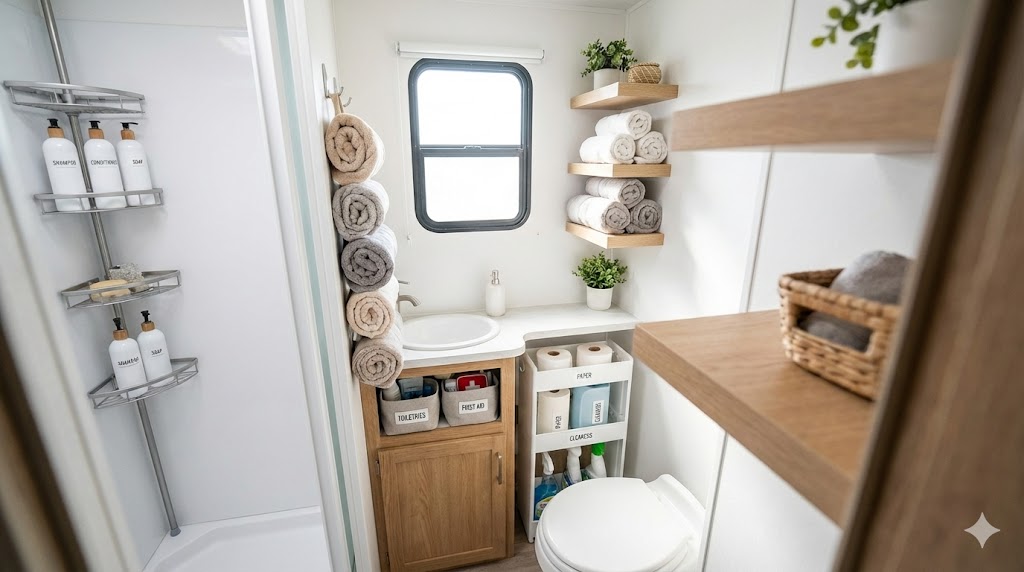
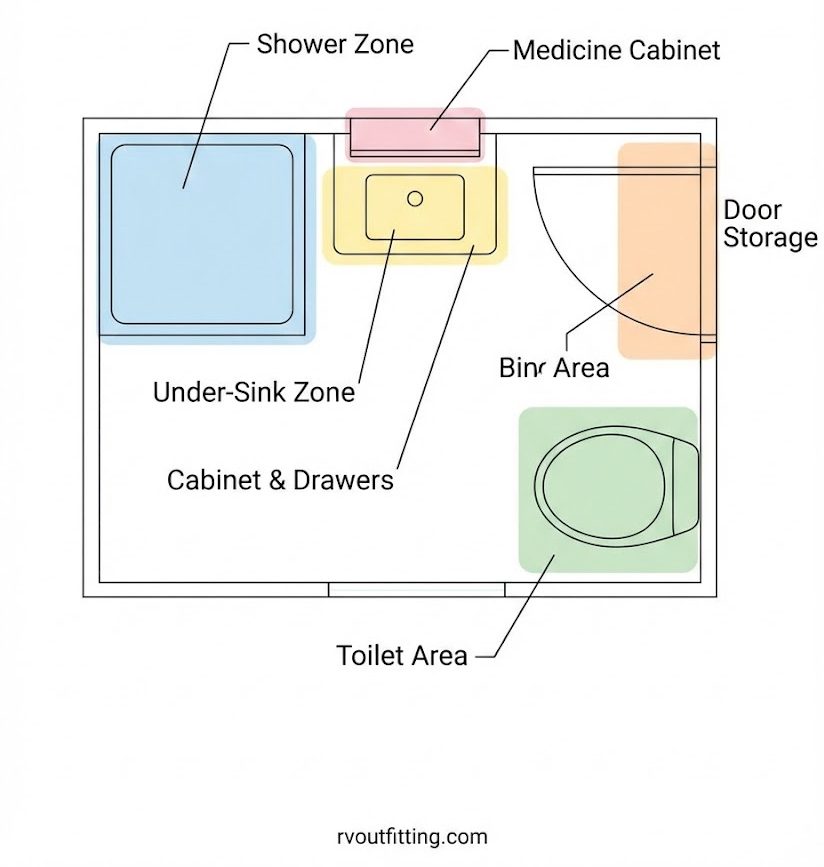
These RV bathroom storage ideas are organized zone by zone—shower, under-sink, cabinets, toilet area, and doors—so you can find solutions that actually stay put on bumpy roads and hold up in humid, compact spaces.
Quick Answer / Quick Start
If you just want to get organized fast, start here:
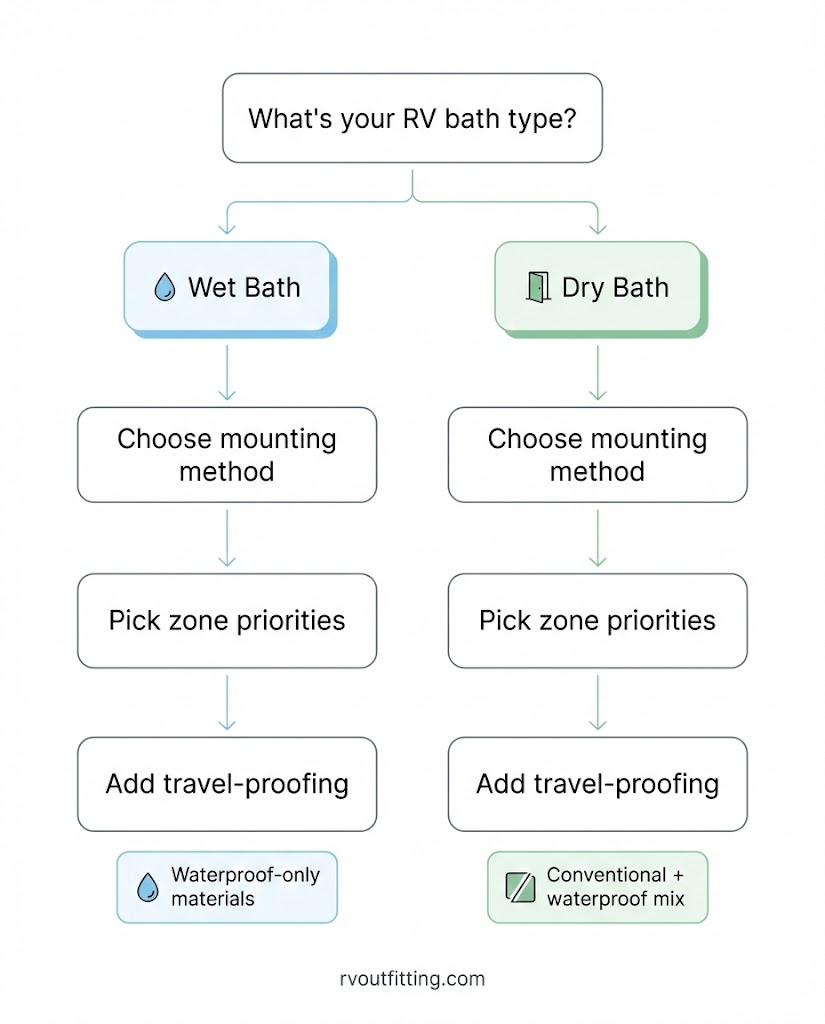
- Identify your bath type first. Wet bath and dry bath RVs need completely different materials and mounting approaches.
- Pick the right mounting method before buying anything. Adhesive, tension, and screw-in options each have trade-offs based on your wall material and humidity level.
- Prioritize three zones: shower storage, towel drying, and toilet area—these create the most daily clutter.
- Measure everything twice. RV door swings, under-sink plumbing, and shower walls are rarely standard sizes.
- Travel-proof every install. Vibration and road bumps will test every shelf, hook, and caddy you add.
- Avoid fabric organizers in wet zones. Humidity and thin RV walls change what “works”—mildew is a real risk.
- Use containment bins and grip pads to keep items from shifting during travel.
⚠️ One-line caution: RV bathrooms are more humid and have thinner walls than home bathrooms. Solutions that work in a house often fail in an RV.
Your RV Bathroom Type + How You Travel
Before you buy a single hook or shelf, you need a quick plan. The wrong organizer for your bathroom type wastes money and creates problems on the road. Spend two minutes here and everything else in this guide gets easier.
Wet bath vs dry bath (what changes)
A wet bath combines the shower, sink, and toilet into one open room—the entire space gets wet when you shower. A dry bath separates the shower from the rest of the bathroom with a wall or door, keeping the toilet and vanity area dry.
Wet-bath rules:
- Every storage item must be waterproof or water-resistant—no fabric pockets, cardboard, or untreated wood.
- Setups need to dry fast since the whole room gets soaked.
- Fewer traditional door-mount or cabinet options because everything is exposed to spray.
Dry-bath rules:
- You can use more conventional door-mounted organizers and cabinet systems outside the shower stall.
- Standard over-the-door pockets and fabric caddies work in the dry zones.
- Shower-specific storage still needs to be moisture-safe, but you have more flexibility elsewhere.
Full-time vs weekend (storage that fits your routine)
Weekenders and short-trippers:
- Prioritize pack-and-unpack-friendly options like hanging toiletry bags and portable bins you can grab and go.
- Removable organizers work well since you’re breaking camp frequently.
- Keep it minimal—you don’t need a system, just a few reliable containers.
Full-timers:
- Invest in semi-permanent installs where everything has a designated home.
- Build in redundancy for toiletries (backups stored separately so you don’t run out mid-trip).
- Think long-term durability—adhesive that holds for months, bins that stack consistently, labels that stay readable.
Measure + map your zones before buying
This step prevents the most common RV storage mistake: buying something that doesn’t fit.
What to measure:
- Door swing clearance (both the bathroom door and any cabinet doors)
- Shower wall dimensions, including any curves or angled corners
- Under-sink space, accounting for plumbing pipes and hoses
- Cabinet depth and shelf height
- Any gap between the toilet and the wall
📏 Rule of thumb: Measure, then measure again. RV dimensions vary wildly between manufacturers, and even a half-inch difference can make an organizer useless.
Mounting Methods That Actually Work in RV Bathrooms
Getting the mounting method right is the single biggest factor in whether your storage survives travel. Here’s what actually holds in RV conditions.
Adhesive/Command-style mounting (when it wins)
Adhesive mounting works best for lightweight items on smooth, non-porous surfaces. It’s the most RV-friendly option for renters and anyone who doesn’t want permanent holes.
Placement rules:
- Surface must be clean, completely dry, and flat before applying.
- Avoid textured panels, porous surfaces, and anything with a rough finish—adhesive won’t bond properly.
- Humidity is the enemy. In wet-bath environments, adhesive needs extra care and may need replacement more often.
Quick “test before road trip” routine:
- Apply the mount and let it cure fully (follow the product’s instructions).
- Load it with the intended items.
- Give it a firm tug before you hit the road.
- Check it again after your first drive—vibration reveals weak bonds fast.
Suction cups (when they fail and what to do instead)
Suction cups are the most common RV shower storage failure. They lose grip when the surface is wet, slightly textured, or exposed to temperature changes—which describes most RV showers.
What to use instead:
- Adhesive-mounted shelves designed for wet environments
- Tension-pole systems that press between two surfaces without attaching to the wall
- Corner bar systems with strong adhesive bases
🚫 Skip the suction cups. If you’ve already tried them and they keep falling, it’s not user error—it’s the wrong method for the environment.
Screws + anchors (thin walls + hidden wires cautions)
Screwing into RV walls gives the strongest hold, but comes with real risks.
Cautions:
- RV walls are thinner than residential walls. Standard drywall anchors may punch straight through.
- Wires and plumbing can run behind panels in unexpected places. Always know what’s behind the wall before drilling.
- Use anchors appropriate for your wall material—options include toggle bolts, molly bolts, and specialty RV wall anchors.
If you’re not confident about what’s behind a panel, adhesive or tension methods are the safer choice.
Mini Decision Table (mounting method selector)
| Factor | Adhesive / Command-Style | Suction Cups | Screws + Anchors |
|---|---|---|---|
| Surface type | Smooth, non-porous | Smooth, non-porous only | Most wall types |
| Wet zone safe? | Yes, with care | Unreliable | Yes |
| Travel vibration | Good for light loads | Poor—tends to pop off | Strongest hold |
| Removable? | Yes, usually damage-free | Yes | No—leaves holes |
| Best for | Light to medium items | Avoid in most RV use | Heavy or permanent items |
| Biggest risk | Humidity weakens bond | Falls during travel | Hidden wires/plumbing |
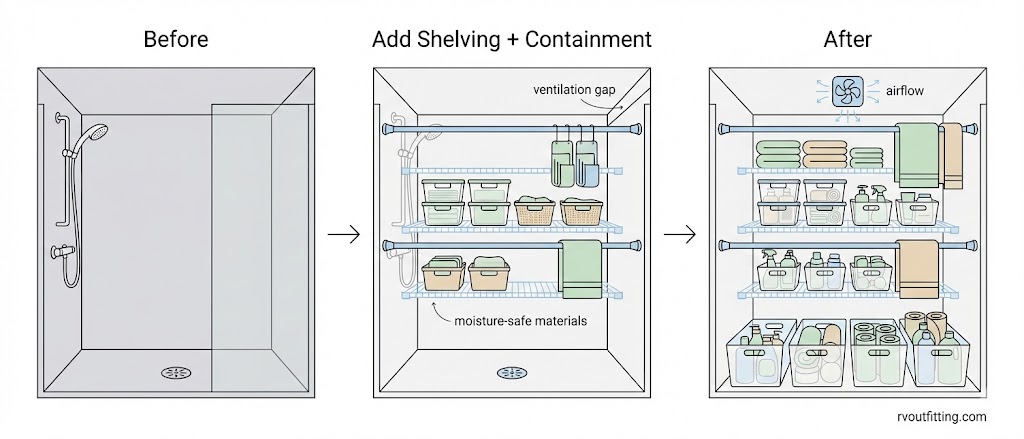
RV Shower Storage Ideas (The Wet Zone)
The shower is the highest-frustration zone in any RV bathroom. Everything gets wet, space is tiny, and items fall constantly during travel. Here’s what actually works.
Corner bar systems (adjustable corner storage)
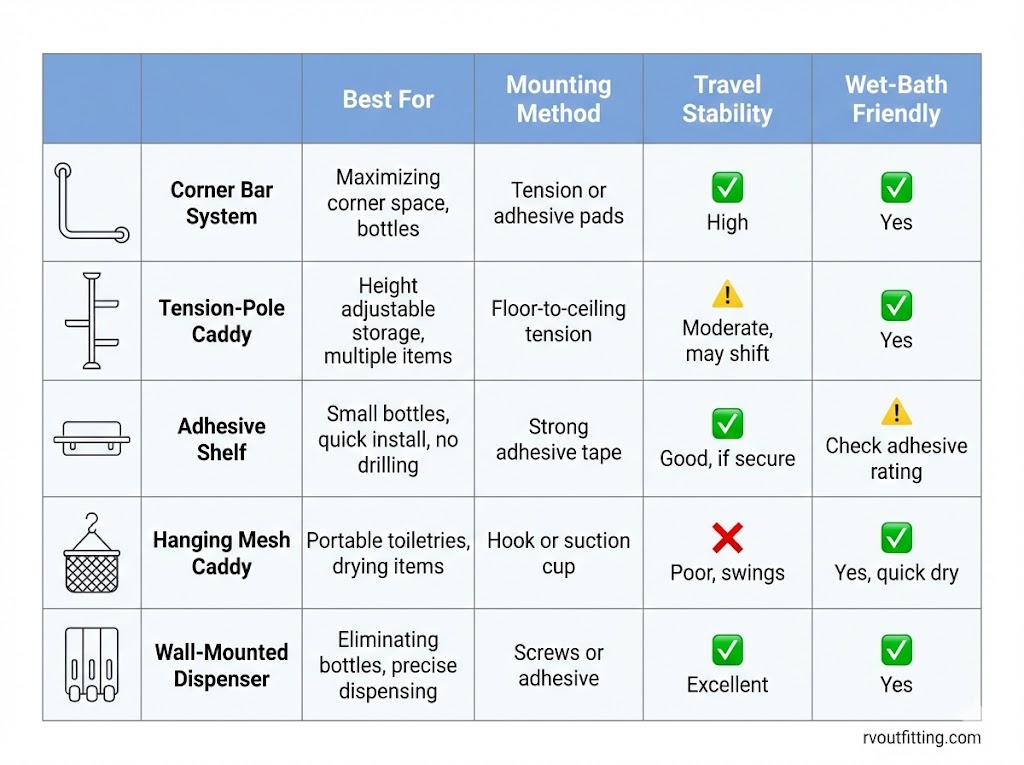
Corner storage bars are one of the most popular trending solutions for RV showers right now. They press into a corner and hold baskets or shelves at adjustable heights.
- Adjustable range fits corners from roughly 7–13 inches. [Source: dossier/outline]
- Typically adhesive-mounted, so no drilling required. [Source: dossier/outline]
- Popular because they use dead corner space and keep bottles off the shower floor.
- Work well in both wet baths and dry-bath shower stalls.
Tension-pole shower caddies (no-drill)
Tension-pole caddies wedge between the floor and ceiling (or between two walls) and hold multiple tiers of shelves.
- Best in dry-bath shower stalls where the pole sits inside a defined space.
- In wet baths, the entire pole and every shelf gets soaked—make sure all components are rust-resistant.
- Check tension after a few drives. Road vibration can gradually loosen the fit.
Adhesive shower shelves + wall-mounted dispensers
Adhesive shelves give you flat storage on shower walls without drilling. Wall-mounted dispensers let you ditch individual bottles entirely by refilling built-in pump containers.
- Shelves are best for holding a few bottles and a soap dish.
- Dispensers reduce clutter dramatically—fewer loose bottles means fewer things to fall during travel.
- The trade-off: dispensers need occasional refilling, but you save significant space and eliminate bottle clutter.
Hanging mesh caddies + shower curtain organizers
Mesh caddies hang from a showerhead, curtain rod, or hook and hold lightweight toiletries in pockets.
- Mesh drains and dries faster than solid fabric, which matters in humid RV bathrooms.
- Mildew prevention: Let the caddy dry fully between showers. In wet baths, remove it from the shower area and hang it where air circulates. Don’t leave damp mesh caddies hanging in a closed space.
- Best for dry-bath setups where you can close the shower and let things air out.
Double shower rod + S-hooks/curtain rings
Adding a second tension rod in the shower creates a whole new “lane” of hanging storage.
- Use S-hooks or curtain rings to hang lightweight baskets, loofahs, or spray bottles from the second rod.
- The inner rod holds the curtain; the outer rod becomes your storage rail.
- Keeps items within reach during a shower without taking up shelf or floor space.
“Nothing falls” hack: plexiglass shelf barriers
This is a simple upgrade that solves one of the biggest RV shower complaints: items sliding off shelves during travel.
- Attach a small plexiglass strip or lip along the front edge of any flat shelf.
- The barrier acts like a guard rail, keeping bottles and containers from sliding off when the RV moves.
- Works on adhesive shelves, built-in shelves, or any flat surface in the shower area.
Under-Sink Organization (Working Around Plumbing)
The under-sink cabinet is prime real estate, but RV plumbing makes it awkward. Pipes, hoses, and valves eat into the usable space, and standard organizers rarely fit. Here’s how to work around it.
Expandable shelves + stacking bins
Expandable shelf organizers adjust in width to fit around pipes, giving you a second “floor” inside the cabinet. Pair them with small stacking bins to create organized tiers.
- Measure around the plumbing first—know where the pipes sit before ordering any shelf.
- Stackable bins keep smaller items corralled and prevent everything from becoming a jumbled pile.
- Group items by use: cleaning supplies on one side, personal care on the other.
Tension rod for spray bottles
A tension rod mounted horizontally inside the cabinet creates instant hanging storage.
- Hang spray bottles by their triggers from the rod—they take up zero floor space.
- Frees up the cabinet floor for bins and larger items.
- Quick to install, easy to remove, and works in almost any under-sink space.
Cleaning supplies in a moving bathroom (dedicated, safer storage)
Cleaning products deserve their own dedicated bin under the sink, separate from personal care items.
- Use a contained bin with a lid or high sides so nothing tips or spills during travel.
- Keep chemical products separated from each other and away from toiletries.
- Secure the bin so it doesn’t slide—a grip pad underneath helps.
⚠️ Travel rule: Before hitting the road, confirm that every bottle under the sink is upright, capped, and contained. A spilled cleaner in a closed cabinet creates fumes and mess you don’t want to discover at your next stop.
Cabinet & Drawer Storage (Small Stuff Control)
Drawers and cabinets in an RV bathroom become junk drawers fast. The key is containment and grouping—every item needs a defined spot, or it ends up everywhere.
Clear bins + drawer dividers + stackables
Group by “use moments”:
- Shower kit (body wash, razor, shampoo)
- Teeth (toothbrush, toothpaste, floss)
- Hair (brush, ties, clips, products)
- Meds/first aid (daily meds, bandaids, pain relievers)
Use clear bins so you can see contents at a glance. Drawer dividers keep bins from sliding. A “label-lite” approach works well: one small label per bin rather than labeling every item.
Lazy Susan for deep cabinets
Deep RV cabinets become black holes where items disappear into the back. A small Lazy Susan (turntable) lets you rotate everything into reach.
- Best for items you grab often: skincare, hair products, daily meds.
- Works better than digging and restacking every time you need something.
- Choose one sized to fit the cabinet without blocking the door’s closing clearance.
Magnetic strips on cabinet doors (micro-item win)
The inside of a cabinet door is hidden storage space most people ignore.
- Mount a magnetic strip on the door interior to hold bobby pins, hair clips, tweezers, nail clippers, and other small metal items.
- Keeps micro-items visible and accessible instead of lost in a drawer.
- Low-profile and doesn’t interfere with the cabinet closing.
Medicine Cabinet Organization (No-Rattle, No-Lost Items)
Medicine cabinets in RVs are small, shallow, and everything inside rattles on the road. The goal is modular, padded, and secure.
Magnetic boxes + toiletry pouches
Use small magnetic containers and zippered toiletry pouches to create a modular system inside the medicine cabinet.
- Magnetic boxes stick to metal cabinet surfaces and hold tiny items (cotton swabs, pills, band-aids) without sliding.
- Toiletry pouches can be grabbed as a unit on travel days or when using campground bathrooms.
- The “modular packs” approach means you can rearrange or grab-and-go without reorganizing the whole cabinet.
Mirror-back storage (hooks on the back of the mirror)
If your medicine cabinet has a mirror door, the back of that mirror is usable space.
- Add small adhesive hooks to hold necklaces, hair ties, cords, or lightweight accessories.
- Padding tip: Add a small felt pad or foam bumper between the hooks and the mirror surface to prevent banging and rattling during travel.
Elastic/staple hack (secure tiny items)
This niche hack uses strips of elastic stapled or adhesive-mounted inside a cabinet to create loops that hold tiny items flat against the wall.
- Useful for items like nail files, small tubes, or single-use packets.
- Keeps everything visible and in place without rattling.
⚠️ Caution: This is a light-duty hack for very small, lightweight items only. Keep it neat and don’t overload the elastic strips.
RV Towel Storage Ideas + Drying Without the Funk
Towels are one of the biggest space and moisture challenges in an RV bathroom. You need to store them, dry them, and keep them from smelling—all in a tiny space.
Hooks for wet towels + outdoor drying workflow
Hooks are the most space-efficient way to hang wet towels in an RV bathroom.
- Mount hooks where air can circulate—not behind a closed door or in a sealed cabinet.
- Best practice: Whenever possible, dry towels outside the RV. Hang them on an outdoor line, over a chair, or on a door-mounted hook with the door open. This keeps moisture out of the bathroom entirely.
- Indoor hooks work for overnight drying, but make sure there’s ventilation.
Swivel towel bars + compact racks
Swivel towel bars fold flat against the wall when not in use and swing out when you need them.
- They beat fixed towel bars in tight clearances because you can push them out of the way.
- Compact racks with multiple arms let you hang several towels in the space a single fixed bar would use.
Rolling technique + towel containment
Rolling towels instead of folding them saves space and makes them easier to stack or store in bins.
- Rolled towels fit neatly into baskets, bins, or open shelving.
- Use a bin or basket with sides to contain rolled towels and prevent them from unrolling and sliding during travel.
Caution: wine rack towel holder (when it’s not practical)
You’ll see the “wine rack as a towel holder” idea recommended frequently online. It looks great in photos but has real limitations in an RV.
- Wine racks are designed for heavy, rigid bottles—not soft, bulky towels that shift and unroll.
- In a moving RV, rolled towels tend to slide right out of wine rack slots.
- If you love the look, it can work for display at a stationary campsite, but don’t count on it as your primary RV towel storage.
Toilet Area Storage (TP, Trash, and Daily Essentials)
The toilet zone is tight, but there’s usually some vertical wall space and slim gaps to work with. The key is slim, vertical storage that doesn’t block movement.
Toilet paper storage that fits small spaces
- Wall-mounted holders keep rolls off the floor and within reach.
- Covered holders or enclosed storage protect rolls from moisture in wet baths.
- RV-safe toilet paper matters: Standard household toilet paper can clog RV plumbing. Store RV-safe or septic-safe rolls and keep them accessible so nobody grabs the wrong kind.
Slim trash cans + discreet placement
A slim, narrow trash can fits where a standard bin won’t.
- Place it where it won’t block the door swing or get in the way of your legs when sitting.
- Look for cans with lids to contain odors in the small space.
- A spot beside the toilet or tucked against a wall works best.
Behind-toilet wall space (spice-rack shelf hack)
The wall behind the toilet is often completely unused. A small spice-rack-style shelf turns this “dead wall” into functional storage.
- Mount a shallow shelf or two for daily essentials: air freshener, a small plant, reading material, or extra TP.
- Keep items lightweight since this is typically a thin wall.
- Adhesive-mounted options avoid drilling into the wall behind the toilet where plumbing may run.
Using Doors for Extra Storage (Hidden Square Footage)
Every door in your RV bathroom—the entry door, cabinet doors, even the shower door—has a back side that can hold storage. It’s the most overlooked space in a tiny bathroom.
Over-the-door pocket organizers
Pocket organizers hang over the top of a door and provide rows of pockets for small items.
- Best for light, dry items: hair products, small toiletry bags, brushes, accessories.
- Mold caution: Don’t store damp items in fabric pockets. In humid bathrooms, fabric pockets can develop mildew quickly. Choose mesh or vinyl pockets for better airflow.
- Make sure the organizer doesn’t prevent the door from closing fully.
Cabinet-door caddies + towel racks on doors
Small caddies or slim racks mounted on the inside of cabinet doors add storage without taking any shelf space.
- Prevent banging: Use adhesive bumper pads where the caddy contacts the cabinet frame to reduce noise during travel.
- Keep weight low. A heavy caddy on a cabinet door stresses the hinges and can cause the door to sag or swing open during driving.
- Best for lightweight items: small spray bottles, sponges, or a hand towel.
Keep Items From Shifting During Travel (Road-Tested Rules)
This is where most RV bathroom setups fail. Everything looks great parked—then you drive for an hour and find chaos. Use these rules to travel-proof your bathroom.
Containment first (bins, baskets, barriers)
The number-one rule is containment. Loose items fall. Contained items don’t.
- Put items in baskets or bins with sides—not just on open shelves.
- Use silicone grip pads under bins and containers to keep them from sliding.
- Add “guard rails” or lip barriers on any open shelf (the plexiglass hack from the shower section works here too).
Museum putty/wax + magnetic strips
For items that sit on surfaces but can’t go in a bin, these two stabilizers work well.
- Museum putty/wax holds lightweight containers, décor, or dispensers in place without permanent bonding. Peel it off when you want to move something.
- Magnetic strips keep metal items (clips, pins, small tools) secured to a surface.
- Both are inexpensive, removable, and surprisingly effective against road vibration.
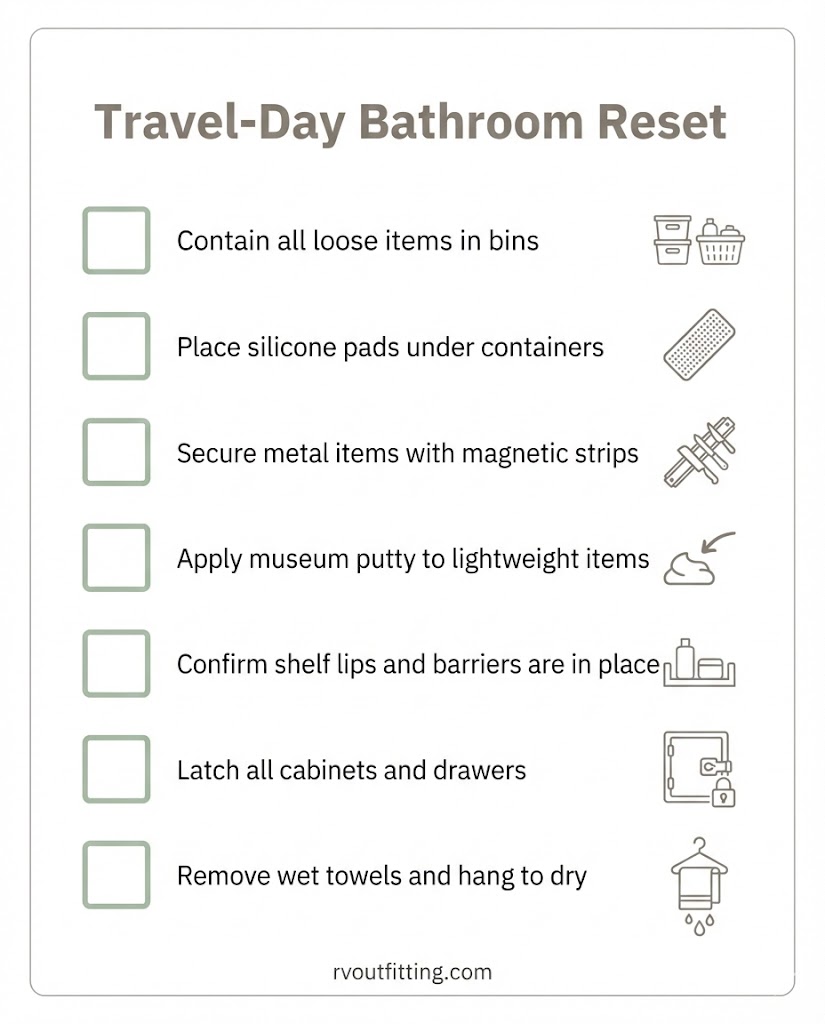
Travel-day reset routine
Before you drive, run through this quick checklist:
- ✅ Close and latch all cabinets and drawers.
- ✅ Stow any wet items (remove damp towels, empty hanging caddies if needed).
- ✅ Confirm adhesion points—give a quick tug on adhesive-mounted shelves and hooks.
- ✅ Reduce hanging loads—take heavy items off hooks and door organizers.
- ✅ Cap and secure all bottles, especially under the sink.
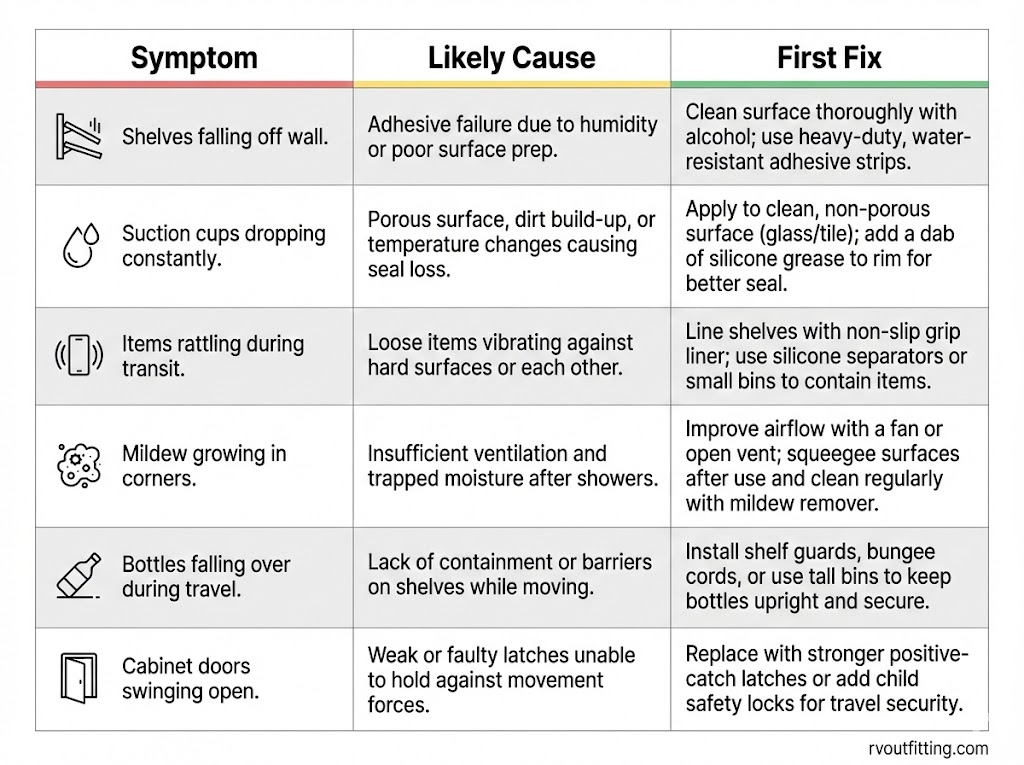
Troubleshooting Matrix: When Storage Fails
When something goes wrong, fix the root cause instead of buying another organizer.
Matrix (table)
| Symptom | Likely Cause | First Fix |
|---|---|---|
| Shelves fall off the wall | Poor surface prep, overloaded weight, humidity weakening adhesive | Clean and dry the surface thoroughly, reduce load, or switch to tension/screw mounting |
| Suction cups keep dropping | Moisture on the surface, textured or porous wall material | Switch to adhesive-mount shelves or a tension-pole system |
| Items rattle constantly | No containment—loose items on open shelves | Add bins, baskets, padding, or museum putty |
| Mildew growing on organizers | Slow-drying fabric pockets in a humid space | Remove fabric organizers from wet zones; replace with mesh, plastic, or metal options |
| Bottles fall during travel | No shelf lip or barrier | Add plexiglass barriers, grip pads, or move bottles into a contained bin |
| Cabinet doors swing open | Latch not engaged or latch worn out | Replace or add magnetic or mechanical cabinet latches |
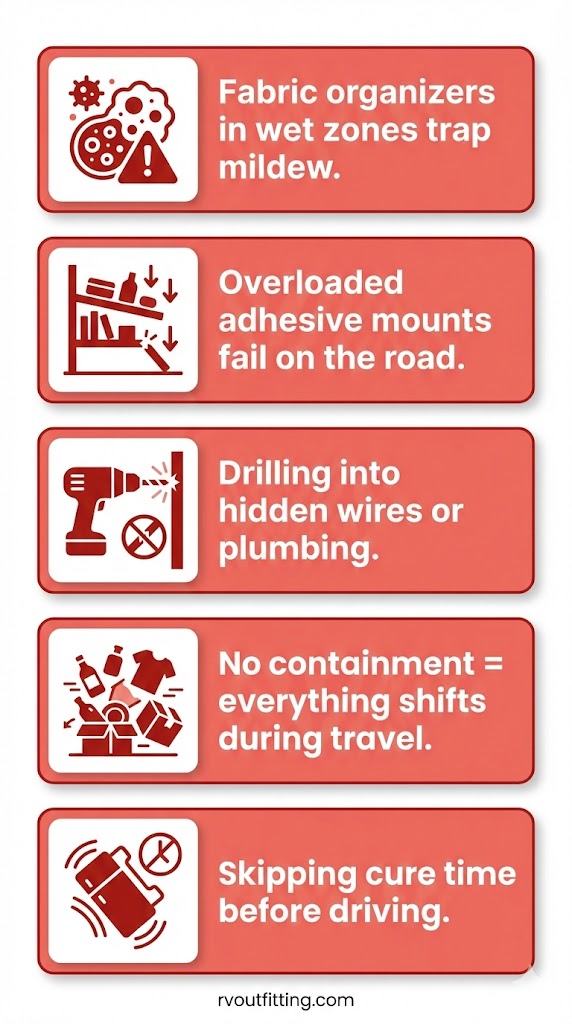
Mistakes to Avoid (Wall Damage, Mold, Annoying Clutter)
These are the mistakes that cost the most time, money, and frustration—and most RV storage guides don’t warn you about them.
Mold/mildew traps (shoe organizers in bathrooms)
Fabric shoe organizers are popular recommendations for bathroom doors—but in a humid RV bathroom, they’re mildew magnets.
- The fabric pockets trap moisture, especially in wet baths where the whole room gets steamy.
- Mildew can set in quickly and is difficult to remove from fabric.
- Safer alternatives: Use vinyl or mesh pocket organizers, or stick with hard-surface storage (shelves, hooks, bins) in wet zones.
Overloading adhesive mounts + ignoring cure time
Adhesive mounts have limits. Two common mistakes kill them:
- Overloading: Piling too much weight on a mount rated for lighter loads. When in doubt, underload.
- Skipping cure time: Not letting the adhesive fully bond before adding items or driving. Always follow the product instructions and test before hitting the road.
🧪 Rule: Test before travel. Load it, tug it, drive a short distance, and check it.
Drilling without knowing what’s behind the wall
Drilling into an RV wall without checking what’s behind it can hit wiring or plumbing—and those repairs are expensive.
- RV walls are thin and often have wiring, water lines, or propane lines running in unexpected places.
- If you can’t verify what’s behind a panel, don’t drill. Use adhesive or tension methods instead.
- When you do drill, start with the smallest pilot hole possible.
Newer RV Bathroom Upgrades & Trends (2024–2026)
These are emerging trends worth knowing about, especially if you’re upgrading an existing setup or building out a new rig.
Trending storage + stability hacks
- Magnetic hooks are showing up more frequently in full-timer upgrade content as a versatile, removable option for towels, caddies, and small tools.
- Museum wax is becoming a standard recommendation for securing lightweight items during travel.
- Combination approaches—adhesive plus containment plus grip pads—are replacing single-method setups.
Wet bath popularity in small builds + multi-use space focus
Wet baths are increasingly common in smaller RV builds, campervans, and van conversions. This is driving demand for multi-use storage solutions that function in fully wet environments and do double duty (storage that also serves as a drying rack, for example).
Composting toilets changing storage needs
As more RVers switch to composting toilets, bathroom storage needs shift.
- Different supplies are needed (composting medium, ventilation maintenance items).
- Cleaning routines change, affecting what gets stored and where.
- Layout priorities shift because the toilet footprint and plumbing setup are different.
Sustainability angle
Eco-conscious RVers are driving some practical storage trends:
- Refillable dispensers reduce plastic bottle clutter and save space.
- Bamboo accessories (shelves, hooks, organizer trays) are replacing plastic in some setups.
- Less single-use packaging means less trash can volume needed—which saves space.
Mini FAQ
How do you organize a small RV bathroom with no storage?
Start with the doors (over-the-door organizers), add adhesive hooks on empty wall space, use a tension rod under the sink for spray bottles, and put small bins inside any cabinet. Focus on vertical space and the backs of doors—that’s where hidden storage lives.
What is the best shower caddy for an RV?
Adjustable corner bar systems and tension-pole caddies tend to perform best because they don’t rely on suction cups. Look for waterproof, rust-resistant materials and something that won’t shift during travel.
How do you store towels in a small RV bathroom?
Roll towels instead of folding them, use hooks for wet towels, and dry outside when possible. Swivel towel bars save space because they fold flat against the wall when not in use.
How do you keep things from falling in an RV shower while traveling?
Use containment bins, add plexiglass lip barriers to shelves, apply silicone grip pads under containers, and secure bottles with museum putty. Avoid suction-cup organizers—they fail on the road.
What are the best no-drill storage solutions for an RV bathroom?
Adhesive-mounted shelves, tension rods, tension-pole caddies, over-the-door organizers, and magnetic strips. These all install without putting holes in your walls.
How do you organize under the sink in an RV?
Use an expandable shelf that adjusts around the plumbing, hang spray bottles from a tension rod, and keep cleaning supplies in a dedicated lidded bin. Measure around the pipes before buying anything.
What is the best way to store toilet paper in a camper?
Use a wall-mounted holder or an enclosed container to protect rolls from moisture. Always stock RV-safe or septic-safe toilet paper and keep it within easy reach of the toilet.
How do I maximize space in my RV bathroom?
Prioritize vertical space: hooks on walls, organizers on door backs, shelves above the toilet, and tension rods under sinks. Measure every zone, use containment bins, and eliminate anything that doesn’t earn its space.
What can I use instead of suction cups in an RV shower?
Adhesive-mounted shelves, corner bar systems, tension-pole caddies, and shower curtain rod hooks with S-hooks. All of these hold up better than suction cups in humid, vibrating RV environments.
How do you dry towels in an RV?
Hang them outside whenever possible. Indoors, use hooks in a ventilated spot or a swivel towel bar. Avoid drying towels in closed cabinets or behind shut doors—air circulation prevents musty smells.
What is the best RV bathroom trash can?
A slim, narrow trash can with a lid. It should fit beside the toilet or against a wall without blocking door swing or leg space. Lids help contain odors in the small space.
How do you organize a wet bath in an RV?
Use only waterproof or water-resistant storage. Adhesive-mounted shelves, tension-pole caddies, and waterproof bins are your core tools. Avoid fabric organizers. Everything needs to dry fast since the whole room gets wet.
Can you use Command hooks in an RV bathroom?
Yes, adhesive-style hooks work well on smooth, clean, flat surfaces. Let them cure fully before loading, avoid textured or porous panels, and always test before driving. Humidity can weaken the bond over time, so check periodically.
How do I keep my medicine cabinet organized while traveling?
Use magnetic containers and zippered toiletry pouches to create a modular system. Add felt padding between items and the cabinet surface to prevent rattling. Keep it modular so you can grab pouches for campground bathrooms.
What are the best RV bathroom accessories for full-time RVers?
Adhesive-mounted shelves, expandable under-sink organizers, a Lazy Susan for deep cabinets, magnetic strips for micro-items, museum putty for travel stability, and refillable shower dispensers. Full-timers benefit from semi-permanent systems where everything has a designated home.