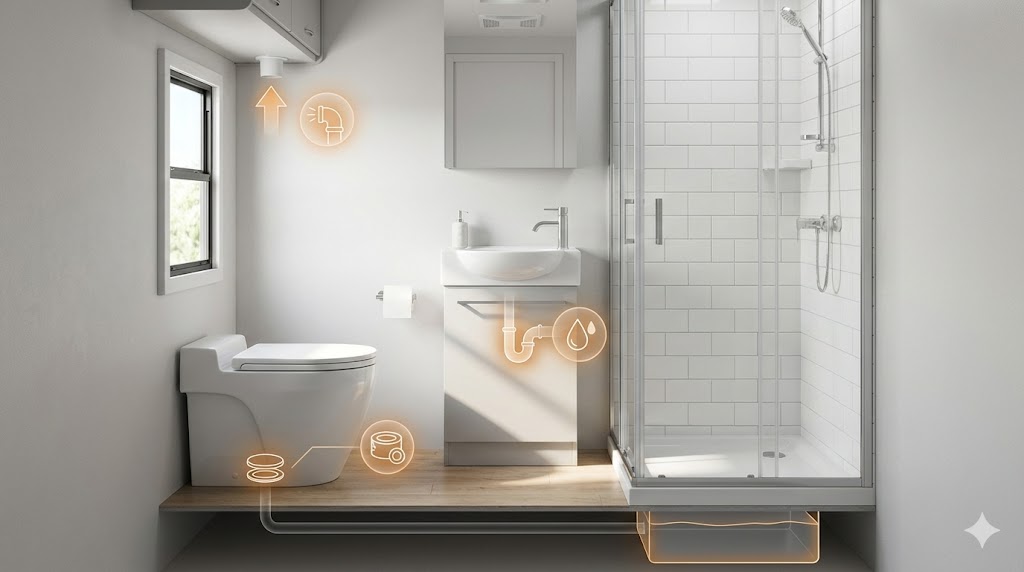
Why Does My RV Bathroom Smell Like Sewer? (2026) Quick Diagnosis Checklist + Step-by-Step Fixes
Last updated: February 2026
If your RV bathroom smells like sewer, this guide walks you through a fast two-minute diagnosis checklist and the exact step-by-step fix that matches your specific symptom — so you stop guessing and start breathing easy.
Quick Summary / Key Takeaways
Primary goal: Diagnose the source of your RV sewer smell in about two minutes, then apply the single fix that matches your symptom. Most RVers can solve this without a technician.
- Smell only when flushing? That usually points to a worn toilet seal, negative pressure from a roof vent fan, or a venting issue at the roof stack.
- Smell coming from drains? Look at dry P-traps, gray tank buildup, or a failed Air Admittance Valve (AAV) first.
- Hot weather making it worse? Odors tend to spike at 85°F and above because heat accelerates bacterial activity and bakes residue onto tank walls.
- Don’t shotgun fixes. Use the decision tree below to isolate the source, then apply one targeted repair. Random product dumping wastes money and time.
- Stay current: If your reading material doesn’t mention AAVs, the Lippert 360 Siphon’s 2025 design update, or the enzyme vs mineral treatment debate heating up in early 2026, it’s already outdated.
- The ~95% case is DIY-friendly. Only a small fraction of sewer smell problems require a technician visit.
Should My RV Toilet Ever Smell? (How the System Should Work)
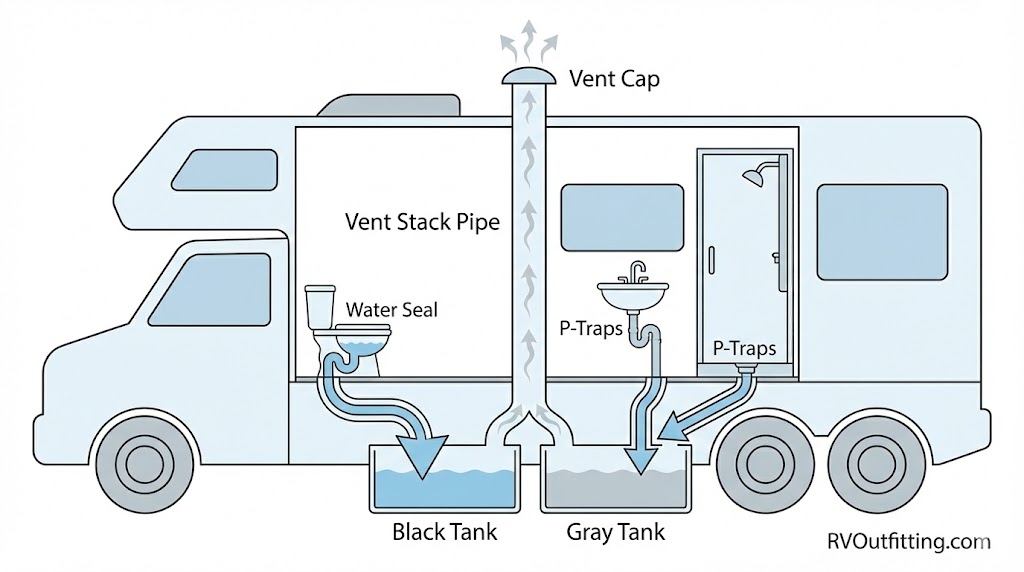
Your RV waste system is designed so you never smell anything inside the coach. Here’s the normal flow: waste drops from the toilet into the black tank, gases rise through the vent stack pipe, and those gases exit above the roofline where wind carries them away. The bathroom stays odor-free because two barriers keep gas out of your living space — a water seal at the toilet and water-filled P-traps at every drain.
There are four main odor pathways that break this system: a failed water seal at the toilet, a dried-out P-trap at a sink or shower drain, a blocked or malfunctioning roof vent pipe, and negative pressure that pulls tank gases backward into the cabin.
What’s normal vs what’s a problem: A brief whiff right at the moment of flushing that disappears within seconds can be normal, especially in warm weather. A persistent sewer smell that lingers, fills the bathroom, or greets you when you open the RV door is a real problem that needs diagnosis.
Quick Diagnosis Checklist (2 Minutes) — “Quick Sniff Test” Decision Tree
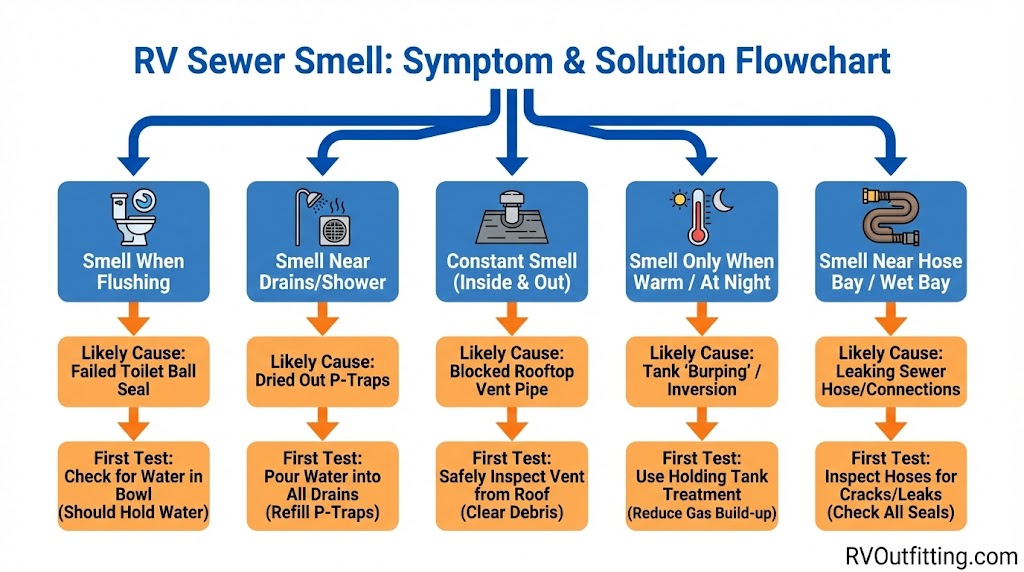
Before you buy anything or start disassembling parts, spend two minutes tracing the smell to its source. Work through these symptom branches one at a time:
Branch 1 — Smell when flushing:
If sewer odor hits you mainly when you press the flush pedal, suspect a worn toilet seal (flush ball or flapper) or negative pressure from a running roof vent fan.
Branch 2 — Smell near drains or shower:
If the strongest odor is at the sink or shower drain, start with dry P-traps. If traps are full and it still smells, suspect gray tank buildup or a failed AAV.
Branch 3 — Smell is constant (all the time):
A 24/7 sewer smell usually points to a clogged or blocked roof vent pipe, significant tank sludge buildup, or a major seal failure at the toilet flange.
Branch 4 — Smell only at night or when it’s warm:
Temperature-driven odor that comes and goes suggests residue buildup in the tank combined with heat expanding gases. Check venting and consider a deep clean.
Branch 5 — Smell near the hose bay / exterior compartment:
If you only smell it outside near your dump connections, the issue may be hose storage, a valve that’s not fully seated, or connections rather than the bathroom system itself.
The Peppermint Oil Diagnostic Hack
Most blogs skip this one. Put a few drops of peppermint oil on a cotton ball, drop it into the toilet, and flush. Then walk through the RV with your nose — wherever you catch peppermint, that’s your leak path. It’s a cheap, effective way to trace exactly where gas is escaping into the cabin.
Two “False Alarm” Checks Before You Panic
False alarm #1 — Gray tank smell mistaken for black tank: Gray tanks (sinks, shower) can produce a sewer-like odor from decomposing food residue and soap scum. Before tearing into the black tank system, confirm which tank the smell is actually coming from.
False alarm #2 — Battery sulfur off-gassing: Some RV battery types (particularly flooded lead-acid) can produce a rotten egg / sulfur smell that mimics sewer gas. If your batteries are located near the bathroom area, rule this out before chasing plumbing problems.
Common Causes of RV Sewer Smell (The 8 You Must Check First)
Dried P-Traps (Sinks/Shower)
Every sink and shower drain in your RV has a P-trap — a U-shaped bend in the pipe that holds a small amount of water. That water acts as a gas barrier. When it evaporates (from storage, heat, or low use), sewer gas from the gray tank flows straight up through the drain and into the cabin.
Symptoms: The strongest odor is right at the drain opening, and it may intensify right after you run a vent fan (which pulls air upward through the now-empty trap). This is one of the most common causes and also one of the easiest to fix — but it recurs if you don’t address the root cause.
Black Tank Valve Left Open (Poop Pyramid)
Leaving your black tank dump valve open while connected to full hookups is one of the most widespread mistakes in RVing. Liquids drain away continuously, but solids stay behind and stack up into what’s known as a “poop pyramid” — a mound of dried waste that blocks flow, fouls sensors, and generates relentless odor.
Symptoms: Persistent smell that dumping doesn’t fully clear. Tank sensors may give inaccurate readings (showing full even after dumping). The tank just never seems “clean.”
Myth buster: The idea that you should leave the black valve open at hookups so the tank “drains itself” is wrong. Keep it closed, let the tank fill, then dump. Liquids need to be present to break down solids and flush them out.
Clogged/Blocked Roof Vent Pipe (Vent Stack Issue)
Your vent stack pipe runs from the top of the black tank up through the RV roof. Its job is to let sewer gases escape above the roofline and allow air into the system so waste flows downward properly. When debris, insect nests, or buildup partially or fully block it, those gases have nowhere to go but back into the cabin.
Symptoms: Odor that worsens in heat or during wind shifts. Smell may spike when flushing because the flush action creates gas pressure that can’t vent upward. You might also hear gurgling at drains.
Vent-cap upgrades (covered in the fixes section) can reduce the likelihood of recurrence and improve airflow.
Leaky Toilet Seal (Flush Ball / Flapper / Bowl Seal / Flange)
RV toilets rely on seals to keep tank gases from rising past the bowl. The most common failure points are the flush ball seal (on pedal-flush Thetford-style toilets), the flapper seal (on Dometic-style toilets), and the flange seal where the toilet base meets the floor.
Symptoms: Sewer smell concentrated near the toilet base or noticeable right after flushing. Sometimes the odor comes in intermittent bursts rather than a constant stream.
Compatible replacement parts vary by toilet model. Common examples include the Thetford seal #31708 and Dometic seal kit #385311462, but always verify compatibility with your specific toilet model before ordering.
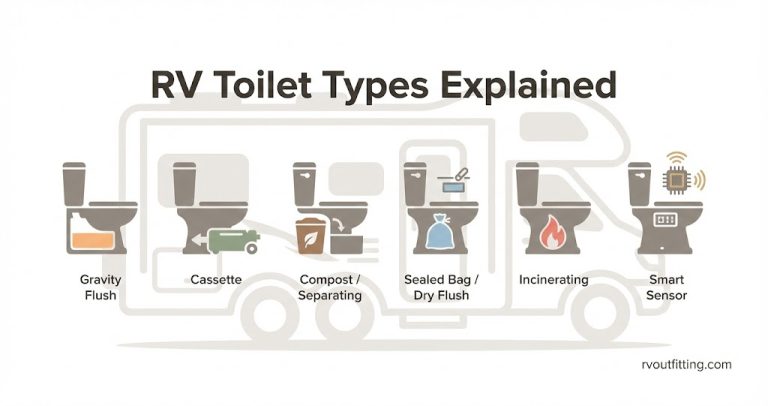
If the seal, flush valve, or flange problem keeps coming back — or your toilet is already uncomfortable or outdated — compare replacement options in our guide to the best RV toilets before spending more on repairs.
Negative Pressure While Flushing (Roof Vent Fan Effect)
Here’s one most people never think about: running your roof vent fan while flushing can create negative pressure inside the bathroom. The fan pulls air upward, and some of that replacement air gets sucked up through the toilet from the black tank below. You’re essentially using the fan to vacuum sewer gas into the room.
Symptoms: Smell appears mainly during or right after flushing, but only when the vent fan is running. Turn the fan off, flush again, and the smell disappears or drops significantly.
This is a behavior fix, not a parts fix — and it’s one of the highest-impact changes you can make for zero cost.
Sludge/Residue Buildup on Tank Walls (Severity Driver)
Over time, waste residue accumulates on the interior walls of your black tank. This residue traps odor-producing bacteria and provides a constant fuel source for the anaerobic (oxygen-starved) conditions that generate the worst smells. It also causes tank level sensors to misread, which can be a clue that buildup is present.
Think of sludge as a severity multiplier. Even if your venting and seals are fine, heavy residue can push odor levels past what those barriers can contain. This is where the difference between routine prevention and a periodic deep clean matters.
Gray Tank Odors Mistaken for Sewer Smell
Your gray tank collects water from sinks and the shower. Food particles, grease, soap scum, and organic residue decompose in that tank and can produce an odor that smells remarkably similar to black tank sewer gas. Many RVers chase black tank fixes for weeks when the gray tank is actually the culprit.
Symptoms: The strongest smell is near sinks or the shower drain rather than the toilet area. Running the kitchen faucet may push a wave of odor up from the drain. If your P-traps are full and the toilet area smells fine, shift your investigation to the gray side.
Failed Air Admittance Valve (AAV / Studor Valve) — The Overlooked Cause
An Air Admittance Valve (AAV), sometimes called a Studor valve, is a one-way valve installed under sinks in many RVs. It allows air into the drain system (so water flows smoothly) but is supposed to close and block sewer gas from escaping back into the cabin. When an AAV fails, it sticks open and becomes a direct odor pathway.
Symptoms: Drain-area odor even when P-traps are properly filled. The smell may change in intensity when you turn your roof vent fan on or off (because the fan affects the air pressure that the AAV responds to).
This is a major diagnostic gap in most online advice. A replacement Oatey AAV is inexpensive and straightforward to install, but you have to know to look for it in the first place.
| Cause | Where It Smells Most | When It’s Worst | First Test |
|---|---|---|---|
| Dried P-Trap | At the sink/shower drain | After storage or low use | Pour water down drain, wait, re-check |
| Black Valve Open (Poop Pyramid) | General bathroom area | Persistent; worse during dump | Close valve, fill tank, dump properly |
| Blocked Vent Pipe | General or near toilet | Heat, wind shifts, flushing | Visual roof check + garden hose flush |
| Leaky Toilet Seal | Near toilet base | During/after flush | Inspect seal visually; check for moisture |
| Negative Pressure (Fan) | Near toilet during flush | Only when roof vent fan runs | Flush with fan off, compare |
| Sludge Buildup | General bathroom | Hot weather; worsens over time | Check tank sensors for misreads |
| Gray Tank Odor | Near sinks/shower | After cooking or heavy sink use | Sniff each drain individually |
| Failed AAV | Under-sink / drain area | Changes with fan on/off | Locate AAV, check if stuck open |
Step-by-Step Fixes (Match the Fix to the Symptom)
Fix #1 — Refill and Stabilize P-Traps
When to use this fix: Smell is strongest at sinks or shower drain; diagnosed as a dry P-trap.
- Run water in every sink and the shower for about 15–20 seconds. This refills the U-bend in each P-trap.
- Wait a few minutes, then sniff the drain again. If the smell drops significantly or disappears, you’ve confirmed the cause.
- Repeat any time the RV has been sitting unused, after storage, or during extended hot weather stretches.
Recurrence tip: P-traps evaporate faster during storage and in hot weather. If you’re parked for weeks without use, make a habit of running water through all drains periodically. Also note that running a vent fan can accelerate evaporation by pulling air through the trap — a dry-trap smell that appears after fan use is a strong diagnostic clue.
Fix #2 — Stop the Poop Pyramid (Close Valve + Correct Dump Routine)
When to use this fix: Persistent odor linked to a black tank that never seems fully clean; diagnosed as poop pyramid or valve-open habit.
- Close the black tank valve immediately if it’s currently open.
- Fill the black tank with water (use the black tank flush or manually add water through the toilet).
- Let it sit to allow solids to hydrate and soften.
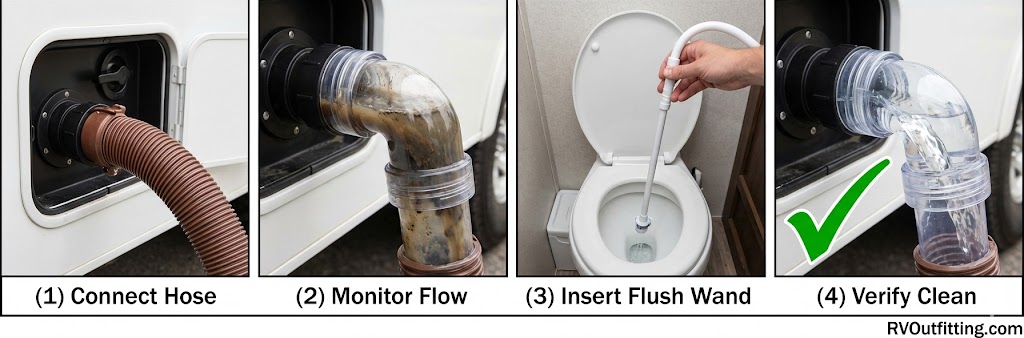
- Dump using a clear dump elbow connector — watch for the flow to run clear as your endpoint.
- Going forward, always keep the black tank valve closed until the tank is at least two-thirds full, then dump.
Helpful tools for this fix include the Valterra Flush King for back-flushing the tank and a clear dump elbow connector so you can visually confirm the tank is clean. A quality sewer hose like the Camco Rhino keeps the hose bay side manageable.
Fix #3 — Unclog/Flush the Roof Vent Pipe
When to use this fix: Smell worsens with heat or wind; spikes when flushing; diagnosed as vent stack blockage.
- Safely access the roof (use a proper ladder on stable ground; if you’re not comfortable on the roof, this is a good one to hand to a technician).
- Remove the vent cap and visually inspect for debris, nests, or buildup.
- Clear any visible obstructions by hand.
- Use a garden hose inserted gently into the vent pipe for a controlled flush downward. Water should flow freely into the black tank.
- Replace the vent cap (or upgrade it — see below).
Safety note: Roof work carries real fall risk. If conditions are wet, windy, or you’re unsure about your RV roof’s weight limits, skip this step and call a tech.
Vent cap upgrade options: The Lippert 360 Siphon and Camco Cyclone are popular vent cap replacements that use wind to actively pull gases upward out of the vent pipe. The 360 Siphon received a 2025 design update that reduced the amount of roof sealant rework required during installation — a meaningful improvement for DIY installers.
Fix #4 — Replace or Recondition Toilet Seals (Ball/Flapper/Flange)
When to use this fix: Smell near the toilet base or during/after flushing; diagnosed as a worn or damaged toilet seal.
- Identify your toilet type and which seal is likely failing. Thetford pedal-flush models typically use a flush ball seal. Dometic models often use a flapper-style seal. The flange seal sits at the toilet base where it mounts to the floor.
- For flush ball or flapper seals, reconditioning with a seal-safe lubricant may restore function temporarily. Use Thetford Toilet Seal Lubricant or an equivalent silicone-based, non-petroleum product. Petroleum-based lubricants degrade rubber seals.
- If lubrication doesn’t resolve the issue, replace the seal. Example part numbers for reference: Thetford #31708, Dometic #385311462. Always verify against your specific toilet model before purchasing.
- For flange seal replacement, you’ll need to remove the toilet from the floor — this is more involved and may warrant a technician for some RVers.
If you’re already pulling the toilet from the floor, it may be smarter to compare repair cost against a replacement. Our best RV toilets breaks down gravity, portable, and composting options by use case.
Fix #5 — Neutralize Negative Pressure During Flush
When to use this fix: Smell appears during flushing only when the roof vent fan is running.
- Replicate the problem: flush the toilet with the roof vent fan running. Note the smell.
- Turn the roof vent fan off completely.
- Flush again. If the smell is significantly reduced or gone, negative pressure was the cause.
- Going forward, turn off the roof vent fan before flushing, then turn it back on afterward.
Why it works in one line: The vent fan creates suction that pulls air (and tank gases) upward through the toilet bowl — turning it off during the flush eliminates that suction pathway.
Fix #6 — Deep Clean the Black Tank (When “Basic” Isn’t Enough)
When to use this fix: Odor persists after addressing seals, venting, and P-traps; tank sensors misread; diagnosed as sludge or residue buildup.
Two-tier model — know which level you need:
Routine prevention: Regular dump routine, adequate water in the tank, and a tank treatment after each dump. This handles most situations.
Deep clean (when routine isn’t cutting it): Sludge visible through a clear elbow, sensors stuck on “full” after dumping, or persistent odor despite other fixes being complete.
Deep clean steps:
- Dump the tank completely using a clear elbow connector to monitor the output.
- Use a black tank flush wand (inserted through the toilet or a dedicated flush port) to blast the tank walls with water.
- Alternate between filling and dumping until the clear elbow shows the water running clear.
- For the toilet bowl itself, a dedicated bowl cleaner like Unique Scrub-It can address surface-level residue. Keep bowl cleaning products separate from tank treatments — they serve different functions.
- For the tank interior during flushes, a small amount of Dawn Ultra dish soap can help break up grease and residue. Use sparingly.
The “Why” Behind the Smell (Aerobic vs Anaerobic Bacteria Science)
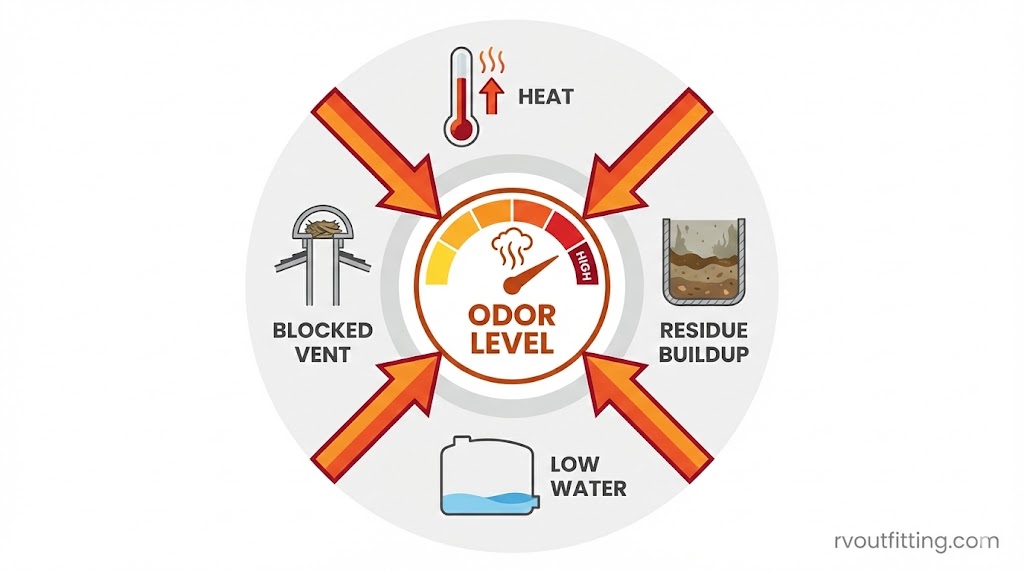
Understanding the biology helps you make smarter decisions about treatments and habits.
Two types of bacteria live in your RV waste tank. Aerobic bacteria need oxygen to work — they break down waste more efficiently and produce far less odor. Anaerobic bacteria thrive without oxygen — they’re less efficient at breaking down waste and they produce hydrogen sulfide (H₂S, the classic “rotten egg” sewer smell) and methane as byproducts.
The conditions inside a sealed, warm, poorly vented black tank heavily favor anaerobic bacteria. Residue on tank walls, low water levels, high heat, and blocked venting all reduce oxygen availability and push the environment toward maximum stink production.
The action takeaway: Anything you do that increases water volume, improves venting airflow, reduces residue buildup, or lowers tank temperature is working directly against the conditions that produce the worst odors.
Choosing the Right Tank Treatment (Enzyme vs Mineral vs Chemical) — 2025–2026 Freshness Battle
The RV tank treatment market is noisy right now, and early 2026 has seen real debate between enzyme-based and mineral-based approaches. Here’s a framework to cut through it.
Three categories, different priorities:
Mineral-based (example: Happy Campers): Uses mineral compounds to control odor directly. Tends to work fast on smell. Fans emphasize simplicity and immediate results.
Bacteria/enzyme-based (example: Unique RV Digest-It Ultra): Introduces beneficial bacteria and enzymes that actively break down waste. Prioritizes “liquefaction” — turning solids into liquid for cleaner dumps. Odor control is a byproduct of the biological breakdown process.
Enzyme-based (examples: Walex Bio-Pak, Walex Bio-Fresh, EcoStrong): Similar biological approach with variations in enzyme formulation and added deodorizers. Some lean more toward odor-first, others toward breakdown-first.
The “odor-first” vs “liquefaction-first” distinction matters: If your primary problem is smell and you need fast relief, mineral-based treatments tend to deliver quicker results. If you want long-term waste breakdown and cleaner tanks over time, enzyme/bacteria-based options may serve you better — but they can take longer to show odor results and may underperform in extreme heat.
Hot weather note: At 85°F and above, many RVers report that their usual treatment stops keeping up. Higher temperatures accelerate bacterial activity faster than some treatments can counteract. If you’re a warm-climate or summer camper, factor heat performance into your choice and consider increasing treatment frequency during peak heat.
| Treatment Type | Example Products | Best Use Case | Hot Weather Note | Primary Strength |
|---|---|---|---|---|
| Mineral-based | Happy Campers | Fast odor knockdown | Generally holds up well | Odor-first |
| Bacteria/enzyme | Unique RV Digest-It Ultra | Long-term waste breakdown | May need increased dosing above 85°F | Liquefaction-first |
| Enzyme | Walex Bio-Pak, Bio-Fresh, EcoStrong | Balanced odor + breakdown | Performance can drop in extreme heat | Varies by formula |
Freshness & Recent Updates (2025–Feb 2026) — What Changed and Why It Matters
If you’re reading conflicting advice about tank treatments in early 2026, you’re not imagining things. The January–February 2026 online discussion around enzyme vs mineral treatments has been unusually active, with strong opinions on both sides. Mineral advocates point to simplicity and fast odor results; enzyme advocates argue for long-term tank health. Neither side is completely wrong — the right choice depends on your priority (smell now vs tank condition over time).
On the hardware side, Lippert released an updated 360 Siphon vent cap design in 2025 that reduced the roof sealant rework previously required during installation. If you looked at the 360 Siphon before and were put off by the install complexity, the newer version is worth a second look.
The competitive freshness bar is high right now. Major competitors in this space updated their content as recently as February 2026, which means any guide that doesn’t address AAVs, the enzyme vs mineral debate, and current vent cap options will fall behind quickly.
Seasonal & Edge-Case Scenarios Competitors Miss
Smell After Storage / Dewinterizing
Pulling your RV out of storage and getting hit with sewer smell is extremely common — and it doesn’t mean something is broken. Dormant systems trigger odors for predictable reasons: P-traps evaporate during months of non-use, tank residue sits and ferments, and venting conditions may change with seasonal weather.
“First hour after storage” checklist:
- Refill every P-trap (run water in all sinks and the shower)
- Do a quick tank flush through the toilet
- Check roof vent pipe for debris or seasonal blockage (leaves, ice damage, nests)
- Confirm the black tank valve is closed
- Sniff-test each area before assuming the worst
If the smell persists after these steps, go back to the diagnosis decision tree and work through the branches systematically. If you’re also bringing your freshwater system back online after storage, handle that separately — don’t mix up freshwater and waste-side troubleshooting.
Smell Only at Night or When It’s Warm
Intermittent odors that appear in the evening, at night, or during the hottest part of the day point to temperature-driven patterns. Heat causes gases in the tank to expand, pushes volatile compounds off residue on tank walls, and generally amplifies every odor source in the system.
Use 85°F as your mental trigger point. Above that temperature, expect your system to work harder and potentially reveal issues (residue, partial vent blockages, marginal seals) that stay hidden in cooler weather.
Targeted approach for warm-weather odor:
- Confirm venting is clear and vent cap is functioning
- Check for residue buildup (sensor misreads are a clue)
- Rule out negative pressure patterns (fan + flush interaction)
- Consider increasing tank treatment frequency during heat spikes
Can Smell Come Through the Dump Hose Even With Valves Closed?
Yes, and this is a separate diagnostic branch from bathroom odors. If you’re catching sewer smell at the hose bay or exterior compartment but the bathroom is fine, the issue is likely at the dump hose connections, stored hose residue, or valve seating rather than the internal plumbing system.
Hose-related mitigation focuses on proper storage, tight connections, and ensuring valves are fully closed and not leaking. This is a distinct troubleshooting path from the bathroom-focused diagnosis covered in this guide.
Long-Term Prevention & Maintenance (Stop Recurrence After Fixing)
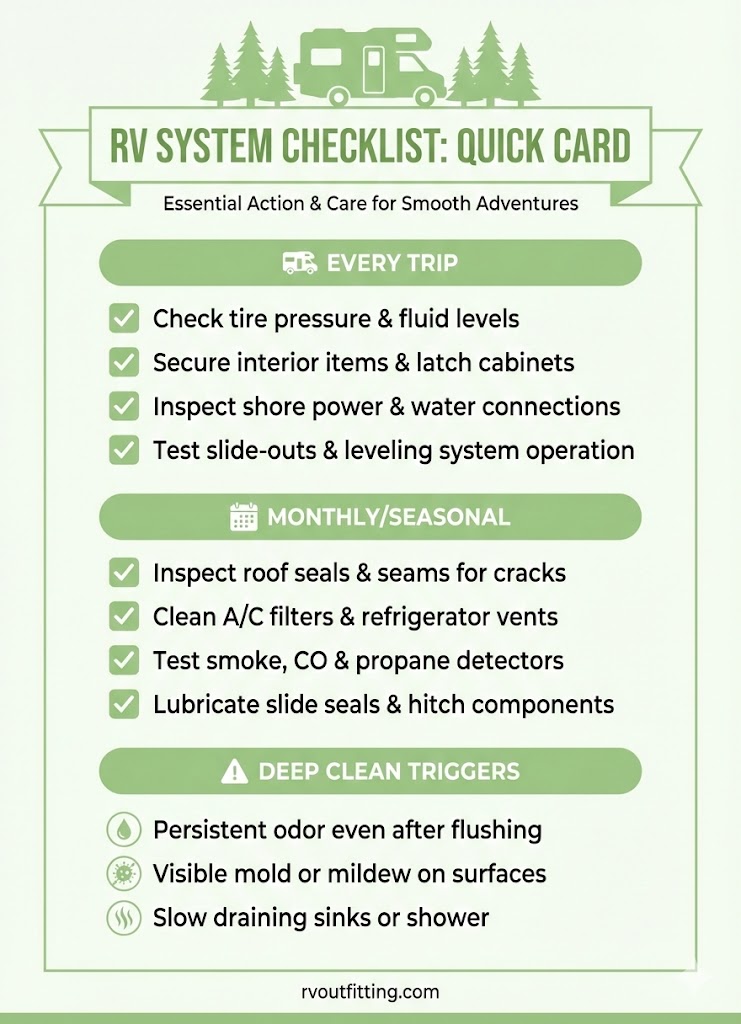
Once you’ve identified and fixed the source, these habits keep the smell from coming back:
Prevent dry seals and traps:
- Run water through every drain periodically, especially during storage and hot weather
- Apply seal-safe lubricant (silicone-based, non-petroleum) to toilet seals to keep them supple and prevent cracking
Prevent buildup:
- Never leave the black tank dump valve open at hookups — let the tank fill, then dump
- Separate routine maintenance (treatment after each dump, adequate water) from deep clean triggers (sensor misreads, persistent odor after fixes, visible sludge through clear elbow)
Product hygiene habits:
- Use RV-grade or septic-safe toilet paper that breaks down readily
- Avoid antibacterial cleaners in the toilet or tank — they kill the beneficial bacteria that help break down waste, which is counterproductive if you’re using enzyme or bacteria-based treatments
- Keep adequate water in the black tank between dumps to support waste breakdown
Maintaining your RV’s broader systems with the same preventive mindset goes a long way toward avoiding cascading issues down the road.
When to Call an RV Technician (The ~5% Case Where DIY Isn’t Enough)
Most RV sewer smell issues are fully fixable with the steps above. But a small percentage of cases need professional hands. Here’s when to escalate:
Red flags that mean “call a tech”:
- Persistent odor remains after you’ve worked through the full decision tree and applied the matching fix
- You suspect a flange or base seal leak but aren’t comfortable removing the toilet. Before paying labor on an older or low-end unit, check whether replacing it makes more sense — especially if you want a taller seat, better bowl seal, or a more comfortable RV bathroom setup. See our comparison of the best RV toilets.
- Repeated venting failures that clearing debris doesn’t resolve (may indicate structural pipe damage)
- You detect moisture, staining, or soft spots around the toilet base (possible subfloor damage from a long-term leak)
Safety and sanity guidance: If you’ve worked through the diagnosis systematically and still can’t isolate the source, stop guessing and adding products. Further random fixes waste money and can mask the real problem.
What to tell the tech (saves labor time and your money): Describe which symptom branch you identified, what tests you already ran, and which fixes you applied. A technician who knows you’ve already ruled out dry P-traps, verified the vent pipe, and tested the negative pressure scenario can skip straight to the less obvious causes. That saves diagnostic time — and diagnostic time is what you’re paying for.
FAQ (People Also Ask)
Why does my RV bathroom smell like sewer?
The most common causes are dried-out P-traps at sink or shower drains, a worn toilet seal, a clogged roof vent pipe, or leaving the black tank valve open (which causes a “poop pyramid” of dried solids). Use the symptom-based decision tree above to narrow down which cause matches your situation before applying a fix.
How do I get rid of sewer smell in my RV?
Trace the smell to its source first — don’t just throw products at it. Refill P-traps, check your toilet seal, verify the roof vent pipe is clear, and confirm your black tank valve is closed. Then apply the one fix that matches your diagnosis. Persistent cases may need a deep tank clean or a vent cap upgrade.
Can gray tanks smell like sewage?
Absolutely. Decomposing food particles, grease, and soap residue in the gray tank can produce a sewer-like odor that’s easily mistaken for a black tank problem. If the worst smell is near sinks or the shower rather than the toilet, investigate the gray side first.
Why does my RV toilet smell when I flush?
Flush-related odor usually points to a worn flush ball or flapper seal that’s letting tank gas past the bowl, or negative pressure caused by running a roof vent fan during flushing. Test by flushing with the fan off — if the smell drops, negative pressure is the cause.
Should I leave my black tank valve open at full hookups?
No. Leaving the valve open allows liquids to drain away while solids stay behind and build up into a “poop pyramid.” Keep the valve closed, let the tank fill to at least two-thirds, then dump. This keeps solids suspended in liquid for a much cleaner dump.
What is the best RV tank treatment for odor control?
It depends on your priority. Mineral-based treatments like Happy Campers tend to knock down odor fast. Enzyme/bacteria-based options like Unique RV Digest-It Ultra focus more on long-term waste breakdown. Enzyme options like Walex Bio-Pak offer a middle ground. Hot-weather campers may need to increase treatment frequency above 85°F regardless of type.
Why does my RV smell like rotten eggs?
The “rotten egg” smell is typically hydrogen sulfide (H₂S) produced by anaerobic bacteria in the black tank. It can also come from sulfur off-gassing from flooded lead-acid batteries. Confirm which source you’re dealing with before chasing plumbing fixes — check battery location relative to where the smell is strongest.
How do I unclog my RV black tank vent pipe?
Access the roof safely, remove the vent cap, and clear any visible debris or nests. Then use a garden hose inserted gently into the pipe to flush downward. Water should flow freely into the black tank. If it doesn’t, the blockage may be deeper and could require a plumber’s snake or a technician.
How often should I deep clean my RV black tank?
There’s no universal schedule — it depends on usage patterns, climate, and how well your routine maintenance is working. Trigger a deep clean when you see signs: tank sensors stuck on inaccurate readings, visible sludge through a clear dump elbow, or persistent odor even after other fixes are applied.
Why does my RV smell worse in hot weather?
Heat accelerates bacterial activity in the tank, causes gases to expand, and volatilizes residue on tank walls. Many RVers notice a sharp increase in odor above 85°F. Improving venting, reducing residue through regular maintenance, and potentially increasing tank treatment frequency all help manage warm-weather odor.
How do I fix a leaking RV toilet seal?
Identify which seal is failing (flush ball, flapper, or flange). Try reconditioning with a silicone-based, non-petroleum lubricant like Thetford Toilet Seal Lubricant first. If that doesn’t resolve it, replace the seal — Thetford #31708 and Dometic #385311462 are common examples, but always verify compatibility with your specific toilet model.
Can a clogged vent pipe cause sewer smell inside my RV?
Yes. The vent pipe is the primary escape route for tank gases. When it’s blocked, those gases build up pressure and find the next easiest path — which is usually back through the toilet or drains into your bathroom.
What causes the poop pyramid in an RV black tank?
Leaving the black tank dump valve open at full hookups. Liquids drain away continuously, but solids lack enough water to break down and flush out. They accumulate into a mound that blocks the tank and generates persistent odor.
Why does my RV shower drain smell like sewer?
The most likely cause is an evaporated P-trap — the water seal in the drain’s U-bend has dried out, allowing gray tank gases to rise into the shower. Refilling the P-trap by running water is the immediate fix. If it persists, check for a failed AAV or gray tank buildup.
Will a 360 Siphon vent cap eliminate RV sewer smell?
A 360 Siphon vent cap can significantly improve odor venting by using wind to actively draw gases up and out of the vent pipe. However, it addresses only vent-related odor causes. If your smell is coming from a dried P-trap, a failed toilet seal, or tank buildup, a vent cap upgrade alone won’t solve it. Diagnose the root cause first.
Go Deeper — Related Guides: