Camco 5.3-Gallon Portable Toilet Review (2026): Honest Owner-Tested Verdict
Freshness / Update Log
Last updated: June 2026
- Re-read the full pool of recent owner feedback, including reviews posted in early-to-mid 2026, to confirm the patterns below still hold.
- Re-checked the recurring complaints (flush-valve sealing, odor, emptying mess) against the praise (sturdiness, height, value) to keep the verdict balanced.
- Verified that the “open the valve before you sit” pressure trick still shows up as the single most useful owner-discovered workaround.
- Confirmed the watch-outs around parts availability and cold/heat storage are still being reported.
Affiliate Disclosure
Heads up: some links below are Amazon affiliate links. If you buy through them, I may earn a small commission at no extra cost to you. It doesn’t change what I write — the patterns here come straight from real owner experiences, warts and all.
A Toilet That Doesn’t Make You Hike to the Bathhouse at 3 a.m.
If you’ve ever lain awake in a camper, van, or cabin doing the math on whether you can hold it until morning or face the cold walk to a shared bathhouse, you already understand the appeal of a self-contained portable toilet. The Camco 5.3-Gallon is one of the most popular budget answers to that exact problem: a compact, plumbing-free unit with a top water tank for flushing and a detachable bottom tank you carry off to dump.
But “popular and cheap” hides a real split in how people feel about it. Some owners swear by it for years; others report leaks, odor, and a flush valve that fights them. The confusion is understandable — the listing makes it sound bulletproof, and the experience depends heavily on how you use, fill, and store it. I went deep into the owner feedback to separate the genuine design quirks from user-error issues, so you can decide whether this is your golden ticket or a headache. If you’d rather zoom out and compare the whole category first, the complete framework for choosing an RV toilet walks through sizing, sealing, and odor control before you commit.
How this review was built (so you can trust it)
- Reviews analyzed: A large pool of owner reviews — several hundred across the positive and critical sides combined (approximate).
- Time window: Roughly the last four years of feedback, with the most recent entries landing in early-to-mid 2026 (approximate, derived from review dates).
- Synthesis method: I tagged feedback into categories — flush/seal performance, odor control, emptying and cleaning, durability and cracking, fitment and size, and support/returns — then separated “setup-driven issues” (wrong fill technique, skipping deodorizer, overfilling) from “likely product failures” (handle leaks, tank cracks, warped latches).
Important limitations:
- Reviews skew toward strong opinions; very satisfied and very frustrated owners are both overrepresented.
- RV, van, boat, cabin, and tiny-house setups vary wildly, so “leaks in my rig” doesn’t always mean a defect — temperature swings and overfilling matter.
- I prioritized patterns that came up repeatedly over one-off complaints.
Quick Verdict (TL;DR)
Best for:
- Campers, van-lifers, and cabin owners who mainly need a nighttime or backup throne and will use deodorizer faithfully.
- Average-height adults who want a taller seat than the smaller travel models.
- Budget-minded buyers who’d rather pay portable-toilet money than RV-toilet money.
Not for:
- Larger-bodied users — the seat and bowl run small, a near-universal complaint.
- Anyone wanting a built-in pour spout or fill-level gauge (it has neither).
- Full-time heavy use without a tolerance for occasional leaks and careful storage.
Standout win:
- When used correctly with a deodorizer tab, many owners report genuinely no smell and a sturdy, comfortable sit at a fair price.
Watch-outs:
- The flush/slide valve is the part most likely to leak or stiffen over time, and Camco doesn’t sell it separately.
Confidence Score: 🟡 6.5 / 10 — Moderate-to-Good (buyer-usefulness, not a reliability stat)
This score reflects how confidently I’d point a well-matched buyer toward this unit — not a failure-rate statistic. I weighed the volume and consistency of praise (sturdiness, height, value, odor control when used right) against the seriousness and frequency of the recurring complaints (valve leaks, small bowl, no replacement parts). It lands at moderate-to-good because the product clearly works well for many people, but the failure modes are real and predictable enough to disqualify some buyers outright.
👉 Check today’s price on Amazon
What This Product Is (and What It Isn’t)
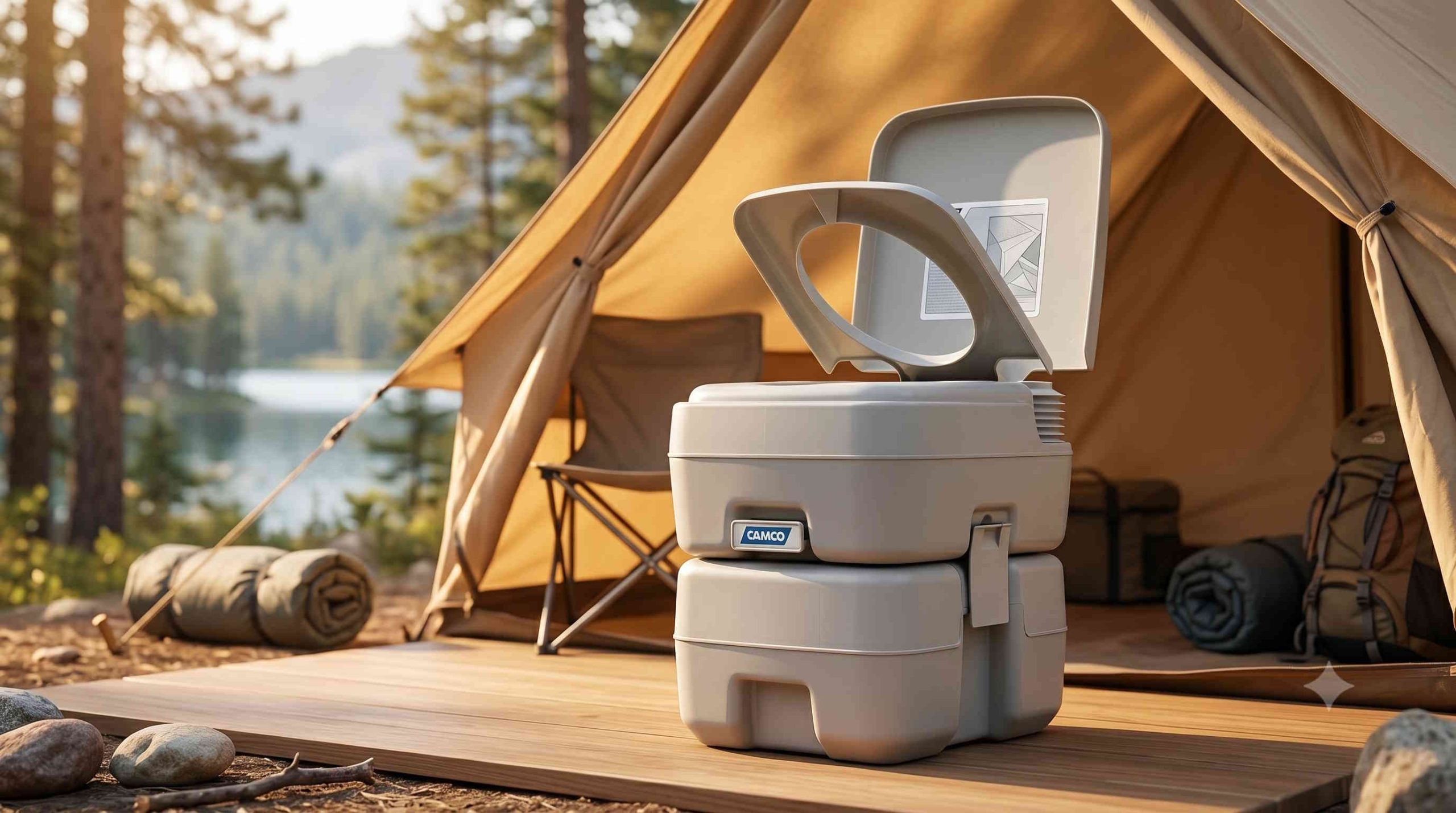
The Camco 5.3-Gallon is a self-contained portable cassette-style toilet. The top section holds fresh water you pump into the bowl to flush; the bottom section is a detachable holding tank you unlatch, carry away, and empty through a screw-cap spout. No plumbing, no hookups, no power.
A few misconceptions worth clearing up:
- It is not an RV-grade fixed toilet. It doesn’t bolt to the floor or tie into a black tank. Owners who wanted a permanent install or boat-mounted unit were disappointed — it ships with no mounting brackets.
- It is not odor-proof on its own. The “seal so tight it keeps secrets” experience only happens with deodorizer tablets in play. Skip them, or lose the seal over time, and odor becomes the number-one complaint.
- It is not a large-person throne. Marketing photos make the bowl look roomier than it is. Owners repeatedly describe the seat and opening as small.
Key Specs That Actually Matter for RVers
- Two-piece detachable design: The top (bowl + flush water) lifts off the bottom (holding tank). This is what makes emptying possible without hauling the whole unit — but it’s also where the latch and seal complaints originate.
- Bellow/accordion-style manual flush pump: No battery, no electronics. Reliable in concept, but many owners find the pump stiff and the water stream weak, covering only part of the bowl.
- Slide/gate valve between bowl and tank: This is the heart of the unit — and the part most likely to wear, stiffen, or leak. It matters because it’s both the odor seal and the thing you operate every single use.
- Taller seat height (vs. smaller travel models): A genuine selling point. Repeat buyers specifically chose this one for height that’s easier on adult knees.
- Carry handle and lightweight plastic body: Great for portability, but the lightness reads as “cheap” to some, and the plastic is vulnerable to cracking if dropped or stored through big temperature swings.
Feature-by-Feature Breakdown (Truth vs Marketing)
| Feature | What the Manufacturer Says | What It Actually Means (User Experience) | Compared to Competitors |
|---|---|---|---|
| Sealing slide valve | Seals tightly to lock in odor | Works well when new and lubricated; a recurring weak point that can leak or stiffen with age | Owners who switched to Thetford often report a more durable, less leak-prone valve |
| Bellow-type flush | Easy manual flushing | Functional but stiff for some; stream is weak and doesn’t always coat the whole bowl | Comparable budget units feel similar; pricier units flush more thoroughly |
| Detachable holding tank | Easy transport and emptying | Genuinely convenient, but the molded shape and lack of a pour spout make dumping messy | Thetford’s pivoting pour spout is repeatedly named as the thing this lacks |
| Compact, lightweight build | Easy to carry and store | Truly portable, but “light” reads as flimsy to some, and corners can crack | Heavier units feel sturdier but are harder to lug |
| Taller seat | Comfortable height | A real win for average-height adults; still too small for larger users | One of the better-rated portables specifically for sit height |
Real-World Owner Experience (Deep Pattern Analysis)
Pattern 1: The flush/slide valve is the make-or-break part
In a nutshell: More owner frustration traces back to this one component than any other — leaks at the handle, stiffening that takes serious force, and eventual failure.
Hidden strength: When it’s working and kept lubricated, it seals odor genuinely well and operates smoothly.
Hidden weakness: Over months of use the handle can get hard to push to the latched position, and once it won’t fully seal, odor and leaks follow. Camco doesn’t sell the valve as a replacement part, so a worn valve can mean a whole new toilet.
What to do about it (safe, practical): Lubricate the valve periodically with a silicone-safe lubricant, and clean it with a non-abrasive cleaner that won’t degrade the seal. Operate it gently rather than forcing it. If it starts leaking from the handle area, that’s your signal it’s wearing — don’t wait for a face-full to act on it.
Pattern 2: Odor is a “setup” problem more often than a “product” problem
In a nutshell: Owners who use deodorizer tablets consistently report little to no smell. Owners who skip them — or whose included tabs arrived as useless dust — describe the smell as the dealbreaker.
Hidden strength: With a quality tank treatment, even full-time users report the smell fades fast and stays controlled.
Hidden weakness: The included sample tabs are frequently reported dead-on-arrival, and a degraded seal lets odor escape no matter what you put in the tank.
What to do about it: Don’t rely on the included samples. Stock a proven RV tank treatment from day one. For the bigger picture on keeping a rig smell-free, the climate-control and ventilation essentials for RVers pair well with good tank habits.
Pattern 3: Emptying is messy by design
In a nutshell: The single most repeated design gripe is the lack of a pour spout combined with a molded tank shape that traps solids.
Hidden strength: The detachable tank itself is light enough to carry to a dump point, and the screw cap is large.
Hidden weakness: The tank’s interior contours catch waste, forcing shaking and rinsing, and the wide opening with no spout invites splashing.
What to do about it: Crack the dump valve slightly before pouring to release pressure (this dramatically reduces splash), tilt and rotate the tank to clear the molded notch, and rinse two or three times. Many owners use a bag-in-bowl method for solids to keep the tank to liquids only.
Pattern 4: Pressure build-up can spray you
In a nutshell: In warm conditions or after a tank sits, internal pressure can build — and opening the valve afterward sends contents upward.
Hidden strength: It’s entirely preventable once you know the trick.
Hidden weakness: Nobody tells new owners, so the lesson is often learned the hard way.
What to do about it: Open the slide valve briefly before you use it (lid down), with the tank “burped” of pressure, then use it and close the valve after. Avoid leaving a full tank baking in the sun.
Pattern 5: Durability hinges on how you store it
In a nutshell: Cracked corners, warped latches, and bowed bottoms show up most in units stored through big temperature and elevation swings — garages, attics, hot vans.
Hidden strength: Owners who store it in stable, cool conditions report years of service.
Hidden weakness: The plastic can warp or crack under repeated thermal stress, and dropped units crack at the corners.
What to do about it: Store it somewhere temperature-stable, don’t drop or over-stuff it, and avoid carrying a heavy full tank by the latches. Anything beyond basic care here is just respecting that it’s lightweight plastic.
Pattern 6: Size runs small for larger users
In a nutshell: The seat, opening, and bowl depth are repeatedly described as small — fine for average and smaller adults and kids, tight for big-and-tall users.
Hidden strength: The taller height is a plus for average adults and a frequent reason for repeat purchase.
Hidden weakness: Larger users report contact with the front of the bowl and a cramped sit.
What to do about it: If you’re big-and-tall, measure against the dimensions before buying and consider a larger unit. Some owners build a raised platform or wider seat as a workaround.
The Good, The Bad & The Ugly (Pros/Cons)
Pros — by theme:
- Sturdiness & height: Frequently praised as solid, stable, and a comfortable height for average adults; several owners are repeat buyers.
- Odor control (used right): With deodorizer, many report genuinely no smell, even in full-time and indoor use.
- Portability & value: Light, compact, plumbing-free, and cheaper than RV toilets — a recurring “great for the price” theme.
- Versatility: Owners use it in vans, campers, boats, cabins, tiny houses, storm shelters, trucks, and as emergency backups during home plumbing outages.
Cons — by theme:
- Valve & sealing: The flush/slide valve is the top failure point — stiffening, handle leaks, and lost seal over time.
- Emptying & cleaning: No pour spout, a tank shape that traps waste, and splash-prone dumping.
- Size: Small seat, opening, and bowl depth for larger users.
- Parts & support: No replacement valve or tank sold separately; mixed customer-service experiences.
- Pressure & splash: Warm-weather pressure build-up can spray if you don’t burp the tank first.
Mini Toolkit: Decide + Fix (Fast)
Issue-Tag Box (most common recurring tags):
- 🚽 Flush-valve leak / stiffening
- 👃 Odor (seal + deodorizer dependent)
- 💦 Splash / pressure spray
- 🧽 Messy emptying (no spout)
- 📏 Small seat & bowl
- 🧩 No replacement parts
Fitment / Use-Case Mini-Matrix:
| Your setup | Reality check |
|---|---|
| Van / camper nighttime use | Strong fit — main reason people love it |
| Boat or fixed install | Poor fit — no mounting brackets |
| Big-and-tall daily driver | Risky — size complaints are consistent |
Mini Decision Tree:
- If you’ll use deodorizer every time → odor is unlikely to be your problem.
- If you’re big-and-tall → consider a larger unit instead.
- If you need a built-in pour spout or level gauge → this isn’t it.
- If you store it in a hot/cold garage or attic → expect shorter life.
- If you want a repairable valve → look elsewhere; parts aren’t sold separately.
Troubleshooting Quickflow (flush valve hard or leaking):
- Stop forcing the handle — excess force accelerates wear.
- Clean the valve area with a non-abrasive, seal-safe cleaner.
- Apply a silicone-safe lubricant to the valve.
- Open the valve gently before each use to burp tank pressure.
- If it still leaks at the handle, treat it as worn and plan a replacement.
- For anything involving re-sealing or modifying the assembly, verify against the manufacturer instructions or consult a qualified RV tech.
Mini Return-Window Reality Check
- Test it before your return window closes — many regretful owners discovered leaks only after the window passed.
- Fill the fresh water tank and check for leaks around the lid and seams before first real use.
- Do a dry “flush + dump” cycle to confirm the valve seals and the cap unscrews easily (some arrive welded-tight).
- Sit-test it for size if you’re a larger user — the bowl runs small and that won’t change.
- Inspect corners and latches for cracks or warping out of the box; shipping damage shows up here.
- For the full pre-purchase validation routine, the step-by-step guide to picking the right RV toilet covers what to confirm before you’re stuck with it.
Installation / Setup Tips (RV-Realistic)
- Open the box outdoors — owners report the deodorizer sample packs sometimes burst inside, scattering dust everywhere.
- Add a proven RV tank treatment to the holding tank from day one; don’t trust the included samples.
- Put a few inches of water in the bowl after the first flush — it makes subsequent flushes and cleaning noticeably easier.
- Open the slide valve briefly (lid closed) before sitting to release pressure, then close it after use.
- Secure the unit while driving — owners report it sliding or tipping during hard stops; bungee it to something stable.
- Don’t overfill the holding tank — at capacity it’s heavy and awkward, and overfilling worsens splash.
- Tilt and rotate the tank when emptying to clear the molded notch where solids hide.
- Consider a bag-in-bowl method for solids to keep the tank to liquids and simplify cleanup.
- Lubricate the flush valve periodically with a silicone-safe product to keep it operating smoothly.
- Store the unit in a temperature-stable spot to avoid warping and cracking.
- Common mistake: skipping deodorizer and blaming the toilet for odor — the seal alone isn’t meant to do that job.
- Common mistake: forcing a stiff valve. For mixing cleaning chemicals safely (never combine bleach and ammonia), follow standard household chemical-safety guidance, such as the CDC’s guidance on cleaning and disinfecting safely.
See It in Action: Visual Reality Check
Specs and bullet points only get you so far — seeing the unit handled in a real space tells you more about size, flush feel, and emptying than any description can. Watch how it actually behaves before you commit.
What to look for in this video (based on owner patterns):
- 📏 Scale Check: Watch how small the seat and bowl opening look relative to the user’s hands — owners consistently say it runs small for larger bodies.
- 💪 Flush Effort: Notice how much force the bellow pump takes and how much of the bowl the water stream actually covers — many call the stream weak.
- 💦 Dump Test: See whether there’s any splash when the valve opens, and whether the contents pour cleanly without a spout — this is the most-complained-about moment.
- 🔒 Latch & Seal: Look at how the two halves latch together; the latches and valve seal are the parts owners report failing first.
Keep in mind this video shows the initial setup — it won’t show the valve stiffening, handle leaks, or corner cracking that some owners report only after months of use and temperature swings.
Owner Stories
The stories below are composite scenarios reflecting repeated patterns across owner feedback.
The full-time fill-in: A household tears out their home bathroom for a remodel and leans on this as the only toilet for three adults. They empty it roughly every other day, learn to tilt-and-rotate to clear the molded notch, and settle on dish soap plus a tank treatment instead of pricey pods. Their verdict: it performed well beyond expectations — they just wish it were an inch or two bigger in every direction.
The cold-storage casualty: A van owner keeps the unit as an emergency backup for a couple of years, stored through hot summers and cold winters. One day the plastic latches deform, the two halves stop holding together, and it starts leaking clean water during flushes. Their takeaway, echoed by others: store it somewhere temperature-stable, because thermal swings warp the plastic over time.
The pressure surprise: A truck driver loves the zero-odor seal but gets sprayed the first time opening the valve after an elevation change. After that, they always crack the valve with the lid down before using — and never have the problem again. It becomes their top tip to other buyers.
🔎 See more owner feedback on Amazon
Who This Is For (and Who Should Skip It)
Buy it if…
- You need a nighttime or backup toilet for a van, camper, cabin, or tiny house.
- You’re an average-height or smaller adult and value the taller seat.
- You’ll commit to using deodorizer tablets every time.
- You want maximum portability with no plumbing or power.
- You’re budget-conscious and fine with light-duty plastic.
- You’ll store it somewhere temperature-stable.
Skip it if…
- You’re big-and-tall and want a roomy seat and bowl.
- You need a built-in pour spout or a fill-level gauge.
- You want a boat or fixed install with mounting brackets.
- You expect to repair a worn valve rather than replace the whole unit.
- You’ll store it in a hot attic or freezing garage long-term.
- You want a no-technique, never-splash dumping experience.
👉 Check today’s price on Amazon
If you’re comparing options, start here: Top RV Toilet Picks
Alternatives (Quick Comparisons)
- If durability and a pour spout matter most: Many owners who left this one named Thetford as their next pick, citing a pivoting pour spout and a longer-lasting hand valve. Worth a look if messy emptying is your dealbreaker.
- If you want a roomier, more residential feel: Larger cassette or RV-style toilets sit higher and wider but cost more and weigh more — better for full-time use than grab-and-go.
- If you’re going off-grid long-term: A composting toilet eliminates the dump-tank chore entirely, at a much higher price and with a different maintenance routine. Some owners specifically compared this unit to that path.
- If you only need occasional liquid-only backup: A simpler bucket-style or collapsible toilet may be enough, though owners note those feel less sturdy than this one.
Deep-Dive FAQ (High-Intent)
What should I test immediately after delivery?
Fill the fresh water tank and check for leaks around the lid and seams, confirm the slide valve seals and the dump cap unscrews easily, and inspect the corners and latches for cracks or warping. Do this well inside your return window — leaks are the most common reason owners wish they’d checked sooner.
What are the most common problems and fixes?
The flush/slide valve stiffening or leaking is number one — lubricate it with a silicone-safe product and operate it gently. Odor is number two, and it’s usually fixed by using a real tank treatment instead of the included samples. Splash and pressure spray are solved by cracking the valve before use to burp the tank.
Will this work with my RV or van setup?
For nighttime and backup use in vans, campers, cabins, and tiny houses, it’s a strong fit and the most common use case. It does not come with mounting brackets, so it’s a poor choice for boat or fixed-floor installs.
Why does it smell, and is that normal?
Some odor on opening the valve is expected. Persistent smell usually means either no deodorizer is being used or the seal has degraded over time. A consistent tank treatment fixes most odor complaints; a worn valve seal is the harder underlying cause.
How do I empty it without making a mess?
Crack the dump valve slightly before pouring to release pressure, tilt and rotate the tank to clear the molded notch where waste hides, and rinse two or three times. There’s no built-in pour spout, so technique matters here.
Is it big enough for larger adults?
The seat, opening, and bowl depth run small — a consistent complaint from bigger users. Average-height and smaller adults and kids generally find it comfortable, and the taller height is a genuine plus.
Can I buy replacement parts if the valve fails?
Generally no — owners repeatedly report Camco doesn’t sell the slide valve or holding tank separately, so a worn valve often means replacing the whole unit. If repairability matters to you, factor that in.
Why does it spray when I open the valve?
Pressure builds inside the holding tank, especially in warm weather or after sitting. Open the valve briefly with the lid down before you use it to burp that pressure, then use it and close the valve afterward.
How should I store it to make it last?
Keep it somewhere temperature-stable. Owners who store it through big heat-and-cold swings report warped latches, bowed bottoms, and cracked corners; those who store it cool and stable report years of service.
Final Verdict
The Camco 5.3-Gallon Portable Toilet is a genuinely useful, affordable, plumbing-free throne that earns its popularity — if you’re the right buyer and you use it correctly. The owners who love it are average-sized, faithful about deodorizer, gentle with the valve, and smart about storage. For them, it’s a sturdy, no-smell, fair-priced solution they buy again.
The owners who regret it tend to be larger-bodied, expecting a pour spout or repairable parts, or storing it through brutal temperature swings — and running into the valve leaks, splash, and cracking that come with those mismatches.
Best-fit buyer: an average-height camper, van-lifer, or cabin owner who needs a reliable nighttime or backup toilet, will use tank treatment every time, and stores it somewhere stable. If that’s you, it’s an easy recommendation. If you’re big-and-tall or want a repair-friendly, spout-equipped unit, look at the alternatives first.