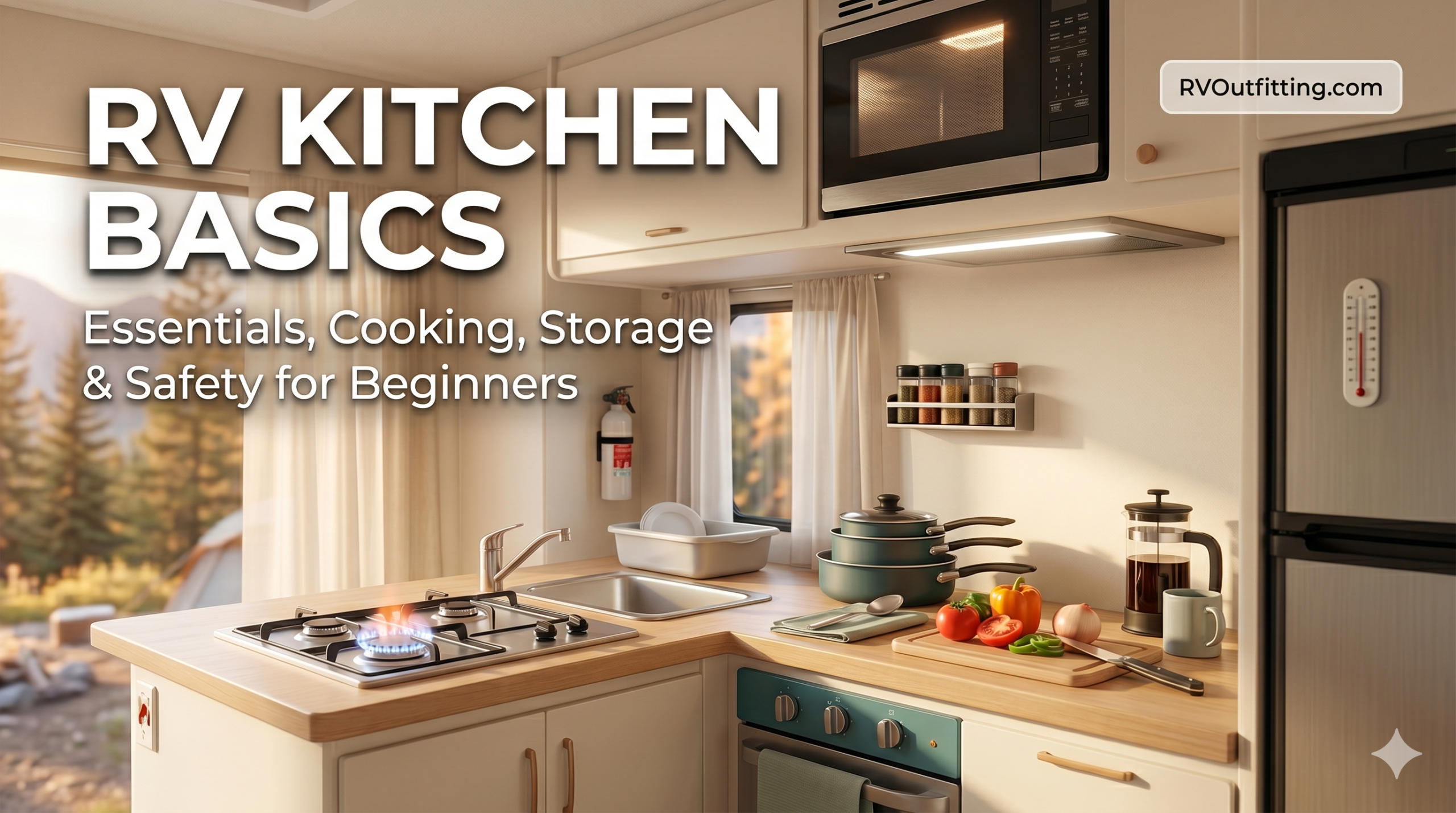
RV Kitchen Basics: Essentials, Cooking Methods, Storage, Fridge Tips, and Safety for Beginners
Last updated: February 2026
If you’re new to RVing, this guide walks you through RV kitchen basics step by step — from what’s built in versus what you’ll add, to cooking, storage, fridge care, water use, and safety — so your first trips feel less chaotic and more delicious.
Quick Summary: RV Kitchen Basics at a Glance
Quick Answer: A workable RV kitchen blends a propane stovetop, RV oven, microwave (often convection or air fryer combo), sink, and refrigerator with smart owner-added gear, safe habits, and realistic power planning.
- A standard RV kitchen usually includes a propane stovetop, RV oven, microwave or convection microwave, sink, cabinets, and an RV refrigerator — but many essentials must be added by the owner.
- The best setup balances space, payload weight, power, water, propane safety, fridge behavior, and travel-safe storage.
- Beginners should prioritize nesting cookware, stackable containers, non-slip shelf liner, a fridge thermometer, a sink strainer, LP/CO detectors, and a well-placed fire extinguisher.
- Compare cooking methods — propane, microwave/convection, air fryer combo microwave, induction, and outdoor grill/griddle — by campsite power, boondocking plans, ventilation, and cleanup.
- Modern advice includes 12V compressor refrigerators, LiFePO4 batteries, solar charging, and larger inverters — older RV kitchen guides often skip these.
- Always check current campground and public-land fire restrictions before relying on outdoor cooking.

Safety note: This guide is general education for beginner RVers. Always follow your RV manufacturer’s manual, propane appliance instructions, and local rules. When in doubt, ask a certified RV technician.
What Comes With an RV Kitchen, and What You’ll Need to Add
Standard RV Kitchen Features
Most RV kitchens come with some mix of:
- A propane stovetop (often two or three burners)
- An RV oven
- A microwave, convection microwave, or air fryer combo microwave
- A single or small double sink
- Cabinets and drawers
- An RV refrigerator (absorption or 12V compressor)
Newer rigs sometimes ship with a convection/air fryer combo microwave — Furrion-style units are a common example. Check your existing appliance before you go buy a standalone air fryer or toaster oven.
RV layouts vary widely between travel trailers, fifth wheels, Class B vans, Class C motorhomes, and Class A motorhomes. A Class B van kitchen is a different world from a fifth wheel kitchen.
RV kitchens also feel different from home kitchens because of:
- Less prep space
- Limited storage
- Cabinets that move while driving
- Fresh and gray tank limits
- Power constraints on shore power, battery, or generator
What Beginners Usually Forget
The “obvious” stuff is rarely the problem — it’s the small add-ons people miss:
- Sink strainer
- Dishpan or collapsible tub
- Biodegradable soap
- Fridge thermometer
- Non-slip shelf liner
- Magnetic spice rack
- Collapsible containers
Safety items often missed:
- LP gas detector (functional, not just present)
- Carbon monoxide detector
- Fire extinguisher within reach
- A real ventilation habit while cooking
Then there’s “quiet weight” — cast iron, canned food, bottled water, ceramic dishes, and small appliances each weigh a little, and together they eat into your payload. RV kitchen choices feed directly into GVWR and cargo carrying capacity, which most beginner guides skip entirely.
How Space, Power, Water, and Propane Change Your Setup
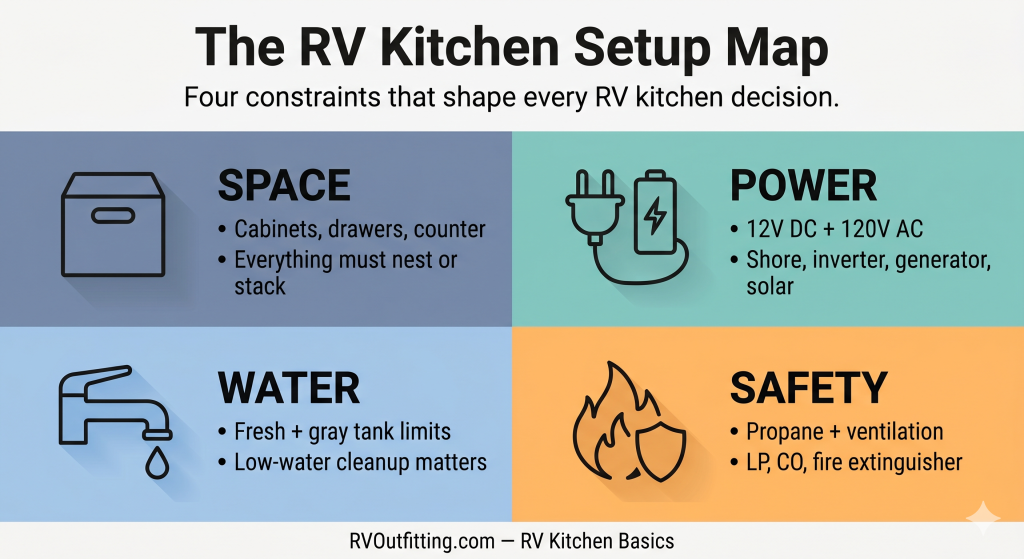
Four limits shape every RV kitchen decision:
- Storage space — cabinet, drawer, pantry, and counter
- 120V AC power — for microwaves, induction, kettles, toaster ovens
- 12V DC battery power — for lights, water pump, control boards, some fridges
- Fresh and gray tank capacity — for sink, dishwashing, cleanup
Power sources also vary: shore power, inverter power, 30 amp service, and 50 amp service all behave differently. Propane is excellent for cooking but needs ventilation, leak awareness, and working detectors.
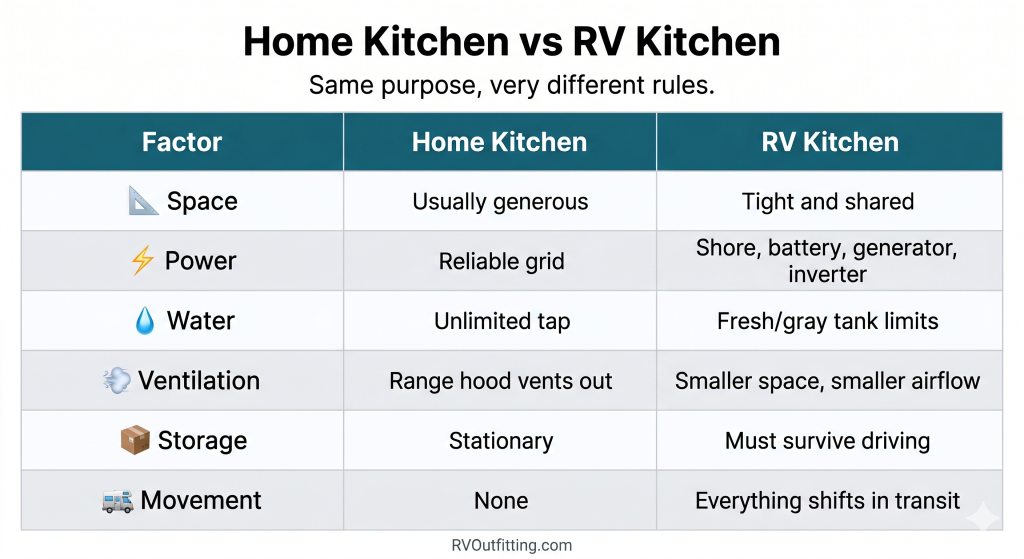
| Factor | Home Kitchen | RV Kitchen |
|---|---|---|
| Space | Usually generous | Tight and shared |
| Power | Reliable grid | Shore power, battery, generator, or inverter |
| Water | Unlimited tap | Fresh/gray tank limits |
| Ventilation | Range hood vents out | Smaller space, smaller airflow |
| Storage | Stationary | Must survive driving |
| Movement | None | Everything shifts in transit |
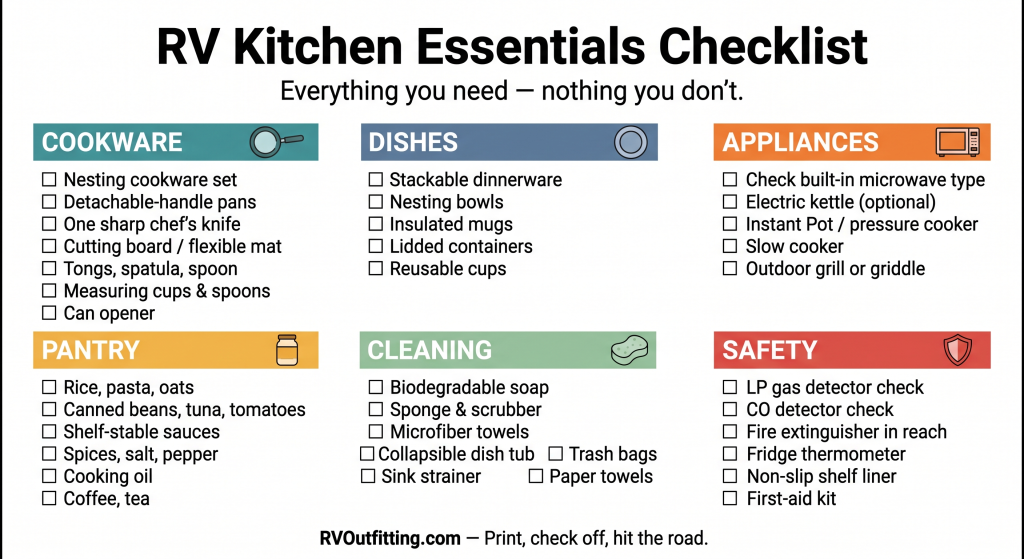
RV Kitchen Essentials Checklist
Cookware and Utensils
Aim for cookware that nests, stacks, or pulls double duty:
- Nesting cookware sets
- Detachable-handle cookware (Carote-style sets are popular)
- Lightweight pans for compact storage
- Magma-style nesting cookware for tight cabinets
- A Camp Chef Dutch oven if you plan to cook outdoors
Cast iron is wonderful — until you count its weight. Use it for outdoor cooking or one good skillet, not a full set.
Utensils worth carrying:
- Tongs, spatula, heat-safe spoon
- One sharp chef’s knife
- Cutting board (flexible mats save space)
- Can opener
- Measuring cups and spoons
Plates, Bowls, Mugs, and Drinkware
Skip your fragile home dinnerware. Better picks:
- Durable, stackable dinnerware (Corelle-style works well)
- Nesting bowls
- Insulated mugs for hot and cold
- Lidded containers that double as leftovers storage
Travel tip: secure dishes with non-slip shelf liner, drawer dividers, or cabinet tension rods so nothing rattles on the road.
Small Appliances Worth Bringing
Useful options, with caveats:
- Instant Pot or pressure cooker
- Slow cooker
- Electric kettle
- Toaster oven
- Single-burner induction cooktop
- Air fryer combo microwave (often built in)
Heads-up: Don’t buy a standalone air fryer before checking whether your RV already has a convection/air fryer combo microwave. Many newer rigs do.
For boondocking, electric appliances can be practical if you have a lithium (LiFePO4) battery bank, solar charging, and a properly sized inverter — but only if. More on that in the power section.
Pantry Staples for RV Cooking
Shelf-stable basics travel well:
- Rice, pasta, oats
- Canned beans, tuna, tomatoes
- Shelf-stable sauces and broths
- Spices, salt, pepper
- Coffee, tea
- Cooking oil
Build in special-diet zones if needed — vegan, gluten-free, keto, diabetic-friendly, allergy-safe. Remote campgrounds may have limited grocery access, so inventory matters.
Try a one-trip pantry reset before every outing:
- Check inventory
- Toss expired items
- Refill basics
- Restock special-diet items separately
Cleaning and Dishwashing Supplies
- Biodegradable soap
- Sponge and scrubber
- Microfiber towels
- Collapsible dish tub
- Trash bags
- Paper towels
A sink strainer is small but mighty — it keeps food scraps out of your gray tank, which keeps smells and sensor problems down.
RV Kitchen Organization: Making Every Inch Work
Use Stackable, Nesting, and Collapsible Gear
The rule that saves space and sanity: every item should nest, stack, collapse, or serve more than one purpose.
- Nesting cookware
- Collapsible bowls and colanders
- Clear bins for pantry zones (breakfast, snacks, spices, dry goods, cleaning)
Overpacking the kitchen quietly steals living space and adds payload — keep the gear earning its spot.
Secure Cabinets, Drawers, and Fridge Items Before Driving
Everything moves on the road. Plan for it:
- Non-slip shelf liner inside cabinets and drawers
- Tension rods to hold dishes in place
- Drawer dividers for utensils
- Lidded containers in the fridge
- Soft bins or baskets for noisy items
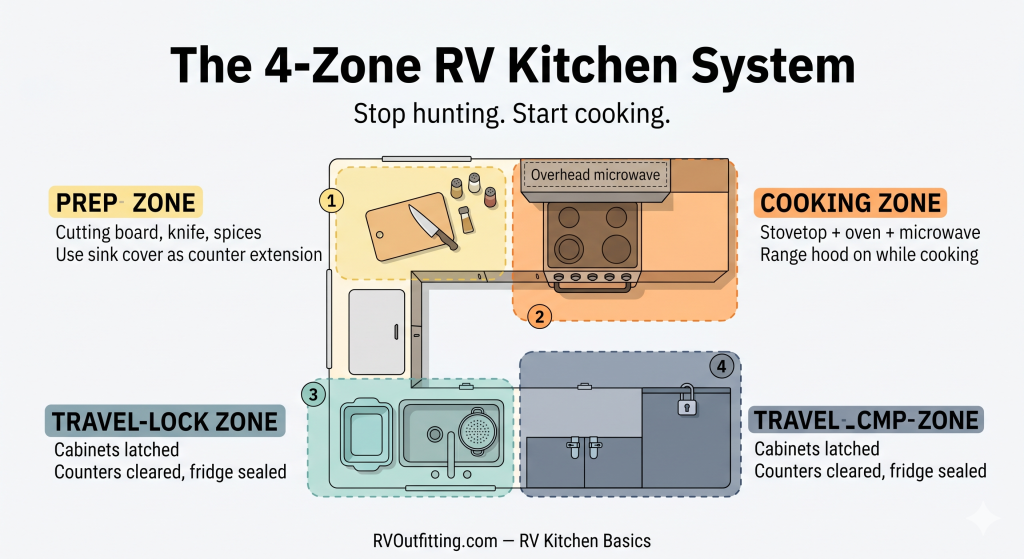
Pre-drive kitchen checklist:
- Latch all cabinets and drawers
- Clear the counters
- Place the sink cover
- Confirm the fridge door is latched
- Secure the coffee maker
Use Vertical and Wall-Mounted Storage Carefully
Vertical storage is gold in a small space:
- Magnetic spice rack
- Magnetic knife strip (placed thoughtfully)
- Over-door baskets
- Wall-mounted holders
Two cautions: magnetic and mounted items must stay secure while driving, and don’t pile heavy stuff up high — it shifts, falls, and can hurt someone.
A sink cover doubling as counter extension is a small win that often makes a big difference.
Build a Simple RV Kitchen System
Systems beat random hacks for repeat trips. Try these four:
- Pre-planning — meals, groceries, pantry reset
- Running inventory — what’s actually in your bins
- One-pot cooking — fewer dishes, less water
- Drive-day reset — secure, clean, lock
Start minimal. Add gear only after you’ve cooked a few real trips and know what’s missing.
How to Cook in an RV: Methods, Trade-Offs, and Strategy
Cooking With Propane
Propane shines when you’re off shore power — boondocking, dry camping, limited hookups, fast meals.
Key terms worth knowing:
- LP gas
- Propane regulator
- OPD valve
- Main shutoff valve
- Pigtail hose
Ventilation matters more than people realize. Propane and any gas cooking can affect indoor air quality in a small RV. Use the range hood, crack a window when appropriate, and keep your LP and CO detectors working.
Microwave, Convection Microwave, and Air Fryer Combo Cooking
Three flavors of the same appliance family:
- Basic microwave — reheating only
- Convection microwave — adds baking and roasting
- Air fryer combo microwave — adds crisping/frying functions
All three are power-hungry. They generally need shore power, generator power, or a properly sized inverter and battery setup.
Easy meals to start with: reheating leftovers, baked potatoes, frozen meals, roasted vegetables, quick breakfast sandwiches.
Induction Cooking in an RV
Induction reduces open-flame cooking indoors, which many RVers love. The catches:
- Requires compatible ferrous cookware (a magnet should stick to the bottom)
- Pulls significant wattage
- Needs an inverter, shore power, or battery system sized for the load
- 30 amp vs 50 amp service changes what else can run simultaneously
Can you run induction while boondocking? Sometimes — when your electrical system is sized for it. LiFePO4 batteries, solar charging, and larger inverters have moved this from “no way” to “yes, with planning.” Older guides that say “never use electric appliances off-grid” are too broad.
Outdoor Cooking to Reduce Heat, Odors, Cleanup, and Gray Tank Load
Outdoor cooking is a strategy, not just a vibe:
- Less heat inside the RV
- Fewer cooking smells lingering
- Less splatter to clean
- Fewer dishes
- Less water down the gray tank
Popular outdoor options: Blackstone griddle, Weber Q-series grill, a basic charcoal grill, or a Dutch oven for slower cooking.
Safety note: Fire restrictions change seasonally. Check campground, national park, state park, and public-land rules before relying on charcoal or open flame.
One-Pot and Low-Cleanup RV Meals
Low-cleanup cooking is an RV superpower:
- One-pot pasta, rice bowls, chili
- Foil-pack meals on the grill
- Skillet dinners
- Pressure cooker meals
- Grilled proteins with simple sides
Beginner strategy: prep at home, cook outside when possible, keep pantry staples flexible. For special diets, dedicate containers and utensils to allergy-safe prep.
| Method | Best For | Power Source | Cleanup | Ventilation Need | Boondocking Fit | Beginner Difficulty |
|---|---|---|---|---|---|---|
| Propane stove | Quick meals, off-grid | Propane | Moderate | High | Excellent | Easy |
| RV oven | Baking, roasts | Propane | Moderate | High | Good | Moderate |
| Microwave | Reheating | 120V AC | Low | Low | Power-dependent | Easy |
| Convection microwave | Baking, roasting | 120V AC | Low | Low | Power-dependent | Easy |
| Air fryer combo | Crisping, frying | 120V AC | Low | Low | Power-dependent | Easy |
| Induction | Fast, flame-free | 120V AC (high draw) | Low | Low | System-dependent | Moderate |
| Outdoor grill/griddle | Big meals, hot days | Propane or charcoal | Easy outside | None indoors | Excellent | Easy |
Your RV Refrigerator: Types, Quirks, and Food Safety
Absorption vs 12V Compressor Refrigerators
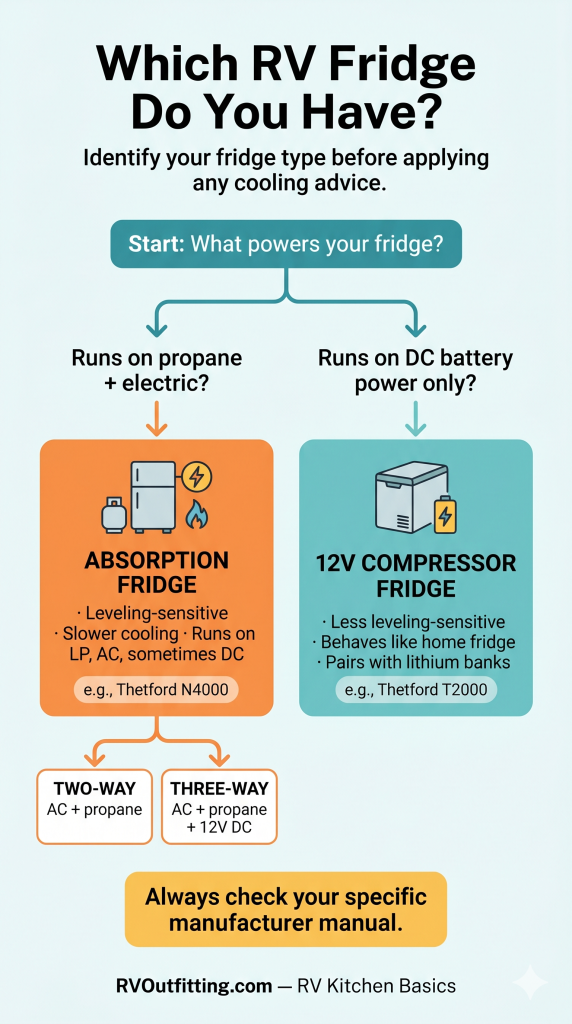
Two main fridge families in modern RVs:
- Absorption refrigerator — can run on propane and electric (often called two-way or three-way depending on AC, DC, and propane options). Common older example: Thetford N4000.
- 12V compressor refrigerator — runs on DC battery power, behaves more like a household fridge. Common newer example: Thetford T2000.
12V compressor fridges are becoming more common, which is why old guides focused entirely on absorption fridges feel incomplete. Identify your fridge type before applying any cooling or leveling advice.
Why Some RV Fridges Need Leveling
Some absorption fridges are sensitive to leveling, especially over time when not level. If your absorption fridge isn’t cooling well, check level first before assuming the worst.
12V compressor fridges generally behave differently and are less leveling-dependent — but always check your specific manual. Exact tolerance numbers aren’t confirmed in the provided outline, so refer to your manufacturer’s spec.
How to Pack and Monitor the RV Fridge
- Use a fridge thermometer — don’t trust the dial alone
- Add a small fridge fan to improve airflow
- Leave airflow gaps; don’t jam the fridge full
- Pre-chill food before loading
- Limit door openings, especially in heat
Hot weather, poor ventilation behind the fridge, and weak power sources can all hurt cooling. Treat your RV fridge as its own appliance with its own habits — not a copy of your home fridge.
Food Safety While Traveling
- Pack to prevent spills (lidded containers, bottle clamps)
- Keep raw meat sealed and contained
- Bring a cooler as backup for long travel days
- Check temperature after arrival before trusting it
Know whether your fridge stays powered during travel — some setups switch fuel sources or shut off on the road. A first-trip fridge test before loading expensive groceries saves heartache. Always defer to your manufacturer’s guidance over generic advice.
Managing Water in Your RV Kitchen
Dishwashing With Limited Water
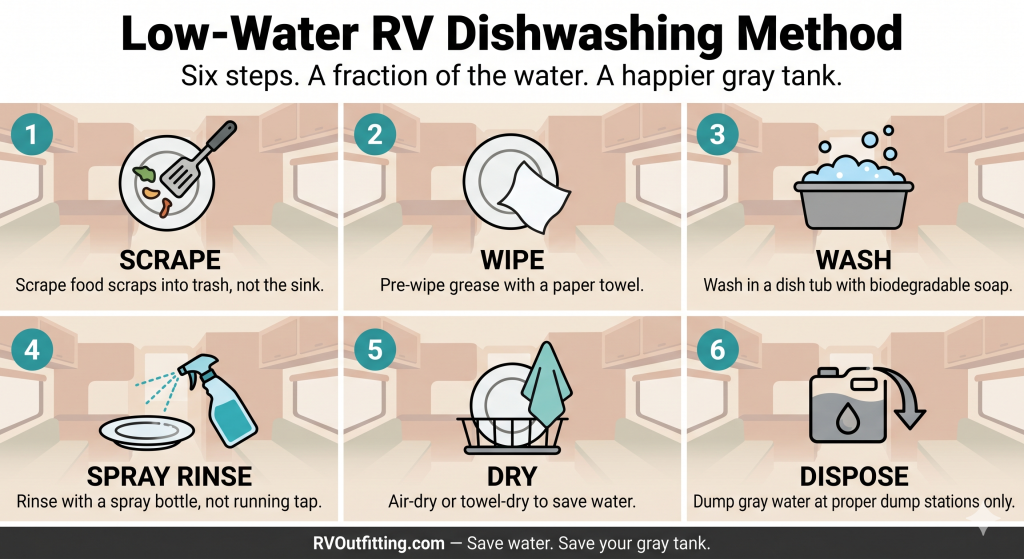
Two-basin dishwashing is the classic low-water method:
- Scrape plates with a paper towel or spatula
- Wash least-greasy items first
- Use a dish tub for soapy wash water
- Use a spray bottle for rinse
- Air-dry or towel-dry
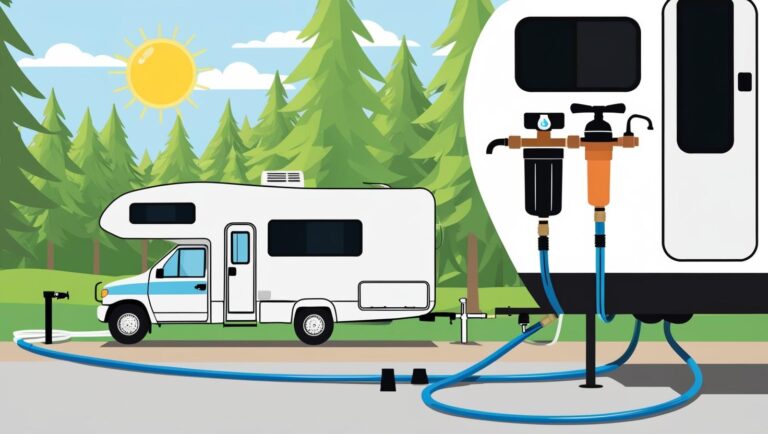
Biodegradable soap is friendlier to the environment, but it doesn’t change where the water goes — gray tank rules still apply. For hookup-day water habits, see our guide to using city water in your RV.
How Cooking Affects the Gray Tank
Dishwater, coffee grounds, grease, and food scraps all end up in the gray tank, where they can affect smell and sensor readings.
Helpful habits:
- Use a sink strainer every time
- Scrape grease into a sealed container, not the sink
- Choose outdoor cooking when possible
- Dump at proper dump stations only
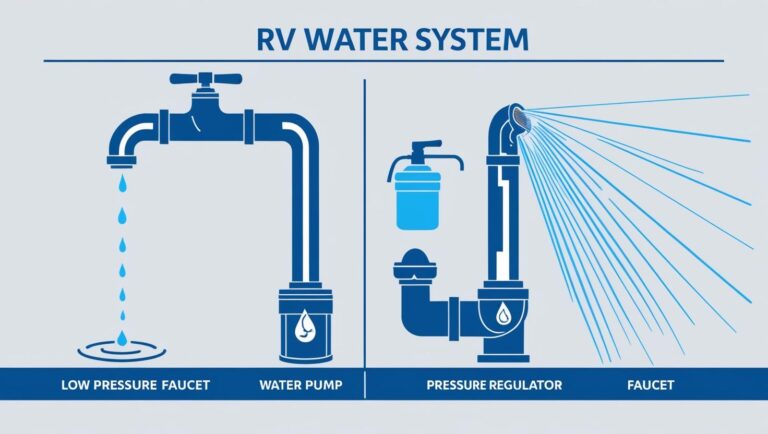
If sink performance feels off, the cause may not be cooking habits — see our low water pressure troubleshooting guide.
Low-Water Cleanup Methods
- Pre-wipe with paper towels before washing
- Spray-bottle rinse instead of running tap
- Collapsible tubs to control water volume
- Plan meals to reduce dish count
Disposable items make sense for boondocking week one; reusable gear wins long-term. While boondocking, conserve fresh water aggressively, monitor gray tank capacity, and check campground rules for outdoor cleanup.
RV Kitchen Safety: Propane, CO, Fire, and Ventilation
Safe Propane Stove Use
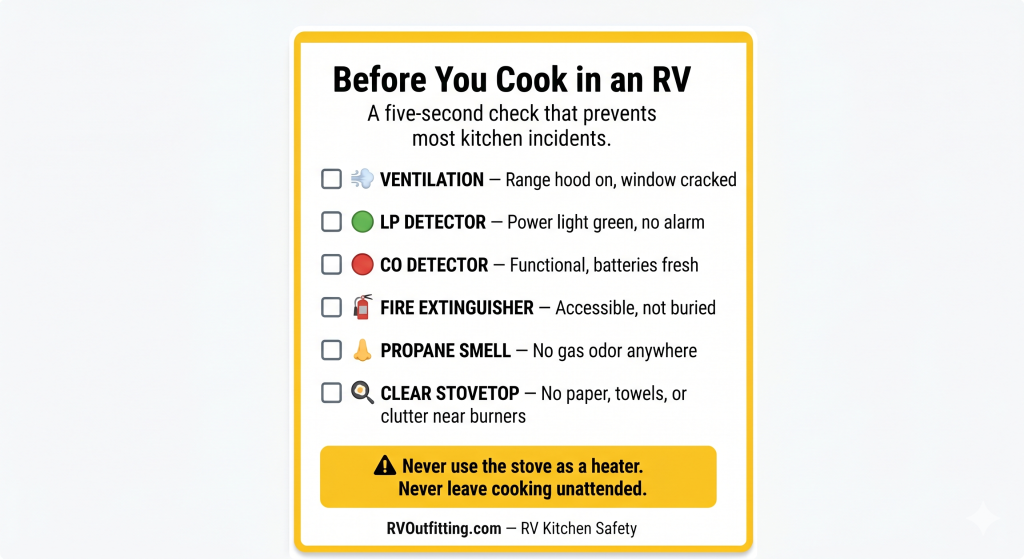
The basics, every time:
- Ventilate — range hood on, window cracked when appropriate
- Never use the stove as a heater
- Keep flammable items (towels, paper) away from burners
- Watch the flame and the food
Know your propane system terms: LP gas, propane regulator, main shutoff valve, pigtail hose, OPD valve. Small RV interiors make ventilation more important than in most home kitchens, and indoor air quality during gas cooking is a real consideration.
What to Do If You Smell Propane
A simple, beginner-safe response:
- Stop using flames immediately
- Don’t flip switches (light switches, fans, anything sparking)
- Ventilate if it’s safe — open doors and windows
- Shut off the propane at the main valve if you can do so safely
- Exit the RV
- Call qualified help
Don’t try to DIY-diagnose a leak. After a suspected leak, have the system professionally inspected before resuming use. A working LP gas detector is non-negotiable.
CO and LP Detector Basics
Two different detectors, two different jobs:
- Carbon monoxide detector — detects CO, a colorless, odorless gas from combustion
- LP gas detector — detects propane leaks
Follow manufacturer guidance for placement, battery checks, and replacement age. ( NFPA 1192 — standard referenced for recreational vehicle safety topics.) ( RVIA — industry body referenced for RV manufacturing and safety guidance.)
Fire Extinguisher Placement and Use
- Mount the extinguisher where you can grab it fast — not buried behind gear
- Remember PASS: Pull, Aim, Squeeze, Sweep
- Clear stovetop area before cooking
- Manage grease — never pour into the sink
- Never leave cooking unattended
For more on kitchen-relevant fire prep, see our guide to top RV fire safety gear
Outdoor Cooking and Fire Restrictions
Outdoor cooking rules vary by location and season:
- Charcoal grills are often restricted first
- Open campfires are commonly restricted in dry conditions
- Propane stoves are sometimes treated differently — but always confirm locally
- Campgrounds, national parks, state parks, and public lands each have their own rules
Check current rules before every trip. This is one of the freshness risks most older RV kitchen articles ignore entirely.
Power Planning for RV Kitchen Appliances
12V DC vs 120V AC in the Kitchen
A beginner-friendly split:
- 12V DC powers lights, water pump, control boards, and some refrigerators
- 120V AC powers the microwave, induction cooktop, electric kettle, toaster oven, and most “home-style” appliances
Your appliance choices depend on whether you’ve got shore power, generator, inverter, and what your battery bank can support.
30 Amp vs 50 Amp Service
The simplest way to think about it:
- 30 amp service has less total capacity — fewer high-draw appliances at once
- 50 amp service has more capacity — more simultaneous use
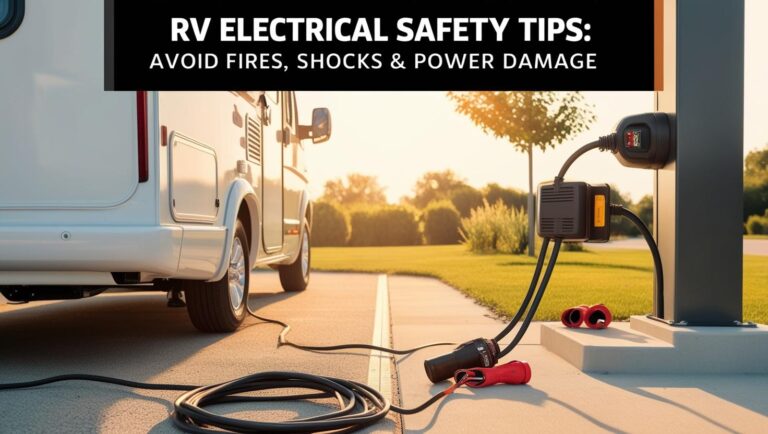
Run a microwave, air conditioner, and electric kettle together on a tight 30 amp setup and something is going to trip. An energy management system and proper surge protection help keep things safe — see our (Internal link: /rv-surge-protectors-101-safeguarding-your-rvs-electrical-system/ — RV surge protectors 101 guide).
Boondocking With Electric Cooking
To run electric appliances off-grid, several pieces must line up:
- A capable battery bank (LiFePO4 is the current go-to)
- Solar charging sized to refill the bank
- An inverter rated for your appliance’s surge and continuous draw
- Realistic expectations about appliance wattage
Induction cooktops, Instant Pots, electric kettles, and microwaves can all work off-grid — when the system supports them. For sizing the solar side, see our guide to sizing your RV solar system
| Appliance | Likely Power Source | Boondocking Suitability | Check Before Use |
|---|---|---|---|
| Microwave | 120V AC | System-dependent | Inverter size, battery |
| Convection microwave | 120V AC | System-dependent | Inverter size, battery |
| Air fryer combo microwave | 120V AC | System-dependent | Inverter size, battery |
| Induction cooktop | 120V AC | System-dependent | Cookware, inverter, battery |
| Electric kettle | 120V AC | Short bursts possible | Inverter, battery |
| Instant Pot / pressure cooker | 120V AC | Often workable | Wattage vs inverter |
| Propane stovetop | Propane | Excellent | Ventilation, detectors |
| RV oven | Propane | Excellent | Ventilation |
| 12V compressor fridge | 12V DC | Excellent | Battery capacity |
| Absorption fridge | Propane / AC / DC | Good | Leveling, fuel source |
RV Kitchen Setup by Camping Style
Weekend Campground Setup
If you’re hooked up most weekends:
- Basic cookware and durable dishes
- A small pantry kit
- Easy meals: grilling, one-pot, simple breakfasts
- Shore power covers most appliances
Hookups reduce water and power stress — but storage and safety still matter. For a broader first-trip framework, see our beginner RV camping guide with checklist.
Boondocking Setup
Off-grid changes priorities entirely:
- Conserve fresh water aggressively
- Control gray tank fill with outdoor cooking and low-water cleanup
- Lean on propane cooking when batteries are low
- Plan solar/lithium/inverter sizing around your kitchen ambitions
- Pack backup no-cook meals (sandwiches, wraps, salads, snacks)
Full-Time RV Kitchen Setup
Full-timers benefit from systems, not gadgets:
- Durable, multi-use tools over single-purpose ones
- Real inventory routines for pantry and freezer
- Repeatable cooking habits, not new experiments every week
- Active payload management — kitchens grow without anyone noticing
Family or Special-Diet Setup
Often skipped in standard guides, but critical for some RVers:
- Allergy-safe containers stored separately
- Separate utensils and cutting boards
- Labeled bins for gluten-free, diabetic-friendly, keto, or vegan staples
- Dedicated prep zones where cross-contamination matters
Remote areas mean less restocking — your inventory control has to be tighter.
| Style | Power Priority | Water Priority | Cooking Priority | Storage Focus |
|---|---|---|---|---|
| Weekend camper | Shore power | Campground hookups | Simple, quick | Compact basics |
| Boondocker | Battery + solar | Strict conservation | Propane + outdoor | Multi-use only |
| Full-timer | Mixed sources | Long-haul routines | Repeatable systems | Inventory-driven |
| Special-diet traveler | Varies | Varies | Allergy-safe prep | Labeled and separated |
Recent Updates and Freshness Risks for RV Kitchens
12V Compressor Refrigerators Are Becoming More Common
If your RV is recent, you may have a 12V compressor fridge that behaves differently than the absorption fridge advice you’ll find in older guides. Identify your fridge type before applying leveling or power-source rules. Thetford’s N4000 and T2000 are examples of the two families.
Induction Is More Practical, But Still Power-Sensitive
Induction has gone from “not for RVers” to “yes, with planning.” The conditions:
- Compatible (ferrous) cookware
- Wattage your inverter can handle
- Battery bank that can absorb the draw
- Shore power, 30 amp, or 50 amp service that supports it alongside other loads
There’s no simple yes/no — use a decision framework based on your system.
Lithium, Solar, and Larger Inverters Change Appliance Advice
LiFePO4 batteries, larger inverters, and capable solar arrays have changed what’s possible off-grid. Older blanket advice that says “never use electric appliances boondocking” is outdated. That said, system sizing still matters — don’t assume any RV can run high-draw appliances. For ongoing care of your solar setup, see our RV solar maintenance and troubleshooting guide
Built-In Convection/Air Fryer Microwaves Can Make Standalone Appliances Redundant
Before you buy a standalone air fryer or toaster oven, read your built-in microwave’s manual. Many newer rigs ship with convection or air fryer combo units — Furrion-style models are common — that already do the job. Your decision tree:
- Use the built-in combo
- Add a standalone appliance only if the built-in doesn’t cover your needs
- Move some cooking outdoors when heat and cleanup are concerns
Campfire and Outdoor Cooking Rules Can Change Seasonally
Seasonal fire restrictions can take charcoal, open flame, and sometimes other outdoor cooking off the table — sometimes for weeks at a time. Always check campground, national park, state park, and public-land rules before you plan your trip around outdoor cooking. This is the single freshness risk competitors most often under-cover.
Common RV Kitchen Mistakes Beginners Should Avoid
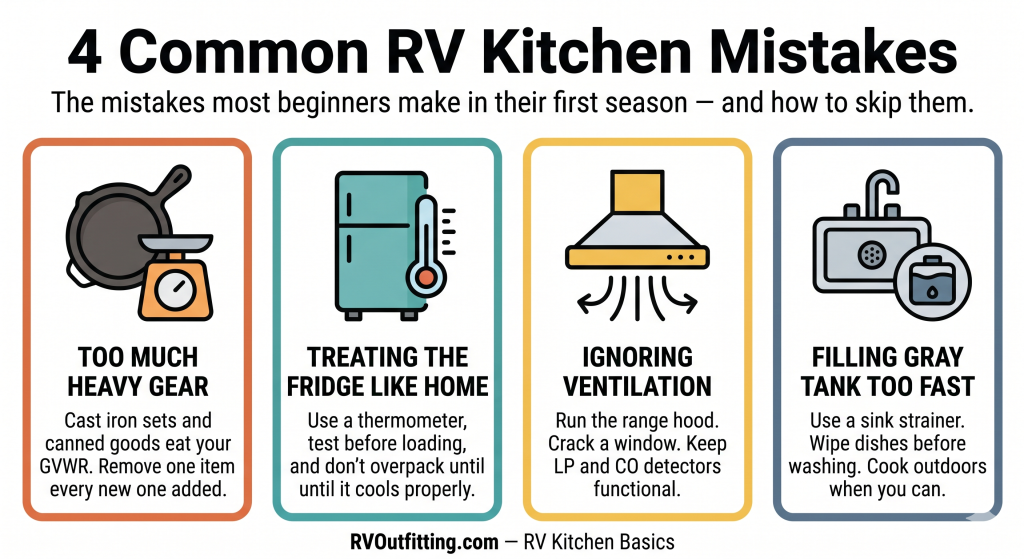
Bringing Too Much Heavy Cookware
Cast iron sets, duplicate pans, cases of canned goods, and bottled drinks all add up. GVWR and cargo carrying capacity are real limits, and the kitchen is a usual suspect.
Rule of thumb: Remove one item for every new item you add. Start light. Add only after you’ve cooked a few real trips.
Treating the RV Fridge Like a Home Fridge
Different cooling behavior, different power sources, airflow sensitivity, leveling quirks — and absorption vs 12V compressor differences on top. Use a fridge thermometer, run a first-trip test, and don’t overpack until you’ve confirmed it cools properly.
Ignoring Ventilation While Cooking
Propane and gas cooking inside a small RV without ventilation is a quiet mistake. Use the range hood, crack a window when appropriate, and keep CO and LP detectors functional. Indoor air quality is a stronger angle than most beginner guides give it credit for.
Filling the Gray Tank With Dishwater Too Quickly
Sink habits matter more in an RV than at home:
- Use a sink strainer every time
- Choose low-water dishwashing methods
- Cook outdoors when possible
- Remember that tank sensors don’t always read perfectly
For deeper context on your RV’s plumbing side, browse our (Internal link: /water-systems/ — RV water systems category).
RV Kitchen Basics FAQ
What appliances does a standard RV kitchen come with?
Most include a propane stovetop, RV oven, microwave (often convection or air fryer combo), sink, cabinets, and refrigerator. Exact equipment varies by rig size, model, and year, so check before buying duplicates.
What do I really need in an RV kitchen?
Nesting cookware, durable stackable dishes, basic utensils, shelf-stable pantry staples, cleaning supplies, a fridge thermometer, and safety gear (LP detector, CO detector, fire extinguisher). The exact mix depends on campground camping vs boondocking — and how much payload you have to spare.
Can I use regular kitchen appliances in an RV?
Often yes, but only when your power capacity supports them. Check appliance wattage against your shore power, inverter, and 30 amp or 50 amp service before running anything high-draw.
What is the difference between an absorption fridge and a 12V RV fridge?
An absorption fridge can run on propane and electric and is more leveling-sensitive. A 12V compressor fridge runs on DC battery power and behaves more like a household fridge. Check your manual for specifics.
Does an RV refrigerator need to be level?
Some absorption refrigerators are leveling-sensitive. 12V compressor fridges generally behave differently. Always follow your specific manufacturer manual.
Is it safe to cook with propane inside an RV?
Yes, when the system is working properly and you follow basic ventilation and safety habits — working LP and CO detectors, range hood on, windows cracked when appropriate, and never using the stove as a heater. If you smell propane, stop, ventilate if safe, shut off propane if safe, exit, and call qualified help.
Can I use an induction cooktop in an RV?
Conditionally yes — with compatible ferrous cookware and enough electrical capacity. Wattage, inverter size, shore power, and battery capacity all matter. Boondocking with induction takes more planning.
Can I run an air fryer or Instant Pot while boondocking?
It depends on your battery capacity, inverter, solar charging, and the appliance’s wattage. LiFePO4 batteries and larger inverters have made this more realistic, but test the setup before relying on it for meals.
How do I conserve water when cooking in an RV?
Cook one-pot meals, move cooking outside when you can, use a spray-bottle rinse and dish tub, and wipe dishes before washing. Less water in equals less gray tank to dump.
How do I keep dishes and kitchen gear from moving while driving?
Use non-slip shelf liner, bins, drawer dividers, tension rods, and cabinet latches. Build a pre-drive reset habit and avoid leaving heavy items loose on counters.