Valterra RV Water Regulator Review – Is This Adjustable Brass Regulator Worth the Price?
Hooking up to campground water is one of those little RV tasks that can either be totally uneventful… or the start of a plumbing horror story. Some parks run gentle, low pressure. Others blast well over 80–100 PSI, which is enough to burst lines and soak your cabinets.
That’s why many RVers pay extra for a “good” adjustable regulator instead of the cheap preset ones. The Valterra Adjustable RV Water Regulator with Gauge is one of the most recommended names in that category – brass, lead-free, adjustable with a gauge, and marketed as a high-flow option for RV plumbing.
In this review, we’ll dig into what the Valterra regulator actually does, how it performs in real RV use, and what long-term owners are saying – including the recurring complaints about gauges failing and occasional leaks.
We’ll also cover who it’s ideal for, who should probably buy something else, and a few usage tips that can significantly extend its life.
Quick Summary
Approximate owner consensus (Amazon + other retailers):
- Approx. rating: ⭐ Around low-to-mid 4-star range overall (heavily skewed to 5★, but with a noticeable group of 1–3★ reviews about gauge failure and leaks)
- Biggest wins:
- Noticeably better flow compared to cheap preset regulators
- Easy pressure adjustment with a flathead screwdriver
- Solid, heavy brass construction that feels high quality
- Most common complaints:
- Gauge failure after months to a couple of years (stuck needles, wrong readings, water/oil inside)
- Cracked body or leaks for some owners, especially after freezing or long-term use
- Higher price than many competitors
Best for you if…
- You camp often (or full-time) and regularly hook up to unknown city water pressure
- You’re frustrated with “trickle” showers from cheap preset regulators and want higher, adjustable pressure
- You’re willing to maintain the regulator properly (no freezing, occasional checks) and accept the chance you may eventually replace the gauge
Probably not for you if…
- You only camp occasionally and are happy with a basic preset 40–45 PSI regulator
- You camp in freezing climates and don’t want to think about winterization or storage
- You’re extremely price-sensitive and prefer to just buy cheaper plastic regulators every few years
Quick Verdict
Overall, the Valterra RV Water Regulator lives up to its reputation as a high-flow, adjustable brass regulator that can dramatically improve your water experience compared to cheap, preset units. Many RVers report finally getting “real shower pressure” while still keeping system PSI in a safe 40–60 PSI range – right where most RV plumbing experts recommend.
However, it’s far from perfect. A significant minority of owners report gauge failures (stuck needles, wrong readings, fogged or water-filled gauges) and occasional cracks or leaks in the brass body, especially if the regulator was exposed to freezing temperatures or left on full-time for years.
If you camp often, want adjustable pressure with good flow, and you’re willing to treat it as a “wear item” you may eventually replace, it’s a strong choice. If you want a cheap, disposable option or never want to think about your regulator again, this may not be your best match.
👉See the current price and more Valterra RV Water Regulator reviews on Amazon
What This Product Is
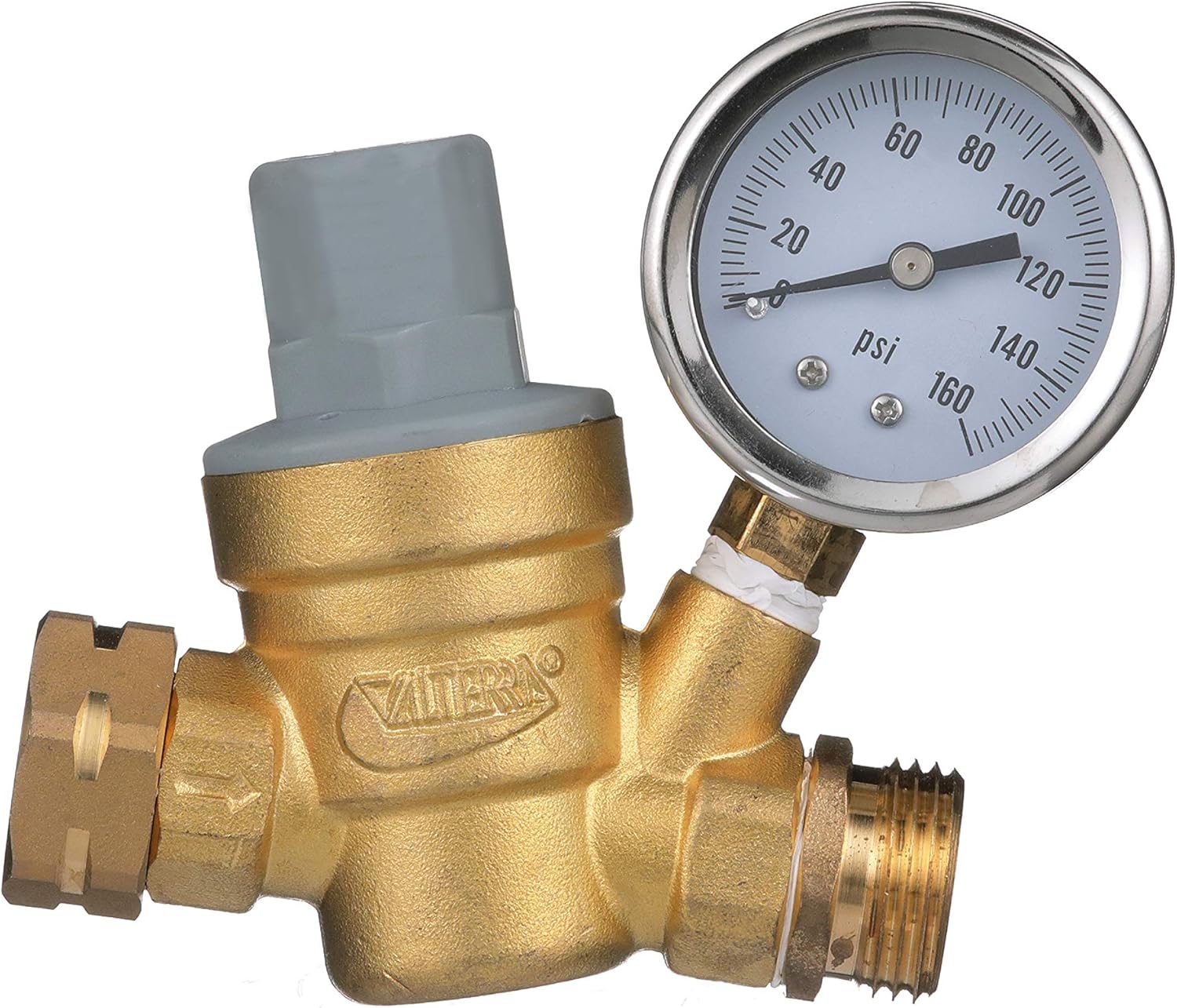
The Valterra Adjustable RV Water Regulator is a lead-free brass water pressure regulator with a built-in gauge. It screws between the campground spigot and your RV drinking water hose and lets you set a specific outgoing pressure to protect your RV’s plumbing.
Key roles in your setup:
- Protects plumbing: Keeps incoming water at a controlled PSI so you don’t blow PEX lines, fittings, toilet valves, or faucets.
- Improves flow (vs cheap regulators): Because it’s designed as a higher-flow unit, many owners see better volume than with small preset 40 PSI regulators.
- Monitors pressure: The integrated gauge shows actual pressure so you don’t just “hope” your regulator is still doing its job.
From Valterra’s own specs and major RV retailers:
- Material: Lead-free brass, drinking-water safe
- Factory setting: ~45 PSI (adjustable with a flathead screwdriver)
- Adjustable range: Roughly 15–85 PSI (settings above 60 PSI are not recommended for RV plumbing)
- Gauge range: 0–120 PSI with a visual red zone above ~50 PSI
- Flow rate: Around 14–15 gallons per minute at 45 PSI (much higher than many small in-line restrictors)
- Connections: Standard ¾” female (spigot side) and male hose connections
- Extras: Inlet screened washer to keep debris out of your RV
Most RV experts suggest keeping RV water pressure in the 40–55 PSI zone to balance good flow with safe plumbing.
Key Features & Specs (Comparison Table)
| Feature / Spec | Valterra Adjustable RV Regulator | Why It Matters for You |
|---|---|---|
| Construction | Lead-free brass | More durable than plastic; safe for drinking water |
| Factory setting | ~45 PSI | Plug-and-play safe starting point for most RVs |
| Adjustable range | Approx. 15–85 PSI (max 60 PSI recommended for RV use) | Lets you fine-tune pressure for your rig and shower |
| Gauge | Analog, 0–120 PSI | Visual confirmation that pressure is in a safe range |
| Flow performance | ~14–15 GPM at 45 PSI | Higher potential flow vs many small, preset regulators |
| Connections | ¾” FHT × ¾” MHT garden-hose style | Standard RV city-water hookup |
| Debris protection | Inlet screened washer | Helps prevent sediment from entering your plumbing |
| Typical lifespan (reported) | Some owners get 3–5 years; others see gauge failure within months | Expect it to be a wear item, especially if used full-time |
| Use cases | RVs, campers, trailers; some owners use it as a house regulator | Versatile but tuned for RV plumbing needs |
Real-World Owner Snapshot
Average rating:
⭐ Roughly low-to-mid 4★ range on Amazon – heavily weighted to 5★ reviews, but with a notable group of 3★ and below focused on gauge failures and long-term leaks.
Top praise themes:
- Solid feel and quality: Many owners comment that it feels heavy-duty and well-built, especially compared to cheaper options.
- Better water flow: Repeated remarks that shower pressure improved significantly versus tiny preset regulators.
- Accurate, easy-to-read gauge (when new): A lot of reviewers are happy with how simple it is to set pressure with a screwdriver and confirm it visually.
- “Set it and forget it”: Quite a few full-timers say they dialed it to 50–60 PSI and just used it for months with no issues.
Most common complaints:
- Gauge failures: Needles stuck at 70–160 PSI, gauges filling with water or oil, or never returning to zero.
- Leaks or cracked body: A smaller but real group report pinhole leaks, cracked brass castings, or leaks around the gauge or seams – sometimes after freezing, sometimes after 6–18 months.
- Price vs longevity: Several owners feel the performance and flow are great, but they expected better lifespan at this price point.
Best for:
- Full-time or frequent RVers who want a high-flow adjustable regulator and are willing to maintain it (no freezing, periodic checks).
- RV owners who care about shower quality and want to run closer to 50–60 PSI safely instead of being stuck at 40 PSI with a cheap preset.
Not ideal for:
- RVers camping only a few weekends a year who might be fine with a cheap preset 40–45 PSI regulator.
- Owners who absolutely do not want to think about maintenance, winterization, or gauge replacement.
Based on the review, the overall story is: excellent performance and flow, but mixed long-term reliability of the gauge and occasional casting issues.
👉See the current price and more Valterra RV Water Regulator reviews on Amazon
What Real Owners Like (Pros)
1. Noticeably Better Flow Than Cheap Preset Regulators
Many owners came from small preset 40 PSI regulators and were unhappy with “trickle” showers or very weak taps. After switching to the Valterra:
- Several reviewers describe “real house-like pressure” in their RV showers.
- One long-term full-timer who had trickle-level water for two years on a cheap regulator was stunned by the difference – filling a coffee pot and showering stopped feeling like an ordeal.
- Another owner compared it directly with a popular knock-off adjustable and found the Valterra held pressure much more consistently when water was flowing.
This matches what we’d expect from the higher flow rating (around 14–15 GPM at 45 PSI).
2. Solid Brass Construction Feels “Real” (Not Toy-Like)
Over and over, reviewers mention that this regulator is:
- “Beefy,” “heavy,” and “well-built”
- Clearly not in the same class as the cheap plastic or tiny brass restrictors
That heavy brass body and lead-free certification help inspire confidence, especially if you’ve previously blown a water line and now worry about every hookup.
3. Adjustable with a Simple Flathead Screwdriver
Owners like that:
- It’s factory-set around 45 PSI, so you’re safe right out of the box.
- You can tweak the pressure with a flathead screwdriver in a few seconds.
- Many RVers set it to 50–60 PSI, which is still within general expert recommendations and feels much better in the shower.
Several reviews specifically mention dialing in:
- ~50 PSI for a comfortable shower and safe plumbing
- ~60 PSI in rigs that can handle it for extra flow (still below the typical 60 PSI “do not exceed” guideline)
4. Readable Gauge (When Working)
When the gauge is healthy:
- People say it’s easy to read at a glance.
- The red zone above ~50 PSI gives a quick visual warning if incoming pressure is high.
- A few owners cross-checked the reading with other gauges and felt it was accurate enough for RV use.
Even some of the 3★ reviews that complain about long-term failure say it worked well while it lasted.
5. Versatile Use Cases (More Than Just RVs)
Interesting bonus: one owner uses this as a whole-house pressure regulator for a three-story sticks-and-bricks home and reports five years of flawless performance there.
While it’s marketed as an RV regulator, the underlying design is similar to many small domestic pressure regulators – so it can do double duty if needed.
What Real Owners Complain About (Cons)
To keep this review honest and genuinely helpful, we need to talk about the patterns in the negative reviews.
1. Gauge Failures Are the #1 Complaint
This is the big theme in 2–3★ feedback:
- Gauges getting stuck at high readings (70–160 PSI) even with no pressure applied
- Gauges filling with water or oil behind the lens
- Needles that no longer move or return to zero
Sometimes this happens after a winter, sometimes after just a few months of use. In a number of cases, owners admit the regulator was left outside in freezing temperatures, which can absolutely damage oil-filled gauges.
A few important points here:
- In some cases, Valterra’s customer service sent a replacement gauge or a whole new regulator quickly.
- In other cases, owners were out of warranty and simply had to replace the unit or buy a third-party gauge.
Bottom line: the regulator may still be controlling pressure even if the gauge is wrong, but you’ve lost your ability to visually verify that – which defeats a key reason for paying extra.
2. Leaks, Cracks, and Pinholes (Sometimes After Freezing)
A smaller but real subset of reviewers experience:
- Hairline cracks or pinhole leaks in the brass casting
- Leaks around the gauge port
- Seam leaks after winter storage
Some explicitly mention that the regulator was left outside over winter or subjected to freezing. Water trapped in any brass body can expand and crack it, so this isn’t unique to Valterra – but at this price point, owners understandably expect more.
Others state that the regulator was well-cared-for and still developed leaks after roughly a year or so.
3. Price vs. Expected Lifespan
Several reviewers highlight the cost:
- Comments like “too expensive for a garden project” or “I expected better for the money” come up.
- A few owners point out that they could buy a cheaper regulator every year for the price of a single Valterra if it doesn’t last.
The reality seems to be:
- Some owners get 3–5 years of use out of one unit.
- Others see gauge failure or leaks within 6–18 months, depending heavily on usage, water quality, and storage.
If you view this as a consumable safety device (like surge protectors or filters), the price is easier to swallow. If you want a decade-long, maintenance-free solution, you might be disappointed.
4. Size, Weight, and Fit
A few owners mention:
- It’s a bit heavy to hang directly off delicate plastic RV inlets.
- The overall size can make it awkward to fit in recessed ground boxes around some campground spigots.
These aren’t deal-breakers but are worth noting. Using a short hose “whip” or 90-degree elbow can help relieve strain – a tip also echoed in general RV plumbing guides.
Who the Valterra Regulator Is Best For (and Who Should Skip It)
Best For You If…
- You camp often or full-time. If you’re on city water in different parks frequently, the ability to set and see your pressure is a big safety and comfort upgrade.
- You care about shower quality and flow. Owners upgrading from cheap preset regulators consistently report much better flow and more satisfying showers.
- You’re willing to do basic care:
- Removing the regulator before freezing temps
- Storing it indoors during winter
- Periodically checking the gauge and connections
- You want brand support. Several reviewers had positive experiences with Valterra replacing faulty gauges or units within warranty.
You Might Want to Skip or Consider Alternatives If…
- You camp just a few weekends a year. A simple preset 40–45 PSI brass regulator might be enough protection for occasional use.
- You’re in harsh freezing climates and hate winterization tasks. Repeated freeze–thaw cycles are brutal on gauges and internal components.
- You’re extremely budget-sensitive. There are cheaper adjustable regulators with gauges (though often with their own reliability issues). If you’re okay replacing regulators more often and don’t care about brand reputation, those may be enough.
- You want digital or dual-stage precision. For high-end rigs or those who obsess over water systems, a high-quality residential PRV plus standalone gauge might be a better route.
Mini Real-World Stories (Paraphrased from Reviews)
- “Two years of miserable water pressure fixed in minutes.”
A full-time RV family lived with weak, almost dripping water flow for two years using a cheap regulator. Every shower and coffee pot fill felt like a chore. After researching and switching to this Valterra unit, they were shocked by how strong and consistent the water pressure became, even at the factory setting. They described the upgrade as “life-changing” for daily comfort. - “Blew a water line once – never again.”
One owner of an older RV had previously blown the main water line underneath their rig at a local campground with high pressure. After that expensive lesson, they purchased the Valterra regulator. Since then, they’ve set it to around 50 PSI and haven’t had a single pressure-related issue, describing it as “worth every dollar” for peace of mind. - “Five years on a three-story house.”
Another reviewer uses the Valterra not on an RV but to regulate water to a three-story home. They set the pressure once and left it. Several years later, hoses that used to burst no longer fail, and they report consistent volume and pressure throughout the house. - “Great until the gauge died.”
A number of owners tell a similar story: the regulator worked perfectly for months, protecting their RV and improving showers, then the gauge suddenly started reading 90+ PSI with no water flowing or filled with liquid. Some received replacements under warranty; others bought new units or simply lived with a “blind” regulator.
These stories reflect the core trade-off: excellent performance while it’s healthy, but uneven long-term reliability of the gauge and sometimes the body.
Installation & Usage Tips (Pulled from Owner Experience + Best Practices)
Many of these tips echo general RV plumbing advice and can help any regulator last longer, not just the Valterra.
- Install at the spigot, not at the RV inlet.
- Screw the regulator directly onto the campground spigot.
- Then attach your RV-safe hose to the regulator, and then the hose to your RV.
- This protects not only your RV plumbing but also the hose and any inline filters.
- Use Teflon tape and don’t overtighten.
- Wrap the male threads with 2–3 turns of thread seal tape.
- Hand-tighten, then use a wrench for just a quarter-turn more.
- Over-tightening can damage brass fittings or RV plastic inlets.
- Avoid letting the regulator “hang” off plastic connectors.
- This unit is heavier than cheap regulators.
- Use a short lead hose or 90-degree elbow so the regulator is supported and not straining the RV’s plastic inlet.
- Set pressure in the safe RV range.
- Most RV plumbing is happiest between 40–55 PSI, with 60 PSI generally considered an upper limit.
- A common setup is 45–50 PSI for general use, up to 55–60 PSI if your rig and fixtures can handle it.
- Never leave it full of water in freezing weather.
- Freezing water inside the regulator or gauge can crack brass, blow seals, or destroy the gauge.
- Before a freeze, disconnect, drain it completely, and store it indoors.
- Add it to your “departure checklist.”
- A surprising number of regulators are lost because people drive away without removing them from the spigot.
- Make “remove regulator” part of your standard breakdown checklist.
- Consider pairing it with a full RV water system check.
If you’re learning how your rig’s water system works, it’s worth reading a broader guide like “RV Water System 101: How Your RV Gets Water” on your own site, plus your posts on:- Hooking up at the campground using city water in your RV
- Troubleshooting low water pressure in your RV
These tie in nicely with a regulator upgrade.
FAQ: Valterra Adjustable RV Water Regulator
You can mark this section up with FAQPage Schema for extra SEO value.
Q1. What pressure should I set the Valterra regulator to for my RV?
Most RV experts recommend staying between 40 and 55 PSI, and generally not exceeding 60 PSI, even though some RV plumbing can technically handle more.A common starting point is 45–50 PSI for good showers without stressing your plumbing. Always check your RV owner’s manual for the exact maximum.
Q2. Is the Valterra regulator lead-free and safe for drinking water?
Yes. The product is marketed specifically as lead-free brass and compliant with modern drinking-water fixture standards in the U.S. and Canada.
Q3. How do I adjust the pressure?
Use a flathead screwdriver on the adjustment screw:
- Turn one direction to increase downstream pressure
- Turn the other to decrease it, while watching the gauge as water flows
Always make adjustments with water running and re-check after the system stabilizes.
Q4. Why did my gauge stop working or fill with water?
Common causes include:
- Exposure to freezing temperatures with water trapped inside
- Internal seal failure or oil leakage in the gauge
- Age, vibration, or manufacturing defects
If the gauge is stuck or reads wrong with no pressure applied, the regulator might still be regulating, but you no longer have accurate visual feedback. Many owners contact Valterra for warranty support in this situation.
Q5. Do I still need a regulator if my campground “says” they regulate pressure?
Yes, you should still use your own regulator. Campground systems can fluctuate widely, and posted numbers may not reflect spikes, nighttime surges, or issues at individual spigots. Having your own regulator is cheap insurance against plumbing damage.
Pros & Cons Summary Box
Pros
- Solid, heavy, lead-free brass construction
- Adjustable with a simple flathead screwdriver
- Higher flow and better shower pressure than many cheap preset regulators
- Easy-to-read gauge (when functioning)
- Can be used on RVs, trailers, and even small houses
- Good customer service in many reported cases
Cons
- Gauge failures (stuck needles, wrong readings, fogging) reported by a noticeable minority
- Some cases of leaking or cracking bodies, especially after freezing or 1–2 years of use
- More expensive than many competing adjustable regulators
- Heavy and somewhat bulky – can stress unsupported plastic inlets or not fit in recessed spigot boxes
- Not a “fit and forget for life” solution – treat it as a device with a finite service life
Final Verdict: Is the Valterra RV Water Regulator Worth It?
If you:
- Hook up to city water often,
- Care a lot about shower quality and water flow, and
- Want to actively protect your RV plumbing from pressure spikes,
then the Valterra Adjustable RV Water Regulator is a compelling option.
It delivers:
- Excellent flow compared to cheap 40 PSI preset regulators,
- Simple, screwdriver-based adjustment, and
- A gauge that gives you real-time visibility into your system pressure.
On the downside, you need to be realistic:
- There is a well-documented pattern of gauge failures over time.
- A smaller group of owners experience leaks or cracks in the brass body, particularly with freeze exposure.
- At this price point, you may feel the lifespan should be longer than what some reviewers report.
My bottom line:
If you’re a regular or full-time RVer who wants a set-and-tweak regulator with better flow and real gauge visibility, and you’re willing to maintain and possibly eventually replace it, the Valterra regulator is worthy of consideration and often worth the premium.
If you only camp occasionally, or you want something ultra-cheap and fully disposable, a basic preset regulator may make more sense – and you can still learn a lot from your broader guides like Best RV Water Pressure Regulators (and How to Use Them).
👉See the current price and more Valterra RV Water Regulator reviews on Amazon