GEARGO RV Surge Protector Review: Real Owner Patterns on Reliability, Rain, and Cold-Weather Error Codes
Affiliate Disclaimer: This article contains affiliate links. If you click through and make a purchase, I may earn a small commission at no extra cost to you. This helps support my deep-dive research.
GEARGO RV Surge Protector Review (30A & 50A): The Good, The Bad, and the “Why Is It Throwing an E6?”
You know the feeling: you pull into a campground late, you’re tired, and the pedestal looks… questionable. Old cover. Loose outlet. Maybe you’ve even heard the horror stories—fried converter, smoked microwave, mystery electrical gremlins for weeks.
That’s exactly why so many RVers end up searching for a GEARGO RV surge protector: it’s priced like a “budget-friendly safety upgrade,” and it promises the two things you want most at hookup time:
- A quick pedestal wiring check
- Surge protection for your rig’s electronics
I went through a wide spread of real owner feedback—both the glowing “peace of mind” takes and the angry “it died on trip #2” ones—to figure out what you should actually expect in day-to-day RV life.
Quick Summary
- Best for: warm-weather weekenders who want a simple “plug-in pedestal check + basic surge protection” at a reasonable price.
- Biggest win: owners repeatedly like how fast it is to verify a safe outlet before plugging your RV in.
- Biggest risk: a recurring cluster of display-model error codes (especially E6/E7 temperature-related faults) and complaints about warranty/support responsiveness.
- Weather reality: the rain cover helps, but multiple owners still report water intrusion if it’s positioned poorly or exposed to sustained rain.
Quick Verdict: The GEARGO can be a solid budget protector when it behaves, but reliability reports are mixed enough that you should treat it like a “good value with known risks”—especially if you camp in shoulder-season cold.
Confidence Score: 6.2/10 ⚡️
👉 Ready to protect your rig at the next hookup? Check the GEARGO price on Amazon 🔌
What This Product Is (and Isn’t)
Let’s set expectations, because this matters.
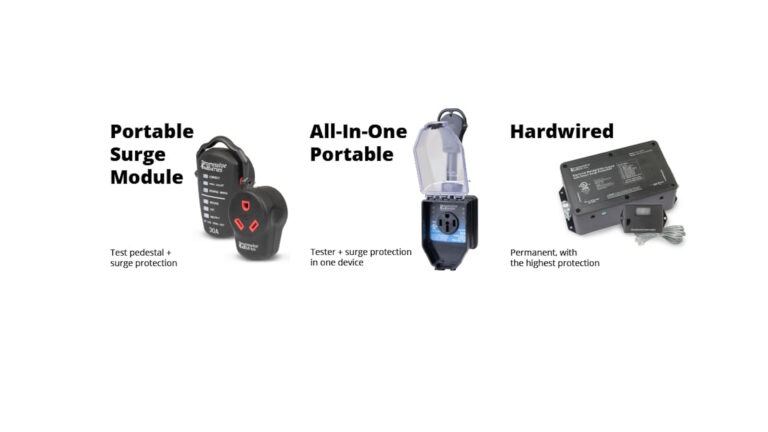
A portable RV surge protector like GEARGO is typically doing two jobs:
- Pedestal / outlet check (circuit analyzer): It helps you spot wiring faults before you connect your RV.
- Surge suppression: It can absorb/deflect certain voltage spikes.
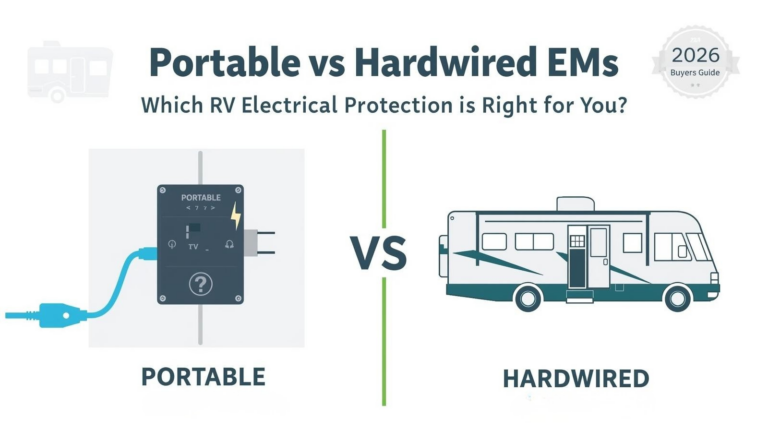
What it usually does not do as well as a true EMS (Energy Management System):
- long-duration brownout management (low voltage over time)
- highly robust fault logic across weird campground power conditions
- consistent “save you from everything” behavior
If you’re new to this, you’ll like this primer:
GEARGO Versions You’ll See (Why Owners Have Different Experiences)
Owners mention a few common “flavors”:
- 30A (TT-30 style) vs 50A (14-50 style)
- Basic (lights only) vs Display / smart shutoff models
- Different advertised joule tiers (you’ll see versions marketed around 9,500J or 12,000J)
That matters because many of the recurring complaints (like temperature sensor codes) cluster around the display models.
Technical Deep Dive (Simple, Practical, RV-Relevant)
30A vs 50A: Don’t Let the Plug Lie to You
- 30A RV service (North America): 120V, up to 30 amps (≈3,600 watts).
- 50A RV service (North America): two 120V “hot legs” (often called split-phase). Your RV can draw up to 50 amps on each leg (massively more available power than 30A).
Why you care: if a device misinterprets 50A pedestal conditions, it can throw codes or refuse to pass power—even when the pedestal is fine. And some owners report exactly that experience with certain 50A units.
Regional note: This style is primarily for USA/Canada campground hookups. If you’re in Australia (230V systems), the connectors and standards are different—this is generally not a plug-and-play fit.
Key Features (Benefit-Driven & Comparative)
Here’s the core promise vs what owners commonly report in real-world use.
| Feature | What the Manufacturer Says | What It Actually Means (User Experience) | Compared to Competitors |
|---|---|---|---|
| Circuit Analyzer (LED fault lights) | “Detects wiring problems” | Many owners like the fast “all green = go” check before plugging in the RV. | Common on budget protectors; premium models add deeper diagnostics. |
| Surge Protection (varies by model: ~9,500J / ~12,000J) | “High joule protection” | Helps with spikes, but doesn’t automatically fix chronic low voltage or bad pedestal behavior. | Higher joule ratings are good, but not the only factor in real protection. |
| Display + Error Codes (some models) | “Smart monitoring and shutdown” | Helpful when stable—but repeated reports of E6/E7 temp-related faults and “won’t pass power” situations. | Premium EMS units tend to be more consistent and better supported. |
| Rain Cover / Weather Shield | “Weather resistant” | Often appreciated, but positioning matters; some users still report water intrusion or cover fit issues. | Some competing designs are more sealed or have better drip protection. |
| Handle / Grip | “Easy plug/unplug” | Owners regularly like the usability—especially with stiff shore cords. | Similar on many portable units. |
| Anti-theft tab (some versions) | “Lockable” | Nice idea; still needs a cable/lock strategy depending on your site. | Common on mid-tier units; not always included on cheap ones. |
Real User Experience Analysis (Deep Pattern, Not Marketing)
Here’s what keeps coming up again and again.
First Impressions: “Feels Solid, Looks Premium”
Across the owner feedback I analyzed, a big early theme is build feel:
- “Sturdy / well made” pops up a lot
- People like bright colors (especially orange) because it’s harder to forget at checkout
- The plug fit is often described as snug (which can be good… until it’s too tight)
In real-world use, many users find the GEARGO hits that sweet spot: “not fancy, but reassuring.”
👉 If you’re mainly after a simple pedestal check + basic protection, see the current GEARGO listing on Amazon 🔌
The 6–12 Month Reality Check: Where the Story Splits
This is where owner experiences diverge.
Group A: “It Just Works”
A frequent buyer surprise is how many owners use it:
- at campgrounds
- at home (via adapters)
- during storm seasons
Some even describe it surviving ugly weather nights without drama—exactly what you want from a “silent protector.”
Group B: “It Throws Codes / Dies / Won’t Pass Power”
One pattern that comes up repeatedly is failure modes that feel especially painful because they happen:
- after the Amazon return window
- at a campsite when you need shore power now
- with unclear support channels for warranty help
The most repeated pain points are:
- Temperature-related fault codes (especially E6 on 30A display units and E7 on some 50A display units)
- Over-voltage style codes (commonly referenced as E2, particularly on some 50A units)
- Support / warranty registration frustration (messages, delayed replies, or no replies)
The Most Common Complaints (Ranked by “How Much It Can Ruin Your Weekend”)
1) Cold Weather Shutdowns (Display Models): The E6/E7 Problem
Owners commonly report a frustrating pattern: once temps drop into the 30s–40s °F, some display units fault out and stop supplying power.
Why it matters:
- If you camp spring/fall, ski season, or full-time in cooler climates, a “won’t work when it’s cold” protector is a deal-breaker.
What it looks like in real life:
- You wake up to no shore power
- The pedestal tests fine
- Plugging in directly works
- The surge protector shows a temperature-related error
Practical takeaway: If you regularly camp below ~40°F (≈4°C), treat the GEARGO display versions as higher risk based on aggregated owner experiences.
2) “It Worked Fine… Until It Didn’t” (Early Failures)
In the reviews I went through, I kept seeing reports of units that:
- worked for a few trips
- then stopped passing power
- or died suddenly
This is the hardest category to forgive, because you buy a surge protector specifically to reduce stress—not add a new failure point.
3) Water Intrusion / Rain Management (Positioning Matters a Lot)
A frequent buyer surprise is that a rain cover doesn’t automatically equal “waterproof.”
Owners report:
- the cover helps in light rain
- but sustained rain + bad positioning can still let water get where you don’t want it
The most important nuance: orientation and drip path matter. If the device becomes the low point where water can pool, you’re asking for trouble.
If water management is a big worry for you, this safety guide is worth reading:
4) Warranty / Customer Service Friction
Based on aggregated owner experiences discussed in these reviews, the after-sale support experience is inconsistent:
- Some owners got replacements or refunds
- Others report dead ends, delayed replies, or confusing warranty steps
Practical takeaway: If you’re the kind of buyer who values rock-solid warranty support, this is one of the biggest reasons to consider alternatives.
The Good, The Bad & The Ugly (Pros / Cons)
✅ The Good (What Owners Consistently Like)
- Quick pedestal safety check: plug it in, confirm the lights, then connect your RV.
- Usability: handles/grips make plugging/unplugging less annoying with stiff cords.
- Value: many buyers feel it’s a fair price for the function.
- Rain cover concept: even when imperfect, lots of owners appreciate having something.
⚠️ The Bad (Annoying, But Not Always a Dealbreaker)
- Cover fit quirks: some plugs don’t nest perfectly, making it fiddly.
- Tight receptacle fit: can be a two-handed job until you get used to it.
- No built-in locking solution (on some versions): you may need to supply your own strategy.
🚫 The Ugly (The Stuff That Can Kill Trust)
- Cold-temp shutdown error codes on certain display models.
- Random error codes / refuses to pass power even when a pedestal tests okay.
- Support inconsistency: when it fails, you want a clean path to resolution.
Owner Stories (The Human Side)
These aren’t direct quotes—just real patterns retold in the way they actually play out at campsites.
Story 1: The “Storm Night” Test
One owner used the GEARGO through a long, nasty thunderstorm stretch—exactly the kind of night you’re half-expecting to smell toasted electronics. The device stayed online, didn’t flinch, and the RV kept running normally. That’s the best-case scenario: you never “see it work,” you just avoid a disaster.
📝 See more owner experiences here: Amazon review thread ⚡
Story 2: The “It Was the Surge Protector… Not the RV” Rabbit Hole
Another common scenario: the RV suddenly loses power to key circuits. You check breakers. You check the RV. You start mentally pricing an electrician. Then someone thinks, “What if I bypass the surge protector?” Plugging in directly restores power—meaning the surge protector became the failure point.
📝 More real-world troubleshooting stories: Amazon reviews 🔌
Story 3: The Cold Morning Surprise
A recurring shoulder-season story: you’re camping in crisp weather. Overnight, power drops. The pedestal seems okay. Your batteries saved you from total misery, but now you’re troubleshooting in a hoodie at 7 a.m. The surge protector is showing a temperature-related fault and refuses to cooperate until the day warms up.
📝 More owner cold-weather reports: Amazon review feed ❄️
Expert Tips & Installation Hacks (Owner-Tested, Camper-Proof)
1) Do the “Pedestal First” Routine Every Time (60 Seconds)
- Plug the surge protector into the pedestal.
- Confirm the indicator pattern looks normal (no fault lights/codes).
- Only then plug in your RV shore cord.
- If anything looks off, don’t force it—find another pedestal or ask the campground to check it.
This is the single biggest “use it correctly” lesson owners reinforce.
2) Rain Strategy: Think Like Water
Owners who had the best luck in wet weather tend to do the same things:
- Keep the unit off the ground
- Ensure the cord has a drip loop so water runs away from connections
- Use the cover, but don’t assume it’s magic
- If you’re in days of steady rain, add extra shelter (like keeping the connection under the pedestal hood if possible)
Important safety note: If a unit has taken on water or tripped, unplug everything and let it dry fully before reuse. If there’s visible damage, replace it.
3) Theft Prevention: Bright Color Helps… But Use a Real Plan
Bright orange is nice, but it’s not a lock. If your unit has an anti-theft tab, consider:
- a small padlock + cable through the tab (where applicable)
- routing the cable so it’s not a trip hazard
4) Cold Weather Reality Check (Be Honest About Your Camping Style)
If you camp in cold temps and you’re choosing between basic vs display versions, owner feedback suggests the display models carry more risk of nuisance shutdowns in the cold.
If cold-weather reliability is non-negotiable, consider a different class of protection entirely:
Who This Is For (and Who Should Skip It)
You Should Consider the GEARGO If…
- You want a budget-friendly RV surge protector that’s easy to use.
- You mostly camp in mild/warm seasons.
- You primarily want the “pedestal check first” habit + surge suppression.
- You like the idea of a rain cover and a more rugged plug/handle design.
👉 If that sounds like you, grab the GEARGO here on Amazon 🔌
You Should Skip It If…
- You routinely camp in below ~40°F (≈4°C) conditions (especially with display models).
- You’re a full-timer who can’t afford surprise shutdowns.
- You want the strongest track record for reliability + support.
- You’ve had repeated campground power issues and want a higher-end protection strategy.
If you’re in the “skip” camp, here’s the safer move:
- See our top surge protector & EMS picks (better options for demanding use cases)
Deep-Dive FAQ
1) Is the GEARGO an EMS or just a surge protector?
In real-world use, owners treat it primarily as a surge protector with a circuit analyzer. Some versions add a display and shutoff behavior, but many RVers still consider premium EMS units a different tier of protection.
2) Why do some owners get E6 or E7 errors?
Owners repeatedly associate E6/E7 with temperature-related faults on certain display models—often triggered in cooler weather. The frustrating part is that it can shut off power even when the pedestal appears fine.
3) Can I use it at home with an adapter?
Many owners do—especially to keep the RV protected while parked. Just remember: home outlets and adapters add their own constraints. Don’t overload a 15A/20A circuit, and keep connections protected from water.
4) Does the rain cover make it waterproof?
Think of it as weather help, not a waterproof guarantee. Owners report better results when the unit is positioned to prevent pooling and when cords are routed to shed water away from the connection.
5) 30A or 50A: should I match my RV service exactly?
Yes. Your RV inlet and main service (30A vs 50A) should determine what you buy. If you sometimes adapt down (50A RV using 30A service), you’ll still want protection that matches your normal setup and your adapters.
Final Verdict
If you want the blunt truth: the GEARGO RV surge protector has a real audience.
When it works, owners love the simple ritual of checking a pedestal before they plug in—plus the “I sleep better now” feeling. But the downside is also real: enough owners report cold-weather shutdown codes, random faults, and uneven support that it’s hard to call it a universal recommendation.
If you’re a warm-weather weekender and you want a budget-friendly layer of protection, it can make sense.
If you’re a cold-weather camper, a full-timer, or someone who demands bulletproof reliability, you’ll likely be happier shopping a higher-confidence option.
👉 Want to roll the dice on value (with eyes wide open)? Check GEARGO on Amazon ⚡