Battle Born LiFePO4 RV Battery Review: Longer Boondocking, Less Battery Anxiety
Affiliate Disclaimer: This article contains affiliate links. If you click through and make a purchase, I may earn a small commission at no extra cost to you. This helps support my deep-dive research.
The “Why Is My Battery Dead Again?” Problem
If you’ve ever woken up boondocking to a dim control panel, a cranky 12V fridge, or that familiar “low voltage” beep from your inverter… you already know the pain. Lead-acid batteries (AGM included) can feel like they’re always negotiating: “Sure, I’ll give you power… but only if you don’t ask for too much, and please don’t discharge me past 50%.”
That’s exactly why so many RVers look at lithium—then immediately hit the next wall: price and trust. Is a premium battery actually worth it, or are you paying for a label?
For this review, I went deep into real owner experiences to save you hours of scrolling. I’m going to tell you what people actually run, what “drop-in” really means in an RV, and where the Battle Born 100Ah LiFePO4 battery shines (and where it can frustrate you).
Quick Summary
- Best for: RVers who want a “buy once, cry once” lithium upgrade and are willing to set up charging correctly.
- Not ideal for: Anyone expecting a perfect plug-and-play swap with zero electrical tweaks—or anyone who hates warranty paperwork.
- Biggest upside: Stable voltage + fast charging = noticeably more usable power than AGM in real camping life.
- Biggest downside: Price is the #1 sticking point, and warranty experiences are mixed (some smooth, some aggravating).
- Typical use cases owners mention: Solar setups, inverter loads, off-grid weekends, and “stop babying the batteries” upgrades.
Quick Verdict (TL;DR)
If you want premium lithium behavior—flat voltage under load, fast recharge, and the freedom to use most of your battery capacity—Battle Born 100Ah LiFePO4 battery owners overwhelmingly report that it delivers… as long as your charging system is lithium-friendly.
Confidence Score: 7.9/10
- Performance & usability: high
- Value for money: depends on your budget tolerance
- Ownership experience: great when everything works; can get messy when warranty support is needed
👉 🔋 Check current price on Amazon
(And if you’re still deciding across brands/features, start here: Best RV LiFePO4 Batteries.)
At-a-Glance Comparison: Lithium vs AGM in RV Life
Here’s the plain-English reason lithium feels like a cheat code in a camper:
| What You Care About | Typical AGM / Lead-Acid | Typical LiFePO4 (including Battle Born-style 12V 100Ah) | What You Feel In Real Use |
|---|---|---|---|
| Usable capacity | Often ~50% recommended | Often 80–100% usable (within BMS limits) | Longer runtime before “voltage panic” |
| Voltage under load | Drops steadily | Holds steady much longer | Inverter + fridge behave more “normal” |
| Recharge speed | Slower acceptance near full | Faster acceptance, especially mid-range | Short generator runs feel more productive |
| Maintenance | More sensitive to partial state of charge | Generally happier living partially charged | Less babysitting, fewer “oops” moments |
| Weight | Heavy (often 2× lithium for same usable energy) | Much lighter | Easier installs, better payload margin |
That “stable voltage” point is why owners often describe lithium as feeling bigger than the same Ah rating in lead-acid.
Technical Deep Dive: What This Battery Is (and Isn’t)
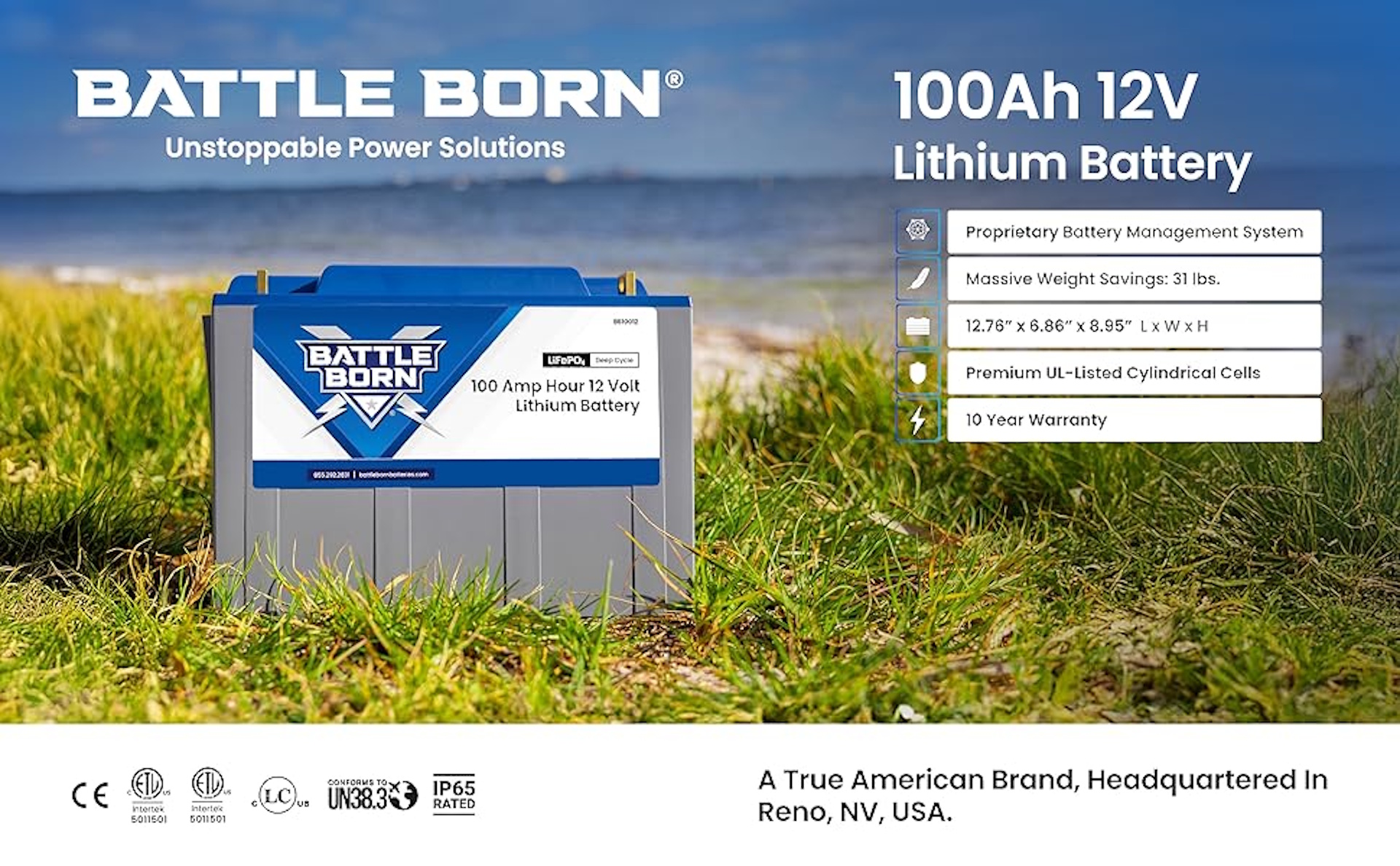
The Battle Born 100Ah unit is a 12V LiFePO4 (lithium iron phosphate) “house battery” designed to replace traditional 12V RV batteries.
Key terms (quick definitions)
- Ah (amp-hours): How much current you can draw over time at a nominal voltage.
- Wh (watt-hours): Ah × voltage = usable energy. (This is the real apples-to-apples.)
- BMS (Battery Management System): The internal “brain” that protects the cells from over/under-voltage, over-current, and sometimes temperature issues.
- Inverter: Converts 12V DC to household AC (120V in the US/Canada; 230V in Australia).
What “drop-in replacement” actually means
A frequent buyer surprise is that “drop-in” often refers to physical fit and wiring simplicity, not “your RV charger is automatically correct.”
In real-world use, many users find they get the best results when they:
- confirm the converter/charger has a lithium profile, or
- adjust solar charge controller settings to lithium-appropriate voltages, and
- avoid charging lithium directly from an alternator without proper current control (often via a DC-DC charger).
If you’re not sure how big your system should be, this guide saves headaches: How to Size Your RV Solar System.
Key Features (Benefit-Driven & Comparative)
| Feature | What the Manufacturer Says | What It Actually Means (User Experience) | Compared to Competitors |
|---|---|---|---|
| 12V 100Ah LiFePO4 format | “Drop-in lithium replacement” | Owners commonly report a huge quality-of-life jump vs AGM—if charging is configured right | Premium-tier cost; budget lithium may add Bluetooth/heating but can vary in support consistency |
| Built-in BMS protection | “Protects battery health” | Many users find it prevents accidental damage (over-discharge/over-current), but BMS cutoffs can confuse older chargers | Some competitors add Bluetooth diagnostics, which can reduce “what happened?” moments |
| Fast recharge acceptance | “Charges efficiently” | One pattern that comes up repeatedly is shorter generator runs and better solar harvesting—people feel they “get more back” each day | Similar to most LiFePO4 chemistry; the difference is often system tuning + support |
| Stable voltage under load | “Reliable performance” | In the reviews I went through, RVers repeatedly mention better inverter behavior and fewer low-voltage alarms | A strong point for LiFePO4 in general; premium builds aim for consistency batch-to-batch |
| Long warranty promise | “Peace of mind” | Based on aggregated owner experiences, warranty is praised by some—and criticized by others who felt the process was strict or slow | This is where premium brands live or die: the hardware matters, but the support experience matters just as much |
First Impressions vs Long-Term Reality (Owner Pattern Check)
First impression (a strong majority of positive reviews)
Across the owner feedback I analyzed, a recurring theme is “this feels like a premium component”—solid construction, clean terminals, and an “I can lift this without grunting” reaction compared to lead-acid bricks.
People also love the psychological shift: instead of nursing batteries, they start using their RV like an RV.
Reality after months/years (where experiences split)
From real-world owner feedback, it looks like the long-term story tends to split into two lanes:
Lane A: “Set it up right once, then forget about it.”
These owners report multiple seasons of trouble-free use, especially when paired with solar and a properly configured converter.
Lane B: “The battery is fine, until something weird happens—and then support becomes the experience.”
This is where you see complaints: unexpected shutoffs, charging confusion, or a failure that turns into a warranty back-and-forth. Not everyone experiences this—but it’s loud enough to matter when you’re paying premium money.
Step 5: Real User Experience Analysis (Deep Pattern Analysis)
Here’s the high-signal stuff I kept seeing—both good and bad.
Pattern 1: The star ratings are polarizing (and that’s telling)
The overall review mix skewed heavily positive, but not universally so:
- A big chunk are glowing 5-star “best upgrade I’ve done” stories.
- There’s also a noticeable cluster of 1-star experiences that revolve less around daily performance and more around failure + warranty friction.
That doesn’t automatically mean “bad product.” It means: if you’re unlucky, the ownership process becomes the product.
👉⚡ See the Battle Born listing on Amazon
Pattern 2: “It only delivers 80%… until you fix the charger”
In real-world use, many users find they don’t get full satisfaction out of a premium lithium battery when their RV is still charging like it’s 2009.
Common scenario:
- You swap from AGM to lithium.
- Your converter tops out at a conservative voltage.
- You think you bought 100Ah of freedom—but it feels like you’re only getting “most of it.”
Once owners switch to a lithium-capable converter/charger or tune their solar controller, the tone changes fast: better runtime, faster recovery, fewer surprises.
If you’re planning the upgrade path, this beginner-friendly walkthrough helps: DIY RV Solar Installation (Step-by-Step).
Pattern 3: Solar + lithium is the “happy place”
A frequent buyer surprise is how often solar shows up in the most satisfied stories. People describe a smoother daily rhythm: harvest in the morning, run loads during the day, and still have plenty left at night.
If your system ever acts up (weird charge behavior, controller errors, mystery shutdowns), bookmark this for later: RV Solar Maintenance & Troubleshooting.
Pattern 4: Price comes up constantly—and owners justify it two ways
Price talk is unavoidable here. Owners typically justify the cost in one of two ways:
- Weight + usable power: “I gained usable capacity without adding payload stress.”
- Long-term math: “If this lasts years, the cost per trip gets reasonable.”
On the flip side, the negative camp often says: “At this price, I shouldn’t have any hassle.”
Pattern 5: The “BMS cutoff confusion” is real (but preventable)
A small but important subset of owners report confusing moments where the BMS appears to cut off output (or the system reads the battery as “dead”) until it’s “woken” or recharged properly.
This is rarely described as dangerous—more like a “why is nothing working?” panic. The fix is usually better charging configuration and monitoring.
The Good, The Bad & The Ugly (Pros/Cons)
Pros & Cons Box (Quick Scan)
Pros (owner themes):
- Voltage stability: RV systems feel calmer; fewer low-voltage complaints under load.
- Recharge efficiency: Owners with solar/generator setups report faster recovery.
- Weight savings: A meaningful win vs lead-acid for many rigs.
- “Set it and forget it” success stories: Especially when charging profiles are correct.
Cons (owner themes):
- Price shock: Many call it expensive, even when they like it.
- Warranty/support variability: Some rave, others feel stonewalled.
- Not always plug-and-play: Older converters/chargers can hold you back.
- Edge-case quirks: Occasional reports of shutdowns/odd behavior that require troubleshooting.
Pros (grouped, with what it means)
- Everyday usability upgrade: The best reviews don’t sound technical—they sound like relief. People stop counting phone charges and start running fans, lights, water pumps, and electronics without anxiety.
- Inverter friendliness: Owners running inverters mention smoother operation for typical RV loads (think TVs, small kitchen gadgets, and yes—sometimes microwaves with the right inverter/battery bank sizing).
- Solar pairing: A chunk of happy campers specifically mention solar as the “unlock.”
Cons (brutally honest)
- The value equation is emotional: At this price tier, even a small hiccup feels insulting.
- Warranty experiences are mixed: Some owners describe quick replacements; others describe a slow, strict process. If you buy premium, this is the one area you should mentally prepare for.
- Your RV might be the weak link: Converter settings, wiring quality, and monitoring matter more than most people expect.
Installation & Setup: How to Make a “Drop-In” Actually Feel Drop-In
Step-by-step: Basic RV swap checklist (safe, practical)
- Turn everything off (shore power disconnected; inverter off; 12V main disconnect off).
- Document your wiring (a quick photo is enough).
- Inspect cable gauge + lugs (loose or undersized connections create heat—never ignore that).
- Add/confirm proper fusing close to the battery bank. (This is non-negotiable safety.)
- Install the battery and torque terminals appropriately—then re-check after a few trips.
- Update charging settings (converter and/or solar controller) to lithium-friendly values.
- Verify with a battery monitor (a shunt-based monitor is the gold standard for confidence).
For broader “don’t burn your rig down” best practices, keep this handy: RV Electrical Safety Tips.
Charger settings: the #1 reason people feel disappointed
Owners commonly report that the battery feels amazing once charging is correct. If it feels “meh,” your charger is the first suspect.
General lithium charging principles (conceptual):
- Avoid lead-acid “equalization” modes.
- Use a lithium-appropriate bulk/absorption profile (often mid-14V range).
- Don’t obsess over float the way you would with lead-acid; lithium doesn’t need constant babysitting.
(Always follow your charger manual and RV manufacturer guidance. Standards like UL 1973 and UN 38.3 exist for a reason—battery safety is a system, not a single part.)
Cold-weather reality (US/Canada/Australia note)
In the US and Canada, plenty of RVers camp below freezing (32°F / 0°C). In colder climates, lithium charging behavior matters. Owners who camp in winter tend to be happier when the battery bank is:
- installed in a warmer compartment, or
- protected from cold charging conditions (some systems add heating or avoid charging when too cold).
Australia is generally milder in many regions, but alpine/cold trips still happen—same rule applies: protect the battery from cold charging extremes.
Owner Stories: The Human Side (Mini-Scenarios)
These are the kinds of “real RV life” moments that show up repeatedly.
Story 1: The boondocker who stopped running the generator so much
One common pattern: an RVer adds lithium + solar, then realizes their daily routine changes. Instead of a long generator run to “maybe” top off lead-acid, they do a shorter recharge window and let solar finish the job. The vibe is always the same: less noise, less fuel smell, more relaxing mornings.
📌 Want to read more owner perspectives in one place? Amazon reviews here
Story 2: The “why is my battery dead?” scare that turned out to be configuration
Another scenario: the battery seems to shut off or read as empty after a deep discharge. The owner panics, then learns the RV’s charging setup or monitoring setup was the weak link. Once they adjust settings or add a proper monitor, the problem doesn’t come back.
Story 3: The premium buyer who loved the battery… until warranty became the story
This is the hard one. A small subset report an early failure or odd behavior, and the frustration escalates when replacement feels slow or conditional. Even if the hardware is great most of the time, this is why I can’t call it a “perfect” ownership experience across the board.
Expert Tips & “Hacks” Owners Wish They Knew Earlier
Here are practical moves that come up again and again:
- Install a shunt-based battery monitor
Voltage alone can mislead you with lithium. A real monitor reduces anxiety and helps you spot charging issues early. - Treat your converter as part of the upgrade cost
If your RV is older, assume you might need a lithium-capable converter/charger. That’s what makes a premium battery feel premium. - Re-check terminal tightness after vibration miles
RV life vibrates. A loose connection can cause heat and weird behavior. A quick re-check after a trip or two is cheap insurance. - Plan your battery bank for your inverter loads
A single 100Ah battery can be perfect for lights, pump, fans, and moderate inverter use. But heavy inverter loads (coffee maker, microwave, space heating) usually want a bigger bank. If you’re unsure, start with planning: How to Size Your RV Solar System.
Who This Is For (and Who Should Skip It)
You should buy it if…
- You want a premium RV lithium battery that many owners describe as a “finally done” upgrade.
- You’re pairing it with solar, or you want faster generator recharge results.
- You’re willing to do (or pay for) correct charging configuration.
You should skip it if…
- You want the cheapest 100Ah lithium option and don’t care about premium-tier pricing.
- You hate troubleshooting and you’re unwilling to touch charger settings.
- You expect warranty/support to feel frictionless 100% of the time.
Deep-Dive FAQ
1) Will a Battle Born 100Ah run my RV fridge?
If your fridge is a 12V compressor fridge, many owners report solid results—especially with solar support. If it’s a propane absorption fridge, your 12V draw is usually controls + fans (lighter), and lithium still helps with overall house power stability.
2) Can I run a microwave with this battery?
Sometimes—but it depends on your inverter and battery bank size. A microwave is a high-draw appliance. Owners who do it reliably typically have a larger battery bank (multiple batteries) and a properly sized inverter.
3) Do I need to change my converter/charger?
Not always, but this is the #1 reason lithium upgrades feel underwhelming. If your converter can’t charge lithium properly, you may not hit full performance—owners who upgrade charging hardware often report the biggest satisfaction jump.
4) Is it safe in an RV?
LiFePO4 chemistry is widely considered more stable than some other lithium chemistries, but safety is still system-level: correct fusing, proper cable sizing, secure mounting, and good connections matter. If you’re not confident, a qualified RV tech is worth it.
5) Is this battery a good “starting battery” for an engine?
Most RVers use this as a house battery, not an engine starting battery. Starting systems have different demands. If you’re trying to solve chassis starting issues, that’s usually a different product category.
Final Verdict
The Battle Born 100Ah LiFePO4 battery is one of those upgrades that can make your RV feel “newer” overnight—lights stay bright, voltage stays steady, and your daily power routine gets simpler. Based on real-world owner feedback, the majority of happy stories come from people who treat the battery as part of a system upgrade (charging profile + monitoring), not a single magic brick.
If you can stomach the premium price and you’re willing to set it up correctly, it’s a strong contender for a long-term RV power build.