ExpertPower 12V 100Ah LiFePO4 RV Battery Review: The Lightweight Upgrade With One Big Asterisk
Affiliate Disclaimer: This article contains affiliate links. If you click through and make a purchase, I may earn a small commission at no extra cost to you. This helps support my deep-dive research.
The Quick Pain Point (Why You’re Even Considering This Battery)
If you’re still dragging around heavy lead-acid (AGM or flooded) batteries, you already know the two classic RV problems:
- Weight (your tongue weight and payload hate you)
- “Usable” capacity (you own 200Ah, but you use maybe half if you want them to live)
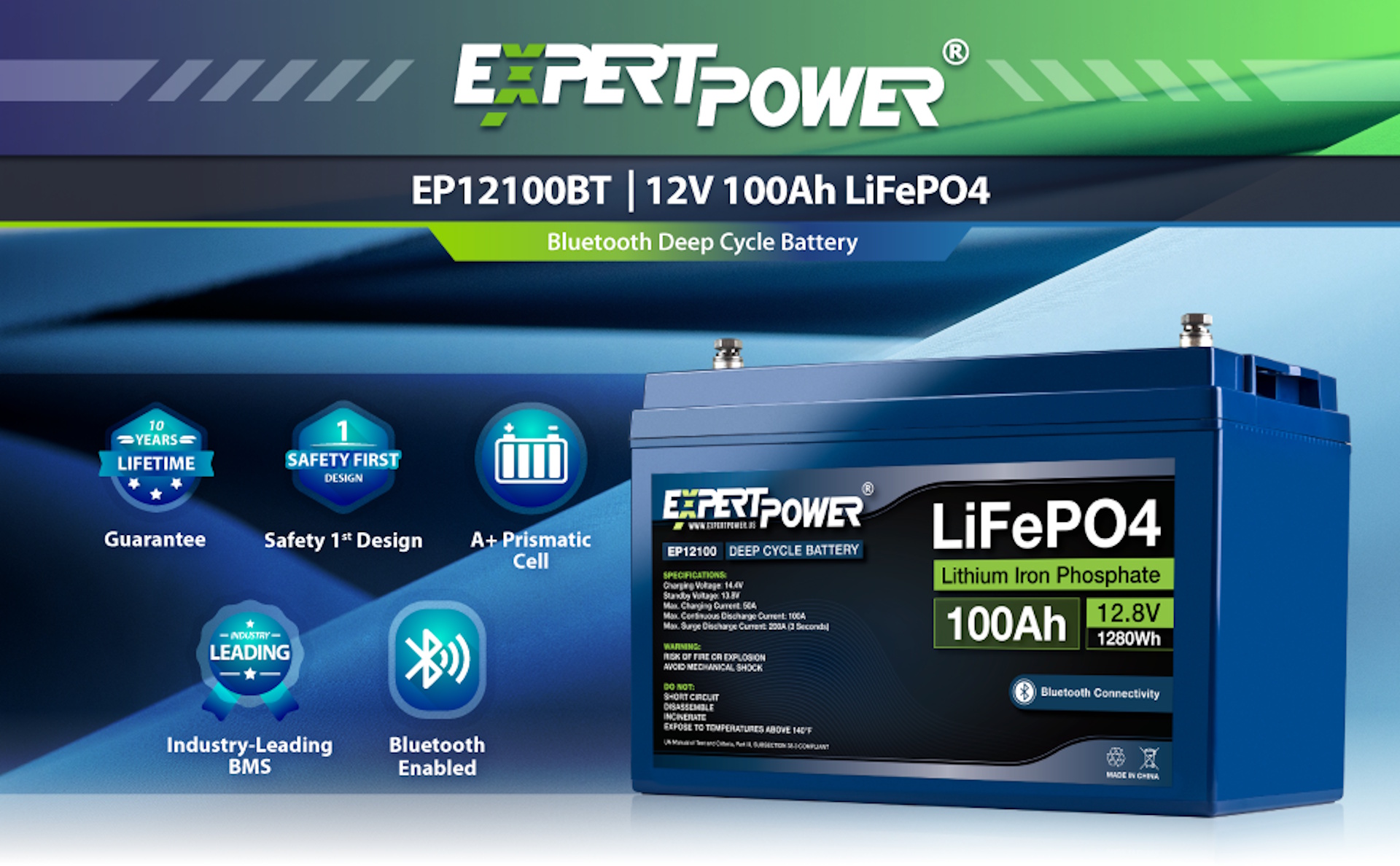
That’s why the ExpertPower 12V 100Ah LiFePO4 RV battery keeps showing up on upgrade shortlists. It promises the holy grail: big usable capacity in a small, light box, plus a built-in BMS (Battery Management System) to keep things safe.
This review is a deep-dive into real owner feedback—so you can skip the weeks of scrolling and make a smarter call.
Quick Verdict (TL;DR)
If your RV power needs are “normal” (12V fridge, lights, fans, water pump, charging devices, and a reasonable inverter), many owners end up genuinely happy—especially with the weight savings and the “it just holds power” feel.
If you want to push high surge loads (big inverter startup, generator starting, some trolling motors, or anything that slams the battery with a sudden current spike), a recurring theme is BMS sensitivity—and that’s the make-or-break detail.
Confidence Score: 7.8/10 🔋🙂
- Higher if you’re using it as a house battery with smart charging
- Lower if you’re expecting it to behave like a high-discharge “starter” battery
👉 🔋⚡ See the ExpertPower 12V 100Ah price on Amazon
Quick Summary (What Most RVers Should Know Up Front)
Across the owner feedback I analyzed, a recurring theme is:
- It’s dramatically lighter than lead-acid, and that alone makes people feel like they “fixed” their RV battery bay overnight.
- Charging is not plug-and-play if your RV converter/charger is old-school lead-acid only.
- A DC-DC charger is often the missing link if you expect your tow vehicle/alternator to charge it properly while driving.
- Big inverter surges can trip the BMS, and once tripped, some owners need a “wake up” style charger behavior to reset it.
If you’re still deciding which lithium battery to buy (and want options with higher discharge ratings, longer warranties, Bluetooth, etc.), this is your mandatory next stop:
What You’re Buying
At its core, this is a 12V 100Ah lithium iron phosphate (LiFePO4) “house battery” aimed at RV/camper/solar use.
Why LiFePO4 feels different than AGM in real RV life:
- Flatter voltage curve: it holds “normal looking” voltage for a long time… then drops quickly at the end.
- Deeper usable capacity: you can use far more of the rated capacity without wrecking it (compared to lead-acid’s “try not to go past ~50%” reality).
- Higher charge acceptance: it can take charge faster if your charging system is correct.
That last part matters: lithium doesn’t magically fix a weak charging setup.
Specs That Actually Matter for RV Use
Here’s the stuff that changes your day-to-day experience:
- Nominal system: 12V RV house systems (works in USA/Canada/Australia RVs because the DC side is still 12V—even though shore power is 120V in the US/Canada and typically 230–240V in Australia).
- Capacity: 100Ah (what you care about is usable Ah + discharge limits)
- BMS limits: this is the “governor” that can shut the party down if you ask for too much current too fast.
- Charging profile: lithium wants the right charger/converter settings
- Cold charging protection: charging below freezing can damage LiFePO4 cells, so low-temp behavior matters a lot for shoulder-season camping.
Comparison Table: Why 100Ah LiFePO4 Can Replace “More Ah” Lead-Acid
| Battery Setup | Typical Weight | “Usable” Capacity Reality | What It Feels Like in an RV |
|---|---|---|---|
| 2× 6V GC2 Flooded (≈ 200–230Ah) | Heavy (often 110–130 lb / 50–59 kg) | Often ~50% usable if you want lifespan | Big capacity on paper, but you baby it |
| 1× 12V AGM 100Ah | Medium-heavy | Often ~50% usable | Fine for weekenders, slow to recover |
| 1× LiFePO4 12V 100Ah | Light (often ~30 lb / 13–14 kg class) | Often much higher usable capacity | Feels like “more power” because you actually use it |
This is exactly why so many upgrades feel dramatic: you’re not just buying Ah—you’re buying usable Ah plus weight savings.
Technical Deep Dive (Without the Engineering Headache)
LiFePO4 vs AGM: the RV-relevant differences
In the reviews I went through, I kept seeing owners describe the same “aha moment”:
- With lead-acid, you plan around battery weakness (slow charging, voltage sag, “don’t go too low”).
- With lithium, you plan around system compatibility (charger settings, BMS limits, and cold charging rules).
Bottom line: lithium is “easier” once the system is dialed.
Why a simple voltmeter lies to you on lithium
Owners commonly report confusion about state of charge early on. That makes sense: LiFePO4 voltage stays relatively flat through much of its discharge curve.
Translation:
- A voltmeter is not a fuel gauge for lithium.
- A shunt-based battery monitor (or SmartShunt style setup) is the grown-up move.
Charging: Converter + Alternator + Solar (the reality)
From real-world owner feedback, it looks like charging success usually depends on whether you have:
- A lithium-capable RV converter/charger (or a modern stand-alone lithium charger)
- A DC-DC charger if you want meaningful alternator charging while towing
- Solar with a lithium profile (and correct voltage setpoints)
If you’re building or upgrading your charging system, these internal guides help you avoid the common pitfalls:
- RV Solar 101: The Complete Guide to Off-Grid Power
- How to Size Your RV Solar System
- DIY RV Solar Installation Guide
Key Features (Benefit-Driven & Comparative Table)
Here’s the part you asked for—manufacturer claim vs what it means in owner reality.
| Feature | What the Manufacturer Says | What It Actually Means (User Experience) | Compared to Competitors |
|---|---|---|---|
| 100Ah LiFePO4 capacity | “High capacity, deep cycle power” | Many users feel like they “got their battery space back” because 100Ah lithium often behaves like more usable power than bigger lead-acid banks | Similar usable benefit to other LiFePO4; difference is BMS limits + warranty |
| Lightweight design | “Easy handling / portable” | A huge “quality of life” win—owners love not wrestling a 100+ lb lead-acid setup | Most LiFePO4 are light; ExpertPower wins when replacing multi-battery lead-acid banks |
| Built-in BMS protection | “Protects against over-current, over/under-voltage” | Works well for many—but surge events (especially inverter startup) are where some owners get burned by shutdowns | Some competitors offer higher surge tolerance, user-reset features, or higher continuous discharge |
| Charging compatibility | “Works with solar, RV, off-grid” | True—if you match charging profiles. A frequent buyer surprise is needing a lithium converter/charger and/or a DC-DC charger | Premium brands often give clearer guidance and longer warranties; budget brands vary wildly |
| Cold-temp behavior | “Low-temp protection” (varies by model/listing) | Mixed owner outcomes: some report smooth cold-season use; others report protection not behaving as expected | Many modern competitors clearly specify low-temp cutoffs (and some add self-heating options) |
Step 5: Real User Experience Analysis (Deep Pattern Analysis)
👉 🔋🛒 Check current pricing on Amazon
Pattern #1: First impression is usually “wow, this is light”
Based on aggregated owner experiences discussed in these reviews, the weight reduction is the first emotional win. People describe it as:
- easier installs
- less strain lifting/positioning
- better payload flexibility
- more freedom to relocate the battery (because LiFePO4 doesn’t vent hydrogen like flooded lead-acid)
If you’ve ever scraped knuckles swapping a pair of GC2s… you get it.
Pattern #2: “It holds power” is real… but only when charging is right
In real-world use, many users find the battery feels “steady.” Once charged, it can sit and support typical RV loads without that constant “voltage sag anxiety” you get with tired lead-acid.
But the consistent caveat is charging setup:
- Some owners realized their tow vehicle’s 7-pin charge line wasn’t enough for proper lithium charging on longer trips.
- Others fixed alternator charging by adding a DC-DC charger and a dedicated circuit.
Practical takeaway: If your plan is “drive and recharge,” budget time/money for DC-DC charging.
Pattern #3: Inverter + sudden surge = where the drama lives
One pattern that comes up repeatedly is the battery acting perfectly normal… until you introduce:
- a big inverter
- a load with heavy startup current
- or an inverter with large input capacitors that “slam” the battery at connection
Then: BMS trips, inverter faults, and you’re staring at a system that looks dead until it’s reset.
The two most common “owner fixes” that show up:
- Pre-charging the inverter (so the capacitors don’t hit the battery like a hammer)
- Using a charger behavior that wakes the BMS (some owners mention chargers with a force/wake mode concept)
I’m purposely keeping this non-mathy, because the point is simple:
This battery is happiest with smooth, sane loads—not violent surges.
Pattern #4: Longevity is split into two camps
This is where I’m going to be blunt.
In the 100Ah-specific reviews I analyzed, the ratings are not universally sunshine:
- About ~62% were 5-star (28 of 45)
- About ~24% were 1-star (11 of 45)
And the negative cluster is not random—it’s concentrated around:
- DOA or early failure
- BMS shutdown / won’t charge
- warranty expectations vs reality
- cold-weather behavior complaints
At the same time, there are owners reporting multi-year success with steady RV usage, including people running fridges and daily loads for many trips without noticeable capacity drop.
My read: quality control and/or BMS edge cases are the risk tax here.
Pattern #5: Customer service is praised… until it isn’t
Owners commonly report surprisingly helpful support—especially troubleshooting and replacement help in some cases.
But there’s also a real subset describing:
- slow response cycles
- frustration around warranty limits
- “support ping-pong” when diagnosing BMS issues
So I’d describe support as high-variance: some wins, some headaches.
The Good, The Bad & The Ugly (Pros/Cons)
✅ The Good
- Weight savings is the headline win. If you’re replacing multiple lead-acid batteries, this can feel like removing a bowling ball from your RV.
- Strong performance for typical house loads. Lights, fans, pumps, fridges—this is where many owners feel it shines.
- Fast charging potential (with the right equipment). Several owners highlight surprisingly quick recharge when paired with a proper lithium charger.
- Clean ownership experience vs lead-acid. No corrosion drama, no electrolyte babysitting, and generally less mess.
⚠️ The Bad
- BMS limits can be a bottleneck. If your setup includes a large inverter or high surge devices, this battery may feel “fragile” even if the cells are fine.
- Reset/wake behavior can be annoying. Some owners wish they could reset the BMS without hooking up a charger.
- Charging compatibility is not optional. If your converter is lead-acid only, you’re leaving performance (and potentially lifespan) on the table.
😬 The Ugly
- A meaningful chunk of 100Ah owners report failures (dead units, won’t charge, sudden shutdowns).
- Cold-weather charging concerns show up repeatedly. Charging LiFePO4 in freezing temps is risky; some owners don’t trust the battery’s low-temp protection behavior.
- Warranty expectation mismatch. Several negative reviews read like: “I thought 10-year life meant 10-year warranty.” That mismatch creates real anger.
Owner Stories (The Human Side)
These are paraphrased real-world scenarios that popped up repeatedly (and they’ll sound familiar if you RV off-grid).
Story 1: The “Why is my battery lower after towing?” moment
One owner installed the battery expecting the tow vehicle to keep it topped off while driving. After a couple days of towing, they realized the battery state was lower, not higher. The fix was adding a proper DC-DC charger and wiring it correctly—after that, charging while towing became predictable.
📌 More owner context here: 🔎 Browse owner experiences on Amazon
Story 2: The “Camper van fridge runs 24/7 and I stopped worrying” setup
Another recurring scenario is the camper van crowd: solar + alternator charging + occasional AC charging. When the system is dialed, owners describe the battery as “unflappable”—steady voltage, reliable fridge operation, and basically no drama trip after trip.
📌 More owner context here: 🧭 See more Amazon owner stories
Story 3: The “BMS shutdown in the middle of nowhere” scare… and the fix
A memorable pattern is the battery seeming dead after a shutdown. Some owners describe being stuck until they learned how to “wake” the BMS with the right charging behavior. The emotional arc is always the same: panic → troubleshooting → relief → “I wish I knew this earlier.”
📌 More owner context here: 🧰 Read more owner scenarios
Expert Tips & Installation Hacks (Stuff Owners Learned the Hard Way)
Here are the practical “pro tips” that keep showing up in owner feedback—things manuals often gloss over.
1) Don’t trust your old converter—verify lithium mode
If your RV converter is designed for lead-acid only, it may:
- charge too slowly
- never fully top lithium
- or use an inappropriate profile long-term
Action: confirm your charger/converter explicitly supports LiFePO4.
2) Use a shunt monitor if you care about accuracy
Because lithium voltage is flat, a shunt-style monitor (amp-hours in/out) is the difference between:
- guessing
- and actually knowing
3) If you tow and expect alternator charging, plan for DC-DC
A frequent buyer surprise is learning the standard trailer charge line isn’t designed for proper lithium charging over long hauls.
Action: a DC-DC charger (installed correctly) makes alternator charging consistent.
4) Pre-charge big inverters to avoid BMS trips
If your inverter has a big input capacitor bank, connection can look like a surge event to the BMS.
Action: use a proper pre-charge method (many owners describe a two-step connection approach) and keep wiring solid and short. This is one of those “small setup detail, huge outcome” items.
5) Storage tip: don’t park it at 100% for months
Owners who store fully charged for long periods sometimes suspect that reduced lifespan followed. For lithium, long-term storage is generally happier at a partial state of charge.
Rule of thumb: store around the mid-range unless you’re heading out soon.
6) Cold weather: protect the battery from freezing charge conditions
Charging LiFePO4 below freezing can damage cells. Even if a product claims protection, many owners prefer not to gamble.
Action: if you camp in freezing temps, keep the battery in a warmer compartment or use a temperature-aware charging strategy.
Who This Battery Is For (And Who Should Skip It)
👉 🔋🛒 Get the ExpertPower 12V 100Ah on Amazon
You should buy this if…
- You want a lighter house battery for boondocking basics: lights, fans, water pump, charging devices, and typical RV loads
- You’re willing to ensure your charging setup is lithium-correct
- Your inverter use is modest (or you understand surge behavior and setup details)
- You value “good performance per dollar” more than maximum warranty length
You should skip this if…
- You plan to run high-surge/high-current loads routinely (big inverter startup loads, generator starting, or anything that frequently slams current draw)
- You camp in serious cold and want clearly specified, confidence-inspiring low-temp charging protection
- You want the safest “buy once, cry once” path with longer warranties and higher discharge headroom
If you want alternatives that are better suited for high-draw builds (or just want the most reliable picks across budgets), don’t guess—use this roundup:
Deep-Dive FAQ
1) Can the ExpertPower 12V 100Ah run a 2000W inverter?
It depends on surge behavior and BMS limits. Many users do fine with moderate inverter loads, but the recurring failure mode is startup surge tripping the BMS. If your build is inverter-heavy, you may be happier with a battery designed for higher continuous and surge discharge.
2) Do I need a special charger for LiFePO4 in my RV?
You need a charger/converter that supports a LiFePO4 charging profile. If your converter is lead-acid only, you can still “make it work,” but you may get slower charging, incomplete charging, or reduced long-term happiness.
3) Why doesn’t my tow vehicle charge it properly through the 7-pin?
Because that circuit is usually designed for light charging/maintenance—not high-current lithium charging over long distances. Many owners solve this with a DC-DC charger.
4) What do I do if the battery seems dead and won’t charge?
A pattern in owner experiences is that some shutdown states require a charger behavior that “wakes” the BMS. Practically: try a known lithium-capable charger and confirm all wiring/terminal connections are correct. If it’s still not recovering, you may be dealing with a failure case.
5) Is it safe to charge LiFePO4 below freezing?
Generally, charging below freezing is a bad idea for LiFePO4 cells. Even if protection exists, many owners treat freezing-temp charging as a hard no and keep the battery in a warmer environment.
Final Verdict (My Straight Answer)
The ExpertPower 12V 100Ah LiFePO4 RV battery is one of those products that can feel amazing in the right lane: lightweight, steady house power, fast charging (with proper gear), and way less hassle than lead-acid.
But it also has a clear “risk profile” in owner feedback: BMS-related shutdown behavior, plus a noticeable minority reporting failures and warranty frustration—especially when the battery is pushed like a high-discharge powerhouse.
If your RV power life is mostly house loads + smart charging, it can be a very satisfying upgrade.
If your plan is big inverter life or high surge demands, I’d strongly consider a battery engineered for that use case.