KEPWORTH LiFePO4 RV Battery Review (12V 100Ah): Built-In Charger + USB—Worth It or Risky?
Affiliate disclosure: This post contains affiliate links. If you click and buy, RVOutfitting.com may earn a small commission at no extra cost to you.
Quick Summary
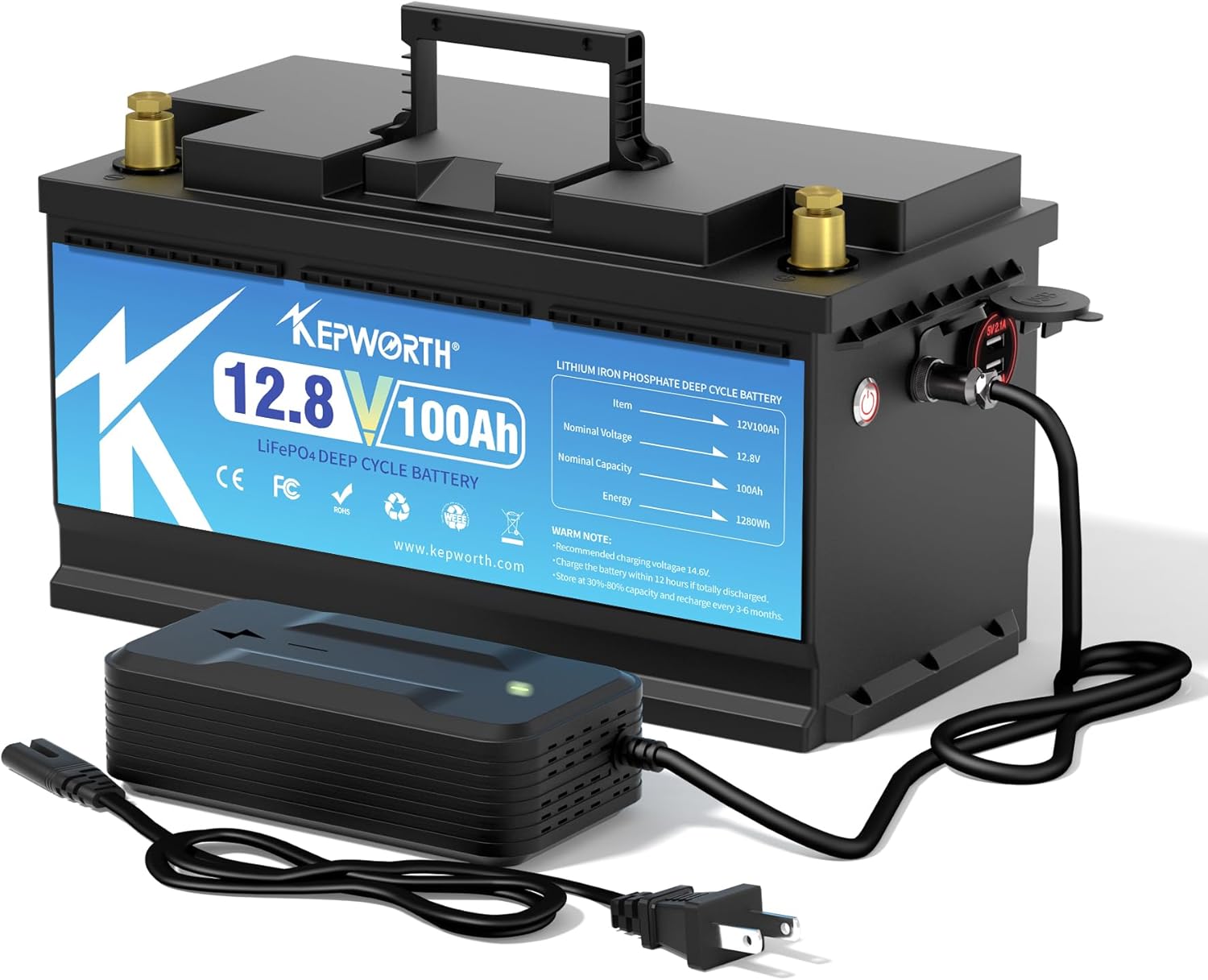
- What it is: A 12V 100Ah (class) LiFePO4 battery positioned as an all-in-one power option, with USB ports and an included wall charger that many owners treat like “plug in and go.”
- What owners like most: Long runtimes, lighter weight vs lead-acid, and the convenience of built-in USB charging.
- What owners complain about most: Slow/unclear charging behavior, minimal instructions, and a small but serious cluster of reports about charger heat, charger failure, and support frustration.
- Best fit: Weekend campers, budget-minded RVers, and boaters who want simple 12V power + device charging without building a complex setup.
- Not ideal: Anyone who needs fast charging, expects premium support, or wants maximum confidence in the included charger.
Quick Verdict
If you want an affordable lithium upgrade that many owners say runs gear for hours (and sometimes all day) while cutting weight compared to lead-acid, the KEPWORTH battery can be a strong value—especially if you like the idea of USB ports built into the battery and an included charger.
However, the buyer feedback is clear: charging is the make-or-break area. Several owners loved it, but a meaningful minority reported confusing charge indicators, hot chargers, or charger failures. If that sounds like a deal-breaker, you may want a simpler “battery-only” approach with a charger you already trust.
CTA (After Quick Verdict)
👉 See the KEPWORTH LiFePO4 RV Battery price and recent reviews on Amazon
What This Battery Is (and Why RVers Buy It)
A LiFePO4 (Lithium Iron Phosphate) RV battery is a modern replacement for traditional lead-acid house batteries. The goal is straightforward: more usable power, less weight, and steadier voltage for your 12V systems.
In plain terms, this battery is intended to power things like:
- RV interior lights
- 12V fridge / cooler (varies by your model and duty cycle)
- Diesel heater
- Water pump
- Fans
- Small electronics charging (especially relevant here because owners repeatedly mention the USB ports)
And for boaters, the feedback leans heavily toward:
- Trolling motors (including series setups for 24V in some cases)
- Fish finder / depth finder
- GPS and accessories
If you’re building or upgrading an off-grid electrical setup, this is also where your “system math” matters. If you’re pairing batteries with solar and want a simple sizing walkthrough, this guide helps: How to Size Your RV Solar System (Panels + Batteries).
Key Features That Actually Matter (Based on Owner Mentions)
Here are the features that consistently showed up in the real buyer snippets—meaning these are the things people noticed in day-to-day use:
- LiFePO4 chemistry (lithium iron phosphate)
Owners frequently compare it to lead-acid by feel and results: lighter and holds power longer in real use. - “Plug-in” charging via included charger (owner-reported)
Multiple buyers specifically mention it comes “with a charger,” and some describe it as an onboard / wall-plug charging style experience. - USB ports built into the battery (major differentiator)
This is one of the clearest recurring reasons people bought it. Several owners loved being able to charge phones and small devices directly. - Side switch that controls the USB ports (commonly misunderstood)
At least one owner said the instructions didn’t explain the switch well, and they had to figure out it controls the USB. - Lightweight feel vs lead-acid
Multiple owners describe it as “very light,” “about half as heavy,” and easier to handle. - Physical size / footprint can surprise you
A few owners call it “big” or “bigger than anticipated,” even when weight was still reasonable for them.
At-a-Glance Spec/Feature Table (What You’re Really Getting)
Note: This table reflects what’s repeatedly described by owners in your snippets (not manufacturer spec sheets).
| Feature | What owners commonly report | Why you should care |
|---|---|---|
| Battery type | LiFePO4 (12V “100Ah class”) | Typically better usable energy and steadier voltage vs lead-acid |
| Weight | Frequently described as “much lighter” than lead-acid; one mentions ~22 lb | Easier installs, less tongue weight pressure in some setups |
| Charging approach | Includes a wall charger; many say it charges fine but slow | Impacts how quickly you can recover after a heavy night |
| USB ports | Two USB ports frequently mentioned | Convenient device charging without an inverter |
| Switch behavior | Switch controls USB ports (per user reports) | Prevents “why aren’t my USB ports working?” confusion |
| Common use cases | Trolling motor, lights, fish finder, fridge/cooler, diesel heater | Helps you match expectations to your actual loads |
| Biggest recurring issue | Charger heat / slow charging / unclear indicator | This is the main risk theme in negative reviews |
Real-World Owner Summary (Based on the Reviews You Provided)
Owner Feedback Snapshot
Rating trend: Heavily 4–5 star overall in your sample, with a smaller but serious set of 1–2 star warnings.
Most-loved themes (recurring):
- Long runtime: Owners describe powering trolling motors, ham radio setups, lights, and even fridges/camping loads for long stretches.
- Convenience: USB ports and “charger included” are frequently called out as value add.
- Weight savings: Many buyers are thrilled to drop lead-acid weight.
Most common complaints (recurring):
- Charging confusion: Poor instructions, unclear “red vs green” status expectations, and slow charging are repeated.
- Charger concerns: Some report the charger gets very hot; a few report charger failure or questionable charging behavior.
- Support experience: A small set of buyers described support as difficult or unhelpful during problems.
Best for:
- RVers/boaters who want simple 12V power, appreciate built-in USB charging, and don’t mind planning around slower charge times.
Not ideal for:
- Anyone who needs fast turnaround charging or expects a premium “no drama” support experience if something goes wrong.
👉 See the KEPWORTH LiFePO4 RV Battery price and recent reviews on Amazon
What Real Owners Like (Pros You’ll Actually Notice)
1) Strong runtime in practical use
Several buyers describe using it through demanding days: trolling motor sessions, fishing tournaments, ham radio operation at high output, and multi-device camping loads. One theme keeps repeating: it goes a long time before needing a charge.
Why that matters for you: if your camping style is “use power all day, recharge later,” owners suggest this battery can fit that rhythm—especially compared to older lead-acid packs that sag earlier.
2) Lighter than lead-acid (a big deal in RVs and boats)
Multiple people explicitly celebrate the weight drop—some describing it as about half the weight of what they replaced.
Why that matters for you: lighter batteries are easier to install and remove, and they’re simply less miserable to deal with when you’re troubleshooting in a tight battery compartment.
3) USB ports are a legitimately useful convenience
This is one of the clearest “delight” moments in the feedback: owners like charging phones and small devices right from the battery, and several say it was a reason they purchased.
Why that matters for you: if you’re trying to avoid running an inverter just to charge a phone, built-in USB can simplify your setup.
4) “All-in-one” feel for casual power needs
A subset of buyers used the battery almost like a compact power source for field work: charging RC packs, powering fans via an inverter, running small pumps, or supporting backup power needs.
Why that matters for you: if your power goal is flexible and semi-portable, owner feedback suggests this product can work well in that role—assuming charging behavior meets your expectations.
What Real Owners Complain About (Cons and Friction Points)
1) Charging can be slow—and sometimes confusing
Multiple 4-star and 1-star reviews revolve around the same point: the included charger takes a long time and the instructions don’t clearly explain what “done” looks like.
What that means for you: if you’re the type who wants to plug in at 10 pm and wake up to a clearly full system, this may frustrate you unless you’re patient and comfortable monitoring charge behavior.
2) Charger heat and safety anxiety shows up in multiple reviews
A few buyers described very hot charging components and anxiety about leaving it plugged in. One Canadian review specifically warns about the “7A charger” behavior and reports it almost caught fire.
What that means for you: charging lithium batteries should never feel like guesswork. Even if most buyers are fine, the risk theme is real in this sample, so you should treat charging with extra care (more on that below).
3) Instructions are reportedly weak
A recurring mid-level complaint: the instructions are poor, particularly around the on/off switch and charging indicators.
What that means for you: if you like products that explain themselves clearly, you may be disappointed. You might be fine if you’re comfortable experimenting carefully (and safely).
4) A small cluster questions capacity / consistency
At least one buyer believed it didn’t perform like a true 100Ah in their cooler use case. That doesn’t prove anything by itself, but it’s a signal that real-world results vary depending on your loads, temperatures, and expectations.
5) Support experience is mixed (and a few reports are ugly)
Most buyers don’t mention support. Some say it was responsive and helpful. But a few describe support interactions as frustrating—especially when troubleshooting was requested in ways the buyer felt were unsafe or unreasonable.
What that means for you: if you’re buying primarily for peace of mind, these reviews suggest you should be comfortable leaning on the marketplace return process if needed.
Pros & Cons Box (Quick Scan)
Pros
- Long runtime in real use (trolling motors, lights, radio, camping loads)
- Much lighter than lead-acid (easier installs/handling)
- Built-in USB charging is genuinely convenient
- “Charger included” can be good value for budget builds
Cons
- Slow charging is a common theme
- Instructions can be unclear (switch/indicators especially)
- Some reports of charger overheating or failing
- A few buyers question consistency, capacity, or support experience
Best For / Not For: Should You Buy It?
Best for you if…
- You want a budget-friendly lithium upgrade and you’re okay with slower charging.
- You like the idea of USB ports built into the battery for phone/device charging.
- You’re using it for moderate 12V loads (lights, fish finder, radio, diesel heater) or typical trolling motor sessions.
- You want something many owners describe as lighter and longer-lasting than lead-acid.
Skip this if…
- You need fast charging and predictable “done” indicators without babysitting.
- You’re uncomfortable with even a small chance of charger heat drama.
- You rely on manufacturer support as part of your purchase value (you want premium troubleshooting and a smooth warranty experience).
- Your setup is high-demand and you’re intolerant of performance variability (e.g., your cooler/fridge absolutely must run all night with no surprises).
Comparison Table: Where KEPWORTH Fits (Without Brand Hype)
This helps you decide based on your buyer type, not marketing.
| Buyer type | Better fit | Why |
|---|---|---|
| “I want simple power + USB charging” | KEPWORTH-style all-in-one | USB ports and included charger can reduce extra parts |
| “I want maximum reliability and already have a good charger” | Battery-only LiFePO4 | You pick the exact charger you trust and understand |
| “I want visibility and control (monitoring)” | Premium monitoring-style lithium | Better for people who want data, not guesswork |
| “I’m replacing lead-acid on a budget” | KEPWORTH (if you accept charging quirks) | Owners often praise value and weight savings |
Mini Real-World Stories (Paraphrased from Owners)
- Tournament-style boating use: One owner used it in regular fishing tournaments and reported their boat started reliably and accessories held strong, with plenty of remaining charge after a full day.
- Cold reality check on charging: A few buyers describe monitoring charging closely because the included charger or cables ran hotter than they expected—highlighting that charging confidence varies across buyers.
- Newbie-friendly win: Several comments read like “I replaced lead-acid and instantly liked it,” mainly due to weight reduction and easier day-to-day use.
Installation & Usage Tips (Based on What Owners Struggled With)
1) Treat the USB ports like a “feature you enable”
Several owners point out the on/off switch controls the USB ports. If your phone isn’t charging:
- Confirm the USB switch is in the “on” position (if applicable on your unit)
- Try a different cable (basic, but it removes doubt fast)
- Test the USB ports with a small device first before assuming the battery is the issue
2) Plan around slower charging
Multiple owners describe the included charger as slow. Practically, that means:
- Recharge earlier than you think you need to
- Avoid “run it dead, charge overnight, leave at dawn” plans until you’ve proven your timing
- If you boondock often, consider how this fits with your recharge options (solar, generator, shore power)
If you’re using solar as your main recharge method, you’ll also want a clean system layout. This guide helps if you’re DIY-ing: DIY RV Solar Installation Guide (Step-by-Step)
3) Charging safety: keep it boring, not exciting
Because some buyers report heat concerns, keep your charging routine conservative:
- Charge in a dry, ventilated area
- Keep charging components away from flammables
- Don’t cover the charger brick or bury it under gear
- If anything smells hot, looks discolored, or feels unusually hot, stop charging and troubleshoot
- Do not disassemble a lithium battery as a “DIY fix” if you’re not qualified—treat internal access as a hard stop
4) Fitment and strain relief matters in an RV
A few owners mention the battery is “big.” In an RV compartment:
- Measure your tray/box space before you commit
- Keep cables routed so nothing rubs or pinches when you close the door
- Use strain relief so weight isn’t hanging off terminals during travel vibration
FAQ (Common Questions RVers Ask)
1) Is this battery good for RV house power or more for boats?
Based on your review sample, owners use it for both. RVers mention fridges, phones, lights, and heaters. Boaters mention trolling motors, fish finders, and tournament days. The better question is whether the charging experience fits your expectations.
2) Do the USB ports work all the time?
Owners commonly mention two USB ports and like them, but at least one review notes confusion because the side switch controls the USB ports. If USB doesn’t work, check the switch first.
3) How fast does it charge with the included charger?
Multiple owners say it charges, but it can take a long time, and the status indicator behavior isn’t always clear. If you need fast charging, plan on validating your real-world charge time early—before a trip.
4) Can I run a trolling motor with it (or wire batteries in series for 24V)?
Several owners used it successfully for trolling motors, and one specifically mentions wiring batteries in series for a 24V motor. If you’re doing series/parallel wiring, double-check your wiring plan and take safety seriously (fusing and correct cable sizing are key).
5) What’s the biggest “watch out” from real buyers?
In the provided reviews, it’s charging: slow charging, unclear instructions, and a small but important set of complaints about charger heat, charger failure, and support frustration.
Final Verdict: Is the KEPWORTH LiFePO4 RV Battery Worth It?
If your goal is straightforward—upgrade from lead-acid, reduce weight, get long runtime, and enjoy the convenience of USB ports—the KEPWORTH battery is praised by many owners as a strong value.
The deciding factor is whether you’re comfortable with the real-world charging themes:
- Many owners say the battery performs well and holds charge impressively.
- But a meaningful minority report slow charging, unclear guidance, and charger-related concerns.
If you’re the type who wants “install it and forget it,” you may prefer a setup where you choose your own charger and keep your system simpler. If you’re comfortable monitoring charging early on and you like the all-in-one convenience, the upside can be excellent for the price.
👉 See the KEPWORTH LiFePO4 RV Battery price and recent reviews on Amazon