
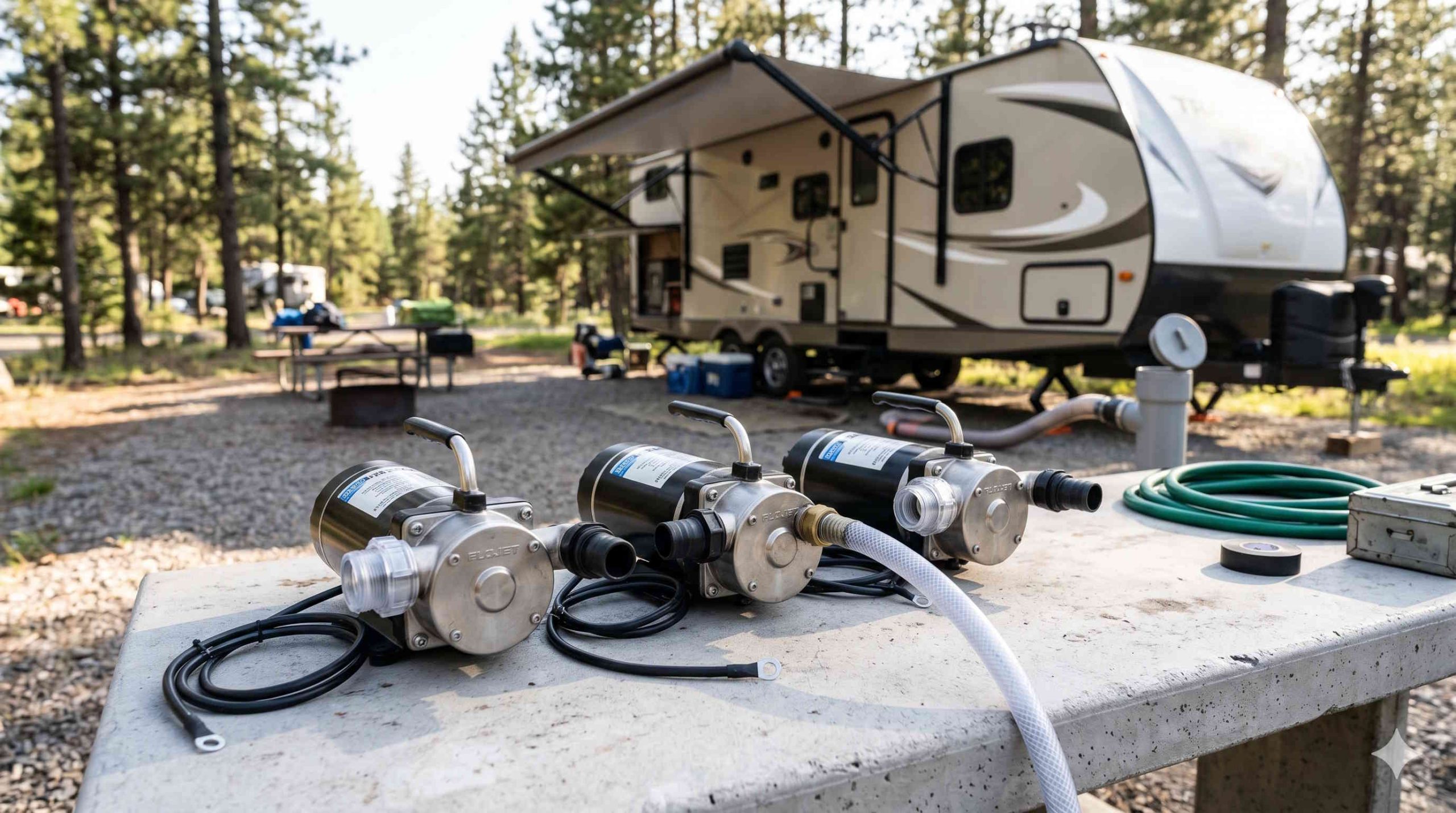
Best RV Macerator Pumps (2026): Top 10 Picks for Uphill & Long-Distance Dumping
Last updated: June 2026
- The biggest shift since our last pass: across nearly every budget unit, the most-blamed “dead pump” reports trace back to the cigarette-lighter plug and inline switch, not the motor — a pattern that rose sharply enough this cycle to reshape how we rank power hardware.
- The premium Jabsco picture split further along a clear line: older brass-stud stock versus current stainless-fastener batches, a difference that now decides whether the pump leaks at the seam.
- A storage-season failure cluster firmed up across several pumps (SEAFLO, Folconroad, Magam): impellers swelling or binding after idle layup is a recurring, preventable killer.
- New normalized failure-mode and use-case artifacts were added below so you can compare all ten on the same labels.
If you’ve ever stood at a sewer cleanout that’s uphill, 100 feet away, or higher than your dump valve, you already know the misery a macerator solves — and the dread of buying one that dies mid-season. The category is full of near-identical budget pumps and a few trusted names, and the reviews swing wildly between “best purchase ever” and “junk that died in months.” The deciding factor is rarely luck; it’s setup, power, and storage discipline.
Why trust this ranking: it’s synthesized from aggregated owner feedback across our individual reviews — not manufacturer claims, lab testing, or sponsored placement.
Methodology Snapshot Review coverage: Multiple individual reviews plus aggregated owner feedback per product, spanning roughly 2015–2026 depending on the model (volume not specified by us beyond what each review states). We tagged feedback into pumping performance, install/power sensitivity, fitment, longevity symptoms, and support/returns, then separated setup-driven issues from likely product/design issues.
Confidence Score rubric (inherited verbatim from each full review — never recalculated):
- 9+ very consistent positives
- 8–8.9 strong with manageable tradeoffs
- 7–7.9 good but install/quality variance matters
- under 7 niche fit / higher downside risk
Tiebreak note: with so many pumps scoring 7/10, ties were broken by outcome consistency and downside severity from the review notes — repairable, install-driven failures rank above hard motor lotteries with weak lift.
Here’s what you’ll get below: a quick verdict and one-glance table to pick fast, a decide-and-fix toolkit, two original data artifacts (failure-mode snapshot + use-case fit matrix), full per-product reviews, and a short buying teaser. Most unhappy owners in these reviews were fighting their setup as much as the pump — so the goal is to match you to the right one and tell you exactly what to test.
Affiliate disclaimer: This article contains Amazon affiliate links. If you buy through them, we may earn a small commission at no extra cost to you. It never changes what we recommend or how we read the feedback.
Quick Verdict
| Award | Product | Best For | Quick Reason |
|---|---|---|---|
| Best Overall | Jabsco 12V DC Macerator Pump | Replacers wanting strong grind + repairability | Strongest grinding, exact-footprint swaps, rebuildable with kits. Bottom line: the most capable pump here if you verify stainless fasteners and mount it low. |
| Best Value | Ristow RV Macerator Pump | Budget buyers who’ll bench-test first | Rivals pumps costing 2–3x more; failures are catchable up front. Bottom line: the smartest dollar-for-dollar pick if you test wiring and fuse on grey water. |
| Best Premium | Flojet Macerator Pump | Fixed-base septic pumping at distance | Genuinely pushes slurry 150–250+ ft with the right hose. Bottom line: earns its price for the disciplined owner who babies the mounting tabs. |
| Best for Long-Distance / Uphill | LATCH.IT V2.0 Macerator Pump | Reaching uphill/distant cleanouts | Repeatedly out-pushes pricier brands on reach. Bottom line: premium-style distance at a budget price if you power it from a battery. |
| Best for Gravity-Fed Installs | SEAFLO 01 Series Macerator Pump | Mounting at/below tank level | Big-brand flow at a fraction of the cost when installed low. Bottom line: an easy value pick if you can gravity-feed it and don’t store it idle full. |
| Best for Occasional / Boondock Use | Kohree RV Macerator Pump | Weekenders & mooch-dockers | Complete kit-in-a-box with rinse port. Bottom line: strong for occasional dumpers who power it properly and swap the hose. |
Tip: Click a Confidence Score in the tables below to see the full review and scoring context.
One-Glance Summary Table
| Product | Best For | Confidence Score |
|---|---|---|
| Jabsco 12V DC | Strong-grind replacement swaps | 7.5/10 |
| SEAFLO 01 Series | Gravity-fed (at/below tank) | 7/10 |
| Ristow | Budget value, bench-test first | 7/10 |
| Flojet | Fixed-base septic at distance | 7/10 |
| LATCH.IT V2.0 | Long-distance / uphill reach | 7/10 |
| Magam | Home dumping / moochdocking | 7/10 |
| Folconroad | Cheap capable backup | 7/10 |
| Kohree | Occasional boondock dumping | 7/10 |
| Kitvance | Seasonal uphill/long-distance | 6.5/10 |
| Amarine | Low-mount marine/RV swaps | 6/10 |
Toolkit: Decide + Fix (Fast)
Issue-Tag Box
| Issue Tag | What It Usually Means | First Fix / Check |
|---|---|---|
| Plug/switch overheat | Cigarette-lighter plug or inline switch melts, loses contact, or trips a fuse | Power from battery clamps instead; check/replace the inline fuse first |
| Runs but won’t pump | Reversed wiring (spins backward) or a dry/stuck impeller | Test on grey water; if tank gurgles with no output, swap polarity; free impeller via shaft slot |
| Spins, weak/fading flow | Worn or swollen impeller, often after idle storage | Inspect/replace impeller; use the rear turn-screw to free it |
| Won’t prime / no suction | Pump mounted too high above the tank, or an air leak in the intake | Mount at/below tank level; tighten and shorten the intake |
| Thermal short-cycling | Heat + small hose + distance tripping the overheat cutoff | Go 3/4″ hose, keep runs level, dump in cooler hours |
| O-ring/gasket falls out | Discharge seal drops out between uses and leaks | Check it’s seated every dump; keep spares on hand |
| Mounting tabs snap | Over-torquing the pump onto a stiff sewer fitting | Mount a clear adapter permanently; connect at the hose, hand-tight only |
| Dies just past return window | Bimodal longevity / unit-to-unit variance | Stress-test multiple full cycles in the first weeks, not one gentle trial |
Decision Tree
- If your cleanout is uphill or far away → reach is the whole point; prioritize LATCH.IT, Flojet, or Kitvance with a 3/4″ hose.
- If you can mount at or below tank level → SEAFLO or Amarine become strong value picks.
- If your layout forces the pump above the tank → skip the weak-lift budget units (Amarine especially); choose a true high-lift pump.
- If you’re replacing an older Jabsco → the Jabsco is often a near drop-in; verify stainless fasteners first.
- If you only power from a cigarette-lighter plug → fix the power plan before buying any of these, or expect trouble.
- If you want a cheap, replaceable backup on the shelf → Folconroad or a second SEAFLO is the move.
- (Skip/avoid) If you need guaranteed, hands-off, multi-year reliability with zero tinkering → none of these budget units fits; see “Who Should Skip” below.
- (Upgrade path) If flow fades over months → suspect the impeller (a cheap wear part) before scrapping the whole pump.
Troubleshooting Quickflow
Symptom: Motor runs, nothing comes out
- Confirm there’s fluid in the line — never run it dry (test on grey water)
- Watch the discharge: nothing out and tank gurgling = motor spinning backward
- If reversed, swap the power leads at the splice and retest
- If it won’t turn at all, free the impeller via the rear screwdriver/shaft slot
- Check/replace the inline fuse in the plug or switch handle
- Still dead? Treat it as defective and escalate within the return window
Symptom: Pump dies or quits a few minutes in
- Touch the cigarette-lighter plug — hot or loose means power delivery, not the motor
- Move to a direct battery connection or power station and retest a full cycle
- If it now runs steadily, the plug was the culprit
- Watch motor temperature: very hot early is the strongest predictor of a short life
- Check hose diameter (3/4″ beats 5/8″/1/2″) and keep runs level to ease heat
- If it still over-amps on clean power, the motor is failing — start the return escalation now
Unique-Data Section
Failure-Mode Frequency Snapshot
Each pump’s single most-reported complaint as its dominant failure mode, normalized across the pool:
| Product | #1 Reported Failure Mode |
|---|---|
| Jabsco 12V DC | Corroding fasteners (older stock) — pump splits at the seam and leaks |
| SEAFLO 01 Series | Impeller-swell lockup after idle storage |
| Ristow | “Wired backwards” out of the box (runs, won’t discharge) |
| Flojet | Mounting tabs/ears snap on twist-on |
| LATCH.IT V2.0 | Bimodal early motor death (power-plug driven) |
| Magam | Post-return-window motor failure (hums, won’t spin) |
| Folconroad | Toggle switch / power-cord failure |
| Kohree | Cigarette-lighter plug melting / power starvation |
| Kitvance | Cigarette-plug & switch overheat (no dry-run shutoff) |
| Amarine | Weak lift + early failure near the return window |
Use-Case Fit Matrix
Rated Strong / Moderate / Poor on review themes only. Blank = not meaningfully addressed by owners.
| Product | Weekend / Occasional | Full-Time / Daily | Off-Grid / Long-Distance | Backup / Spare |
|---|---|---|---|---|
| Jabsco 12V DC | Strong | Moderate | Moderate | Moderate |
| SEAFLO 01 Series | Strong | Moderate | Moderate | Strong |
| Ristow | Strong | Moderate | Strong | Moderate |
| Flojet | Moderate | Strong | Strong | Poor |
| LATCH.IT V2.0 | Strong | Moderate | Strong | Moderate |
| Magam | Strong | Poor | Strong | Moderate |
| Folconroad | Strong | Poor | Moderate | Strong |
| Kohree | Strong | Poor | Strong | Moderate |
| Kitvance | Strong | Poor | Strong | Moderate |
| Amarine | Moderate | Poor | Poor | Strong |
Quick Decision Matrix
- Need the strongest grinding + a repairable unit → Go to #1 Jabsco
- Need big-brand flow on a budget, mounted low → Go to #2 SEAFLO 01 Series
- Need the best value if you’ll bench-test it → Go to #3 Ristow
- Need long-distance push to a fixed home septic → Go to #4 Flojet
- Need maximum uphill/distance reach at a budget price → Go to #5 LATCH.IT V2.0
- Need a home-dumping / moochdocking workhorse → Go to #6 Magam
- Need a cheap, capable backup on the shelf → Go to #7 Folconroad
- Need a complete occasional-use kit-in-a-box → Go to #8 Kohree
- Need an inexpensive seasonal uphill pump → Go to #9 Kitvance
- Need a low-mount marine/RV drop-in replacement → Go to #10 Amarine
Comparison Table
| Product | Best For | Owner-Reported Outcome | What Owners Liked | Common Complaints / Tradeoff | Owner Signals | Confidence Score |
|---|---|---|---|---|---|---|
| Jabsco 12V DC | Strong-grind replacement | Strong | Grinding power, exact-fit swaps | Corroding fasteners (older stock) | Repairable, era-dependent | 7.5/10 |
| SEAFLO 01 Series | Gravity-fed installs | Strong | Value, fast maceration | Sudden lockup after storage | Install-sensitive, serviceable | 7/10 |
| Ristow | Budget value | Strong | Long-distance push, price | Reversed wiring out of box | Catchable up front, weak support | 7/10 |
| Flojet | Fixed-base septic | Strong | Distance, strong grind | Brittle mounting tabs | Unforgiving setup, durable when babied | 7/10 |
| LATCH.IT V2.0 | Long-distance/uphill | Strong | Reach, complete kit | Bimodal early failure | Power-plug driven, quiet | 7/10 |
| Magam | Home/moochdocking | Moderate | Reach, clear elbow + rinse | Post-window failure | Plug weak link, durability split | 7/10 |
| Folconroad | Cheap backup | Strong | Value, quiet, long runs | Switch/cord failure | Semi-disposable, fixable | 7/10 |
| Kohree | Occasional boondock | Moderate | Complete kit, rinse port | Plug melting, weak hose | Power-dependent, occasional-use | 7/10 |
| Kitvance | Seasonal uphill | Strong | Solves geometry, clean teardown | Connector/longevity gamble | Setup-sensitive, no dry-run shutoff | 6.5/10 |
| Amarine | Low-mount swaps | Moderate | Value, easy drop-in | Weak lift, early failure | Mount-low only, thin support | 6/10 |
Detailed Product Reviews
#1. Jabsco 12V DC Macerator Pump — Strong Grind, Rebuildable
Key takeaway: The most capable pump here for owners who verify they’re getting the stainless-fastener version and mount the intake at or below tank level.
Tagline: Powerful, repairable, era-dependent.
At a Glance
- Best for: Replacing an older Jabsco with an exact-footprint, near plug-and-play swap
- Owner-reported outcome: Strong
- Confidence score: 7.5/10
Signature (from review notes)
- Failure signature: Corroding studs on older stock let the pump split at the flange and leak
- Install friction: Moderate
- Downside risk: Medium
Owner signals: Grinding power: Positive — out-pumps the budget unit it replaced. Longevity: Mixed — some get 12+ seasons, others a few months. Fasteners: Negative — older brass studs corrode and shear.
Quick Summary: A genuinely strong grinder and the one owners who tried knock-offs first kept coming back to. The key tradeoff is that longevity is era-dependent, and you can’t always tell from the listing which version you’re getting.
The Deep Dive (Why It Ranked Here)
- Across our review analysis, the loudest complaint by far is corroding fasteners on older stock — but it’s a known, fixable issue Jabsco addressed with stainless hardware
- Owners commonly report near-instant prime and fast tank evacuation when the intake sits at or below the tank’s minimum level
- A frequent buyer surprise is a “used or refurbished” unit arriving with missing caps or water inside — a fulfillment problem worth inspecting for on arrival
- Shaft-seal leaks and tired impellers are common over time, but both are cheaply rebuildable rather than throwaway
- Owners who exercise it monthly and feed it strong, non-dipping 12V report the longest lifespans by a wide margin
Why Buy
- Strongest, most-trusted grinding in this lineup
- Exact-footprint replacement for many older Jabsco units — frequently no-modification swaps
- Rebuild and impeller kits make it repairable, not disposable
Dealbreakers / What to Consider
- Longevity is genuinely inconsistent across eras; verify stainless fasteners (a magnet won’t stick to true stainless)
- The “arrived used” cluster means you must inspect before wiring it in
- If you need a truly maintenance-free pump or can’t control which version you receive, look harder at alternatives
Verdict for You:
- Pick this if: you’ll do a little homework before installing.
- You’re replacing an older Jabsco and want an exact-fit swap
- You value grinding power and can mount the intake low
- Skip this if: you want zero-maintenance reliability.
- You can’t confirm you’re getting a current stainless-fastener unit
- Your layout forces a tall vertical self-prime
Quick Links: Check price on Amazon · Read the full Jabsco review
#2. SEAFLO 01 Series RV Macerator Pump — Budget Flow, Mount It Low
Key takeaway: A legitimately strong value pump if you can mount it at or below the tank and never store it idle with waste inside.
Tagline: Big-brand flow, install-sensitive.
At a Glance
- Best for: Gravity-fed installs at or below the tank outlet
- Owner-reported outcome: Strong
- Confidence score: 7/10
Signature (from review notes)
- Failure signature: Impeller swells and locks the motor after idle storage
- Install friction: Moderate
- Downside risk: Medium
Owner signals: Value: Positive — matches pumps costing two-to-three times more. Priming: Mixed — reliable only when mounted low. Storage: Negative — seizes if left idle and full.
Quick Summary: Strong, fast maceration at a price the premium brands can’t touch — with the catch that priming and longevity punish any mounting-height or storage mistake.
The Deep Dive (Why It Ranked Here)
- One pattern that comes up repeatedly is “works great, then suddenly seizes” — and it frequently follows idle storage, where the impeller swells and binds
- Owners commonly report it primes within seconds and empties tanks fast when mounted low with a short, sealed intake
- A huge share of the harshest reviews are really install-geometry failures: the pump mounted feet above the tank, then blamed for not lifting
- In damp or marine spots, owners report seal intrusion and bracket corrosion — it doesn’t love a permanently wet home
- The end-cap shaft access is an easy-to-miss feature that lets you free a stuck impeller without scrapping the unit
Why Buy
- Standout price-to-performance when it lasts
- Strong flow and aggressive grinding
- Serviceable, and often bolts to existing brand-name holes and hoses
Dealbreakers / What to Consider
- Reliability variance is the dominant complaint — treat it as a serviceable consumable with a spare on the shelf
- It often doesn’t include a 3″-to-1.5″ adapter; plan fittings before install day
- If you need genuine vertical lift above the liquid level, skip this
Verdict for You:
- Pick this if: you can gravity-feed it.
- You can mount at or below the tank for a gravity feed
- You want big-brand-style flow at a fraction of the cost
- Skip this if: your geometry forces a high mount.
- Your only mounting spot is well above the tank
- The pump will sit idle with waste for months at a time
Quick Links: Check price on Amazon · Read the full SEAFLO 01 Series review
#3. Ristow RV Macerator Pump — Best Value If You Test First
Key takeaway: A genuinely capable long-distance pump that rivals units costing 2–3x more — if you bench-test the wiring and fuse on grey water before trusting it.
Tagline: Great value, verify before you trust.
At a Glance
- Best for: Budget buyers who’ll do a 5-minute pre-use test
- Owner-reported outcome: Strong
- Confidence score: 7/10
Signature (from review notes)
- Failure signature: Ships wired backwards (runs but won’t discharge)
- Install friction: Moderate
- Downside risk: Medium
Owner signals: Distance: Positive — pushes 100+ ft, often uphill. QC: Negative — a real subset arrives reversed or with a dead fuse. Support: Negative — manufacturer contact is hit-or-miss.
Quick Summary: When it’s right — and most units are — it grinds and pushes waste impressive distances for a fraction of premium pricing. The gamble is out-of-box quality control and weak after-sale support.
The Deep Dive (Why It Ranked Here)
- Based on aggregated owner experiences, the most-obsessed-over issue is the “wired backwards” lottery: the pump spins backward, you hear gurgling, but nothing discharges — and it’s a quick polarity fix
- A frequent buyer surprise is the “worked great twice, then dead” arc that’s often just a blown inline fuse in the plug, not a dead motor
- The included garden-hose adapter is the most-replaced part — a thread mismatch causes leaks owners solve with a hardware-store coupling
- The most consistent positive pattern is long-distance, uphill performance — owners pushing 50, 100, even 150 feet into home sewers and totes
- A minority do fail outright (seized motor, blown fuses under load); those are not user-fixable
Why Buy
- Strong grinding and long-distance, uphill pumping when fed proper power
- Repeatedly matches or beats pumps costing 2–3x more in owners’ own comparisons
- Easy, fast install for most owners
Dealbreakers / What to Consider
- Reversed wiring and dead inline fuses arrive in a real subset of units — bench-test on grey water
- If you need responsive warranty support, this isn’t it
- Small portable power packs may underpower it; wire to house batteries or a generator
Verdict for You:
- Pick this if: you’ll do a quick pre-use check.
- You want premium-brand performance without the price
- You’re comfortable verifying wiring and fuse before first use
- Skip this if: you want guaranteed out-of-box reliability.
- You rely on responsive manufacturer warranty support
- A messy mid-dump surprise would be a dealbreaker
Quick Links: Check price on Amazon · Read the full Ristow review
#4. Flojet Macerator Pump for RV — Premium Reach, Unforgiving Setup
Key takeaway: Worth its premium for the fixed-base owner who’ll baby the fragile mounting tabs and run a fat 3/4″ hose — abused, it fails fast.
Tagline: Long-distance push, fragile tabs.
At a Glance
- Best for: Pumping to a fixed home septic/cleanout, especially 50–150+ feet away
- Owner-reported outcome: Strong
- Confidence score: 7/10
Signature (from review notes)
- Failure signature: Plastic mounting ears/bayonet tabs snap, sometimes on first twist-on
- Install friction: Hard
- Downside risk: Medium
Owner signals: Grinding: Positive — chews paper and solids reliably. Distance: Positive — owners report 150–250+ ft with the right hose. Tabs: Negative — the #1 dealbreaker complaint.
Quick Summary: A genuinely capable macerator that disciplined owners keep for years — but its brittle tabs and heat-sensitive motor turn careless installs into one-week failures. One key tradeoff: it ships with bare leads, so you wire it yourself.
The Deep Dive (Why It Ranked Here)
- In our review analysis, the most-reported failure is the plastic tabs snapping when torqued onto a stiff sewer fitting — owners who mount a permanent clear adapter and connect at the hose report years of service
- The thermal cutoff produces a “runs 45 seconds, stops 5 minutes” cycle in heat or on long/narrow-hose runs — a feature, not a defect, but a slow reset
- “Motor hums but won’t pump” is often a dry impeller or reversed factory wiring, both fixable without replacing the pump
- Hair and the wrong toilet paper quietly kill flow over time; cleaning restores it
- When set up right, owners report 2–6 years of service and remarkable distance
Because the tab-snap weakness is so specific, the fix that separates multi-year owners from one-week casualties is a permanent clear adapter — the kind of fitment detail the macerator pump buyer’s framework for RVers walks through before your return window closes.
Why Buy
- Strong grinding — handles RV TP and solids when fed correctly
- Genuinely long-distance pumping with the right hose
- Comes with a reusable carry case owners appreciate
Dealbreakers / What to Consider
- Brittle plastic mounting tabs that snap, often just past the return window
- Not pre-wired; expect to add connectors and heavier-gauge wire
- If you want plug-and-play with zero wiring, skip this
Verdict for You:
- Pick this if: you’ll protect the tabs and wire it properly.
- You pump to a fixed home septic at distance or modest uphill
- You’ll mount a permanent clear adapter and run a 3/4″+ hose
- Skip this if: you want plug-and-play simplicity.
- You’ll connect by force-twisting onto a tight fitting
- You pump long uphill runs through small hose in hot climates
Quick Links: Check price on Amazon · Read the full Flojet review
#5. LATCH.IT V2.0 RV Macerator Pump — Budget Reach, Power It Right
Key takeaway: Premium-style long-distance reach at a budget price for owners who power it cleanly off a battery and stress-test it inside the return window.
Tagline: Long reach, bimodal lifespan.
At a Glance
- Best for: Moving waste a long distance or uphill to a septic, cistern, or tote
- Owner-reported outcome: Strong
- Confidence score: 7/10
Signature (from review notes)
- Failure signature: Bimodal — early motor death or years of service, often power-driven
- Install friction: Moderate
- Downside risk: Medium
Owner signals: Reach: Positive — 100+ ft and up real grades. Power hardware: Negative — car adapter and fuse housing overheat. Support: Mixed — free gaskets for some, silence for others.
Quick Summary: A capable, well-priced macerator that excels at the one thing macerators exist for — moving waste uphill and far. The honest catch is bimodal reliability, and the car adapter causes more “failures” than the motor does.
The Deep Dive (Why It Ranked Here)
- A frequent buyer surprise is the bimodal lifespan: many run for years, a loud minority die within weeks — and the early failures cluster around the included car adapter and inline fuse, not the motor
- Owners who hard-wire to a battery report dramatically better outcomes, including one who revived a “dead on arrival” unit by correcting the fuse
- One pattern that comes up repeatedly: it leaves a hose-full to dump on the ground unless you run rinse mode with clean water before disconnecting
- A subset with large tanks report thermal shutdowns mid-dump, pointing back to power quality and hose sizing
- The discharge gasket/o-ring is the small part that decides your day — keep it seated and registered for warranty replacements
Why Buy
- Strong real-world lift and long-distance pumping — the standout reason owners keep it
- Complete kit: hoses, fittings, clamps, spare switches, carry case
- Priced well below premium rivals, often near half the cost
Dealbreakers / What to Consider
- A real minority of early motor failures, sometimes just past the return window
- Car-adapter power and inline fuse housing are weak points prone to overheating
- A missing gasket can sideline you, with no easy local replacement
Verdict for You:
- Pick this if: you can give it clean 12V power.
- Your dump point is uphill, far away, or you’re transferring to a tote
- You can power it from a battery or dedicated 12V source
- Skip this if: you need hands-off reliability.
- Your only realistic power is a car cigarette-lighter adapter
- You won’t stress-test it inside the return window
Best Pairing Gear: A dedicated 12V battery or power station — owners repeatedly tie clean battery power to the long-lived units.
Quick Links: Check price on Amazon · Read the full LATCH.IT V2.0 review
#6. Magam RV Macerator Pump — Home-Dumping Workhorse
Key takeaway: A strong budget pick for home dumping and moochdocking, as long as you swap the weak plug and stress-test it inside the return window.
Tagline: Capable at home, weak plug.
At a Glance
- Best for: Home/septic dumping when your rig parks too far or at the wrong slope
- Owner-reported outcome: Moderate
- Confidence score: 7/10
Signature (from review notes)
- Failure signature: Motor hums but won’t spin, often 2–5 months in (just past returns)
- Install friction: Moderate
- Downside risk: Medium
Owner signals: Distance: Positive — many cite 100+ ft to a cleanout. Plug: Negative — internal spring overheats and deforms. Durability: Mixed — a clear two-camp split.
Quick Summary: When you get a good unit — and most owners do — it punches well above its price, with a fresh-water rinse and clear inspection elbow that make a grim task manageable. The catch is durability variance and a weak power plug.
The Deep Dive (Why It Ranked Here)
- The information most reviews miss: failures cluster just past the 30-day return window, around the 2–5 month mark — the timing is the real risk, more than any single defect
- The cigarette-lighter plug is the Achilles’ heel — a spring inside overheats and deforms; many satisfied owners simply bypass it with battery clips or a hard-wired socket
- Hose diameter quietly decides clog vs. flow: 1/2″ hose clogs, 3/4″ fixes it
- Some harsh “it’s slow” reviews trace to a pump head that wasn’t seated from the factory — fixable in minutes if you inspect first
- Owners who get a sound unit and treat the power connection gently report years of quiet service
Why Buy
- Grinds and moves waste reliably over long distances and modest grades
- Fresh-water rinse and clear inspection elbow make the job tolerable
- Performs like pumps costing two to three times more, for those who get a good unit
Dealbreakers / What to Consider
- The plug/spring and inline switch are the most common failure points
- A real minority fail shortly after the return window, with patchy support
- 12V-only (no AC), so battery reach to the dump valve takes planning
Verdict for You:
- Pick this if: you’ll swap the plug and test hard early.
- You dump at home or moochdock to a distant cleanout
- You’re comfortable using battery clips or a socket
- Skip this if: you need guaranteed longevity.
- You won’t stress-test inside the return window
- You expect five-minute emptying of large tanks
Quick Links: Check price on Amazon · Read the full Magam review
#7. Folconroad Macerator Pump for RV — Cheap, Capable, Semi-Disposable
Key takeaway: A surprisingly powerful budget pump that’s best treated as semi-disposable — strong performance, inconsistent lifespan.
Tagline: Strong early, switch is weak.
At a Glance
- Best for: Budget buyers who’ll treat a pump as a replaceable tool or backup
- Owner-reported outcome: Strong
- Confidence score: 7/10
Signature (from review notes)
- Failure signature: Toggle switch / power cord fails before the motor does
- Install friction: Moderate
- Downside risk: Medium
Owner signals: Pumping: Positive — pushes 100–150 ft, uphill in some cases. Switch: Negative — corrodes, overheats, sometimes DOA. Storage: Mixed — second-season seizing tracks dry-run and storage habits.
Quick Summary: When it runs, owners love it — fast, quiet, long hose runs, a fraction of premium pricing. The catch is consistency: the switch and cord are weak, and a real share don’t survive their second season.
The Deep Dive (Why It Ranked Here)
- The loudest recurring theme is “second-season” failure — units that work great, then won’t grab water after storage; the failures cluster around dry-running and storage habits, not pure luck
- When owners autopsy a “dead” pump, the culprit is usually the cheap toggle switch or plug, not the motor — fixable for anyone comfortable with basic 12V wiring
- Dry-running and “flushable” wipes are instant killers; the rubber impeller wants to be wet to spin freely
- Overheating on hot days is real but manageable — one owner ices the motor; smoking on first use is a different, return-worthy category
- Several owners who cracked open this and pricier pumps reported near-identical internals — you’re largely paying elsewhere for better wiring and support
Why Buy
- Strong waste-grinding and pumping for the price; handles long and uphill runs
- Runs quieter than many owners expected
- Dramatically cheaper than premium pumps owners call mechanically near-identical
Dealbreakers / What to Consider
- Toggle switch is fragile, corrosion- and heat-prone, sometimes DOA
- Power cord is frequently too short, and the cigarette plug overheats
- A real share die in month 3–6 or fail to wake up after winter storage
Verdict for You:
- Pick this if: you’re fine maintaining a cheap tool.
- You want garden-hose convenience and can do basic 12V wiring
- You’ll commit to no-dry-run, no-wipes, clean-before-storage discipline
- Skip this if: you want one pump for a decade.
- You won’t maintain it or troubleshoot a switch
- A failure just past the return window would sting your budget
Quick Links: Check price on Amazon · Read the full Folconroad review
#8. Kohree RV Macerator Pump — Complete Kit for Occasional Dumpers
Key takeaway: A well-equipped occasional-use kit that shines for boondockers and weekenders who power it from a real battery and swap the included hose.
Tagline: Kit-in-a-box, power-dependent.
At a Glance
- Best for: Boondockers and mooch-dockers reaching a faraway cleanout or tote
- Owner-reported outcome: Moderate
- Confidence score: 7/10
Signature (from review notes)
- Failure signature: Cigarette-lighter plug melts; many “dead pump” reports are power starvation
- Install friction: Moderate
- Downside risk: Medium
Owner signals: Kit: Positive — gloves, fittings, rinse port, box. Plug: Negative — melts, loosens, quits. Hose: Negative — included one leaks and kinks.
Quick Summary: Its core job — grinding waste and pushing it through a thin hose to wherever you can reach — it does well, and the rinse port and complete kit are real wins. Two honest risks: a flimsy plug that masquerades as pump failure, and motors that quit just past the return window.
The Deep Dive (Why It Ranked Here)
- The reliability cliff is the obsession: many unhappy buyers describe weeks-to-months of good service, then an abrupt stop frequently just past the return window
- The information-gain insight is that failures track the power source — “starved pump” reports sit right next to mentions of the plug melting; owners who hard-wire to a battery overwhelmingly report it “never quits”
- The included garden hose draws fire across happy and unhappy owners alike — cuts, leaks, kinks; an easy, cheap fix with a dedicated hose
- The pre-installed gasket/o-ring falls out between uses; the kit includes a spare, and owners who keep extras shrug it off
- It’s a current-hungry pump — one owner measured ~120W — so a real battery or power station matters, not a bargain adapter
Why Buy
- Grinds waste and toilet paper without clogging when powered well
- Reaches faraway cleanouts and totes through thin hose — the core value
- Genuinely complete kit with a handy storage box
Dealbreakers / What to Consider
- Cigarette-lighter connector melting/failing is a repeated, serious complaint
- A real cluster of motors quit just past the return window, with hit-or-miss support
- The included hose isn’t trustworthy for black water — budget for a replacement
Verdict for You:
- Pick this if: you dump occasionally and power it right.
- You can power it from a proper battery or power station
- You want a complete kit rather than assembling parts
- Skip this if: you’ll grind it daily.
- You’re a full-timer cycling it hard every day
- Your only power plan is the cigarette-lighter plug
Best Pairing Gear: A dedicated 5/8″ or 3/4″ discharge hose — owners replace the included one before the first black-tank dump.
Quick Links: Check price on Amazon · Read the full Kohree review
#9. Kitvance RV Macerator Pump — Inexpensive Geometry-Solver
Key takeaway: An inexpensive, capable grinder for occasional and seasonal RVers moving waste uphill or over distance — with weak connectors and a real longevity gamble.
Tagline: Solves the geometry, gambles on longevity.
At a Glance
- Best for: Seasonal/off-grid users whose cleanout is uphill, far, or higher than the dump valve
- Owner-reported outcome: Strong
- Confidence score: 6.5/10
Signature (from review notes)
- Failure signature: Cigarette-plug and plastic switch overheat; no dry-run shutoff
- Install friction: Moderate
- Downside risk: High
Owner signals: Reach: Positive — pumps 100+ ft and meaningful rise. Connectors: Negative — plug and switch overheat/fail. Longevity: Mixed — a 4–9 month vs. 15–18 month split.
Quick Summary: When it works and you respect its limits, it turns an awful chore into a hands-off job. The tradeoff is that its electrical connectors and switch are weak points, and longevity is a genuine gamble.
The Deep Dive (Why It Ranked Here)
- The dominant theme: the connector and switch fail long before the pump does — many “the pump died” reports are really the cheap plug or plastic switch failing
- Longevity is a coin-flip that usage style predicts — light, well-powered use correlates with the long-lived units; weather-exposed, weak-power use with early death
- It pumps liquid eagerly but punishes hair, regular TP, and run-dry mistakes — there’s no dry-run auto-shutoff
- The clear elbow is the single best accessory you can add, turning the run-dry risk into a non-issue
- Don’t let it hang off your outlet, and watch the O-ring — owners lose it and get a flooding mess
Because the run-dry and connector weaknesses are so setup-driven, validating your dump geometry and power setup against a full macerator selection framework is worth doing before you commit.
Why Buy
- Solves a real geometry problem — pumps uphill, over 100+ ft, into totes
- Fresh-water rinse and backflush port make teardown tidy
- Cheap enough that even occasional replacement beats premium pricing for many owners
Dealbreakers / What to Consider
- The cigarette-lighter plug and plastic switch overheat, melt, or fail
- No dry-run protection — it will cook itself if left running empty
- A meaningful share die in 4–9 months, especially under heavy or weather-exposed use
Verdict for You:
- Pick this if: you’ll treat it as stowable field gear.
- Your cleanout is uphill, far, or higher than your dump valve
- You’d rather replace a cheap pump occasionally than pay triple
- Skip this if: you need set-and-forget durability.
- You can’t tolerate a mid-trip failure with no instant replacement
- You flush regular TP or send lots of hair down the grey tank
Best Pairing Gear: A clear discharge elbow — owners call it cheap insurance against the run-dry failure this pump has no shutoff for.
Quick Links: Check price on Amazon · Read the full Kitvance review
#10. Amarine RV Macerator Pump — Low-Mount Budget Swap
Key takeaway: A low-cost, easy-swap replacement worth buying only if you can mount it low and treat it as a “keep a spare” consumable.
Tagline: Cheap swap, weak lift.
At a Glance
- Best for: Budget RVers/boaters replacing a same-style pump with identical connections
- Owner-reported outcome: Moderate
- Confidence score: 6/10
Signature (from review notes)
- Failure signature: Weak lift plus failures landing around or just past the return window
- Install friction: Moderate
- Downside risk: High
Owner signals: Value: Positive — half or a third the price of name brands. Lift: Negative — barely lifts above a foot. Support: Negative — unreachable service, dead warranty links.
Quick Summary: A genuine money-saver and easy swap for the right setup, undermined by weak lift, inconsistent lifespan, and thin support. Mount it at or below tank level or you’ll fight it.
The Deep Dive (Why It Ranked Here)
- The pattern owners obsess over is “great until it isn’t” — a cluster of failures land right around or just after the return window or first season
- The information-gain insight: one owner who’s an engineer traced failures to the impeller (a serviceable wear part), not the motor — flow fades while the motor keeps spinning
- Lift is the silent dealbreaker — owners’ bucket tests show it stops pumping much above a foot; mount it low and it flies
- There’s an RV-vs-marine fork: marine swaps tend to be clean drop-ins, while RV installs more often need adapters
- Rising amp draw, whining, and breaker trips are the early death signals to watch
Why Buy
- Repeatedly half (or a third) the price of name brands
- Easy drop-in for many marine swaps — identical connections and screw holes
- Cheap enough to keep a spare on hand
Dealbreakers / What to Consider
- Too many “died after a few months / just past return” reports to ignore
- Weak lift/priming above a foot or so sets up false expectations
- Owners widely report unreachable customer service
Verdict for You:
- Pick this if: you can mount low and keep a spare.
- You’re replacing a same-style marine macerator with identical connections
- You want big savings and accept the risk
- Skip this if: you need lift or support.
- You need genuine vertical lift in your layout
- You depend on responsive warranty/customer support
Best Pairing Gear: If you’re upgrading the whole dump-and-fill setup, our roundup of dependable RV water pumps covers the pressure side of the system.
Quick Links: Check price on Amazon · Read the full Amarine review
Who Should Skip ALL of These
If you can already gravity-dump straight into a sewer connection a few feet away, none of these earns its place — a traditional 3-inch hose is cheaper and has no motor to fail. And if you genuinely need a sealed, hands-off pump that runs daily for years with zero tinkering, every unit here carries some version of the same budget-grade electrical or longevity gamble; a higher-end built-in or sani-style macerator is the better category to shop.
Buying Guide: How to Avoid a Bad Purchase
Mount Height Decides Almost Everything
The single biggest predictor of satisfaction across these reviews is where the pump sits relative to your tank. At or below the tank outlet, owners rave about flow; mounted high, the same pumps “won’t suck.” If your layout forces a high mount, prioritize a true high-lift unit — the kind of constraint the complete macerator buying framework helps you pressure-test before you commit.
Power Is the Hidden Failure Point
More “dead pump” reports trace to the cigarette-lighter plug and inline fuse than to the motor. Plan to power from battery clamps or a power station, and keep spare fuses on hand from day one.
Hose Diameter Is a Free Performance Upgrade
Owners repeatedly fix clogs and thermal short-cycling simply by moving from 1/2″ or 5/8″ hose to 3/4″. Bigger bore means less resistance, less heat, and fewer panic moments.
Week-One Testing Checklist
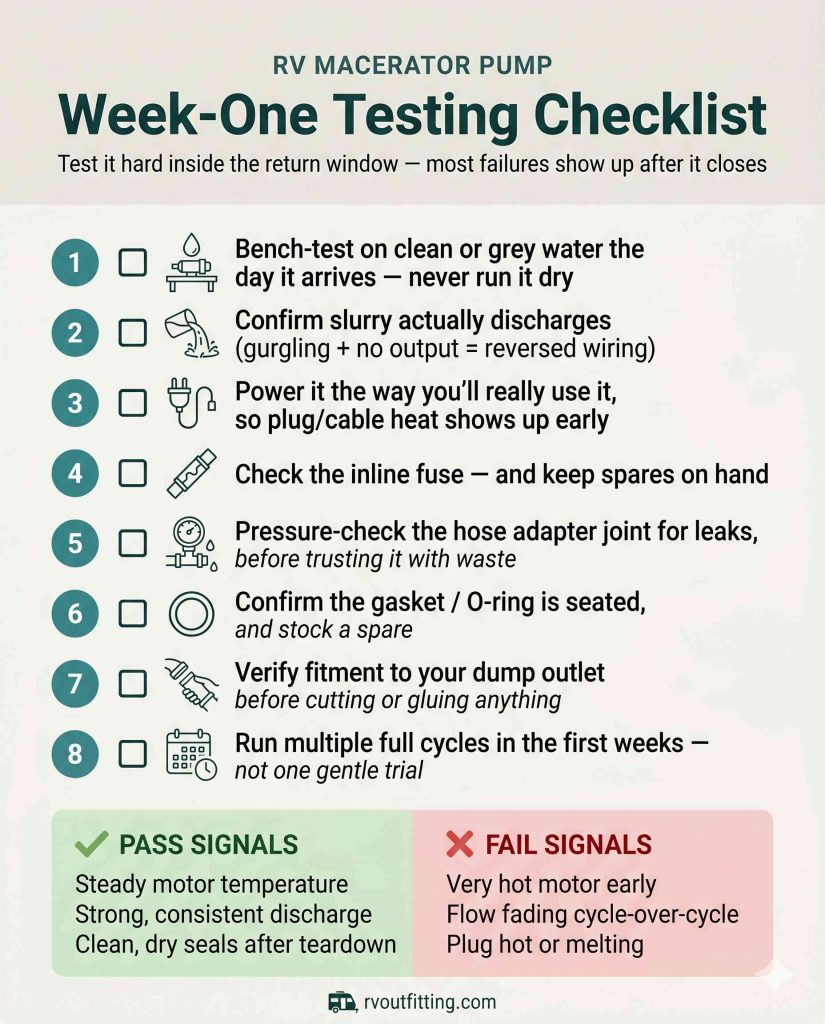
- Bench-test with clean or grey water the day it arrives — never run it dry.
- Confirm slurry actually discharges (gurgling with no output = reversed wiring).
- Power it the way you’ll actually use it, so plug/cable heat shows up early.
- Check the inline fuse and keep spares.
- Pressure-check the hose adapter joint for leaks before trusting it with waste.
- Confirm the gasket/o-ring is seated, and stock a spare.
- Verify fitment to your dump outlet before you cut or glue anything irreversible.
- Run multiple full cycles in the first weeks — not one gentle trial.
Printable “Week-One Validation” Quick Card
Check off before you trust it:
- ☐ Tested on clean/grey water, never dry
- ☐ Slurry discharges (no backward-spin gurgle)
- ☐ Powered from battery/power station, not just the plug
- ☐ Inline fuse checked; spares on hand
- ☐ Hose adapter joint leak-checked
- ☐ Gasket/o-ring seated; spare stocked
- ☐ 3/4″ hose in use for long/uphill runs
- ☐ Fitment confirmed before any permanent mod
- ☐ Pump rests on ground/blocks, not hanging off the outlet
- ☐ Multiple full cycles run inside the return window
Pass Signals: steady motor temperature · strong, consistent discharge · clean dry seals after teardown Fail Signals: very hot motor early · flow fading cycle-over-cycle · plug hot or melting
➡️ Best overall pick: Check today’s price on the Jabsco 12V DC Macerator Pump
Go Deeper (Optional): — the complete RV macerator pump buying guide — for the full sizing, fitment, and power framework this ranking intentionally doesn’t repeat.
FAQ
What’s the most reliable RV macerator pump in 2026?
The Jabsco scores highest here at 7.5/10 for its grinding power and repairability, but “reliable” depends on getting a current stainless-fastener unit and mounting it correctly. Across every pump in this ranking, install discipline and clean 12V power predict longevity more than brand alone.
Why does my macerator pump run but not pump anything?
Most often it’s spinning backward from reversed wiring, or the impeller is dry or stuck. If the motor runs and the tank gurgles with no discharge, that specific symptom points to reversed polarity — swap the leads and retest on grey water. A dry or jammed impeller can usually be freed via the rear shaft slot.
Can a macerator pump push waste uphill and over long distances?
Yes — that’s the entire reason to own one. Owners routinely report runs of 100+ feet and modest uphill grades, with some pushing 150–250+ feet on level ground using a 3/4″ hose. Reach is the benefit; it trades raw speed for distance, so it’s slower than a wide gravity dump.
Why do so many macerator pumps die just after the return window?
It’s a recurring pattern across budget units, and it’s usually a mix of unit-to-unit variance and power/storage habits. The defense is to stress-test hard and early — run multiple full dump cycles in your first two weeks rather than one gentle trial, so a weak unit surfaces while you can still return it.
Should I power a macerator from the cigarette-lighter plug?
No, not as your long-term plan. The included car-style plug and inline fuse are the most-reported weak points across these pumps — they overheat, loosen, and melt. Power from battery clamps or a 12V power station, and treat the plug as a temporary convenience at most.
What hose size should I use with a macerator pump?
Use a 3/4″ hose for most runs, especially long or uphill ones. Owners repeatedly resolve clogs and thermal short-cycling just by moving up from 1/2″ or 5/8″ hose, since the bigger bore cuts resistance and heat.
Are budget macerator pumps as good as name brands like Jabsco?
For the right buyer, often yes on performance — several owners report near-identical internals. The premium you pay elsewhere buys better wiring, support, and consistency, not necessarily a stronger pump. If you’ll bench-test and maintain a budget unit, the value can be hard to beat.
How do I stop my macerator from leaving waste on the ground when I disconnect?
Run the pump in rinse mode with clean water for a few minutes after closing your tank valves, so whatever’s left in the discharge tube is closer to clean water before you detach it. A clear elbow also lets you see exactly when the flow turns clean.
Note: discharging RV waste must follow local regulations — always dump into an approved sewer or septic connection.
Final Verdict & Quick Links
- Best Overall: Jabsco 12V DC Macerator Pump — strongest grind, repairable, best for verified-stainless replacers
- Best Value: Ristow RV Macerator Pump — premium-rivaling performance if you bench-test first
- Best for Long-Distance / Uphill: LATCH.IT V2.0 — budget reach when powered cleanly off a battery
Check the current price on Amazon for the Jabsco 12V DC Macerator Pump.


